Chinese porcelain
Chinese porcelain remains a timeless symbol of cultural exchange
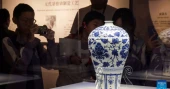
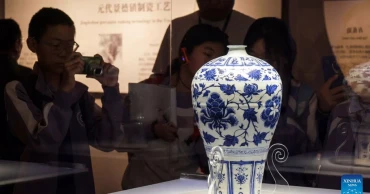
Chinese blue-and-white porcelain has long served as a bridge between civilizations, influencing art across continents and continuing to inspire cultural exchanges today.
Italian Renaissance painter Giovanni Bellini highlighted three pieces of blue-and-white porcelain in his final masterpiece, The Feast of the Gods. Chinese historian Yan Chongnian said a vessel in the painting closely resembles porcelain unearthed at the imperial kiln site in Jingdezhen, east China's Jiangxi Province. Weng Yanjun, head of the Jingdezhen Imperial Kiln Institute, said the porcelain not only decorates the mythical feast scene but also reflects historical exchanges between civilizations.
As porcelain imports to Europe increased and still-life painting became popular, blue-and-white porcelain frequently appeared in Western oil paintings, demonstrating its lasting influence on European society.
Known as China's porcelain capital, Jingdezhen has produced ceramics for more than 1,700 years. Since the Song Dynasty (960-1279), its porcelain has been exported to Central Asia, West Asia, Europe and Africa. Ge Chengyong, a professor at the China Academy of Cultural Heritage, said Chinese porcelain preserves the memory of civilizations, promotes mutual learning and contributes to global culture.
The exchange also influenced Chinese ceramics. Jiangxi Provincial Academy of Culture and Tourism researcher Li Shiqi said mythological themes became common on export porcelain in the mid-18th century, creating new artistic possibilities and strengthening cultural understanding.
Today, artists continue to combine oil painting with ceramic art. Jingdezhen-based ceramic artist Wang Yantian said the fusion enriches artistic expression, supports cultural inheritance and boosts industry development.
The city also attracts international artists. Australian artist David Reid, who moved to Jingdezhen in 2018, said the city inspires him to blend Chinese elements with Western modernism. French ceramic artist Camille Kami, impressed by Jingdezhen's centuries-old craftsmanship, chose to settle there after studying ceramics across Europe.
Chen Kelong, Jingdezhen Party chief, said the city will continue promoting creativity and innovation while strengthening international cultural exchanges. He said Jingdezhen has established partnerships with more than 180 cities in over 70 countries and attracts artists and ceramists from more than 50 countries and regions.
2 months ago