US Secretary
Rubio warns ASEAN that Iran's Hormuz demands could threaten global shipping
US Secretary of State Marco Rubio on Wednesday warned that Iran's demand to control and collect tolls from ships passing through the Strait of Hormuz could set a dangerous global precedent and threaten freedom of navigation.
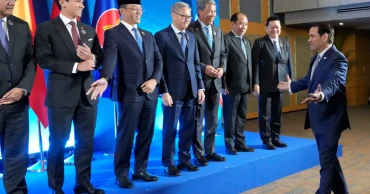
Speaking at the opening of the annual Association of Southeast Asian Nations (ASEAN) foreign ministers' meeting in Manila, Rubio said allowing any country to control an international waterway and charge ships for passage would pose risks not only in the Middle East but also in the Indo-Pacific region.
"If a country is allowed to control an international waterway, charge tolls and attack ships that refuse to pay, it would create a dangerous precedent that could be repeated in other parts of the world, including this region," Rubio said.
His remarks came as ASEAN members voiced concern over the renewed conflict in the Middle East, which has also affected economies in Southeast Asia. Despite the US focus on the Middle East, Rubio assured ASEAN leaders that Washington remained fully committed to the regional bloc.
On the sidelines of the meeting, Rubio also joined his counterparts from the Quad grouping — the United States, Australia, India and Japan — to discuss cooperation on technology, humanitarian assistance, disaster response, maritime security and transnational security.
In a joint statement, the four countries reaffirmed their commitment to strengthening maritime security and maintaining peace and stability in the Indo-Pacific, amid growing concerns over China's expanding influence in the region.
"The Quad remains a priority, and we will meet again later this year," Rubio wrote in a post on X.
The Trump administration has repeatedly criticised China's increasingly assertive actions in the South China Sea, particularly those affecting smaller claimant countries such as the Philippines, a long-standing US treaty ally.
The South China Sea disputes, involving China, Taiwan, Vietnam, Malaysia, Brunei and the Philippines, are among the key issues being discussed during the three-day ASEAN meetings in Manila.
Rubio also held talks with Indian External Affairs Minister Subrahmanyam Jaishankar, where they discussed regional security, the conflict involving Iran and efforts to finalise an interim trade agreement aimed at reducing tariffs imposed by President Donald Trump on Indian goods.
According to US State Department spokesperson Tommy Pigott, both sides agreed on the importance of completing the interim trade deal, which is nearing completion.
Rubio was also scheduled to meet Chinese Foreign Minister Wang Yi on the sidelines of the ASEAN meetings.
2 months ago