IIPS
PRI for interoperable instant payment system to cut remittance costs
The Policy Research Institute of Bangladesh (PRI) on Thursday proposed developing an Inclusive Instant Payment System (IIPS) to unify the country's fragmented digital payment landscape, identifying cross-border remittance as the highest-value use case for the initiative.
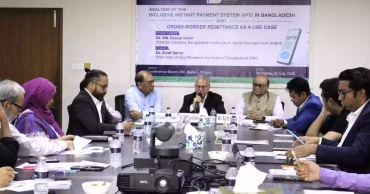
The proposal was presented at an inception workshop titled "Analysis of the Inclusive Instant Payment System (IIPS) in Bangladesh and Cross-Border Remittance as a Use Case," held at the PRI office in Banani.
The study was jointly presented by PRI Research Director Dr Bazlul Haque Khondker and Director MA Razzaque.
The proposed system, to be built on the open-source Mojaloop platform, will enable instant, low-cost and interoperable transactions across banks, mobile financial service (MFS) providers and other financial institutions, unifying bank-to-bank, wallet-to-wallet and bank-to-wallet transfers, QR payments, remittances, merchant payments and government-to-person disbursements within a single framework aligned with the National Financial Inclusion Strategy and the Sustainable Development Goals.
The study noted that Bangladesh's MFS sector, dominated by bKash, Nagad and Rocket, has expanded into remittances, salary disbursement and government payments but remains closed-loop, preventing funds from moving seamlessly between providers.
Earlier interoperability initiatives, including the 2017-2020 BFP-B programme and the ICT Division's Binimoy platform, which was scrapped in 2024, saw limited adoption as voluntary participation gave dominant providers little commercial incentive to interoperate.
Citing the Global Findex Database 2025, the study said only 43 percent of adults in Bangladesh own a financial account, while just 34 percent make or receive digital payments, with a 20-percentage-point gender gap that is among the widest in South Asia.
According to the presentation, remittances represent the single largest benefit pool for the proposed system. Bangladesh received $30.3 billion in formal remittances in fiscal year 2024-25, but formal inflows stagnated in FY23 despite record overseas employment, with informal hundi channels remaining cheaper and faster for many migrants.
While global remittance costs average around 6.5 percent, IIPS-enabled corridors such as Singapore-Thailand's PayNow-PromptPay link have cut costs to below 1 percent, and the study estimated potential annual savings of $250-400 million for Bangladesh from similar low-cost, interoperable corridors.
The research applies a panel fixed-effects model using Global Findex and World Bank World Development Indicators data spanning 87 to 107 middle-income countries to simulate the likely impact of IIPS adoption on financial inclusion, digital payments and macro-financial indicators such as remittance flows, comparing a 2026 implementation scenario against a business-as-usual outlook through 2030.
The four-stage research pathway includes literature and benchmarking against global instant payment systems such as India's UPI, Brazil's PIX, Pakistan's RAAST and Thailand's PromptPay, followed by ecosystem and survey design, benefit-impact modelling, and policy recommendations for interoperable, low-cost payment rails.
2 months ago