State Minister for Health and Family Welfare
Bangladesh sets 5-year target to eliminate cataract blindness: State Minister
Bangladesh will take all necessary measures to completely eliminate cataract blindness within the next four to five years, State Minister for Health and Family Welfare Dr MA Muhit has said on Thursday.
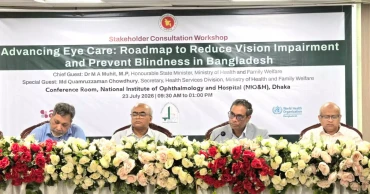
"Through a national roadmap implemented with coordinated efforts from the public, private and NGO sectors, it is possible to eliminate cataract blindness in Bangladesh within the next four to five years," the state minister said while addressing a stakeholder consultation workshop titled "Advanced Eye Care in Bangladesh: Action Plan for Reducing Visual Impairment and Preventing Blindness" at the National Institute of Ophthalmology and Hospital in Sher-e-Bangla Nagar.
He also emphasised delivering high-tech eye care services to the country's most marginalised and poor populations as a civic right, through the use of artificial intelligence (AI) and modern technology.
The state minister noted that Bangladesh's public sector, private initiatives and NGOs are all doing commendable and visible work in eye care.
However, he said, a national initiative is being undertaken because there is no unified, common reporting system connecting these efforts. "This sector will not change in a day, so we are moving forward with a five-year perspective plan."
Muhit said that in the first year itself, existing eye care facilities and planning at district hospitals will be reassessed and effective steps taken accordingly, including recruitment of additional manpower where needed and a strong push to build capacity at district-level hospitals.
Giving specific directions on extending eye care to people of all ages, the state minister said coordinated campaigns and programmes will be launched to identify vision problems among schoolchildren and provide them with necessary glasses. "Eye health of working people at factories, offices and other institutions will also be looked after, with arrangements made to provide them with glasses as well."
He said a large-scale cataract surgery programme will be undertaken to address cataracts among the elderly, adding that performing several hundred thousand successful surgeries every year could make the country free of cataract blindness within the next four to five years.
Muhit said modern technology offers vast opportunities in treating emerging eye conditions such as diabetic retinopathy. "We can introduce an AI-based enhanced screening system. The use of technology has made community outreach and field-level service delivery far easier than before. We want high-tech eye care to reach the doorsteps of marginalised people, not remain confined to the wealthy in cities."
Referring to the shortage of skilled manpower as a major challenge in the eye care sector, the state minister said, "We must give the highest priority to human resource development and training cadres. There are already many good training institutions in the NGO and private sectors in the country. We need to increase the number and quality of all public and private institutions to make it easier for physicians to acquire the necessary skills."
Senior ophthalmologists, academics, experienced physicians working at district and peripheral levels, and representatives of international organisations took part in the workshop's open discussion session.
2 months ago