Russian ballistic missiles
Why more Russian ballistic missiles are getting through Ukraine’s air defenses
Ukraine is facing growing difficulties in stopping Russian ballistic missiles, which can reach their targets within minutes — and sometimes seconds — after being launched.
The missiles are exposing Kyiv and other Ukrainian cities to increasingly heavy attacks because they travel extremely fast and descend steeply toward their targets. Ukraine says the US-made Patriot system is currently the only defense system in its arsenal capable of stopping some of Russia’s most advanced ballistic missiles.
But Ukraine does not have enough Patriot systems or interceptor missiles to protect all of its cities.
Unlike cruise missiles, which fly more like unmanned aircraft, ballistic missiles are launched like rockets before diving toward their targets at several times the speed of sound.
That gives air-defense crews very little time to detect, track and intercept them.
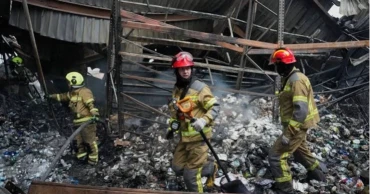
The difficulty was highlighted by Russia’s latest attack on Kyiv, which struck a brewery, a warehouse and a mail-sorting facility. At least 17 people were killed and dozens injured, President Volodymyr Zelenskyy said Wednesday.
Thomas Withington, an electronic warfare expert at the Royal United Services Institute, compared intercepting such a missile to trying to catch a ball moving extremely fast.
Russia's main ground-launched ballistic missile is the Iskander-M. It also uses the air-launched Kinzhal and has fired S-300 and S-400 air-defense missiles at ground targets.
The Zircon, technically a hypersonic anti-ship cruise missile, also travels at speeds that create similar challenges for air-defense systems.
Patriots provide limited protectionThe Patriot system is designed to defend against fast-moving missiles. Its PAC-3 interceptor is built to hit an incoming warhead directly rather than explode near it.
The system must quickly detect and track an incoming missile, calculate its flight path and launch an interceptor, sometimes leaving only seconds to complete the engagement.
Ukrainian Air Force spokesman Yurii Ihnat said Patriots are currently the only systems in Ukraine capable of intercepting Russia’s Iskander-M, S-400 and Zircon missiles.
The United States and its allies have other advanced missile-defense systems, including THAAD and ship-based Aegis systems, but those have not been supplied to Ukraine.
Even Patriot systems cannot guarantee protection. If a battery is unavailable, deployed elsewhere or running short of interceptors, other Ukrainian air defenses often cannot fill the gap.
Ukraine also has too few Patriot batteries to cover every major city. Russia complicates the challenge by launching ballistic missiles alongside cruise missiles, drones and decoys, forcing Ukrainian defenders to deal with many targets at once.
Global shortage of interceptorsThe shortage of interceptor missiles has become a wider international problem.
The US-Israeli conflict with Iran has used large numbers of Patriot and THAAD interceptors. An Associated Press analysis estimated that the US stockpile of Patriot interceptors had fallen by at least 65% from its level before the conflict, although the Pentagon said it still had a large supply.
Increasing production will take time. Lockheed Martin delivered more than 600 PAC-3 MSE interceptors in 2025 and is working to increase annual production to 2,000 by the end of 2030.
NATO says Europe’s first Patriot missile production facility is expected to open in Germany in September.
Washington has also sent mixed signals about expanding production in Ukraine.
At a NATO summit in Turkey last month, President Donald Trump said the United States would allow Ukraine to produce Patriot missiles. About three weeks later, however, he said he had not made a final decision.
Even if approval is given, US officials and experts told AP that establishing production in Ukraine would take years.
Ukraine seeks to destroy missile launchersUkraine is also trying to prevent missile attacks before they begin by targeting Russian launchers and related infrastructure.
People familiar with the discussions told AP that Zelenskyy asked Trump to help secure Elon Musk’s approval for Ukrainian forces to use Starlink communications for targeting inside Russia, where access to the service has been restricted.
Such access could potentially help Ukrainian drones locate Russian missile launchers and supporting infrastructure, reducing the number of missiles that Ukrainian Patriot batteries would have to intercept.
The request has not been publicly confirmed by the White House, the Ukrainian Embassy or SpaceX.
Ukraine is also developing a proposed lower-cost missile-defense system called Freya, which is intended to reduce the country’s dependence on Patriot systems.
In July, Ukraine and nine European countries formed a coalition to work on a joint missile-defense capability. Zelenskyy said the countries could work together to develop a system for mass production within 12 months.
Freya remains under development, however, and it is not clear when it could become operational.
Following the latest Russian ballistic missile attack on Kyiv, Zelenskyy said Ukraine received only one-third as many air-defense missiles during the first half of 2026 as it did during the same period last year.
He urged countries that cannot immediately increase deliveries of interceptor missiles to instead impose tougher sanctions on Russia, saying a significant part of Russia’s ballistic missile production has remained largely unaffected by existing sanctions.
8 hours ago