Jute prices fall
Jute prices fall, Narail farmers fear losses
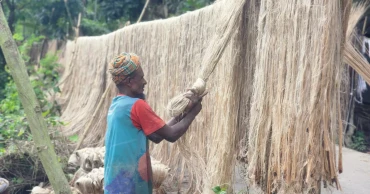
The fields are green no more. Farmers in Narail are busy cutting jute, soaking the stalks in water, stripping the fibre and drying it under the sun.
For many, it is the busiest time of the jute season.
But behind the good harvest is growing anxiety.
Farmers say favourable weather has helped them get a good yield this year, but falling market prices are making it increasingly difficult to recover their production costs.
With labour, land preparation and processing expenses continuing to rise, many fear jute cultivation may no longer remain profitable.
Some are already considering giving up the crop next year.
At Shuldhia village under Lohagara upazila, farmer Monu Molla cultivated jute on 60 decimals of land this year spending around Tk 25,000.
When he took up the crop, he had expected a better return.
Jute was initially selling at around Tk 4,500 per maund, but the price has now fallen to around Tk 3,000, he said.
“The amount we get from selling jute does not match what we spend on cultivation,” Monu said .”If the price does not increase, I may not cultivate jute next year.”
The situation is similar for farmers in other parts of the district.
At Korgram village in Narail Sadar upazila, farmer Dipak Roy was busy retting jute in the Chitra River when he spoke about his worries.
He said jute prices were initially between Tk 4,000 and Tk 4,500 per maund, but had now dropped to Tk 3,000-Tk 3,500.
And farmers fear the price could fall further by the time the fibre is processed and taken to the market.
“We are only retting the jute now. It still has to be separated, washed, dried and taken to the market,” Dipak said.
“By then, the price may fall to Tk 2,000-Tk 2,500. Where will we get a fair price?”
He said labour costs have become another major burden.
“A worker charges Tk 500 and works only from around 9am to 1pm. After all the expenses, it costs around Tk 20 to bring one bundle of jute home,” he said.
“The yield is good. But if the market price is not right, how will we survive?”
Another farmer, Mobarak Hossain, said farmers are spending money at almost every stage of production.
“We have to pay Tk 10 just to bring one bundle of jute from the field. Then there are the costs of preparing the land, cutting the jute, retting, separating the fibre and drying it,” he said.
“After selling the jute at the market, much of the money goes back to the labourers. We are not making a profit.”
Mobarak urged the government to take steps to ensure a fair price for jute.
“We want the government to fix a minimum price for jute so that farmers are not forced to sell below their production costs,” he said.
2 months ago