Halal economy
Halal economy can be a major area of opportunity: Commerce Minister
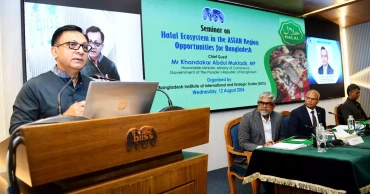
Commerce Minister Khandakar Abdul Muktadir stressed the need for reducing its reliance on traditional export products and explore emerging sectors, particularly by developing a strong and internationally competitive halal ecosystem based on the experience of ASEAN countries.
He made the call while addressing a seminar titled “Halal Ecosystem in the ASEAN Region: Prospects for Bangladesh,” organised by the Bangladesh Institute of International and Strategic Studies (BIISS).
The minister said the halal economy can no longer be viewed as being limited to food and beverages.
It has evolved into a broad global economic system covering food, pharmaceuticals, cosmetics, modest fashion, tourism, logistics, technology, finance and international certification, he said..“We must first enhance our domestic production capacity to increase exports. This requires both local and foreign investment, as well as ensuring a safe and attractive environment for investors,” he said.
Muktadir said preferential access to international markets is one of the key conditions for attracting investment.
He said the government is working to sign free trade agreements (FTAs), preferential trade agreements (PTAs) and economic partnership agreements (EPAs) with different countries to retain Bangladesh’s export advantages after its graduation from the least developed country (LDC) category.
He stressed the need for an independent, reliable and internationally recognised halal certification system to tap the growing global halal market.
Such a system would increase international confidence in Bangladeshi products and help the country enter new markets, he said.
Speakers at the seminar said Bangladesh’s export sector has long been heavily dependent on the readymade garment industry.
To remain competitive in the changing global trading environment, the country needs to diversify both its products and markets, with the halal economy offering significant potential.
They stressed that Bangladesh needs an integrated system covering production, quality control and certification to enter the global halal market.
Participants highlighted Malaysia’s halal ecosystem as a useful model for Bangladesh.
Speakers said Bangladesh has a large domestic market and strong capabilities in agriculture, food processing, pharmaceuticals, leather and garments.
These strengths could help the country become an important partner in the global halal supply chain.
The seminar identified five strategic priorities for making Bangladesh’s halal sector globally competitive: establishing an internationally recognised national halal assurance framework; developing specialised halal industrial clusters with modern laboratories and logistics facilities; upgrading existing industries to international standards; involving small and medium enterprises, researchers and young entrepreneurs; and establishing a “Bangladesh Halal” brand globally through economic diplomacy.
BIISS Director General Maj Gen A S M Ridwanur Rahman delivered the welcome address, while BIISS Research Director Dr Mahfuz Kabir presented the keynote paper.
2 months ago