Bangladesh trade policy
Bangladesh trade policy: WB finds para-tariffs doubling border protection, urges phased reform
Bangladesh's actual protection at the border is roughly double what its tariff schedule suggests, with regulatory and supplementary duties, not customs tariffs, driving both the distortion and the fiscal risk of reform, according to a new World Bank study presented on Tuesday.
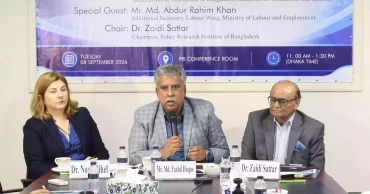
The study, titled "Bangladesh Trade Policy at a Crossroads: Evidence for the National Tariff Policy, LDC Graduation, and the Next Generation of Trade Agreements," was presented by Nora Dihel, Senior Economist for Macroeconomics, Trade and Investment at the World Bank, at a programme organised by the Policy Research Institute of Bangladesh (PRI) at its Banani office.
Using FY2026 data, the study finds Bangladesh's trade-weighted average Most Favoured Nation (MFN) tariff stands at 7.0 percent across 5,666 tariff lines.
But once regulatory and supplementary duties, so-called para-tariffs are added, average nominal protection nearly doubles to 15.4 percent.
The extra protection is concentrated in specific sectors rather than applied uniformly, with footwear, hides and skins, stone and glass, and transportation equipment carrying the widest gap between tariff and actual protection, footwear alone sees nominal protection of 70.4 percent against an MFN tariff of just 25 percent.
The report notes that tariff rationalisation, though committed to under the National Tariff Policy gazetted in August 2023 and reiterated under the Smooth Transition Strategy, has not moved beyond the proposal stage.
The proposed FY2026-27 budget revised duties on 261 tariff lines, but independent assessments cited in the study conclude that incentives remain oriented toward the domestic market and fall short of earlier commitments. Bangladesh is scheduled to graduate from Least Developed Country (LDC) status on November 24, 2026, though the government has formally requested a deferral of at least three years, with a decision still pending.
Using its Tariff Reform Impact Simulation Tool (TRIST), the World Bank modelled the fiscal cost of reform under several scenarios. It found the cost is driven almost entirely by para-tariffs rather than customs duties: a 10 percent cut to customs duty alone would cost about $189 million in import tax revenue, but the same cut combined with full removal of para-tariffs would cost $1.4 billion.
Full elimination of both customs duties and para-tariffs would cost $3.7 billion, or 40.8 percent of import tax revenue, equivalent to 0.83 percentage points of GDP.
The study recommends a phased approach, prioritising duty cuts on intermediate inputs alongside reductions on the most protected consumer goods, followed by a pre-announced multiyear phase-out of remaining para-tariffs, and eventual convergence toward the tariff levels of regional competitors India, China and Vietnam.
It cautions that reforming intermediate inputs alone, without addressing high-protection consumer goods, could worsen the existing bias against exporters.
The report also flags that Bangladesh's statutory tariff schedule diverges sharply from duties actually collected. Analysis of FY2025 transaction-level customs data shows 28.4 percent of Tk 5,686 billion in total imports entered without full payment of customs duties, while 25.6 percent benefited from an exemption of at least half the statutory duty.
Over half of imports from China and India received such exemptions, with exemption incidence rising alongside both transaction value and the statutory rate.
A companion computable general equilibrium (CGE) analysis using the GTAP model examined Bangladesh's broader trade policy choices.
It found that if all trade preferences lapse upon LDC graduation with no replacement, real GDP would contract by 0.24 percent (roughly $1.1 billion), while a passive "do nothing" approach, allowing preferences to lapse while competitors deepen their own market access, would cost about 0.21 percent of GDP, hitting unskilled wages (-0.83 percent) and total exports (-2.48 percent) hardest.
By contrast, the study found that a deep multi-partner free trade agreement push, benchmarked on the depth of Vietnam's trade deals, would boost real GDP by 0.73 percent, or about $3.2 billion, with two-thirds of the gain concentrated in agreements with the Regional Comprehensive Economic Partnership (RCEP) and ASEAN.
Unilateral reforms requiring no negotiating partner, deeper cuts to input tariffs and removal of para-tariffs on intermediate goods, could deliver GDP gains of up to 0.52 percent on their own, the study found.
The World Bank saud while tariff reform carries a manageable fiscal cost of under one percentage point of GDP even under the most comprehensive scenario, it must be paired with domestic revenue mobilisation, removal of non-tariff barriers, services trade liberalisation, and adjustment support for workers in sectors most affected by liberalisation, to be effective.
1 month ago