weapons in space
US confirms deployment of weapons in space for first time
The United States has acknowledged for the first time that it has deployed weapons in space, a significant disclosure following years of warnings about the possibility of countries such as Russia placing weapons in orbit.
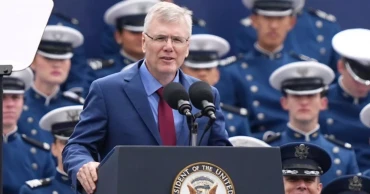
US Air Force Secretary Troy Meink said Monday that the United States has deployed "on-orbit space control weapons" capable of protecting the Joint Force from hostile actions by adversaries.
Meink did not provide details about the weapons, how they operate or whether they are designed to target objects in space or on Earth.
The United States warned two years ago that Russia was developing a new space-based anti-satellite weapon, although the White House said at the time that there was no immediate threat.
The reports renewed longstanding concerns about space-based threats from Russia and China, particularly because much of the US infrastructure depends on satellite communications. The United States has also previously demonstrated its ability to destroy satellites from the ground.
Speaking at the Air and Space Forces Association's Air, Space & Cyber Conference, Meink said the Air Force was expanding its use of autonomous systems and predicted that the service would look "radically different" by 2032.
He said, for example, that one-way attack drones could replace artillery as the "primary killer."
"We are increasing readiness against existing threats," Meink said.
The disclosure comes as the Trump administration places greater emphasis on space-based military capabilities.
During Trump's first term, in 2019, he established the Space Force as a separate branch of the US military. In his second term, he has announced the "Golden Dome" missile defense system, which includes plans to deploy US weapons in space.
Trump said last year that he expected the system to be "fully operational before the end of my term," which ends in January 2029. He said it would be capable of intercepting missiles "even if they are launched from space."
He also ordered the Pentagon during the first week of his presidency to pursue space-based missile interceptors.
The Congressional Budget Office has estimated that the space-based components of the Golden Dome alone could cost as much as $542 billion over 20 years.
In 2024, the Biden administration said Russia was developing a space-based nuclear weapon capable of remaining in orbit for long periods before releasing a burst powerful enough to destroy nearby satellites.
The disclosure sparked renewed debate at the United Nations over weapons in space.
In April 2024, Russia vetoed a US-Japanese resolution calling on countries not to develop or deploy nuclear weapons or other weapons of mass destruction in space. Such weapons are prohibited under a 1967 international treaty signed by both the United States and Russia.
The treaty also established outer space as a global commons to be used only for peaceful purposes.
Russia's delegation described the resolution as hypocritical and a double standard. Moscow instead proposed a separate resolution calling for a ban on all weapons in space "for all time," but it failed to pass.
Russia has argued that the United States and its allies oppose a complete ban on weapons in outer space because they intend to deploy weapons there.
1 month ago