Russia's wartime economy
Russia's wartime economy faces growing pressure from debt, military spending
Growing military spending is putting increasing pressure on Russia's wartime economy, widening the budget deficit and adding to concerns among consumers and businesses as economic growth slows.
Economists, however, say the situation does not point to an immediate financial crisis or economic collapse. Strong oil revenues, supported by higher prices linked to the war in Iran, are helping the government finance its 4 1/2-year-old invasion of Ukraine, at least for now.
Low unemployment and increased government spending in poorer regions have also helped limit public dissatisfaction.
The situation supports the Kremlin's message of economic stability ahead of Russia's tightly controlled parliamentary election, which began Friday and ends Sunday.
But economists warn that longer-term problems are weakening the economy's foundations and could eventually lead to a crisis.
Consumers and businesses grow more pessimisticConsumer confidence has declined from its peak in 2024-25, when increased military spending boosted economic growth and wages.
More recently, consumers have faced higher gasoline prices and shortages caused by Ukrainian drone attacks on Russian oil refineries. Many small businesses have also lost goods and customers following attacks on online retailers Wildberries and Ozon.
Economic growth has also slowed from more than 4% annually in 2023-24. The government expects growth of just 0.6% this year. The economy contracted in the first quarter before recovering somewhat in the second.
The consumer sentiment index compiled by independent Russian pollster Levada Center fell to 94 during the summer, down from 116 in spring and summer 2025. A reading below 100 indicates that negative sentiment outweighs positive sentiment.
People interviewed about the election in Moscow mainly raised concerns about pensions and rising prices.
Alexander Vertukhin, a 72-year-old retired military prosecutor, said the government should focus on ensuring "a decent standard of living for pensioners."
"I'm doing fine, both financially and in every other respect," he said.
Dmitry Kirillin, 26, said he wanted housing and travel within Russia to become more affordable and for pensioners to be able to live comfortably rather than simply survive.
"I'd like prices to rise more slowly, if that's possible in the current situation," he added.
Chris Weafer, CEO of consultancy Macro-Advisory Ltd., said gasoline shortages and strikes on Wildberries had made the war more noticeable to ordinary Russians but did not amount to a crisis.
He described the economy as being in "tolerable stability" and said the public was "grumbling" but not protesting.
"The economy is under strain — it's stagnant to the effect that it's stable but not growing," Weafer said. "But it's not facing recession either."
He said most people were "not that affected" by Ukrainian strikes and that disruptions to shopping habits were unlikely to change public support for the Kremlin.
President Vladimir Putin's approval rating has fallen in recent months but remains above its level before the war began in 2022.
Budget deficit risesA major sign of economic pressure is Russia's growing budget deficit and the government's efforts to raise additional revenue.
Putin's government has increased the value-added tax paid by consumers, raised other fees and tightened taxes on small businesses. Despite these measures, the deficit has continued to grow.
By the end of July, the deficit had reached 2.8% of annual economic output, nearly twice the original target for the year.
Resources in Russia's reserve fund had fallen to 1.6% of GDP, leaving the government increasingly dependent on borrowing from domestic banks.
That borrowing comes at a high cost, with interest rates on Russian bonds reaching as much as 17%, according to Janis Kluge, an expert on Russia's finances at the German Institute for International and Security Affairs.
Budget pressure is "adding to doubts about how long Russia can sustain the war," Kluge wrote in a recent report.
Russia's central bank has kept interest rates high to control inflation driven by military spending. High borrowing costs are putting pressure on civilian businesses, which do not receive the same preferential access to credit as defense companies.
Private lending by Russian banks to defense-related companies has also increased, providing another source of war financing. Such borrowing is not fully reflected in official deficit figures.
Economists warn of long-term risksWestern sanctions have limited Russia's access to new investment, potentially reducing productivity and long-term economic growth.
Some economists warn that high military spending, weak growth, rising debt and expensive borrowing are gradually weakening the economy's structural foundations, even though it has not collapsed.
The current path is "unsustainable," according to Torbjörn Becker of the Stockholm School of Economics. However, he said the timing of any potential crisis remains uncertain.
Higher oil prices provide reliefHigher oil prices linked to the war in Iran have provided Russia with additional revenue.
Oil export earnings, which had fallen below $10 billion a month before the Iran war, increased to $15.8 billion in June and $13.8 billion in July.
Russia's budget pressures "may effectively disappear for as long as elevated energy prices persist," Becker wrote.
He argued that stronger action against Russia's sanctions-evading oil tanker fleet should be a priority to reduce that revenue.
War spending boosts poorer regionsMilitary spending and enlistment bonuses have brought more money into Russia's poorer regions outside Moscow and St. Petersburg.
Defense factories are operating at high capacity, while the national unemployment rate stands at 2.2%.
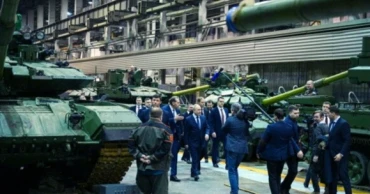
The Uralvagonzavod tank factory in Nizhny Tagil increased its workforce from about 20,000 to more than 38,000 after the invasion of Ukraine as it moved to round-the-clock production, according to a recent report by the Center for Strategic & International Studies on Russia's defense industry.
Kupol, a company producing drones and surface-to-air missiles, is the largest industrial enterprise in Russia's Udmurtia region and more than doubled its output in 2025.
However, shortages of skilled workers are limiting production in defense companies and other sectors. The problem has been compounded by the departure of several hundred thousand mostly younger Russians amid fears of conscription and political repression.
Kremlin says economy remains stableKremlin spokesperson Dmitry Peskov said monthly deficit figures could fluctuate and that the situation was not a cause for concern.
"Macroeconomic stability is absolutely ensured," he said.
However, Andrei Klepach, chief economist at Russia's state-owned VEB.RF development bank, warned in a speech that sanctions and economic isolation were causing Russia to fall behind in global technological and economic competition.
"We're falling behind in the technological and economic competition in the world," he said, adding, "we can't win the competition in this war of attrition."
Klepach was later fired.
3 hours ago