Chinese exports
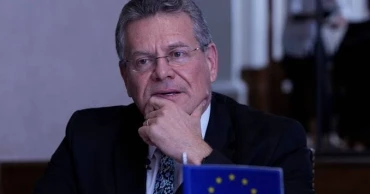
EU envoy heads to Beijing as rising Chinese exports fuel trade concerns
The European Union is preparing for tougher talks with China as a trade deficit of more than $1 billion a day raises concerns about job losses and increases pressure on the bloc to take a harder position toward its second-largest trading partner.
EU Trade Commissioner Maroš Šefčovič will travel to Beijing Thursday for two days of talks with Chinese Commerce Minister Wang Wentao. The discussions will focus on reducing the EU's 360 billion euro ($410 billion) trade deficit with China. Šefčovič earlier gave Beijing until October to show meaningful progress.
Across the 27-member EU, politicians and economists are increasingly concerned that China's large state subsidies and rising exports are threatening key industries, including steel and automobile manufacturing. China has redirected more exports toward the EU and other markets since the United States increased tariffs.
European lawmakers voiced strong concerns about trade with China during a debate Tuesday in Strasbourg. On Wednesday, the European Parliament voted 454-86 in favor of a resolution calling for tougher action, including “economic reciprocity” and a proportionate EU response if China fails to open its markets.
Before the vote, Belgian lawmaker Hilde Vautmans, who led the resolution, said Europe has economic power and should use it.
EU considers tougher trade measuresThe EU has already introduced trade measures targeting Chinese steel and small e-commerce shipments, but it remains uncertain how far the bloc is prepared to go.
France's High Commission for Strategy and Planning called in February for swift action, including tariffs of up to 30% on many Chinese exports and a weaker euro against China's currency.
German carmakers are facing falling sales in China, while Chinese automakers are gaining ground in Europe by offering lower prices, helped by heavy state subsidies. Major manufacturers, including Volkswagen, have already announced large-scale job cuts.
France and Germany have also urged the EU to rethink its China policy. A letter seen by The Associated Press called for easier use of the bloc's Anti-Coercion Instrument, sometimes described as a “trade bazooka.” The tool, which has never been used, could restrict trade and investment from countries found to be putting excessive pressure on EU members or companies.
However, EU countries are not united on tougher measures. Spain, the eurozone's fourth-largest economy, has maintained a more cooperative approach toward China. Prime Minister Pedro Sanchez has visited Beijing four times in three years.
The European Policy Centre said in June that industries including batteries, solar panels, steel, electric vehicles, chemicals and machinery were already losing jobs and production capacity. It called for a trade investigation body modeled on Section 301 of the US Trade Act.
European Commission President Ursula von der Leyen has described the situation as another “China shock” for Europe, comparing it with the loss of hundreds of thousands of US manufacturing jobs in the early 2000s.
Tim Rühlig, a China analyst at the European Union Institute for Security Studies, said the EU needs domestic economic reforms as well as a stronger trade policy toward China.
He said Europe cannot simply protect itself from Chinese competition, but it must strengthen its industries to remain competitive in future technologies over the next 15-20 years.
Rühlig said the EU also cannot completely cut economic ties with China as it did with Russia after its invasion of Ukraine. Instead, Europe needs to decide where it should reduce dependence on China and where cooperation remains possible.
China prepares for prolonged trade disputeChina has warned the EU against adopting protectionist policies. A spokesperson for China's Commerce Ministry said France and Germany should not encourage the bloc to take such measures.
“Protectionism cannot enhance competitiveness, and decoupling or cutting off supply chains will only harm others without benefiting oneself,” the ministry said.
China is the EU's second-largest goods trading partner after the United States. Chinese exports to the EU increased 15.3% during the first eight months of this year, while imports from the EU rose 6.2%, according to China's customs agency.
An editorial in China's state-run Global Times last month said the EU lacked the capacity to fight a trade war with China and challenged the bloc to try if it was determined to do so.
China's exports to Europe, Southeast Asia, Latin America and Africa increased after US tariffs took effect last year. Despite trade restrictions, China recorded a global trade surplus of $1.2 trillion in 2025.
Max Zenglein, Asia-Pacific senior economist at The Conference Board, said China's export sector has remained resilient despite US tariffs and other restrictions.
Ahead of Šefčovič's meeting with Wang, China launched an anti-dumping investigation into EU exports of p-nitrotoluene, a chemical used in dyes and pharmaceuticals. Beijing had warned last month that it would retaliate if the EU introduced tougher protectionist measures.
Zenglein said China has faced several rounds of external pressure and has largely resisted efforts to change its economic policies.
China's economy remains heavily dependent on exports as domestic demand stays weak. The EU imports large quantities of Chinese lithium-ion batteries and hybrid electric vehicles, while Chinese automakers are expanding their production facilities in Europe.
Bank of America economists said improving US-China relations after a summit between Chinese President Xi Jinping and US President Donald Trump in Washington has shifted attention toward China-EU trade relations.
Zenglein said Chinese investment in Europe could become an important bargaining tool in negotiations, particularly as EU countries compete to attract investment, jobs and new manufacturing projects.
2 days ago