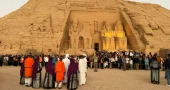
Egyptian temple
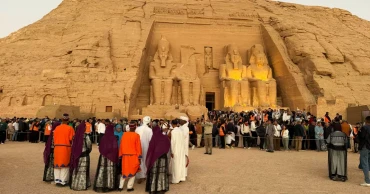
Golden sunbeam illuminates ancient Egyptian temple twice a year
Hundreds of tourists and local residents gathered at an ancient temple in southern Egypt at dawn Thursday to witness a solar phenomenon that has occurred for thousands of years, with some visitors spending the night outdoors to secure a glimpse of the spectacle.
Twice a year, on Oct 22 and Feb 22, sunlight enters the dark inner chamber of the Great Temple of Ramesses II, illuminating statues of the pharaoh and two gods. The dates are believed to mark Ramesses II's accession to the throne and birthday, respectively.
The phenomenon, caused by the temple's precise alignment with the sun, lasts about 20 minutes.
“Today is a very special day, as you can see. It’s a celebration and a historic holiday,” Hisham Khela, a local tour guide accompanying Italian tourists, told The Associated Press.
Egyptology enthusiasts and other visitors formed an uneven single-file queue, holding up mobile phones and selfie sticks to capture the event. Many appeared tired after waking up early, while the crowds looked small beside the enormous statues surrounding the temple, which overlooks the Nile.
To celebrate the occasion, performers in colourful costumes gathered outside the temple, smiling and dancing in unison to meditative chimes, tabla percussion and the distinctive sounds of mizmars, an ancient Egyptian wind instrument.
Inside, visitors stood shoulder to shoulder in near darkness as sunlight travelled about 60 metres (200 feet) into the temple, illuminating statues of Ramesses II and the gods Amun-Ra and Ra-Horakhty, according to the National Research Institute of Astronomy and Geophysics.
For many first-time visitors, the ancient spectacle offered unforgettable memories.
Janice Souudi, who travelled from Atlanta, Georgia, said it was her first visit to Egypt and would not be her last.
“I came here today for the huge temple statues and how well preserved they are. But I was most impressed with the colors of the carvings and hieroglyphics and imagery,” she said. “Beautiful, stunning, worth it!”
During the 1960s, archaeologists undertook a massive operation to dismantle and relocate the temple to protect it from rising waters caused by the Aswan High Dam.
Engineers carefully preserved the temple's solar alignment during the relocation, ensuring that more than 3,000 years after its construction, sunlight continues to reach its inner chamber.
2 hours ago