rail and technology
Tarique invites Japanese investment in key sectors, including energy, rail and technology
Prime Minister Tarique Rahman on Wednesday invited Japanese companies to invest in Bangladesh's priority sectors, including automotive manufacturing, energy, technology and space, and high-speed rail and logistics, promising government support and reforms to improve the business environment.
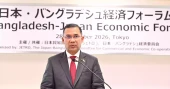
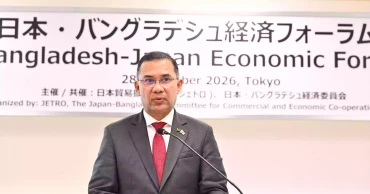
Addressing the Bangladesh-Japan Economic Forum Dialogue at JETRO headquarters in Tokyo, he said the two countries should take their long-standing relationship to a new level through trade and investment following the signing of the Economic Partnership Agreement (EPA), Bangladesh’s first such agreement with any country.
The dialogue was organised by the Japan External Trade Organization (JETRO) in cooperation with the Japan-Bangladesh Committee for Commercial and Economic Co-operation (JBCCEC), with support from the Bangladesh Embassy in Japan.
JETRO President Susumu Kataoka delivered the opening remarks, while Japan's Parliamentary Vice-Minister of Economy, Trade and Industry Shinji Wakayama addressed the event as a guest speaker.
The programme also featured a memorandum of understanding (MoU) exchange and announcements of investment and cooperation projects.
The Prime Minister said Bangladesh has a market of more than 180 million people, a young workforce with a median age of 27 and a growing middle class. “The country is expected to become one of the world’s top 10 consumer economies by 2030,” he added.
He said Bangladesh is expected to become the world’s ninth-largest consumer economy by 2030, while its annual GDP is projected to cross US$1 trillion by 2034, driven by a rising affluent middle class.
Under the EPA signed between Bangladesh and Japan in February this year, Tarique said 7,379 Bangladeshi products will enjoy duty-free access to Japan, while Japanese goods, including steel, automotive parts and electronic components, will receive preferential access to Bangladesh. “Investors on both sides will benefit from recently simplified and progressive rules on investment, services and customs procedures.”
He said Japanese automotive manufacturers, large retailers, agro machinery developers and many others are already taking steps to set up factories in the Japanese Economic Zone in Araihazar, pledging that the government will provide all the support in this regard.
The Prime Minister said Japanese companies have raised three key concerns — reliable energy, efficient infrastructure, and predictable customs clearance and taxation — and that his government has already resolved some of them and is working to address the remaining issues.
“I fully understand that businesses need certainty. Investors need confidence. Our job is creating the right environment to deliver both,” he said, adding that the government will provide every possible support for the initiative.
Tarique said Bangladesh’s ambition is to transform the country into a global manufacturing hub.
“By setting up factories in Bangladesh, you not only enjoy direct access to a large and growing domestic market but also benefit from efficient factors of production to export to the rest of the world,” he said.
In the energy sector, the Prime Minister invited Japanese companies to explore Bangladesh’s future energy needs and participate in energy infrastructure, efficient power generation and renewable energy projects.
He said Bangladesh is planning to establish a Bangladesh-Japan Technology Park focused on artificial intelligence, cloud computing, robotics and electronics manufacturing, involving Japanese companies, universities and investors.
Tarique also called for cooperation with Japanese institutions in space science, satellite engineering and related technologies to strengthen Bangladesh’s space capabilities.
On rail and logistics, he said Bangladesh plans to develop a nationwide elevated high-speed rail network connecting six major divisional cities.
The Prime Minister said the government plans to prepare a national master plan, assess passenger and freight demand, prioritise routes and conduct feasibility studies, inviting Japanese institutions to invest in the initiative.
2 hours ago