artificial intelligence (AI)-powered traffic signals
PM says govt to expedite work on metro rail routes, consider monorail in Dhaka
Prime Minister Tarique Rahman on Wednesday said the government had taken initiatives to expedite the work on the remaining metro rail routes in Dhaka and was seriously considering introducing a monorail system to make public transport more accessible in different parts of the capital.
He also said the government was installing artificial intelligence (AI)-powered traffic signals at 50 points in Dhaka, which were expected to become operational within the next two months to help improve traffic management and reduce congestion.
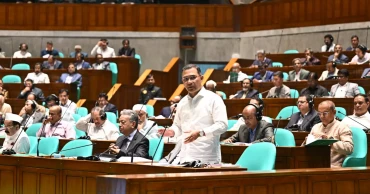
The Prime Minister made the remarks while replying to a question from Abul Kalam, MP from Cumilla-9, during the question-and-answer session in Parliament.
“We have seen that metro rail services are operating on several routes. Initiatives have been taken to complete the work on the remaining routes quickly,” he told the House.
Tarique said the government was also giving serious consideration to introducing monorail services to facilitate the movement of people in areas where conventional metro rail routes might not be suitable.
“Monorails can reach smaller areas and neighbourhoods. They can go into inner parts of localities such as Mohammadpur, Dhanmondi and Sabujbagh,” he said.
The Prime Minister expressed the hope that introducing monorail services would make commuting easier for ordinary people in different parts of Dhaka.
AI-powered traffic signals
Speaking about measures to ease traffic congestion in the capital, Tarique said the government was installing new AI-powered traffic signals at 50 points across the city.
He said new traffic signal lights and equipment had already been installed at different intersections, although they had not yet started operating.
“We hope these lights will start functioning within the next two months,” the Prime Minister said.
He expressed confidence that the AI cameras and traffic signals would improve traffic management, make roads more suitable for movement and significantly reduce congestion in Dhaka.
Tarique said traffic speed in Dhaka had increased from around 4km per hour during the previous regime to nearly 11km per hour following improvements in traffic management.
He, however, noted that traffic congestion during the office rush and school hours in the morning and afternoon was common in major cities around the world.
“In any major capital or densely populated city in the world, there is usually some traffic congestion during two periods – when offices and schools start in the morning and when they close,” the Prime Minister said.
He said such congestion often continued for two to four hours in major cities and that a similar situation was also seen in Bangladesh. “Even so, we are trying to reduce it as much as possible and improve the traffic management system,” he told the House.
Earlier, responding to a starred question from Abul Kalam, Tarique said construction of the 12-kilometre inner circular ring road from Rayerbazar Sluice Gate to Postogola Bridge under Dhaka South City Corporation was underway to ease traffic congestion in the capital.
He said construction of the first five-kilometre section was progressing, with 52 percent of the work completed. The portion is expected to be completed by December 2028.
“The remaining seven-kilometre section's proposed design has been sent to the Bangladesh University of Engineering and Technology (BUET) for vetting. The government plans to complete the construction by June 2030 after the approval of the project,” the Prime Minister added.
He also said four project proposals under the Roads and Highways Department were at different stages of processing to facilitate the construction of the inner circular ring road.
These include upgrading the Mirpur Bridge-Dhour national highway to four lanes with service lanes, constructing an interchange at Gabtoli on the Dhaka-Aricha national highway, upgrading the Postogola-Chashara national highway and widening a 5.10-kilometre portion of the Gabtoli-Swarighat national highway to four lanes with service lanes.
Replying to another supplementary question from Rangpur-3 MP Mahbubur Rahman Belal, Tarique said he would discuss with technical experts the feasibility of constructing a bypass around Rangpur city to ease its chronic traffic congestion.
The MP said Rangpur, the country's second-largest city corporation by area, has around eight lakh people across 33 wards and serves residents of eight districts for medical treatment, education and administrative purposes.
He said the city faces severe traffic congestion as most vehicles have to use a limited number of roads, urging the government to construct a bypass to reduce public suffering.
The Prime Minister said the government was cautious about using agricultural land for new roads and infrastructure, particularly in areas where farmers cultivate two or three crops a year.
He said the government would consider the proposal after discussing its technical feasibility with the officials concerned.
The sitting began at 4:15pm with Deputy Speaker Barrister Kayser Kamal in the chair. The first 30 minutes of the day's proceedings were allocated for the Prime Minister's question-and-answer session.
30 minutes ago