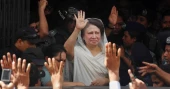
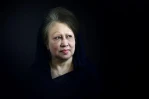
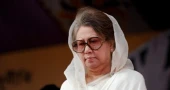
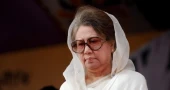
BNP Chairperson Begum Khaleda Zia

Curtain falls on a political giant as Khaleda Zia passes into history
One of the iconic figures in Bangladesh’s political history, BNP Chairperson and three-time former Prime Minister Begum Khaleda Zia, known as an uncompromising leader, lifelong fighter and true patriot, passed away on Tuesday morning (December 30, 2025). She was 80.
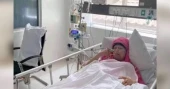
Her long and turbulent political journey came to a solemn end at 6:00am on Tuesday at Evercare Hospital, where she had been receiving treatment for 37 days.
“The BNP Chairperson breathed her last at 6:00am,” AKM Wahiduzzaman, the party’s ICT Affairs Secretary, said early in the morning. Her death was later confirmed by the medical board and senior party leaders.
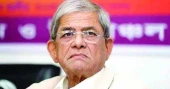
“It is with a heavy heart that we announce the passing of our esteemed Chairperson,” said BNP Secretary General Mirza Fakhrul, his voice choked with emotion.
Read more: Khaleda to be laid to rest beside Zia; Janaza at Parliament’s South Plaza
She is survived by her eldest son Tarique Rahman, three granddaughters, and millions of supporters and admirers. Her long political career has left a lasting mark on Bangladesh’s political landscape and inspired generations.
Shockwave in Winter Morning
Widow of slain President and BNP founder Ziaur Rahman, Khaleda Zia had long been woven into the fabric of Bangladesh’s political drama — its rises, ruptures, hopes, and hostilities. Her final months were marked by an unrelenting battle against pneumonia, chronic lung infections and persistent cardiac complications.
News of her death spread quickly through the city in the early hours, cutting through the cold winter morning and heavy fog. People across the country were stunned. Silence fell, while scenes of grief unfolded inside and outside the hospital.
A deep sense of grief swept across Bangladesh with condolence messages pouring in from leaders at home and abroad.
The BNP announced seven days of mourning over the death of its long-time leader. The government has declared three days of national mourning, including a general holiday on Wednesday.
As per the BNP Standing Committee’s decision, Khaleda Zia’s namaz-e-janaza will be held at 2:00pm on Wednesday at the South Plaza of the National Parliament and Manik Mia Avenue in the capital.
She will be buried with full state honours at Chandrima Udyan beside the grave of her husband, former President Ziaur Rahman, at 3:30pm.
Khaleda Zia led the BNP for 41 years and earned the title of the ‘uncompromising leader’ during the anti-autocracy movement of the 1990s. She served as a Member of Parliament five times -- Prime Minister three times and Leader of the Opposition twice.
Read more: Jaishankar to represent India to pay last respect to ex-PM Khaleda Wednesday
Starting her political journey as a homemaker, Khaleda spent much of her over four-decade political life on the streets, leading movements and facing arrests and imprisonment, but never leaving the country. She never lost an election she contested.
The BNP chief had been suffering from multiple chronic illnesses, including liver and kidney complications, heart disease, high blood pressure, diabetes, arthritis and infections.
She was admitted to Evercare Hospital on November 23. As her condition worsened, her elder son, BNP Acting Chairman Tarique Rahman, and other family members rushed to the hospital late Monday night.
Shortly after 2:00am, Khaleda Zia’s personal physician, AZM Zahid Hossain, told reporters that she was passing through an ‘extremely critical time’ and requested the nation to pray for her recovery. A few hours later, doctors declared her dead.
Family members, including Tarique Rahman, his wife Zubaida Rahman, their daughter Zaima Rahman, the family of her late son Arafat Rahman Koko, her siblings, and BNP Secretary General Mirza Fakhrul Islam Alamgir, were present at the hospital at the time.
Doctors, nurses and hospital staff were seen in tears as the news broke. The news spread rapidly on social media, with people from all walks of life expressing grief. BNP leaders, activists and supporters gathered outside the hospital in large numbers.
Read more: Khaleda Zia: 41 years at BNP’s helm - an uncompromising leader
At around 9am, the head of the medical board Prof Shahabuddin Talukder said with a choked voice that the medical team tried their best for more than a month, but Khaleda Zia was declared clinically dead at 6:00am.
BNP Secretary General Mirza Fakhrul Islam Alamgir said the loss is ‘irreparable’ and something the nation would never be able to overcome.
Govt’s Reactions
Fakhrul said Chief Adviser Muhammad Yunus had called him to express condolences. BNP Senior Joint Secretary General Ruhul Kabir Rizvi announced a seven-day mourning programme following the death of Khaleda.
As part of the programme, black flags will be hoisted at all party offices across the country for a week starting Tuesday while party leaders and activists will wear black badges and Quran khatam and prayers will be held nationwide during the period.
Condolence books were opened at BNP’s central office, Chairperson’s Gulshan office and other party offices across the country.
Read more: Top foreign dignitaries to attend Khaleda Zia’s funeral
An emergency meeting of the Advisory Council was held in the afternoon, where Mirza Fakhrul attended as a special guest. The meeting began with a minute’s silence, and decisions were taken regarding state mourning and funeral arrangements.
Law Adviser Asif Nazrul said Khaleda Zia’s contribution to the country would remain unforgettable.
The BNP Standing Committee also held an emergency meeting chaired by Tarique Rahman. BNP offices at Naya Paltan, Gulshan and elsewhere witnessed emotional scenes as leaders and supporters broke down in tears.
Tarique’s Tributes
Meanwhile, Tarique Rahman paid an emotional tribute to Khaleda, remembering her as a tender and loving mother who was also a steadfast guardian for her family and the nation.
“My mother, BNP Chairperson Begum Khaleda Zia, has responded to the call of Almighty Allah and left us today. Inna lillahi wa inna ilayhi raji'un (Indeed, we belong to Allah, and to Him we shall return),” he wrote in an emotional post on his verified Facebook page.
Read more: Vehicular movement to be restricted while Khaleda Zia’s body transported in city
To many, he said, she was the leader of the nation, an uncompromising leader, the ‘Mother of Democracy’, the ‘Mother of Bangladesh’.
“To me, Khaleda Zia was a tender and loving mother who devoted her entire life to the country and its people. Throughout her life, she stood firm against autocracy, fascism, and domination, leading the struggle for freedom, sovereignty, and the restoration of democracy,” he said.
Though her life was illuminated by sacrifice and struggle, Tarique said at home Khaleda was their truest guardian, a mother whose infinite love gave them strength in their darkest moments.
He said Khaleda endured repeated arrests, denial of medical care, and relentless persecution. “Yet even in pain, confinement, and uncertainty, she never stopped sheltering her family with courage and compassion. Her resilience was not loud, but it was unbreakable.”
For the country, Tarique said she lost her husband and lost her child. “In that loss, this nation and its people became her family, her purpose, her very soul. She leaves behind an unforgettable legacy of patriotism, sacrifice, and resistance, a legacy that will live on in the democratic conscience of Bangladesh.”
Khaleda’s Legacy
Khaleda Zia leaves behind a legacy as a steadfast leader, a symbol of resilience and patriotism, and one of the most influential states persons in Bangladesh’s history.
History rarely announces its chosen figures in advance. BNP Chairperson Khaleda Zia has proven it. Her life was a testament to resilience, determination and leadership, marked by an unwavering commitment to democracy and deep patriotism.
Read more: Tarique, other family members were by Khaleda’s side during her demise
Starting as a homemaker, she entered politics seven months after the assassination of her husband, late President and BNP founder Ziaur Rahman and rose to become Bangladesh’s first female Prime Minister in less than a decade.
Over a political career spanning nearly 43 years, she faced personal tragedies, imprisonment and political turbulence, yet remained a steadfast leader and a unifying symbol of democracy in Bangladesh.
She led the Bangladesh Nationalist Party (BNP) for 41 consecutive years as its chairperson, shaping not only her own remarkable political journey but also the course of the nation’s turbulent politics.
Khaleda Zia, who entered politics with no prior political experience following the assassination of her husband and BNP founder Ziaur Rahman in 1981, went on to shape a remarkable 43-year political journey.
Analysts describe her as a charismatic and uncompromising leader. She led a long struggle against military rule under HM Ershad, forming a seven-party alliance that played a key role in his fall.
Her political journey was not without hardships. She endured imprisonment, family tragedies—including the deaths of her husband and younger son, Arafat Rahman Koko—and repeated political harassment.
Read more: BNP to open condolence book for Khaleda Zia at Gulshan office
Even when the army-backed government in 2007 offered her opportunities to return to power or to go abroad, she firmly refused, saying that Bangladesh was her only home and the place where she wished to live until her death. Through this stance, she emerged as a symbol of resilience, integrity and national unity.
Khaleda Zia was also known for her pragmatic approach. She supported dialogue and compromise when necessary, including the introduction of a neutral caretaker government system into the constitution, even when initially opposed within her party.
She skillfully led BNP through multiple alliances, protests and elections, balancing strategic decisions with her principles.
From Putul to Unifying Figure
Born on August 15, 1945, as Khaleda Khan and nicknamed ‘Putul’ by her family, she married Ziaur Rahman in 1960 and became a widow at 36, raising her two sons, Tarique Rahman and Arafat Rahman, while gradually emerging as a decisive political leader.
Throughout her leadership of BNP, Khaleda Zia earned respect not only from her followers but also across political parties. Analysts describe her as a unifying figure, a champion of democracy, and a symbol of perseverance who transformed Bangladesh’s political landscape, paving the way for women to lead at the highest level.
Read more: Khaleda’s Death: Govt announces 3-day state mourning, general holiday Wednesday
Khaleda Zia was admitted to Evercare Hospital on November 23 due to heart and lung infections and passed away at 6:00 pm on Tuesday.
She was nominated for three constituencies—Dinajpur-3, Feni-1 and Bogura-7—for the upcoming 13th parliamentary election, although her party also fielded alternative candidates in view of her critical health condition.
9 months ago
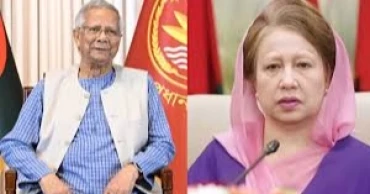
Prof Yunus mourns death of former Prime Minister Khaleda Zia
Chief Adviser Prof Muhammad Yunus on Tuesday (December 30, 2025) expressed profound sorrow at the death of three-time former Prime Minister and BNP Chairperson Begum Khaleda Zia, describing her a towering figure in the country’s democratic movement.
"With the sad demise of Begum Khaleda Zia, the nation has lost one of its most significant political guardians. I am deeply saddened and shocked by her death," said Prof Yunus in a condolence message.
He said Khaleda Zia was not merely a political leader, but an inseparable chapter in the history of Bangladesh. “In recognition of her long struggle, historic contributions, and the deep sentiment of the people toward her, the government declared her a person of great national importance earlier this month,” he added.
Chief Adviser calls Council of Advisers to discuss Khaleda Zia’s burial: Fakhrul
The Chief Adviser said that her role in establishing democracy, nurturing a multiparty political culture and safeguarding people’s rights would be remembered with respect.
He said through her firm and uncompromising leadership, the nation repeatedly found inspiration to overcome undemocratic conditions. "Her contributions to the country and its people will remain etched in national memory."
Despite political differences, her long political journey, people-oriented leadership, and unwavering resolve consistently guided the nation toward welfare and democratic values, Prof Yunus said.
"With her death, Bangladesh has lost an experienced, tested, and influential statesperson," he said.
Prof Yunus recalled that Khaleda Zia was the first female Prime Minister of Bangladesh and led the struggle to restore democracy during periods of authoritarian rule.
Entering politics in 1982 following the assassination of her husband, former President, Army Chief, and heroic freedom fighter Ziaur Rahman, she rose from a homemaker to a central figure in national politics.
Her decisive leadership played a pivotal role in ending the nine-year autocratic rule of General Hussain Muhammad Ershad, helping to restore democratic governance in the country.
The Chief Adviser highlighted several of her landmark initiatives, noting that many of her policies carried the nation forward. In particular, the introduction of free education and stipend programs for girls is widely regarded as a milestone in advancing women’s education in Bangladesh.
Read more: Former Prime Minister Khaleda Zia passes away
He said Begum Khaleda Zia’s political career was marked by notable electoral success, having been elected from multiple parliamentary constituencies between 1991 and 2001, and winning all seats she contested in the 2008 general election.
Following her assumption of office in 1991, she laid a strong foundation for the national economy through economic liberalization and reform-oriented policies, the Chief Adviser added.
Prof Yunus described Begum Khaleda Zia as a powerful symbol of struggle and resistance during what he termed the fascist regime of Sheikh Hasina. Her steadfast stance, he said, inspired the nation throughout a prolonged period of political adversity.
He also stated that she became a victim of severe political vendetta due to her success and influence. “She was sentenced to 17 years in prison in what were widely viewed as false and fabricated cases and spent a prolonged period in incarceration,” he said.
The Chief Adviser extended his heartfelt condolences to the bereaved family, as well as to BNP leaders, activists, and supporters across the country.
On this day of irreparable national loss, he called upon citizens to remain calm and patient, and urged everyone to offer prayers and supplications for the departed leader from their respective positions.
Read more: BNP announces 7-day mourning programme
9 months ago

BNP announces 7-day mourning programme
BNP has announced a seven-day mourning programme following the death of its Chairperson and former prime minister Khaleda Zia.
BNP Senior Joint Secretary General Ruhul Kabir Rizvi announced the programmes at a media briefing on Tuesday morning (December 30, 2025).
As part of the programme, black flags will be hoisted at all party offices across the country for a week starting Tuesday while party leaders and activists will wear black badges during the period.
Chief Adviser calls, council of advisers to discuss Khaleda Zia’s burial: Fakhrul
The party will also open condolence books at all its offices including the central office at Nayapaltan and the chairperson’s office in Gulshan to allow people to pay their respects.
Earlier, BNP Secretary General Mirza Fakhrul Islam Alamgir told reporters that the programmes announced were preliminary and tmore programmes would be declared later.
The BNP also said that decisions regarding Khaleda Zia’s janaza and burial would be announced in due course.
Read more: Former Prime Minister Khaleda Zia passes away
9 months ago
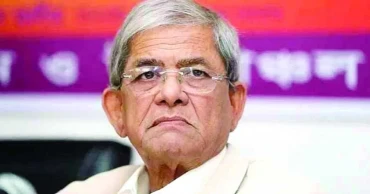
Chief Adviser calls Council of Advisers to discuss Khaleda Zia’s burial: Fakhrul
Chief Adviser Prof Muhammad Yunus has called BNP leaders to inform them that the Council of Advisers will discuss issues, including state honour and burial arrangements for former Prime Minister and BNP Chairperson Begum Khaleda Zia, BNP Secretary General Mirza Fakhrul Islam Alamgir said on Tuesday.
Speaking at a media briefing at Evercare Hospital, Fakhrul said the Chief Adviser would place the matter before a meeting of the Council of Advisers scheduled for 10:00am.
He said the decisions taken would later be coordinated with the government’s programmes.
Fakhrul also said a meeting of the BNP Standing Committee would be held.
Jamaat Ameer mourns Khaleda Zia’s death
“The mother of democracy and our national guardian left us at 6:00am. This loss is irreparable. The nation will not be able to make up for it,” he said.
He said Khaleda Zia devoted her entire life to the welfare of the people and that her death has created a political vacuum in the country.
Former Prime Minister Begum Khaleda Zia, 80, breathed her last at 6:00am on Tuesday (Dec 30) while undergoing treatment at Evercare Hospital in the capital.
9 months ago
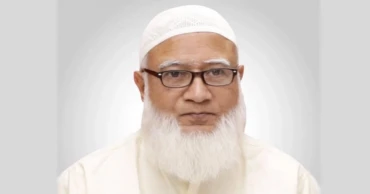
Jamaat Ameer mourns Khaleda Zia’s death
Bangladesh Jamaat-e-Islami Ameer Dr Shafiqur Rahman has expressed profound sorrow over the death of former Prime Minister Khaleda Zia.
In a post shared on the social media platform Facebook on Tuesday morning (December 30, 2025), the Jamaat Ameer prayed for Khaleda Zia.
Khaleda Zia, former PM and Bangladesh's tallest leader, passes away
In his message, the Jamaat Ameer said “May the Almighty Allah, gave mercy on BNP Chairperson Begum Khaleda Zia, forgive her and accept her as a guest in His beloved Paradise. May Almighty Allah grant patience and steadfastness to her family, loved ones, Amen.”
The BNP Chairperson breathed her last at 6am on Tuesday while undergoing treatment at Evercare Hospital, according to AKM Wahiduzzaman, the party’s ICT Affairs Secretary and head of its Online Activists Network.
Read more: Khaleda Zia’s condition turns extremely critical, say physicians
9 months ago
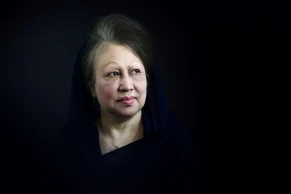
Former Prime Minister Khaleda Zia passes away
The long, turbulent and towering journey of Khaleda Zia — three-time former Prime Minister and Chairperson of the Bangladesh Nationalist Party (BNP) — came to a solemn end on Tuesday morning at the age of 80.
The chairperson of the Bangladesh Nationalist Party (BNP) breathed her last at 6am on Tuesday, according to AKM Wahiduzzaman, the party’s ICT Affairs Secretary and head of its Online Activists Network.
Khaleda Zia had been receiving treatment at the Coronary Care Unit (CCU) of Evercare Hospital in Dhaka’s Bashundhara residential area since November 23.
The 80-year-old former prime minister has long been suffering from multiple health complications, including arthritis, diabetes, and ailments affecting her kidneys, liver, lungs, heart and eyes. She has been under medical care for these conditions for several years.
Widow of slain President and BNP founder Ziaur Rahman, Khaleda Zia had long been woven into the fabric of Bangladesh’s political drama — its rises, ruptures, hopes, and hostilities.
Her final months were marked by an unrelenting battle against pneumonia, chronic lung infections and persistent cardiac complications. Even as her frail condition worsened, those close to her recall a woman who held on with the same resolve that once defined her political life.
Khaleda Zia’s condition turns extremely critical, say physicians
For supporters, her passing marks the end of an era — a painful goodbye to a matriarch who shaped oppositional politics for decades. For others, it seals the chapter on a figure whose legacy will forever spark debate. But for Bangladesh, the departure of Khaleda Zia leaves behind a silence — one heavy with history, conf
“It is with a heavy heart that we announce the passing of our esteemed Chairperson,” Fakhrul said, his voice choked with emotion.
Khaleda Zia was admitted to Evercare Hospital on the night of November 23 on the advice of a medical board after being diagnosed with infections in her heart and lungs.
She had been nominated for three constituencies — Dinajpur-3, Feni-1 and Bogura-7 — for the upcoming 13th parliamentary election.
Khaleda Zia’s death marks the end of an era in Bangladesh politics. She was known for her firm commitment to democracy and her significant contributions to national politics and governance.
She is survived by her eldest son Tarique Rahman, three granddaughters, and millions of supporters and admirers. Her long political career has left a lasting mark on Bangladesh’s political landscape and inspired generations.
Khaleda had long been suffering from liver cirrhosis, arthritis, diabetes, kidney, lung, heart and eye problems.
Since her conditional release in 2020, she had been receiving regular treatment under a medical board led by cardiologist Prof Shahabuddin Talukder.
Jamaat Ameer mourns Khaleda Zia’s death
In June 2022, she suffered a heart attack caused by a 95 percent blockage in her left artery. A stent was placed to remove the blockage. Doctors detected two more blocks, but they could not be removed due to her fragile health.
On June 23, 2024, specialist doctors led by Prof Shahabuddin Talukder implanted a pacemaker in her chest.
During the Awami League government, her doctors repeatedly recommended sending her abroad after she was diagnosed with liver cirrhosis in November 2021. Despite the severity of her condition, she was not granted permission to travel, as the government cited legal complications relating to her convictions.
On October 26, 2023, as her condition worsened, a group of US specialist doctors performed a TIPS procedure to stop water accumulation in her abdomen and chest and to prevent bleeding caused by liver complications.
On August 6, 2024, a day after the fall of the Awami League government, Khaleda Zia was fully freed through an order from President Mohammed Shahabuddin, clearing the way for her overseas treatment.
After a tearful reunion with her eldest son and BNP Acting Chairman Tarique Rahman at London’s Heathrow Airport — their first meeting in more than seven years — she was taken directly to the London Clinic.
She received treatment there for 17 days under a medical board led by liver specialist Professor John Patrick Kennedy.
After being discharged on January 25, she moved to Tarique Rahman’s residence, where she continued treatment under the supervision of Professors Kennedy and Jennifer Cross.
She celebrated Eid in London with her family for the first time in more than six years.
On May 6, she returned home on a Qatari royal air ambulance, accompanied by her two daughters-in-law, including Dr Zubaida Rahman. The return followed nearly four months of advanced treatment in London and drew a large and emotional public reception.
Since her return, Khaleda had been under the care of a medical board and her personal physicians at her Gulshan residence. She was also hospitalised at Evercare on several occasions.
Born on August 15, 1945, in Dinajpur, Khaleda Zia led a simple early life before her marriage to General Ziaur Rahman, who would later become President of Bangladesh. She played a supportive role during the 1971 Liberation War.
After Ziaur Rahman’s assassination in 1981, she entered politics. She became BNP Chairperson in 1984 and held the position for nearly four decades.
She became a central figure in the movement against military ruler HM Ershad, earning wide respect for her steadfast and uncompromising commitment to democracy.
Khaleda Zia became Bangladesh’s first female Prime Minister in 1991. On 20 March 1991,
She was sworn in as Bangladesh’s first female Prime Minister, marking a historic milestone in the country’s political history.
She played a key role in reintroducing the parliamentary system of government, replacing the presidential system. The 12th constitutional amendment, which she piloted, was passed by the Jatiya Sangsad on 6 August 1991, and Khaleda Zia took oath under the new parliamentary system on 19 September 1991.
During her first term (1991–1996), her government made significant progress in education, including introducing free and compulsory primary education, tuition-free schooling for girls up to class ten, stipends for female students, and the Food for Education program.
Her administration also promoted nationwide tree plantation campaigns and initiated the construction of the Jamuna Multipurpose Bridge. On the regional front, Khaleda Zia revitalised the South Asian Association for Regional Cooperation (SAARC) by hosting a summit in Dhaka in 1993.
However, her first term was also marked by political challenges. Opposition parties, including the Awami League, Jatiya Party, and Jamaat-e-Islami, launched movements demanding a neutral caretaker government to oversee parliamentary elections, creating significant political unrest.
Khaleda Zia was re-elected for a second consecutive term after BNP’s victory in the 6th Jatiya Sangsad elections on 15 February 1996, although all major opposition parties boycotted the polls. To address demands for a caretaker system, the 6th Jatiya Sangsad passed the 13th constitutional amendment. Khaleda subsequently handed over power to a caretaker government on 30 March 1996. In the elections held under Justice Muhammad Habibur Rahman’s caretaker administration on 12 June 1996, the BNP was defeated by the Awami League.
Between 1996 and 2001, she served as Leader of the Opposition.
In the October 1, 2001 election, held under a neutral caretaker government, Khaleda Zia’s BNP-led alliance won a landslide victory, and she took office as Prime Minister for the third time on October 10.
During her third term, her government oversaw a significant rise in export earnings and remittances from Bangladeshi workers abroad.
The industrial and telecommunications sectors grew steadily, and foreign direct investment gradually increased.
Her administration also took major steps to improve law and order, including launching Operation Clean Heart and creating the Rapid Action Battalion.
There was a strong crackdown on Islamic extremist groups, including the JMB and HUJI. Her administration faced ongoing criticism over allegations of corruption and political unrest.
Khaleda Zia held the unique record of winning from five constituencies in different elections and never personally losing any seat.
Khaleda Zia left office on 28 October 2006. In the subsequent Ninth Jatiya Sangsad election on 29 December 2008, held under the two-year caretaker government of Dr Fakhruddin Ahmed, her party won only 30 seats.
During the caretaker government period in 2007–2008, several corruption cases were filed against her.
On September 3, 2007, she was arrested on corruption charges and spent nearly a year in detention before her release on September 11, 2008. After a heavy defeat in the December 2008 election, she again became Leader of the Opposition.
She continued her push for electoral reforms after the abolition of the caretaker system in 2011. Her political activities faced restrictions, including confinement to her house and office before the 2014 election, which BNP boycotted.
In 2014, her Gulshan office was blocked by sand trucks for weeks, limiting her ability to protest. She remained in her office for 92 days. During this time, she could not even attend the funeral of her younger son, Arafat Rahman Koko, due to arrest warrants issued in graft cases.
Her family members gradually moved abroad after 2008, leaving her largely isolated as she battled both legal and health challenges.
On February 8, 2018, she was jailed after being sentenced in the Zia Orphanage Trust case. The High Court later extended her sentence to 10 years, and she was also convicted in the Zia Charitable Trust case.
She was released on March 25, 2020, on humanitarian grounds during the COVID-19 pandemic, but was restricted to her home and barred from leaving the country.
On August 6, 2024, Khaleda Zia was fully freed after President Mohammed Shahabuddin, exercising his authority under Article 49 of the Constitution, exempted her from all remaining sentences.
She made her first public appearance in six years at the Armed Forces Day reception at Senakunja on November 21, 2024, and attended the same event again this year, just two days before being admitted to hospital.
Khaleda Zia is remembered as an uncompromising champion of democracy. In 1986, when major political parties joined the election under military ruler Ershad, she boycotted it, refusing to legitimise an autocratic regime.
Even when the army-backed government later tried to negotiate, offered her ways to return to power, and attempted to send her abroad, she firmly refused.
She said Bangladesh was her only home and she would never leave her country or her people.
Her resolve was also clear in 2017. Although she could have stayed in the UK as convictions in what she described as “false cases” loomed, she returned to Dhaka knowing she would likely be jailed.
Six months later, she indeed went to prison. Such decisions defined her character — a leader who never compromised on principles, never surrendered to authoritarian pressure, and never abandoned her people.
Khaleda Zia was an icon of unity, widely respected and accepted not only by the people but also by leaders across most political parties.
Khaleda in critical condition, undergoing challenging treatment phase: Dr Zahid
During times of national crisis, she brought people together and guided the nation through challenging periods.
Her broad acceptance was evident when she was admitted to the hospital: leaders from numerous political parties visited to inquire about her condition, many publicly expressed concern, and offered prayers for her recovery.
Social media was also flooded with messages and well-wishes, reflecting the deep respect and affection she commanded across the country.
Her journey of life — from a private homemaker to a defining figure in national politics — reflects her unwavering dedication to public service, even though personal tragedy, political turbulence and prolonged imprisonment. Her legacy will continue to shape Bangladesh’s democratic history.
9 months ago
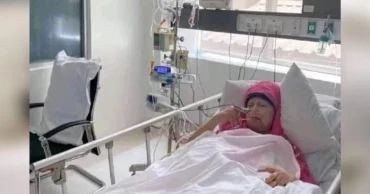
Khaleda Zia’s condition turns extremely critical, say physicians
The health condition of BNP Chairperson and former Prime Minister Begum Khaleda Zia, who is being treated in the Critical Care Unit (CCU) of Evercare Hospital, has worsened and become extremely critical, members of her medical board said on Monday night (December 29, 2025).
“Khaleda Zia’s condition is extremely critical. She is being kept on life support and is now receiving regular dialysis,” said her medical board member Dr Ziaul Haque.
He said whenever the dialysis is stopped, her physical condition worsens significantly. “Due to her advanced age and multiple health complications, it is not possible to provide all treatments at the same time.”
Another board member Dr Zafar Iqbal said Khaleda Zia’s condition could be described as “critically ill”.
Read more: Nomination papers submitted on behalf of Khaleda in Feni-1
“We seek prayers from everyone. Some further tests have been advised, and decisions will be taken after the results are available. She remains under treatment in the CCU,” he said.
Another physician of the medical board, wishing anonymity, said the doctors are making their best efforts, adding that the rest now depends on the will of Allah.
“She is elderly, and many long-standing illnesses have resurfaced at this age. Some of these conditions could not be treated properly at the right time earlier. Recovery from multiple complications has become very difficult due to her age,” he said.
The physician said the BNP chief’s condition fluctuates between slight improvement and deterioration. “She is under constant observation, and new tests are being conducted every day.”
After his return from London last Thursday, BNP Acting Chairman Tarique Rahman visited Evercare Hospital to see his mother.
Read more: Khaleda Zia integral to an important chapter in Bangladesh history: Prof Yunus
He regularly visits her after completing his daily programmes and stayed beside her hospital bed for several hours before leaving late at night. Tarique went straight to Evercare Hospital after spending more than three hours at the BNP central office in Nayapaltan.
In a brief address to party leaders and workers gathered outside the party office, he urged everyone to pray for his mother’s recovery.
Khaleda Zia has been receiving treatment in the CCU of Evercare Hospital for more than a month. Her treatment is being conducted under the supervision of cardiologist Professor Shahabuddin Talukder.
Following a medical board meeting on Saturday night, Khaleda Zia’s personal physician Professor AZM Zahid Hossain said her condition remains complex and critical.
“Her condition is extremely complex, and she is now going through a critical moment. If, by the grace of Almighty Allah and the tireless efforts of doctors, she can overcome this crisis, then we may see some positive outcome,” he said.
The 80-year-old former prime minister has long been suffering from multiple health complications, including arthritis, diabetes, kidney, liver, lung, heart and eye problems. She had been receiving treatment for these conditions for years.
While staying at her residence, she recently developed breathing difficulties, cough, fever and phy
sical weakness. As her condition gradually worsened, she was admitted to Evercare Hospital on November 23.Following medical examinations, rapid deterioration of her lungs, heart and kidneys was detected, prompting doctors to move her to the CCU on November 27.
Read more: Khaleda in critical condition, undergoing challenging treatment phase: Dr Zahid
A medical board comprising 30 local and foreign specialist doctors has been formed to oversee her treatment. The board holds daily meetings and makes adjustments to her treatment plan as needed.
9 months ago
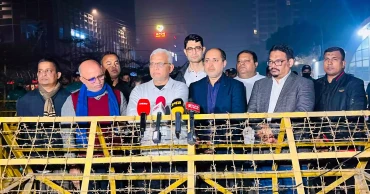
Khaleda in critical condition, undergoing challenging treatment phase: Dr Zahid
BNP Chairperson and former Prime Minister Begum Khaleda Zia remains in a critical condition and is passing through a very challenging phase of her treatment, her personal physician Dr AZM Zahid Hossain said on Saturday night (December 27, 2025).
“Her condition is extremely complex, and she is now going through a critical moment. If, by the grace of Almighty Allah and the tireless efforts of doctors, she can overcome this crisis, then we may see some positive outcome,” he said.
Zahid made the remarks while briefing reporters outside Evercare Hospital in the capital following BNP Acting Chairman Tarique Rahman’s second time visit to the hospital.
He said the BNP chief has been undergoing treatment at the hospital since November 23, and her physical condition deteriorated significantly after admission.
Read more: BNP demands release of teacher held over offensive remarks about Tarique
Zahid, also a BNP Standing Committee member, said Khaleda Zia was initially admitted to a cabin, but due to a sharp decline in her health, she was later shifted to the CCU and then to the ICU, where she is currently receiving treatment under close and round-the-clock medical supervision.
Dr Zahid said a medical board, comprising specialist doctors from Bangladesh as well as from the UK and the USA, is overseeing her treatment. “The board sits regularly—usually around 10:00pm—to review her condition and determine the next course of treatment.”
He said treatment is being carried out under the leadership of Dr Shahabuddin Talukder, following the collective decisions and advice of the medical board members.
Earlier in the day, BNP Acting Chairman Tarique Rahman, accompanied by his wife Dr Zubaida Rahman, visited Evercare Hospital for the second time and spent a long time beside his mother’s bed, Dr Zahid said.
He said Dr Zubaida Rahman, herself a physician, also participated in the medical board discussions alongside local and foreign doctors.
Dr Zahid said Tarique Rahman expressed gratitude to the doctors, nurses and paramedics for their continuous efforts in treating his mother and sought prayers from the country’s people for Khaleda Zia’s recovery.
Read more: Tarique visits Evercare again to see ailing mother
He also conveyed Tarique Rahman’s request to party leaders and activists to refrain from gathering unnecessarily at the hospital so that medical services for Khaleda Zia and other patients are not disrupted.
Dr Zahid urged the nation to continue praying for Khaleda Zia, saying her recovery now largely depends on overcoming the present critical phase.
9 months ago
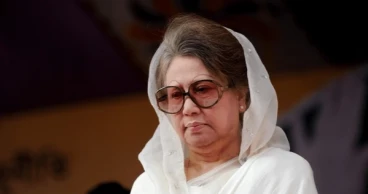
Khaleda Zia’s health yet to improve, London trip ‘on hold’
BNP Chairperson Begum Khaleda Zia, who is undergoing treatment at Evercare Hospital in Dhaka, will not be flown to London for the time being as her health has not improved sufficiently for travel.
A member of her medical board, wishing anonymity, told UNB on Monday (December 08, 2025) that Khaleda Zia’s recovery is still not at the level needed for an air trip.
“Whenever one complication improves, another appears. While one health parameter is under control, another rises,” the doctor said.
He said while her long-standing liver complication is being managed, the medical board remains concerned about her kidney problem. “So, our medical team has decided not to send her abroad until her condition improves further.”
Read more: Khaleda’s London medical trip 'depends on her health condition'
Khaleda Zia, 80, has been treated at Evercare Hospital since November 23 and was moved to the Critical Care Unit (CCU) on November 27 due to multiple health complications.
Her treatment is supervised by a board led by cardiologist Professor Shahabuddin Talukder, including specialists from Evercare Hospital and from the UK, USA, and China.
The former prime minister has long been suffering from multiple chronic illnesses, including arthritis, diabetes, kidney, liver, lung, heart, and eye problems.
Currently, a medical board of around two dozen local and foreign specialists meets daily at Evercare to adjust her treatment.
Another board member said her health is not worsening, but she is still at risk. “Advanced care is being given in the CCU. Each night, the board reviews her condition. Specialists discuss individual issues, adjust medications, change doses, or stop and restart medicines as needed.”
He said Khaleda’s daughter-in-law Dr Zubaida Rahman, BNP Acting Chairman Tarique Rahman’s wife, attends the board meetings in person while meals are sent daily from her Gulshan home as advised by the doctors.
Read more: Air ambulance delay likely to push Khaleda Zia’s London travel to Sunday
Air Ambulance Not Arriving Tuesday
The air ambulance arranged by the Emir of Qatar to fly Khaleda Zia to London will not arrive on Tuesday either as the operator has asked to cancel its previously approved landing at Dhaka’s Hazrat Shahjalal International Airport.
A senior official at the Civil Aviation Authority of Bangladesh (CAAB) said Germany-based FAI Aviation Group submitted a formal request through a local agency to withdraw its earlier landing slot.
Earlier, CAAB had approved the ambulance to land in Dhaka on Tuesday morning.
The BNP had planned to fly Khaleda Zia to London on Friday for advanced treatment in a special air ambulance from Qatar.
However, the flight was first delayed due to a “technical issue,” and later the Qatari embassy said the Emir’s special ambulance would not come and promised a replacement aircraft from Germany.
BNP has not yet confirmed when the new air ambulance will arrive or when Khaleda Zia will be flown to London.
Read more: Khaleda’s London trip to be delayed until she’s fit: Dr Zahid
10 months ago
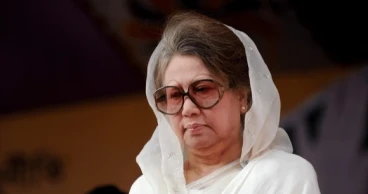
Medical team hopeful about Khaleda’s recovery in Bangladesh
The medical board treating BNP Chairperson Begum Khaleda Zia is hopeful that she may recover in Bangladesh with proper treatment, even without being taken abroad.
A doctor from the board, wishing anonymity, said on Sunday night (December 07, 2025) that her condition has slightly improved.
“Madam is better than before. We are trying our best to treat her here. We believe she can recover with treatment in the country. She has been in more critical condition before and still recovered. It may not be necessary to take her to London,” he said.
The physician also said several of Khaleda’s health parameters are improving. “CT scans, ECG and a few other tests were done on Sunday, and the results came back better.”
Asked how long she will remain in the CCU, he said it depends on her physical improvement. “Local and foreign doctors are ensuring the best treatment. “Her daughter-in-law Dr Zubaida Rahman is coordinating treatment at her bedside. She will stay in Bangladesh for several more days.”
Read more: No compromise with terrorism, extortion, drugs: Mirza Abbas
The doctor also said Khaleda tries to speak at times with her family members. “Her younger brother, his wife and her two daughters-in-law have been constantly by her side.”
Meanwhile, BNP Chairperson’s Adviser Dr Enamul Haque Chowdhury said on Sunday night that Khaleda will be taken to London as soon as the medical board makes the final decision.
“The Qatar government will arrange an air ambulance whenever needed. This is not a problem. We are waiting for the board’s decision. With everyone’s prayers, we hope she will overcome this. If the board decides, she will be taken to London for advanced treatment. The hospital in London will be chosen later,” he said.
Last Thursday, the medical board advised that she should be taken to the UK for advanced treatment.
Read more: BNP to review NEIR policy if voted to power: Amir Khosru
It was announced that, like in January, she would be flown to London on a special air ambulance provided by the Emir of Qatar. The air ambulance was expected to take her on Friday morning.
However, BNP Secretary General Mirza Fakhrul Islam Alamgir said on Friday that the air ambulance could not arrive due to technical issues.
As per his announcement, the air ambulance was expected to reach Dhaka on Saturday, but it did not arrive on Sunday either. When it will come remains uncertain.
As usual, Dr Zubaida Rahman, wife of BNP Acting Chairman Tarique Rahman, visited Evercare Hospital on Sunday afternoon to see Khaleda Zia.
Dr Zubaida is also a member of Khaleda Zia’s medical board.
She arrived in Dhaka on a Biman Bangladesh Airlines flight on Friday morning. She has since been closely monitoring Khaleda’s condition.
Even when staying at her Dhanmondi residence, she receives updates on her mother-in-law over the phone, said Atiqur Rahman Rumon of the BNP Media Cell.
The BNP chief has been receiving treatment at Evercare Hospital since November 23 and was moved to the Critical Care Unit on November 27 with multiple health complications.
Her treatment is being supervised by a medical board led by cardiologist Professor Shahabuddin Talukder, which includes doctors from Evercare Hospital as well as specialists from the UK, USA and China.
Read more: 10 injured in Gazipur-1 over BNP nomination dispute
10 months ago