UN Women
AI is reinforcing gender bias, online abuse and workplace inequality, UN Women warns
As artificial intelligence becomes increasingly embedded in daily life, from drafting emails and preparing presentations to designing marketing campaigns, UN Women has raised concerns that the technology is reinforcing long-standing gender stereotypes, intensifying online abuse and sidelining women from critical decisions about the future of AI.
The agency issued the warning ahead of the United Nations Global Dialogue on Artificial Intelligence Governance and the AI for Good Global Summit, scheduled to take place in Geneva in early July.
It called on governments, technology firms and developers to integrate gender equality into every stage of AI development, deployment and governance.
Recent studies suggest that while generative AI is transforming how billions of people work and access information, it is also perpetuating existing inequalities through biased algorithms and discriminatory outputs.
In the United Kingdom, for example, 88 per cent of advertising and media agencies have already adopted AI technologies in some capacity.
According to UN Women, evidence shows that gender and racial bias remain widespread across AI systems. An analysis of 133 AI models found that 44 per cent exhibited gender bias, while more than one-quarter demonstrated both gender and racial bias.
Researchers have repeatedly found that large language models tend to associate women with domestic responsibilities such as childcare and family life, while linking men to leadership, business and professional achievement. Some AI-generated outputs have also portrayed women as sexual objects or as subordinate to men.
UN Women noted that when researchers asked AI systems to complete sentences that began with a person's gender, roughly one in five responses contained sexist or misogynistic content. Some responses even depicted women as property or objects.
Experts say these outcomes are not isolated mistakes but a recurring pattern across AI platforms. According to UN Women, the biases reflect decades of unequal representation embedded in the data used to train these systems.
Speaking to UN News, Jayathma Wickramanayake, UN Women Lead on Digital Technologies, explained that AI models “pull bias from decades of text written by people, about people, in a world where women were filed under home and family, and men were filed under business and career”.
She warned that the issue extends beyond technical shortcomings. For Ms. Wickramanayake, the most worrisome part is that this is not a design flaw – “it’s a real policy gap that was left wide open”.
The agency pointed out that among 138 countries assessed worldwide, only 24 explicitly mentioned gender in their national AI strategies, while just 18 included substantial gender-responsive measures.
For the UN Women digital expert, this isn’t a bug waiting to be fixed in the next update, “it’s a choice that we make over and over in training data, in design rooms, in policy documents that stay silent on half of the population”.
Beyond stereotypes, UN Women warned that AI is also contributing to growing online safety risks for women and girls. Existing forms of digital abuse are becoming easier to create, distribute and scale through AI-powered tools.
Data collected by the agency show that nearly one in four surveyed women human rights defenders, activists and journalists reported experiencing AI-assisted online violence. Twelve per cent said their personal images had been shared without consent, while six per cent reported being targeted through deepfake content or manipulated images and videos.
As AI-generated content becomes more common, concerns are increasing that harassment, misinformation and image-based abuse will become more difficult to identify and prevent.
UN Women also expressed concern over the limited representation of women in the industries responsible for building AI technologies. According to the International Labour Organization (ILO), women make up only 30 per cent of the global AI workforce despite the sector’s rapid growth.
The agency warned that the people designing AI systems do not adequately reflect the diversity of the populations these technologies are intended to serve. Without stronger participation from women and other underrepresented groups, existing biases could become permanently embedded in future technologies.
The economic consequences of AI are also expected to affect women disproportionately. UN Women noted that women are nearly twice as likely as men to work in occupations facing a high risk of automation outside the AI sector. Factors such as race, disability, income level and geographic location could further deepen these inequalities.
As labour markets continue to evolve under the influence of artificial intelligence, communities already facing exclusion may be pushed further behind unless governments adopt targeted interventions, the agency said.
At the same time, UN Women stressed that addressing bias is not only a matter of fairness and human rights but also a sound business strategy.
Research conducted by the Unstereotype Alliance, a UN Women-led initiative, found that advertising free from gender stereotypes consistently delivers stronger commercial performance. Brands using inclusive advertising experienced higher sales growth, stronger customer loyalty and greater pricing power than their competitors.
The agency said businesses that incorporate inclusion into AI-driven marketing and content creation are likely to benefit from stronger reputations and improved financial performance, while those that fail to do so may face commercial and reputational risks.
To help address these challenges, the Unstereotype Alliance launched a playbook in June 2026 designed to help marketers identify and eliminate bias whenever they use generative AI tools.
Despite the risks, UN Women emphasised that artificial intelligence also has significant potential to advance inclusion when developed responsibly. The technology can be used to identify and reduce stereotypes, increase representation and improve accessibility for people who are often overlooked by existing systems.
The agency stressed that achieving these benefits will depend largely on who participates in designing AI systems and whether the experiences of women and girls are reflected throughout the technology's lifecycle.
As policymakers, technology companies and international organisations prepare to gather in Geneva next month, UN Women delivered a clear message: excluding women and girls from the development of AI risks carrying historic inequalities into the technologies of the future.
The agency concluded that when designed safely and deployed intentionally, AI can help counter the very harms now being documented by detecting stereotypes rather than reproducing them, expanding representation rather than narrowing it, and improving accessibility on a large scale.
3 months ago
Women need targeted support to tackle COVID-19 impact: CPD Dialogue
Speakers at a virtual dialogue on Thursday said fiscal measures would be more effective in easing the burden of the coronavirus pandemic on women than monetary measures.
The government has aptly rolled out a number of liquidity support and fiscal stimulus packages in response to the pandemic, they said.
However, the speakers said, these packages were not designed keeping women in mind, and hence have not been entirely successful in addressing women’s special needs during the pandemic.
They said most women are unaware of the liquidity support while some, who are aware of it, are reluctant to apply for loans.
Due to the economic downturn and the uncertainty regarding the future, women need cash handouts more than loans, they noted.
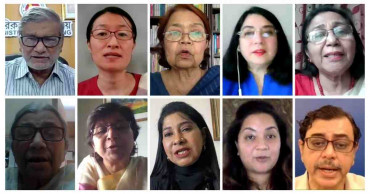
These observations emerged at the virtual dialogue titled “Socio-Economic Recovery Measures of the Government: How Much Women Have Benefitted” held on Thursday. Centre for Policy Dialogue (CPD), in partnership with UN Women, hosted the dialogue.
CPD has recently undertaken a study on the theme in collaboration with UN Women. The findings of the study were shared at the dialogue.
This study explores the gender dimension of the government’s COVID-19 policy measures and recommends policies for making the COVID-19 response work for women.
CPD’s Executive Director Dr Fahmida Khatun made the keynote presentation during the virtual dialogue. She presented some of the highlights from a rapid survey on women entrepreneurs’ access to the stimulus package.
In this respect, she focused on a range of issues, such as providing training for women entrepreneurs and improving women’s access to finance.
She also pointed out that child marriage, burden of unpaid care and domestic work, and violence against women have increased during the pandemic.
Commenting on the promotion of the incentive package, chief guest of the event, Planning Minister MA Mannan said everyone should work together to bring this information to the right people.
He mentioned the government recognises the challenges of women during the pandemic and is working towards improving their situation.
Shoko Ishikawa, Country Representative, UN Women Bangladesh Country Office joined the dialogue as a Special Guest and focused on the global picture of women due to pandemic. She mentioned that globally, 47 million women and girls are forced into poverty because of COVID-19. She also added that all packages need to ensure adequate and transparent delivery for women.
Professor Rounaq Jahan, Distinguished Fellow, CPD chaired the dialogue.
She opined that though COVID-19 added disadvantages for women, a plan of action for specific groups to support in specific areas for women entrepreneurs need to be prepared.
A task force might be formed to monitor the progress of this work.
MSMEs are in the informal financial system and their issues cannot be solved unless they are taken to the formal banking/financial channel, said Dr Lila Rashid, former Executive Director, Bangladesh Bank.
Selim RF Hussain, Managing Director and CEO, BRAC Bank stated that banks should also focus on investing in non-financial advisory services for women entrepreneurs.
Shaheen Anam, Executive Director, Manusher Jonno Foundation; Kaniz Almas, CEO & Managing Director, Persona; Dr Fauzia Moslem, President, Bangladesh Mahila Parishad and Vidiya Amrit Khan, Director, Desh Group of Companies joined the virtual dialogue and delivered their remarks as distinguished discussants.
The dialogue was participated by relevant government officials, business leaders, development activists, experts and academia, representatives from the development partners and media professionals.
5 years ago
.jpg)
Only 1 in 20 women directors of listed companies 'independent'
Just 1 in 20 of the women , who currently make up 18 percent of directors on the boards of listed companies in Bangladesh, are independent directors .
5 years ago

UAE leads countries advocating women's rights at global level
The United Arab Emirates is at the forefront of the countries advocating women's rights at the global level through a series of initiatives and programmes aimed at supporting and empowering women in many societies and countries.
5 years ago

Women often assaulted online in Asia but find limited recourse: UN Women study
Civil society activists say that women commonly face online violence in Asian countries but for many victims, fear and distrust make reporting these attacks to authorities “often the last resort,” a new UN Women study has found.
5 years ago
.jpg)
Women in Life: Commonwealth begins 16 days of actions Wednesday
The Commonwealth and the NO MORE Foundation are launching a ‘16 Days of Actions’ blog series on Wednesday to help end violence against women and girls.
5 years ago

Covid-19 pandemic hitting women hard, says UN survey
Most nations are failing to provide enough social and economic protection for women since the Covid-19 pandemic, two UN agencies said on Monday, reports Xinhua.
6 years ago

Equal pay essential to build a world of dignity, justice for all: UN
The United Nations is marking the first-ever International Equal Pay Day on Friday drawing attention to the gender pay gap and the systemic inequalities it is rooted in.
6 years ago

Returnee women workers to receive Covid prevention packages
UN Women Bangladesh in collaboration with Unilever Bangladesh and Ministry of Expatriates’ Welfare and Overseas Employment (MoEW&OE) launched a project on Saturday to support women returnee migrants with ‘dignity’ packages and health-hygiene kits in 10 districts across the country.
6 years ago
.jpg)
UN Women, WDO to jointly work to prevent VAWG
The UN Women in Asia and the Pacific and the World Design Organization (WDO) have decided to support the prevention of violence against women and girls (VAWG).
6 years ago