constitutional amendment
Inclusive opinions to be taken for an acceptable constitutional amendment: Salahuddin
Chairman of the parliamentary special committee on constitutional amendment and Home Minister Salahuddin Ahmed on Tuesday said the body will recommend an "acceptable" constitutional amendment, taking opinions from political parties and people from all walks of life.
“We want to prepare an acceptable amendment proposal with the opinions of people from all classes and professions, including political parties,” he told reporters, coming out from the committee's first meeting in the midway.
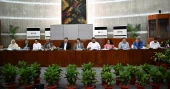
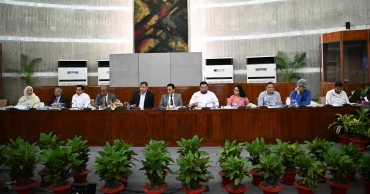
The first meeting of the committee began around 12:30 pm and concluded at about 1:30 pm at the Cabinet Room of the Jatiya Sangsad Bhaban.
Salahuddin said the committee would adopt an open and inclusive approach in formulating its recommendations.
"As we are liberal and open, we will listen to everyone. We will incorporate all necessary proposals for amendments and prepare our report accordingly," he said.
He said the committee's recommendations would later be translated into a constitutional amendment bill, which would be placed before Parliament.
"The bill will be discussed in Parliament, and we want to adopt the amendment through understanding so that it reflects public expectations," he said.
The chief of the parliamentary special body said the committee would also seek to incorporate the state structure related promised democratic reforms into the proposed amendments.
He said the committee sat in its first meeting to discuss the preparation of a list of persons and organisations to be consulted, as well as fixing a schedule for the consultations.
It plans to seek opinions from constitutional experts, lawyers, political parties, professional bodies and other stakeholders.
Salahuddin said any person or organisation interested in offering suggestions would also be given the opportunity to do so.
He, however, could not specify when the committee would submit its report, saying the timeframe has yet to be determined.
On the opposition's absence from the committee, Salahuddin said the government requested the opposition to nominate five representatives, but the names have not yet been received.
"We still hope they will reconsider and submit the names. We will also hold discussions with them," he said.
He added that even if the opposition does not nominate members, the committee will seek opinions from all opposition lawmakers.
Suggestions may be submitted during committee meetings or in writing outside the meetings, he said.
"We want to bring forward an acceptable amendment that reflects public aspirations. We want to adopt a report through discussions with everyone," Salahuddin added.
The committee will review 48 constitutional reform proposals included in the July National Charter.
Proposals on which political parties reached consensus will be incorporated into the amendment recommendations, while issues where the BNP registered dissent will be considered as notes of dissent, he said.
Salahuddin said the committee would also examine constitutional reform commitments included in the BNP's election manifesto, but not reflected in the July National Charter.
Referring to the 2024 July mass uprising, the Home Minister said public expectations have risen significantly following the uprising.
He stressed the need to rebuild Bangladesh in line with the aspirations of those who sacrificed their lives in the July uprising.
July charter to be followed word by word: Law minister
Law Minister Md Asaduzzaman said the constitutional amendment process would move forward by upholding both the July National Charter and the spirit of the July uprising.
"We cannot move merely on emotions by bypassing the July National Charter or imposing any political ideology or agenda. We will bring a constitutional amendment proposal before Parliament by following the July Charter word-by-word,” he said.
The committee will place a proposal to implement for building a new Bangladesh as dreamt by the July martyrs.
Responding to a question on whether the amendment process would remain credible if the opposition did not join the committee, the law minister said the government would make every effort to obtain the opposition's recommendations.
He said the recommendations of the opposition are already reflected in the July National Charter, which was signed by 33 political parties.
He said the committee has taken several policy-level decisions at its first meeting on how to proceed with the constitutional amendment process.
As part of its consultation, the committee will hold discussions with families of those killed in the July uprising, July warriors, leaders of the Anti-Discrimination Student Movement, representatives of different professions, journalists, members of the Supreme Court Bar Association, retired judges and other stakeholders.
Chief Whip Nurul Islam Moni, also a member of the committee, expressed hope that the opposition would finally join the constitutional amendment committee. “The door remains open for them at all times," he said.
Moni said there is no difference between constitutional amendment and reform, as any change made to the Constitution amounts to reform.
Committee members who attended the meeting also include Chairman of parliamentary standing committee on home ministry Zainul Abedin, Chairman of parliamentary standing committee on the law ministry Andaleeve Rahman, State Minister for Planning Zonayed Abdur Rahim Saki, State Minister for Expatriates' Welfare and Overseas Employment Nurul Haque, State Minister for Land Mir Mohammed Helal Uddin, State Minister for Social Welfare Farzana Sharmin, Shakila Farzana and Mahmudul Hoque Rubel.
Besides, another committee member Islami Andolan Bangladesh lawmaker Md. Oli Ullah didn’t attend the meeting.
2 months ago
Constitutional amendment sees progress, stalemate over Upper House continues: Salahuddin
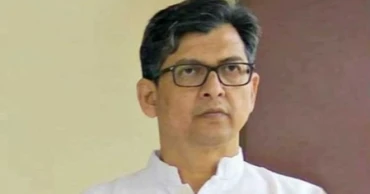
BNP Standing Committee member Salahuddin Ahmed on Tuesday said though progress has been achieved regarding the constitutional amendment issue in the reform dialogue, there is still disagreement over the formation of the Upper House of a prospective bicameral parliament.
“Most political parties are in principle supporting the formation of a bicameral parliament. But, disagreements remain regarding the formation process, powers and functions of the upper house,” he said at a press briefing after the 14th day of the second-round of reform talks between the National Consensus Commission and political parties at the Foreign Service Academy in the capital.
In line with BNP’s 31-point reform agenda, Salahuddin said his party proposed formation of a 100-seat upper house with representatives from diverse sectors -- such as academics, political scientists, social scientists, and marginalised communities.
The members of the upper house should be nominated or selected through a specific mechanism, possibly following the PR system that is now used for women reserved seats in parliament.
Clarifying BNP’s position over the PR system, he said his party opposes the Proportional Representation (PR) system for forming the upper house. “We are not in favor of the PR system (by votes). It could invite scope for some parties to exercise extra influence, disrupting the balance in the upper house,” he said.
Reached a consensus on decentralisation of subordinate courts: Salahuddin
He emphasised that the upper house should not simply mirror the lower house. “Its role and authority must be distinct to ensure its effectiveness. We don't want the upper house to be just a replica of the lower house. Its functions and objectives must be different," said the BNP leader.
On the issue of constitutional amendments, Salahuddin said BNP has proposed that a referendum be made mandatory for any amendment to key constitutional provisions—such as the Preamble and Articles-8, 48, 56 and 142 as well as the caretaker government-related articles (58(b), 58(c) and 58(d).
“This proposal has been accepted by almost all. Our goal is to prevent arbitrary interference with the caretaker government system in the future. The parliament has the authority to enact laws alongside the court verdict (regarding caretaker government issue). This system can be reintroduced into the constitution based on public demand,” he said.
About the woman seats, Salahuddin said the reserved seat issue could not be discussed on Tuesday due to time constraints, but he hoped that it would be taken up in the next discussion.
1 year ago

Putin backs amendment allowing him to remain in power
Russian President Vladimir Putin on Tuesday backed a proposed constitutional amendment that would allow him to seek re-election after his current term ends in 2024, ending uncertainty about his future.
6 years ago