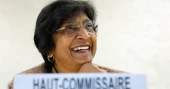
UN human rights chief
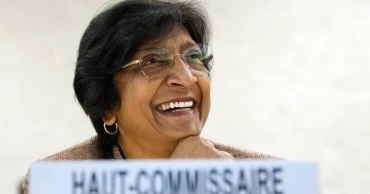
Former UN human rights chief Navi Pillay wins Nobel Peace Prize
Navanethem “Navi” Pillay, a former United Nations human rights chief and judge at the International Court of Justice, won the Nobel Peace Prize on Friday for her efforts to advance peace and international law.
Announcing the award in Oslo, Norwegian Nobel Committee Chair Jørgen Watne Frydnes said the South African-born Pillay, 85, had made significant contributions to promoting peace and justice worldwide.
Her work “is a source of hope and inspiration to all those who seek to bring about a more peaceful world,” he said.
Frydnes added that the committee had not yet managed to contact Pillay to inform her of the award, widely regarded as one of the world's most prestigious honours.
In a statement, the committee said the rising number of wars and conflicts, alongside political attacks on judges and international legal institutions, made it important to reaffirm the role of international law in resolving disputes peacefully.
It said a global legal system that brings war criminals to justice and ensures accountability for abuses against victims was essential to achieving lasting peace.
The Norwegian Nobel Committee received 287 nominations for this year's prize, slightly more than a quarter of them organisations. Experts say the committee generally considers efforts to establish lasting peace, promote international fraternity and strengthen institutions that support these objectives.
Last year, Venezuelan opposition leader María Corina Machado received the Nobel Peace Prize for her campaign for a democratic transition in Venezuela. She was praised as a woman who kept democracy alive amid growing darkness.
Machado later presented her Nobel medal to US President Donald Trump after the United States ousted Venezuelan President Nicolás Maduro. However, the gesture was largely symbolic, as the Nobel Committee has clarified that the award itself cannot be transferred to another person.
Nominations may be submitted by a select group of eligible individuals and organisations, including heads of state, national-level politicians, university professors, directors of foreign policy institutes, former Nobel laureates and members of the Norwegian Nobel Committee.
Four other Nobel Prizes were announced earlier this week. The medicine prize went to three scientists whose work helped develop a light-based tool for investigating brain functions. The physics prize recognised a scientist's efforts to explain an unusual group of neutrinos, while the chemistry prize honoured two scientists for uncovering the mechanisms behind mirror-image molecular structures, work that has contributed to the development of numerous medicines.
Canadian poet, essayist and translator Anne Carson won the literature prize on Thursday for works described as “bold and inventive” that combine classical and modern elements while blurring the boundaries between poetry and prose.
The Nobel Memorial Prize in Economic Sciences is scheduled to be announced on Monday.
This year's Nobel Prize carries 12 million Swedish kronor, equivalent to about $1.2 million, whether awarded to an individual, a small group of laureates or an organisation.
125 years of the Nobel Peace Prize
This year marks the 125th anniversary of the Nobel Peace Prize, which has been awarded since 1901. So far, it has gone to 112 individuals and 28 organisations. The International Committee of the Red Cross has received the honour three times, while the UN refugee agency has won it twice.
The prize has been withheld on 19 occasions, mostly during the two world wars. No award was given in 1948, the year Indian independence leader Mahatma Gandhi was assassinated. Gandhi had been nominated 12 times but never received the prize.
In 1939, a Swedish member of parliament nominated Adolf Hitler but later withdrew the nomination, explaining that it had never been intended seriously.
11 days ago
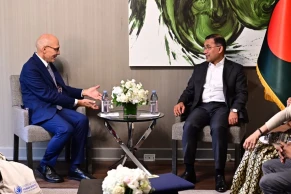
UN human rights chief Volker Türk meets PM Tarique Rahman
UN High Commissioner for Human Rights Volker Türk on Friday met with Prime Minister Tarique Rahman on the sidelines of the 81st United Nations General Assembly, discussing various issues of mutual interest.
The meeting was held at the bilateral meeting room of the Prime Minister’s suite at the Hyatt Grand Central in New York City, where he has been staying during his visit
Mentionably it was Turk's office that produced an influential report into the atrocities committed by Bangladesh's security/law enforcing agencies - at least in the vast majority of cases it was able to look at - during the student-led movement that culminated in the July Uprising of 2024. That Uprising was a recurring theme in Prime Minister Tarique's maiden appearance at the UN's general assembly, in which he paid his sincere respects to “all those who were martyred and injured in the mass uprising of the brave students and people in July-August 2024 against fascism.”
25 days ago

Civil society needs 'space, enabling conditions': Bachelet
Civil society needs "space, and enabling conditions" to play their crucial role in identifying and helping resolve human rights challenges, UN Human Rights Chief Michelle Bachelet said Monday.
She had "important exchanges" with a diverse range of civil society actors in the city, according to her office.
Talking to reporters after the meeting at a city hotel, rights activist and coordinator of Nijera Kori Khushi Kabir said they talked about the human rights situation in Bangladesh highlighting both “positive aspects and weaknesses” and the areas where corrective measures are needed.
“These issues were discussed clearly and openly,” she said.
Bangladesh Environmental Lawyers Association (BELA) Chief Executive Syeda Rizwana Hasan said she highlighted the challenges and role of international rights bodies.
Read: Bachelet assures UN’s continued efforts to ensure safe repatriation of Rohingyas
She said issues of democracy, digital security, accountability, good governance and environment came up for discussion in the meeting. ,
Barrister Sara Hossainm, who received the US Secretary of State’s International Women of Courage Award, said they shared the issues of those who work on human rights and provide legal support.
Bachelet is scheduled to meet Prime Minister Sheikh Hasina Wednesday morning. She will make a statement on her four-day visit in the afternoon before her departure.
She had meetings with four ministers, including Foreign Minister AK Abdul Momen, Sunday.
The top executive of the UN Human Rights body will also interact with the forcibly displaced Rohingya people during her Cox's Bazar trip.
Through this visit, she would be equipped with concrete information to press hard for the repatriation of the Myanmar nationals to the ancestral homeland Rakhine, said the Ministry of Foreign Affairs.
Bachelet arrived in Dhaka Sunday morning as Bangladesh continued "constructive dialogue" with her for the promotion and protection of human rights.
4 years ago
.jpg)
UN rights chief urges countries to confront legacy of slavery, colonialism
Michelle Bachelet, the chief of UN human rights, urged countries to address today’s systemic racism and “centuries of violence and discrimination” through reparations and other processes.
6 years ago