Nobel Laureates
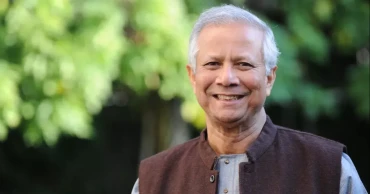
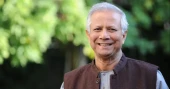
Professor Yunus joins Nobel laureates in signing declaration on AI, nuclear weapons
A joint declaration has been signed signed at the Global Nobel Laureates Assembly on Artificial Intelligence and Nuclear War, warning that artificial intelligence and nuclear weapons together pose an unprecedented danger to humanity's future.
Professor Muhammad Yunus joined fellow Nobel Laureates, including Romano Prodi, Jody Williams, Maria Ressa, Denis Mukwege, and Juan Manuel Santos at the event, said a press release .
The Assembly opened at Borgo Laudato Si', Castel Gandolfo, with a ceremony featuring an opening address from Professor Yunus, alongside welcome remarks from Cardinal Fabio Baggio, C.S., President of Borgo Laudato Si', an opening address from Cardinal Ángel Fernández Artime, S.D.B., Pro-Prefect of the Dicastery for the Institutes of Consecrated Life and Societies of Apostolic Life, and introductory remarks from Cardinal Silvano Maria Tomasi, President Emeritus of the Domus Communis Foundation and President of the Global Nobel Laureates Assembly.
On the second day of the Assembly, Professor Yunus took part in a high-level session on Artificial Intelligence, Democracy and the Economic Revolution: Toward a New World Order, where he delivered an address.
He also held a series of bilateral meetings on the sidelines of the Assembly, including with Cardinal Mauro Gambetti, Archpriest of Saint Peter's Basilica and President of the Fabric of Saint Peter, and Dr Qu Dongyu, Director-General of the Food and Agriculture Organization of the United Nations (FAO).
The three-day Assembly concluded on Thursday, with the signing of the declaration at Rome's Capitoline Hill. Titled "Humanity at the Threshold," the declaration draws a direct parallel between the dawn of the nuclear age and the current AI era, arguing that the world risks repeating the mistakes of the past by entering an AI arms race alongside a worsening nuclear one.
The laureates warn that AI is eroding human judgement in nuclear command systems, fuelling cyber threats to critical infrastructure, and enabling information warfare that undermines the shared trust nations need for peace.
Invoking Pope Leo XIV's call for an "unarmed and disarming peace," the signatories reject the idea that security can be built on fear or mutual destruction. They set out six principles.
1.Disarming the next arms race – urging restraint and cooperative governance to prevent AI and nuclear competition from shaping the coming century.
2.Responsible development – calling for transparency and accountability from AI developers, and an outright ban on unsupervised, fully automated recursive self-improvement in AI systems.
3.Responsible use – demanding an international treaty to keep AI out of nuclear launch decisions and to protect nuclear infrastructure from cyber interference.
4.Responsible governance – supporting the UN's Independent International Scientific Panel on AI and new international institutions to oversee AI development.
5.Responsible leadership – emphasising the role of young people and education in confronting these threats.
6.Nuclear disarmament – renewing calls for time-bound, verifiable elimination of nuclear weapons and reinforcing existing treaties, including the Non-Proliferation Treaty and the Treaty on the Prohibition of Nuclear Weapons.
The declaration closes by invoking Bertrand Russell and Albert Einstein's appeal to "remember your humanity, and forget the rest," framing the moment as one on which the survival of future generations depends.
Professor Daniel Holz, Chair of the Science and Security Board of the Bulletin of the Atomic Scientists; Cardinal Peter Turkson, Chancellor of the Pontifical Academies of Sciences; Archbishop Renzo Pegoraro, President of the Pontifical Academy for Life; a wider gathering of Nobel Laureates; and actress Sharon Stone also joined.
2 months ago
.jpg)
Bangladeshi Afrin to meet 40 Nobel laureates in Chemistry
A graduate of Cumilla University’s Department of Chemistry has got the opportunity to meet 40 Nobel laureates in her field from around the world.Khandaker Afrina Haque, from Cumilla’s Chauddagram, was a student of just the third graduating batch of the department at CU, and is now doing an M.Phil at BUET.She will travel to Germany to attend the 71st Nobel Laureates Reunion at Lindau, where she will have the opportunity to meet some 40 Chemistry laureates, when they gather in the German tourist town from June 26 - July 1 next year.Afrina is one of just two Bangladeshis invited to join them by the Lindau Nobel Laureate Committee after various screenings under the auspices of the Bangladesh Academy of Sciences. "It's like a dream, I never thought I would get such a huge opportunity," the budding chemist gushed. Afrina attained the highest GPAs - 3.89 at Bachelor's and 3.92 at Master's - recorded till now in the Chemistry Department of Cumilla University, and she was research-oriented from the very beginning.
READ: 3 US-based economists receive economics Nobel Prize
She said, “From the very beginning, I was interested in studying and researching.”She is currently pursuing research at BUET under Al Naqib Chowdhury, who advised her to apply for this event.Afrina's teachers are also happy with her success. Cumilla University Department of Chemistry’s Prof. Syedur Rahman said Afrina was talented and hardworking from the beginning. "We are very proud. Such students are the assets of the department, the star of Cumilla University. We look forward to more of her success," Prof. Syedur said.
READ: Russian Nobel winner: Peace Prize is for my paper, not meThe Lindau Nobel Laureate Meetings focus on Nobel Prizes in Physiology, Medicine, Physics and Chemistry. Each meeting is organized consisting of various sessions, lectures, discussions, master classes, panel discussions and exchange of knowledge, ideas and experiences of young researchers with Nobel laureates.
4 years ago

Patent-free Covid-19 vaccines: Yunus’ petition gets 1 million signatures
Nobel laureate Muhammad Yunus’ petition on putting people ahead of pharma patents has received nearly one million signatures.
5 years ago
.jpg)
Coronavirus: More Nobel laureates joined appeal to declare vaccine a common good
Six more Nobel Laureates, two Nobel winning organisations and a distinguished scientist have joined the appeal to declare COVID-19 vaccines a global common good.
6 years ago
.jpg)
Declare COVID-19 vaccines a global common good: Global leaders
Some 105 global leaders including 18 Nobel Laureates have signed a call initiated by Yunus Centre to declare COVID-19 Vaccines as a global common good.
6 years ago