German president
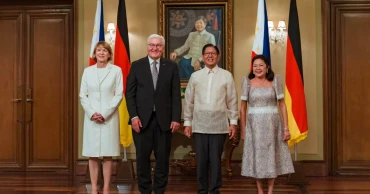
Europe concerned over South China Sea tensions, German president says
German President Frank-Walter Steinmeier on Tuesday expressed concern over rising tensions in the disputed South China Sea, warning that any major conflict in the region could threaten freedom of navigation and disrupt global trade.
Speaking alongside Philippine President Ferdinand Marcos Jr. during a state visit to Manila, Steinmeier said Europe is closely monitoring developments in the South China Sea, particularly ongoing confrontations between the Philippines and China.
Referring to the recent disruption in the Strait of Hormuz linked to the Iran conflict, Steinmeier said such incidents show how regional disputes can have global economic consequences.
“The situation in the South China Sea remains tense, and that is a cause for concern,” he said through an interpreter. “The Indo-Pacific, especially Southeast Asia, is one of the world’s most dynamic economic regions. Any serious incident there would also affect Europe.”
He warned that violations of international maritime law could jeopardize freedom of navigation, similar to the impact caused by the closure of the Strait of Hormuz, which led to sharp increases in global fuel and fertilizer prices.
The Strait of Hormuz situation was among the topics discussed during a private meeting between Steinmeier and Marcos.
Although Steinmeier did not directly name any country, Germany has previously criticized China’s actions in the South China Sea, saying they undermine the rights of coastal states such as the Philippines and threaten free navigation along one of the world’s busiest trade routes.
The territorial disputes involve China, the Philippines, Vietnam, Malaysia, Brunei and Taiwan.
The United States, while not a claimant in the South China Sea, has repeatedly stated that it is committed to defending the Philippines under their mutual defense treaty if Filipino forces, vessels or aircraft come under armed attack.
China, meanwhile, has urged Washington not to interfere in the regional disputes.
During a visit to Manila in 2024, then German Foreign Minister Annalena Baerbock voiced concern over China's actions in the disputed waters, including incidents involving Philippine vessels. She said such actions violated the rights of coastal nations and hindered their economic development.
Baerbock also said China’s sweeping claims in the South China Sea were not supported by international law and called for a peaceful settlement of the disputes.
On Tuesday, Steinmeier reaffirmed Germany’s support for the Philippine Coast Guard, which has played a key role in protecting the country’s maritime interests and has been involved in several confrontations with Chinese vessels.
Marcos thanked Germany for consistently backing the Philippines’ efforts to uphold international law in the South China Sea and for supporting compliance with the 2016 international arbitration ruling.
The ruling, based on the 1982 United Nations Convention on the Law of the Sea, rejected China’s broad claims in the South China Sea. China refused to participate in the arbitration process, rejected the decision and continues to oppose it.
3 months ago

President urges world leaders to take effective steps to solve Rohingya problem
President Abdul Hamid on Thursday called upon the world leaders including from Germany to take effective initiatives to have a permanent solution to the Rohingya problem.
Visiting President Hamid made the call during a meeting with German President Frank-Walter Steinmeier at his official residence Bellevue Palace.
During the meeting, the President thanked the German government for providing humanitarian assistance to the Rohingya who were forcibly displaced from Myanmar and for raising the issue at the United Nations, President’s Press Secretary Joynal Abedin told UNB.
The Bangladeshi President also called for effective measures to repatriate Rohingyas to their homeland.
Mentioning Germany as a reliable development partner of Bangladesh, the President highlighted the issue of German co-operation in the development of Bangladesh since independence.
He thanked the German government for sending the corona vaccine and medical equipment to Bangladesh as a grant.
Stating that the existing trade relations between Bangladesh and Germany are very good and are expanding day by day, Abdul Hamid called for more German investment in various sectors, including Bangladesh's high-tech parks and special economic zones.
The President praised the new steps taken by Germany and the European Union to address the adverse effects of climate change.
He hoped that Germany and the European Union would be more liberal in their trade and investment with developing countries, including Bangladesh.
Expressing gratitude for launching the Bangabandhu Professional Fellowship at the University of Heidelberg in Germany, the President called for visa facilitation for Bangladeshi students.
The President said Bangladesh is moving ahead economically because of the government's zero-tolerance policy against terrorism and extremism.
Alongside, Hamid thanked the German President for his speech on the occasion of the golden jubilee of Bangladesh's independence and the birth centenary of Father of the Nation Bangabandhu Sheikh Mujibur Rahman.
Expressing satisfaction over Germany's bilateral trade with Bangladesh, the German President emphasized exchanging visits at the public-private level to increase trade between the two countries.
Appreciating Bangladesh's initiative in controlling the Corona epidemic, the German President said that his country would continue its cooperation in this regard.
During the meeting, they also discussed various issues including international politics.
Secretary to the President's Office Sampad Barua, Military Secretary Major General SM Salah Uddin Islam, President's son Rasel Ahmed Tuhin and Bangladesh Ambassador to Germany Mosharraf Hossain Bhuiyan were present during the meeting.
4 years ago

German President lauds Bangladesh’s impressive growth
German President Frank-Walter Steinmeier on Tuesday said Bangladesh has undergone an “impressive development and is today a vibrant democracy” with high economic growth rates.
“At the same time, Bangladesh has succeeded in clearly reducing poverty in the country using innovative development policy strategies,” he said in a message sent to President Abdul Hamid.
Also read: French senator lauds Bangladesh’s progress; recalls Bangabandhu
Foreign Minister Dr AK Abdul Momen read out the message at a programme held at the National Parade Ground on Tuesday, marking the birth centenary of Father of the Nation Bangabandhu Sheikh Mujibur Rahman and the Golden Jubilee of Bangladesh’s Independence.
The German President said the world very much values Bangladesh’s peaceful foreign policy and its generous humanitarian engagement, particularly when it comes to taking in hundreds of thousands of Rohingya who have fled their homes.
Also read: India praises Hasina's statesmanship, Bangladesh’s "miraculous” progress
“The global challenges of our time, particularly the current pandemic situation and climate change, can only be tackled if we work together. Our many years of friendly relations provide a very firm basis for such cooperation,” the message reads.
On the occasion of the 50th anniversary of Bangladesh’s Independence, he conveyed to his Bangladesh counterpart and the people of Bangladesh his sincere congratulations. “I wish you strength and every success for the tasks that lie ahead.”
Also read: Bangladesh’s importance in S Asia growing: US
5 years ago

German President lauds Bangladesh's progress, efforts to deal with COVID-19
German President Frank-Walter Steinmeier on Wednesday praised the remarkable socio-economic progress achieved by Bangladesh under Prime Minister Sheikh Hasina's dynamic leadership.
5 years ago
German president thanks Gorbachev for his role in German reunification
German President Frank-Walter Steinmeier in a letter published on Tuesday expressed his appreciation for former Soviet Union leader Mikhail Gorbachev's role in reuniting Germany.
In the letter released by his office Tuesday, Steinmeier wrote that Germany's peaceful reunification and the end of Europe's division "would not have been possible without the courageous and humane decisions that you personally made at that time."
"Germany is forever indebted to you and deeply grateful," the president wrote.
In retrospect, not all the hopes of those days have been fulfilled, Steinmeier wrote, referring to the current state of European-Russian relations ahead of the 30th anniversary of the fall of the Berlin Wall on Nov. 9.
"What bothers me most is the state of German-Russian and European-Russian relations. It remains a matter of duty and commitment not to accept the growing alienation of recent years and to keep an eye on the goal of a common future in peace and cooperation," wrote Steinmeier.
On Nov. 9, 1989, the Berlin Wall fell and the former Soviet Union announced that it would not interfere with the issue, paving the way for the reunification of the two Germanies on Oct. 3, 1990.
6 years ago