Editors’ Council
Govt to form advisory committee for media commission
The government has decided to form an advisory committee to facilitate the formation of a media commission, leaders of the Editors’ Council said after a meeting with Prime Minister Tarique Rahman on Sunday.
The decision came during a meeting between the Prime Minister and leaders of the Editors’ Council at the Cabinet Division’s Public Administration conference room at the Secretariat.
Speaking to reporters after the one-and-a-half-hour closed-door meeting, Editors’ Council President and New Age Editor Nurul Kabir said they had a detailed discussion with the Prime Minister on the existing media environment and laws affecting the sector.
He said they informed him about the undemocratic aspects within the existing laws and regulations related to the media and agreed that many of those issues need to be reviewed.
“We have agreed to form a consultative committee comprising all relevant stakeholders to establish a democratic media regime in Bangladesh. The committee will work throughout June and prepare a final report sometime in July, based on which we will formulate a democratic media law,” the New Age Editor said.
Nurul Kabir said the Editors’ Council also discussed ways to overcome various problems and unhealthy practices in the media sector.
“We assured the government that as long as it behaves democratically, the editors will remain engaged with them,” he said adding that the government welcomed the proposal.
Nurul Kabir said misinformation and disinformation on social media and other platforms are harming all sections of society, including journalists.
“We want to work together to remove the barriers that stand in the way of building credibility, trust and public confidence in the media,” he said.
The Daily Star Editor Mahfuz Anam told reporters that they handed over a list to the Prime Minister.
“We informed him that around 282 journalists are facing different kinds of cases, and among them, 94 have been made accused in murder cases. We submitted the list to the Prime Minister. I would not say the list is fully complete; there may still be omissions. But we prepared it with sincere efforts,” he said.
Mahfuz Anam said the Prime Minister accepted the list and asked the Information Minister to look into the matter and take necessary initiatives.
“We strongly said that filing murder and other cases against journalists is not good for the environment of a democratic country. It is also not good for the image of the government,” he said.
Asked what the Prime Minister said on the issue, he replied, “He took the matter very sincerely and said they would examine it. They are interested in addressing the issue.”
Editors’ Council leaders said the advisory committee would consult stakeholders.
They said discussions at the meeting also covered strengthening the Press Council, withdrawal of cases filed against journalists, clearing outstanding advertisement dues of newspapers, updating the existing conditions for newspaper declarations, media freedom, journalists’ professional safety and various challenges and prospects of the newspaper industry.
Several important policy decisions were also taken at the meeting, including steps to make the Press Council more independent, effective and stronger.
Leaders of the Editors’ Council thanked the Prime Minister and said journalists did not faced any obstruction in carrying out their professional duties during the government’s first three months in office.
The Prime Minister later hosted a lunch for the journalists.
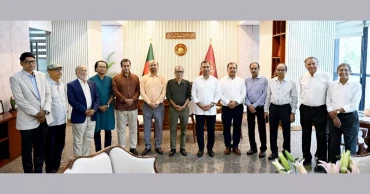
After the meeting, members of the Editors’ Council took a group photograph with him.
Editors’ Council President and New Age Editor Nurul Kabir, General Secretary and Banik Barta Editor Dewan Hanif Mahmud, The Daily Star Editor and Publisher Mahfuz Anam, Prothom Alo Editor and Publisher Matiur Rahman, Manabzamin Chief Editor Matiur Rahman Chowdhury, Financial Express Editor Shamsul Huq Zahid, Inqilab Editor AMM Bahauddin, Suprobhat Bangladesh Editor Rusho Mahmud and Karatoa Editor Mozammel Haque attended the meeting.
Information and Broadcasting Minister Zahir Uddin Swapon, State Minister Yasser Khan Choudhury and Prime Minister’s Information Adviser Dr Zahed Ur Rahman were among the attendees.
4 months ago
Khaleda Zia’s grace, sense of dignity were truly admirable: Nurul Kabir
President of the Editors’ Council Nurul Kabir on Friday said former Prime Minister and ex-BNP Chairperson Khaleda Zia consistently stood out in Bangladesh’s political landscape for her grace, decency, restraint and strong sense of self-respect.
“Khaleda Zia created a unique example in Bangladeshi politics through her refined conduct, decency, moderation, dignity and restraint, which always impressed me,” he said while addressing a citizens’ condolence meeting organised in memory of Khaleda Zia at the South Plaza of the Jatiya Sangsad Bhaban.
Reflecting on her centrist and democratic political approach, Nurul Kabir said that although he was never directly involved with BNP’s political strategies, he had always supported the party’s democratic ideals.
Highlighting her restraint amid personal suffering, the veteran journalist said, “Despite the oppression, persecution and hardships she and her family endured, no one has ever heard her utter words of condemnation. Such restraint is undoubtedly rare.”
Civic condolence over Khaleda’s passing on Friday
Recalling an incident from the night of March 25, 1971, Nurul Kabir said that when Bengali officers were preparing to take up arms against Pakistani commanders, a Pakistani Subedar Major under then Major Ziaur Rahman attempted to break open an arms cache and open fire on Bengali officers. “It was Khaleda Zia who stopped him. She was an ordinary housewife at the time, yet her courage saved the lives of many Bengali officers that night.”
He stressed that her bravery should not be underestimated, noting that without her courageous intervention in the early hours of the war, many Bengali officers might have lost their lives. “It could even have affected Ziaur Rahman’s historic declaration of independence on March 26.”
Addressing BNP leaders and activists, Nurul Kabir urged them not to take any action that would dishonour Khaleda Zia’s ideals. “Do nothing that would make people say Khaleda Zia was fortunate to have passed away and not lived to witness such days.”
He called upon BNP to continue its democratic journey and actively participate in building a beautiful and democratic Bangladesh.
8 months ago
.jpg)
Matiur Rahman’s indictment: Editors’ Council voices concern
Sampadak Parishad (Editors’ Council) on Sunday voiced concern over the indictment of Daily Prothom Alo editor Matiur Rahman and eight others in a case filed over the death of a student last year.
5 years ago