Starship
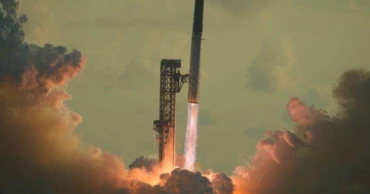
SpaceX’s Starship reaches orbit for first time, but mission ends early
SpaceX’s massive Starship reached orbit for the first time Monday and successfully deployed 26 of the company’s most advanced Starlink satellites, but controllers ended the mission earlier than planned as a safety precaution.
The spacecraft reentered the atmosphere over the Pacific Ocean and splashed down north of Hawaii about three hours after lifting off from southern Texas. SpaceX had planned a 10-hour mission involving six complete orbits of Earth to demonstrate the spacecraft’s readiness for NASA’s Artemis lunar program.
Starship tipped over and burst into flames after hitting the water, bringing the flight to a dramatic conclusion.
The mission faced an early setback when one of Starship’s engines shut down prematurely. However, the remaining systems performed well, and because the failed engine was no longer required, flight controllers decided after several tense minutes to continue.
“Starship is orbital,” Mission Control announced, prompting cheers at SpaceX’s launch site.
NASA Administrator Jared Isaacman congratulated SpaceX for reaching orbit while managing the mission in what he described as a safe, responsible and inspirational manner.
The 407-foot (124-meter) rocket, billed as the largest and most powerful ever built, carried 26 advanced Starlink satellites. They were deployed individually to join more than 11,000 older satellites already providing internet services worldwide.
SpaceX later said it chose to terminate the flight early “out of an abundance of caution” because of the engine problem.
Monday’s launch marked Starship’s 14th full-scale flight from the southern tip of Texas in three years. Previous test flights traveled only as far as the Indian Ocean, covering roughly half the globe, with several ending in fiery failures.
This time, SpaceX intended to send Starship around Earth six times at an altitude of about 170 miles (275 kilometers), with the spacecraft traveling at roughly 17,500 mph (28,000 kph). Instead, controllers brought it down after only a couple of orbits.
The first-stage booster was also not designed to return to the Texas launch site during Monday’s flight. It instead fell into the Gulf of Mexico several minutes after liftoff.
SpaceX plans to review the mission before attempting to return Starship to the launch pad. Musk has stressed the importance of avoiding debris falling over populated areas, saying the company is therefore proceeding cautiously.
Depending on the findings from Monday’s flight, the next Starship could attempt to return to Starbase, where giant mechanical arms are designed to catch the hovering spacecraft. Musk has estimated the chances of a successful catch at about even odds or slightly better. If successful, SpaceX could fly the spacecraft again by the end of this year or early next year.
The fully reusable Starship was designed to reduce launch costs. SpaceX recovered the previous Starship from the Indian Ocean in July, allowing engineers to inspect it directly and make changes to the newly launched spacecraft’s heat shield.
SpaceX is seeking certification for Starship to conduct regular orbital flights, a major step toward its ambitions for lunar and Mars missions.
NASA’s Artemis III mission could launch as early as next summer and involves multiple spacecraft docking in Earth orbit, including an Orion capsule carrying astronauts and commercial lunar landers.
Under the planned sequence, Jeff Bezos’ Blue Moon would launch first, followed by Orion. Starship would then dock with Orion after Blue Moon separates for its lunar mission.
Artemis IV is scheduled for no earlier than 2028 and could see astronauts land on the moon using either Blue Moon or Starship, depending on which spacecraft is ready. Later lunar missions are expected to alternate between the two systems.
Musk originally developed Starship with the goal of transporting large numbers of people to Mars. For now, SpaceX is prioritizing lunar missions and plans to use Starship to deploy large numbers of satellites, eventually reducing reliance on the company’s Falcon 9 rocket.
A second Starship launch facility is nearing completion at NASA’s Kennedy Space Center in Florida, while a third is planned for Louisiana.
20 days ago

SpaceX delays launch of upgraded Starship after last-minute technical issues
SpaceX came close to launching its newest and largest Starship rocket on a test flight Thursday evening, but a series of technical problems forced the company to stop the countdown less than 30 seconds before liftoff.
The 407-foot-tall rocket was set to begin a test mission from Texas that would have carried it halfway around the globe. However, problems emerged at the newly built launch pad at Starbase near the Mexico border, leaving the company without enough time to fix them before the launch window closed.
Later, Elon Musk said a hydraulic pin that secures the launch tower’s arm failed to retract properly.
Musk added that if engineers can quickly resolve the issue, another launch attempt could take place on Friday.
The delayed launch came just one day after Musk announced that SpaceX plans to become a publicly traded company.
The latest version of Starship was carrying 20 mock Starlink satellites that were supposed to be released during the flight before the spacecraft made a controlled splashdown in the Indian Ocean at the end of the planned one-hour mission.
This would have been the 12th test flight for Starship and the first since last fall.
NASA is depending on this upgraded version of Starship for its future mission to land astronauts on the moon within the next few years.
4 months ago
.jpg)
SpaceX launches Starship on highest test flight, crash-lands
SpaceX launched its shiny, bullet-shaped, straight-out-of-science fiction Starship several miles into the air from a remote corner of Texas on Wednesday, but the 6 1/2-minute test flight ended in an explosive fireball at touchdown.
5 years ago