local-business
Indices mixed at mid-session: Dhaka down, Chattogram up
The country’s stock markets showed a mixed trend in the first half of Monday’s trading, with indices falling in Dhaka while gaining in Chattogram.
During the first hour of trading, the key index of the Dhaka Stock Exchange (DSEX) dropped by 2 points, while the Shariah-based DSES and the blue-chip DS30 indices each gained 2 points.
Most of the companies traded on the DSE saw a decline in share prices. Prices increased for 133 companies, fell for 182 and remained unchanged for 80 others.
The total turnover on the DSE crossed Tk 380 crore in the first half of the session.
DSE warns investors against dealings with Moshihor Securities over fraud
Meanwhile, the overall index of the Chittagong Stock Exchange (CSE) rose by 26 points during the same period.
Despite the index gain, most of the companies on the CSE witnessed a fall in prices — 57 advanced, 61 declined, and 21 remained unchanged.
The turnover at the CSE stood at over Tk 4.40 crore in the first half of trading.
7 months ago
Remittance hits USD 2.68 billion in Sept: BB report
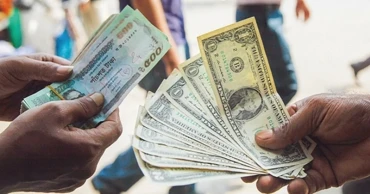
The inflow of remittances through formal banking channels increased in September compared to the previous two months, with Bangladesh receiving a total of USD 2.68 billion, according to data released by Bangladesh Bank.
The central bank’s Monthly Workers’ Remittance Report for September shows that the highest inflow during the month was recorded in the second week — from September 7 to 13 — when expatriates sent USD 789 million through the banking system.
The September figure marks the highest monthly remittance so far in the current fiscal year (FY2025–26). Earlier, Bangladesh received USD 2.47 billion in July and USD 2.42 billion in August.
Remittance inflow also showed year-on-year growth, up from USD 2.40 billion in September 2024. The highest remittance inflow of 2025 was recorded in March, reaching USD 3.29 billion.
Private commercial banks accounted for the majority of remittance receipts in September, handling USD 1.95 billion. Among them, Islami Bank Bangladesh PLC led the chart with USD 698 million.
State-owned banks received USD 466 million, with Janata Bank topping the group at USD 170 million.
Specialized banks received USD 258 million, while foreign commercial banks handled a modest USD 6.24 million in remittances.
But, remittance inflows declined in the five banks undergoing merger processes.
Among them, Social Islami Bank and EXIM Bank received USD 4.51 million and USD 1.14 million, respectively, while Union Bank, Global Islami Bank and First Security Islami Bank recorded inflows of below USD 1 million each.
Two private commercial banks — ICB Islami Bank and Padma Bank PLC — received no remittance during the month. Among foreign commercial banks, all except Standard Chartered saw negligible inflows.
7 months ago
Indices up in early trading at Dhaka, Chattogram bourses
Indices at both the Dhaka and Chattogram stock exchanges witnessed an upward trend in the first hour of trading on Sunday, the first working day of the week, as most companies saw gains in their share prices.
At the Dhaka Stock Exchange (DSE), the benchmark DSEX index rose by 43 points, while the Shariah-based DSES index gained 5 points and the blue-chip DS30 index advanced by 12 points.
Out of 254 traded companies, share prices of 254 advanced, 63 declined and 62 remained unchanged during the first hour.
Stocks rise at DSE, CSE as indices gain
The turnover at the DSE exceeded Tk 160 crore.
Similarly, the overall index at the Chittagong Stock Exchange (CSE) increased by 85 points.
Among the 61 traded companies, the prices of 40 rose, 18 fell and 3 remained unchanged, with total turnover surpassing Tk 1 crore in the first hour of trading.
7 months ago

Multimode Group unveils new logo, modernized website in grand ceremony
Multimode Group, a leading business conglomerate, officially unveiled its new corporate logo and modernized website on Saturday.
The event was graced by the presence of Multimode Group Chairman, prominent industrialist Abdul Awal Mintoo as the Chief Guest. The event was held at the group headquarters in Dhaka.
Among others in attendance were the group Vice Chairman Nasreen Fatema Awal, Deputy CEO Tabith Awal, Director Tajwar M. Awal, and Director Tafsir Awal.
Mahbub Anam, Managing Director of Lal Teer Seed Limited (a subsidiary of Multimode Group), along with employees and officials from different levels of the Multimode Group, were present at the function.
The entire ceremony was broadcast live to two key locations of Multimode Group's subsidiaries: the Livestock Farm Office of Lal Teer Livestock, located in Uthura, Bhaluka, Mymensingh, and the Research and Development Center in Bashon, Joydebpur, Gazipur.
During the event, the speakers highlighted the glorious history and progress of the Multimode Group. Senior officials also delivered inspirational speeches to motivate the employees and staff.
The unveiling ceremony concluded with the cutting of a cake, marking the official end of the memorable day.
Attendees expressed hope that the new logo and website would add a new dimension to the Multimode Group's branding and market identity, according to a press release.
8 months ago

22-day ban on Hilsa: Nearly 100 tonnes of hilsa sold overnight in Faridpur
Around 100 tonnes of hilsa were sold from Friday night to Saturday morning as a nightlong Hilsa fair was held under the Hashamdia Flyover in Bhanga municipality of Faridpur district.
A huge crowd of buyers from nearby upazilas were seen in the fair as a 22-day nationwide ban on hilsa fishing began from Saturday midnight to protect mother hilsa during breeding season.
The ban will remain in force until October 26.
Despite limited supply, prices remained within buyers' reach, according to several customers and vendors.
Some traders said there were more buyers than fish but the prices didn’t rise unfairly.
Hilsa was being sold at prices Tk 100–200 lower per kg than regular market rates.
One kg-sized Hilsa was priced between Tk 2,000 and Tk 2,200, 500-gram-sized Hilsa fetched Tk 800–1,000 per kg and 250-gram-sized Hilsa sold for Tk 550–600 per kg.Locals said the fair is held once a year on the eve of the government’s annual Hilsa conservation ban.
Vendors including Naran Dutta, Haran Saha and Zakir Hossain said the overall supply was lower than last year but prices stayed relatively stable.
8 months ago
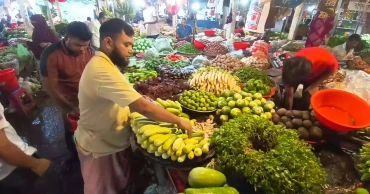
Vegetable prices soar in Manikganj amid inclement weather
Incessant rainfall has caused price hikes of all types of vegetables in Manikganj markets, with green chili seeing the steepest rise, leaving consumers worried.
The price of green chili, which used to sell for Tk 100 per kilogram, has jumped four-fold to Tk 400.
Other vegetables have also become more expensive as brinjal and bitter gourd are now selling at Tk 100 per kilogram, while ridge gourd, ivy gourd, and okra are priced at Tk 80.
Bottle gourd is available for Tk 60 per kilogram. Onion prices have increased slightly, reaching Tk 60 per kilogram, up by Tk 10.
A visit to the Manikganj Bus Stand vegetable market on Friday revealed the price hike across the board.
593 metric tons of green chilies imported from India via Benapole in two days
Jagir Bandar Dhaleshwari wholesale market usually receives nearly 1,000 sacks of green chili daily from Manikganj and surrounding districts, which are then distributed to Dhaka and other markets across the country.
However, due to the Puja holidays and a recent closure of Indian LCs, only 50 to 60 sacks of chili are arriving, meeting barely half the usual demand.
Local wholesalers said that domestic chili arrives from western districts including Chuadanga, Meherpur, and Jhinaidah, along with regular imports from India.
Recent rains have delayed harvests, while the closed Indian border has cut imports, creating a shortage.
Wholesalers said the limited supply has caused chili prices to surge by Tk 200–400 per sack. Shahid Uddin, a wholesaler at Dhaleshwari, said, “Two days ago, a 5-kg pack of chili sold for Tk 1,000. Yesterday it rose to Tk 1,200–1,300, and today it reached Tk 1,500.”
Chili growers in Manikganj worried over low production due to drought
Market inspections also revealed that prices of other vegetables, including brinjal, bitter gourd, ridge gourd, bottle gourd, ivy gourd, and long beans, have risen by Tk 100–200 per sack due to reduced supply.
8 months ago

Islami Bank’s official Facebook page hacked
The official Facebook page of Islami Bank Bangladesh was hacked early Friday, with the attackers posting a threatening message and changing the page’s profile and cover photos.
The hacking group, identifying itself as ‘Team MS 47OX’, claimed responsibility through a post at 5:42 am, warning that they were monitoring the bank’s operations and might soon launch cyber-attacks on its website and Facebook page.
A review of the page showed the name remained unchanged, though the visuals were replaced with images linked to the group.
Some users also reported seeing unusual posts around the time of the breach.
Nazrul Islam, head of public relations at Islami Bank, said the page was hacked early in the morning and that the bank’s IT department is working to restore control.
8 months ago
Banks, stock markets to remain closed for 4 days from Wednesday
The banking sector and the stock markets in Bangladesh will remain closed for four consecutive days starting from Wednesday.
According to Bangladesh Bank, on the occasion of Durga Puja banks, other financial institutions and stock market will remain closed.
The four-day closure includes two weekly holidays.
Bank holiday: Transactions, stock markets to remain suspended Tuesday
Public holiday was announced on October 1 under a government executive order while October 2 holiday is for ‘Bijaya Dashami’ (the final day of Durga Puja).
October 3 and 4( Friday and Saturday) are weekly holidays.
However, essential automated services, including ATM, CRM (Cash Recycler Machines), and Mobile Banking, will remain operational.
8 months ago
BSEC approves bond issuance for three banks
The Bangladesh Securities and Exchange Commission (BSEC) on Tuesday approved bond issuance proposals from three banks to bolster their Tier-II capital base under Basel III.
The approval was given in the commissions’ its 975th meeting chaired by Chairman Khondoker Rashed Maqsood.
BRAC Bank PLC received approval to issue an unsecured, non-convertible, fully redeemable, floating-rate social subordinated bond worth Tk 1,000 crore, carrying a coupon rate of Reference Rate plus 2.5% margin.
The bonds will be issued through private placement to institutional investors at a face value of Tk 10 lakh per unit. Prime Bank Investment Limited will act as trustee and BRAC EPL Investment Limited as arranger.
The bond will also be listed on the Alternative Trading Board (ATB).
United Commercial Bank PLC was allowed to issue an unsecured, non-convertible, redeemable, floating-rate subordinated bond worth Tk 800 crore, with a coupon rate of Reference Rate plus 3% margin.
The bond will be privately placed among institutional investors at Tk 1 lakh per unit. DBH Finance PLC will serve as trustee, while UCB Investment Limited will act as arranger. The bond will also be listed on the ATB.
Trust Bank PLC received approval to issue an unsecured, non-convertible, redeemable, floating-rate subordinated bond worth Tk 500 crore, carrying a coupon rate of Reference Rate plus 3% margin.
Jamuna, Pubali Banks get BSEC nod for subordinated bonds
The bond will be issued via private placement to institutional investors at Tk 1 lakh per unit. DBH Finance PLC will act as trustee, with UCB Investment Limited and Trust Bank Investment PLC as arrangers. The bond will also be listed on the ATB.
The proceeds from these bond issues will be used to strengthen the Tier-II capital base of the respective banks, enhancing their capital adequacy under Basel III requirements.
8 months ago
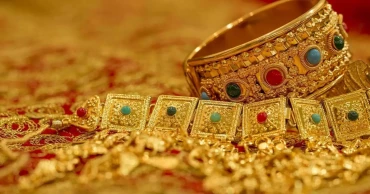
Bangladesh traders start selling 22-carat gold at record high
Gold traders in the country have started selling 22-carat gold at a historic high of Tk 195,384 per bhori (11.664 grams) from Tuesday.
The Bangladesh Jewellers’ Association (BAJUS) increased the rate by Tk 2,415 per bhori, citing higher prices of pure gold in the local market.
As per the revised tariff, 21-carat gold will cost Tk 186,496 per bhori, 18-carat gold Tk 159,855, and traditional gold Tk 132,725 per bhori.
The selling price will include a mandatory 5 percent VAT set by the government and a minimum making charge of 6 percent fixed by BAJUS, with additional variations depending on design and quality.
The latest hike comes just two days after BAJUS lowered the price on September 27, when the rate of 22-carat gold was set at Tk 192,969 per bhori.
Earlier, on September 23, the association raised the price by Tk 3,663 to Tk 194,859 per bhori — then the highest on record.
So far this year, gold prices in the local market have been revised 59 times — raised on 41 occasions and reduced 18 times.
In September alone, BAJUS adjusted gold prices 12 times, with the metal soaring by Tk 21,000 per bhori in just one month.
8 months ago