Asia

China sets this year’s economic growth target at ‘around 5%’
China’s government on Sunday set this year’s economic growth target at “around 5%” as it tries to rebuild business activity following the end of anti-virus controls that kept millions of people at home.
Premier Li Keqiang, the top economic official, announced the target in a report on government work to the ceremonial legislature, the National People’s Congress.
Also Read: China expands defense budget 7.2%, marking just .1% increase
Chinese leader Xi Jinping said earlier this year’s official priority is an economic revival based on consumer spending after growth sank to 3% last year, its second-lowest level since at least the 1970s.
3 years ago

China expands defense budget 7.2%, marking just .1% increase
China on Sunday announced a 7.2% increase in its defense budget for the coming year, just .1% higher than in 2022.
That marks the eighth consecutive year of single-digit percentage increases in what is now the world’s second-largest military budget. The 2023 figure was given as 1.55 trillion yuan ($224 billion).
Along with the world’s biggest standing army, China has the world’s largest navy and recently launched its third aircraft carrier. According to the U.S., it also has the largest aviation force in the Indo-Pacific, with more than half of its fighter planes consisting of fourth or fifth generation models.
Also Read: Quad FMs, wary of China's might, push Indo-Pacific option
China also boasts a massive stockpile of missiles, along with stealth aircraft, bombers capable of delivering nuclear weapons, advanced surface ships and nuclear powered submarines.
China spent 1.7% of GDP on its military in 2021, according to the World Bank, while the U.S., with its massive overseas obligations, spent a relatively high 3.5%.
China budgeted 1.45 trillion yuan (then $229 billion) for last year — roughly double the figure from 2013. Consistent annual increases for more than two decades have allowed the 2 million-member People’s Liberation Army to increase its capabilities across all categories.
3 years ago

Hong Kong court convicts activists behind Tiananmen vigil
Three Hong Kong activists from a now-defunct group that organized annual vigils commemorating China’s 1989 crackdown on pro-democracy protesters were convicted on Saturday for failing to provide authorities with information on the group in accordance with a national security law.
Chow Hang-tung, Tang Ngok-kwan and Tsui Hon-kwong were arrested in 2021 during a crackdown on the city’s pro-democracy movement following massive protests more than three years ago. They were leaders of the Hong Kong Alliance in Support of Patriotic Democratic Movements of China before it disbanded under the shadow of the Beijing-imposed law.
The alliance was best known for organizing candlelight vigils in Hong Kong on the anniversary of the Chinese military’s crushing of the 1989 Tiananmen Square pro-democracy protests. Critics say its shutdown has shown freedoms that were promised when Hong Kong returned to China in 1997 are eroding.
Before the group voted to disband, police had sought details about its operations and finances in connection with alleged links to democracy groups overseas in August 2021, accusing it of being a foreign agent.
But the group refused to cooperate, arguing police were arbitrarily labeling pro-democracy organizations as foreign agents. It added the police did not have a right to ask for its information because it was not a foreign agent and the authorities did not provide sufficient justification.
Under the security law’s implementation rules, the police chief can request a range of information from a foreign agent. Failure to comply with the request could result in six months in jail and a fine of 100,000 Hong Kong dollars ($12,740) if convicted.
On Saturday, principal magistrate Peter Law ruled the defendants were obliged to answer the notice served to them, which he called “sound and legal,” and their non-compliance was unjustified.
The alliance had been actively operating with various entities and people abroad, Law said, so it was necessary to explore their dealings and connections to determine their affiliation and ultimate purpose.
“Such requirement for information was nothing like a broad-brush fishing exercise but rather was constrained in terms of periods of time and nature,” he said. “The police had taken an abstemious and self-restrained approach.”
During previous legal proceedings, the court ordered a partial redaction of some information after prosecutors argued that a full disclosure of information would jeopardize an ongoing probe into national security cases.
The undisclosed details in a redacted police report submitted to the court include the names of groups that were alleged to have links with the alliance.
“Leaking of secret information, such as identities, strategies and interim investigation results of others would definitely seriously jeopardize the ongoing investigation,” Law said on Saturday.
The annual vigil organized by the alliance was the only large-scale public commemoration of the June 4th crackdown on Chinese soil and was attended by massive crowds until authorities banned it in 2020, citing anti-pandemic measures.
Chow, along with two other former alliance leaders, Lee Cheuk-yan and Albert Ho, were charged with inciting subversion of state power under the security law in 2021. The alliance itself was charged with subversion.
The national security law criminalizes secession, subversion, and collusion with foreign forces to intervene in the city’s affairs as well as terrorism. Apart from the activists, pro-democracy publisher Jimmy Lai is also facing collusion charges under the law, which has already jailed or silenced many dissidents.
In Beijing, Wang Chao, spokesperson for the National People’s Congress, China's legislature, hailed the enactment of the law in 2020 as an important milestone in the practice of the “one country, two systems” governing principle.
The principle promises the former British colony the right to retain its own political, social and financial institutions for 50 years after the 1997 handover.
“Hong Kong has had a major turn from chaos to stability,” he said.
3 years ago
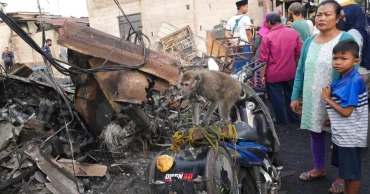
Indonesia fuel depot fire kills 19; 3 still missing
Indonesian rescuers and firefighters on Sunday searched for three people who were still missing under the rubble of charred houses and buildings, after a large fire spread from a fuel storage depot in the capital and killed at least 19 people.
The Plumpang fuel storage station, operated by state-run oil and gas company Pertamina, is near a densely populated area in the Tanah Merah neighborhood in North Jakarta. It supplies 25% of Indonesia’s fuel needs.
At least 260 firefighters and 52 fire engines extinguished the blaze just before midnight on Friday after it tore through the neighborhood for more than two hours, fire officials said.
Footage showed hundreds of people running in panic as thick plumes of black smoke and orange flames filled the sky.
Also Read: Indonesia oil depot fire kills 15, 16 still missing
National police chief Gen. Listyo Sigit Prabowo said a preliminary investigation showed the fire was caused by a technical problem involving excess pressure as the depot received fuel from Pertamina’s Balongan Refinery in West Java province.
“It was found that a fire occurred during a filling of Pertamax fuel,” Listyo told a news conference late Saturday, referring to a type of fuel oil produced by Pertamina.
He didn’t elaborate as investigators from Pertamina and the police were still working to establish the cause of the fire, including by questioning dozens of witnesses and examining video recordings from surveillance cameras.
Residents living near the depot said they smelled a strong odor of gasoline, causing some people to vomit, after which thunder rumbled twice, followed by a huge explosion.
Sri Haryati, a mother of three, said the fire began to spread about 20 minutes later, causing panic.
“I was crying and immediately grabbed our valuable documents and ran with my husband and children,” Haryati said, adding that she heard smaller blasts that echoed across the neighborhood as orange flames jumped from the depot.
Rescuers were still searching for three people who were reported missing. About 35 people were receiving treatment in five hospitals, some of them in critical condition.
Listyo said more than 1,300 people were displaced and taking shelter in 10 government offices, a Red Cross command post and a sport stadium.
Pertamina's head Nicke Widyawati apologized and said the company would provide help to the community and cooperate in the investigation.
“We will carry out a thorough evaluation and reflection internally to prevent similar incidents from happening again,” Widyawati said in a statement, adding that the company ensured the safe supply of fuel oil.
On Saturday, grieving relatives gathered at a police hospital’s morgue in eastern Jakarta to try to identify their loved ones. Officials said the victims were burned beyond recognition and could only be identified through DNA and dental records.
In 2014, a fire at the same fuel depot engulfed at least 40 houses, but no casualties were reported.
Indonesia’s State Owned Enterprises Minister Erick Thohir told reporters that the government will remap safe zones for residential areas away from vital objects.
He said the incident showed the Plumpang area is not safe for the community, and the government is planning to move the fuel storage depot to Tanjung Priok port in northern Jakarta.
3 years ago

Gunmen in military uniforms shoot dead governor, 5 civilians in central Philippines
Gunmen in military uniforms fatally shot a governor and five civilians on Saturday while the provincial leader was meeting villagers at his home in the central Philippines, in the latest brazen assault on local politicians in the country, police said.
At least six men armed with assault rifles and wearing military-style camouflage and bullet-proof vests alighted from three SUVs and opened fire on Negros Oriental Gov. Roel Degamo, hitting him and at least five other people in front of his home in Pamplona town. The province has a history of violent political rivalries.
Pamplona Mayor Janice Degamo, the wife of the slain governor, said in a Facebook video that the five villagers also died.
She demanded justice and said her husband “did not deserve that kind of death. He was serving constituents on a Saturday along with his department heads.”
A total of 10 suspects were seen fleeing the scene and later abandoned the SUVs, police said. Police set up security checkpoints and launched a province-wide search for the suspects.
President Ferdinand Marcos Jr. condemned the mid-morning attack, which took place as impoverished villagers gathered in front of Degamo’s house to seek medical and other aid.“My government will not rest until we have brought the perpetrators of this dastardly and heinous crime to justice,” Marcos said in a statement.
Marcos said without elaborating that authorities had gathered “much information and now have a clear direction on how to proceed to bring to justice those behind this killing.” He addressed the mastermind and the killers, saying, “We will find you. If you surrender now it will be your best option.”
Degamo’s killing underscores that even local politicians are not immune from high-profile gun violence that has persisted despite the government’s pledge to combat it.
Last month, Gov. Mamintal Alonto Adiong Jr. of southern Lanao del Sur province was wounded and four of his bodyguards killed in an attack on their convoy. Police said they killed one of the suspects in a clash.
In a separate recent attack, unidentified men reportedly wearing police uniforms fired at the van of northern Aparri town Vice Mayor Rommel Alameda, killing him and five companions in northern Nueva Vizcaya province. The suspects remain at large.
Crimes, decades-long Muslim and communist rebellions, and other security concerns are some of the major problems inherited by Marcos, who took office in June last year.
3 years ago

Indonesia oil depot fire kills 15, 16 still missing
Indonesian rescuers and firefighters on Saturday searched for possible victims under the rubble of charred houses and buildings after a large fire broke out at a fuel storage depot in the capital, killing at least 15 people and leaving 16 others missing.
The Plumpang fuel storage station, operated by state-run oil and gas company Pertamina, is near a densely populated area in the Tanah Merah neighborhood in North Jakarta. It supplies 25% of Indonesia’s fuel needs.
At least 260 firefighters and 52 fire engines managed to extinguish the blaze just before midnight on Friday after a fire spread through the neighborhood for more than two hours, fire officials said. They were working to secure the area on Saturday.
Video of the fire broadcast on television late Friday showed hundreds of people in the community running in panic while thick plumes of black smoke and orange flames filled the sky and firefighters battled the blaze.
A preliminary investigation showed the fire broke out when a pipeline ruptured during heavy rain, possibly from a lightning strike, said Eko Kristiawan, Pertamina’s area manager for the western part of Java.
Residents living near the depot said they smelled a strong odor of gasoline, causing some people to vomit, after which thunder rumbled twice, followed by a huge explosion around 8 pm.
Sri Haryati, a mother of three children, said the fire began to spread in their neighborhood about 20 minutes later, causing sudden panic among residents.
“I was crying and immediately grabbed our valuable documents and ran with my husband and children,” Haryati said.
She said she heard smaller blasts that echoed across the residential neighborhood as orange flames jumped from the depot compound and columns of black smoke billowed.
Data from the Indonesian Red Cross’ command center said the death toll had been revised to 15 from 17 after authorities found that some victims were counted twice. Rescuers continued searching for 16 people who were reported missing or separated from their families amid the chaos. About 49 people were receiving treatment in five hospitals, some of them in critical condition.
Acting Jakarta Governor Heru Budi Hartono said about 600 displaced people were being taken to temporary shelters at government offices, a Red Cross command post and a sport stadium.
Pertamina’s president director Nicke Widyawati apologized for the incident and said the company would provide help to affected communities.
She said the company is working closely with related institutions and law enforcement to investigate the cause of the fire at the depot.
“We will carry out a thorough evaluation and reflection internally to prevent similar incidents from happening again,” Widyawati said in a statement, adding that the company ensured the supply of fuel oil will be safe.
The company will utilize fuel supplies from a number of Pertamina’s fuel terminals on Java island and support the Cilacap and Balongan refineries, which are channeled by sea to Tanjung Priok terminal in North Jakarta.
As investigators tried to piece together what happened, grieving relatives went to a police hospital’s morgue in eastern Jakarta Saturday morning to identify loved ones. Officials said all of the bodies were burned beyond recognition.
“The condition of corpses made them hard to recognize ... they could only be identified through DNA and dental data,” said Trunoyudo Wisnu Andiko, the Jakarta Police spokesperson.
Friday’s fire was the second large blaze at the Plumpang fuel depot. In 2014, a fire engulfed at least 40 nearby houses, but no casualties were reported.
Fahmi Radhi, an energy analyst from Gajah Mada University, urged Pertamina and the government to immediately move the depot away from the nearby community settlements.
“Pertamina has been negligent by not using international standard security systems,” he said in an interview with Kompas TV. He said that since the 2014 fire there have been no efforts to put such a system in place and that regular inspections should be conducted to avoid future fires.
“Pertamina’s board of directors should be held responsible for this deadliest fire by being dismissed immediately,” Radhi said.
An oil spill in 2018 caused a fire that killed five people and sickened hundreds in the port city of Balikpapan. Authorities said it came from a broken pipe that Pertamina was using to transfer crude oil.
In March 2021, a fire at Cilacap gasoline storage facility at the largest oil refinery on the main island of Java prompted the evacuation of 80 nearby residents and injured at least 20 people. Cilacap is one of six Pertamina refineries with a processing capacity of 270,000 barrels a day. Eight months later, more than 900 people were evacuated after a fire broke out at the Pertamina Balongan Refinery in West Java province.
3 years ago

Pakistani rupee reaches record low against USD
Pakistani rupee suffered a big blow against the U.S. dollar as the greenback was traded at a historic low of 285.09 rupees in the interbank market on Thursday, according to the State Bank of Pakistan.
It marks a 6.66-percent drop from Wednesday's closing price of 266.11 rupees.
Talking to Xinhua, Khurram Schehzad, chief executive officer of Alpha Beta Core, a Pakistani financial advisory and investment strategy firm, said that the core reason for this dramatic fall is the lack of confidence in the market.
Uncertainty arose as Pakistan's International Monetary Fund program is still pending, he said, adding that the country's foreign exchange reserves are also shrinking due to the near future debt repayments.
3 years ago

Jailed Malaysia ex-PM Najib acquitted in latest 1MDB trial
Malaysian former Prime Minister Najib Razak was acquitted Friday in the latest trial in response to the multibillion-dollar looting of the 1Malaysia Development Berhad state fund.
Najib, who is serving a 12-year prison term after losing the final appeal in his first of several corruption trials linked to the 1MDB scandal, was found not guilty on the charge of tampering with an audit report to cover up wrongdoings.
Defense lawyer Mohamad Shafee Abdullah said the High Court ruled that prosecutors did not have sufficient evidence to prove Najib guilty of abusing his position as Prime Minister and Finance Minister to order amendments to the 1MDB audit report in 2016 before it was presented to Parliament.
“My client is very grateful to Allah for the decision today because it really uplifted his spirit and the desire to fight for his innocence,” Shafee said Friday at a news conference.
The 1MDB development fund was set up months after Najib became prime minister in 2009.
Investigators allege more than $4.5 billion was stolen from the fund and laundered by Najib’s associates through layers of bank accounts in the United States and other countries to finance Hollywood films and extravagant purchases that included hotels, a luxury yacht, art and jewelry. More than $700 million landed in Najib’s bank accounts.
He and his wife, Rosmah Mansor, were hit with multiple graft charges after the saga led to his ruling coalition’s shocking defeat in 2018 general elections. Rosmah was sentenced in 2022 to 10 years in prison and a record fine of 970 million ringgit ($217 million) for corruption over a solar energy project and is out on bail pending an appeal.
Shafee said financer Low Taek Jho — believed to be the mastermind of the scandal — remained at large.
Former 1MDB CEO Arul Kanda Kandasamy, who was jointly charged with abetting Najib and appeared as a prosecution witness during the trial, was also acquitted by the court Friday.
Shafee has maintained that charges against Najib were politically motivated. Najib is seeking a review of the top court’s decision in August to reject his final appeal and is hoping for a favorable outcome later this month, he added.
3 years ago

Cambodian opposition leader gets 27 years on treason charge
A court in Cambodia on Friday found Kem Sokha, leader of the dissolved Cambodia National Rescue Party, guilty of treason and sentenced him to 27 years imprisonment to be served under house arrest.
Judge Koy Sao of the Phnom Penh Municipal Court said Kem Sokha, backed by foreign powers, had used human rights and politics as a guise to organize people to stage a “color revolution” aimed at toppling the legal government. The maximum sentence on the charge is 30 years.
The opposition Cambodia National Rescue Party was dissolved shortly after his 2017 arrest on related charges.
The ruling, four months ahead of a general election, is the latest blow against the opposition, which has faced years of legal harassment from the government of Prime Minister Hun Sen. Kem Sokha, 69, is the country’s most prominent opposition politician not in exile — others having fled abroad to escape what were generally seen as politically inspired prosecutions.
The court said Kem Sokha is barred from all political activity, including voting, and not allowed to meet with outsiders, Cambodian or foreign, except for family members. He may leave the house only with the court's permission.
Also Read: Experts say bird flu threat small despite Cambodian fatality
His lawyer, Ang Udom, told reporters he will file an appeal within one month.
Kem Sokha was head of the Cambodia National Rescue Party when he was arrested in September 2017. The government charged that an old video of him speaking at a seminar about receiving advice from U.S. pro-democracy groups was proof of collusion with a foreign power to illegally take power.
His arrest marked the beginning of a fierce campaign by the government to use the courts — widely considered to be under its influence — to silence its critics in the political and media spheres or drive them out of the country.
Rights organizations decried Friday's court ruling. “The Cambodian justice system has once again shown its jaw-dropping lack of independence by convicting Kem Sokha on baseless, politically motivated charges,” Amnesty International Deputy Regional Director Ming Yu Hah said in an emailed statement. “This verdict is an unmistakable warning to opposition groups months before national elections. The use of the courts to hound opponents of Prime Minister Hun Sen knows no limits.”
The United States Embassy in Cambodia also said it was “deeply troubled” by the conviction. U.S. Ambassador Patrick Murphy, along with representatives of other Western nations, had attended Friday's hearing.
“Denying Kem Sokha and other political figures their freedom of expression and association undermines Cambodia’s constitution, international commitments, and past progress to develop as a pluralist and inclusive society,” said the U.S. statement, emailed to journalists.
Kem Sokha’s trial started in January 2020 but was soon suspended due to the coronavirus outbreak and resumed in 2022.
The popular CNRP was seen as an electoral threat to Hun Sen’s Cambodian People’s Party ahead of the 2018 general election. Kem Sokha’s arrest was swiftly followed by the dissolution of the party by the Supreme Court in November 2017, after the government accused it of plotting its overthrow.
The CNRP had been the only credible opponent of Hun Sen’s party, which consequently swept all the seats in the National Assembly. Rights groups and Western nations charged that the election was neither free nor fair.
Crackdowns continued even after the 2018 polls, as more than 100 former CNRP members and civil society activists were targeted with the charge "incitement to commit a felony” for their nonviolent political activities.
Hun Sen’s 2023 election opponents have come under similar pressure. In October, Son Chhay, a deputy president of the Candlelight Party — the CNRP's de facto successor — was fined the equivalent of $750,000 for remarks he made alleging unfairness and irregularities in the 2022 local elections.
Thach Setha, another of the party’s leaders, was arrested in January for allegedly issuing several bounced checks in 2019.
Hun Sen has been in power for 38 years and has vowed to stay in office until 2028. He has endorsed one of his sons to succeed him. He uses guile and threats to exercise authoritarian power in the framework of electoral democracy.
Kem Sokha was released from prison on bail in September 2018, more than a year after he was arrested, and put under house arrest. In November 2019, he was freed from house arrest but still banned from political activity.
The co-founder of the CNRP, Sam Rainsy, has been in self-imposed exile since 2015, avoiding prison for a defamation conviction along with a slew of other legal charges brought by the government. As in Kem Sokha’s case, the charges are widely seen as politically motivated.
Sam Rainsy was the de facto leader of the party while Kem Sokha was in prison before his release on bail. Tensions grew between supporters of the two opposition leaders because some felt Kem Sokha faced more pressure from Hun Sen’s government while Sam Rainsy was free in exile.
The legal actions against Kem Sokha were widely seen as encouraging a split between the two. Hun Sen is an adroit political operator, and has a record of using divide-and-conquer tactics against his foes.
Kem Sokha’s political career began in 1993 when Cambodia held an election organized by the United Nations after more than two decades of war and unrest, and he was elected to the National Assembly. He established the independent Cambodian Center for Human Rights in 2002.
Rejoining politics in 2005, he founded the Human Rights Party, which finished third in the 2008 general election. In 2012, that party merged with Sam Rainsy’s original Candlelight Party to form the Cambodia National Rescue Party, which captured 55 seats out of 123 at stake in the 2013 election.
3 years ago

Quad FMs, wary of China's might, push Indo-Pacific option
The top diplomats of Australia, India, Japan and the United States said Friday their Indo-Pacific-focused bloc is not aimed at countering China but released a statement littered with buzzwords and phrases that reflect growing unease over China’s influence in the region.
Meeting in New Delhi, the four foreign ministers barely mentioned China by name and insisted that the so-called “Quad” is designed to boost their own national interests and improve those of others through enhanced cooperation in non-military areas.
Yet their comments at a joint public event and the written statement made clear the grouping exists to be an alternative to China with repeated references to the importance of democracy, rule of law, maritime security and the peaceful settlement of disputes all of which Beijing regards with suspicion when coming from Quad members.
“We strongly support the principles of freedom, rule of law, sovereignty and territorial integrity, peaceful settlement of disputes without resorting to threat or use of force and freedom of navigation and overflight, and oppose any unilateral attempt to change the status quo, all of which are essential to the peace, stability and prosperity of the Indo-Pacific region and beyond,” the ministers said in the statement.
In a direct shot at China, which has become increasingly aggressive in the Pacific and alarmed its smaller neighbors by pushing claims to disputed maritime zones, the ministers said they viewed with concern “challenges to the maritime rules-based order, including in the South and East China Seas.”
“We strongly oppose any unilateral actions that seek to change the status quo or increase tensions in the area,” they said. “We express serious concern at the militarization of disputed features, the dangerous use of coast guard vessels and maritime militia, and efforts to disrupt other countries’ offshore resource exploitation activities.”
In an oblique reference to China, as well as Russia, which have blocked actions at the U.N. Security Council and other institutions on matters ranging from Ukraine to Myanmar, North Korea, trade, technology and health, they said they "are committed to cooperate to address attempts to unilaterally subvert the UN and international system.”
And, just a day after China and Russia thwarted the Group of 20 largest industrialized and developing nations from adopting a joint communique on Russia's war against Ukraine, the Quad specifically endorsed language to which Beijing and Moscow objected. That included a line that said "the use or threat of use of nuclear weapons is inadmissible.”
“We underscored the need for a comprehensive, just and lasting peace in Ukraine in accordance with international law, including the UN Charter,” they added, repeating another line China and Russia had refused to agree to at Thursday's G-20 foreign ministers meeting that was also held in the Indian capital.
Speaking at a group event at India's Raisina Dialogue, the four ministers maintained that the Quad does not seek conflict with China or to antagonize it but rather to promote democracy, good governance, transparency, digital security and global health and disaster relief.
“As long as China abides by the law and international norms and acts under international institutional standards this is not a conflicting issue between China and the Quad,” Japanese Foreign Minister Hayashi Yoshimasa said in a rare direct reference to China.
U.S. Secretary of State Antony Blinken said the group is not designed to blunt China's rise by demanding that countries align with Quad members or Beijing.
"Our proposition is not to say to countries in the region ‘You have to choose’," he said. “Our proposition is to offer a choice, a positive alternative.”
Australian Foreign Minister Penny Wong and Indian Foreign Minister Subrahmanyam Jaishankar agreed.
"I prefer to think about what we are for, not about what we are against," Wong said.
"We do offer more choices." Jaishankar said. “We do collectively offer something different. Countries are interested, many of them are looking as the Indo-Pacific as a changing theater and how to define themselves.”
3 years ago