Australia

Australia reports worst May on record for flu cases
Australia has reported its highest number of influenza infections in May on record.
According to the latest data from the national disease surveillance system, 65,770 flu cases were recorded across Australia in May.
It marks an increase of more than 100 percent from the previous May record set in 2019.
As of June 5, 87,989 total influenza cases have been logged in Australia in 2022, according to the National Notifiable Diseases Surveillance System (NNDSS).
Of those, 47,860, or 54 percent, were reported in the two weeks leading up to June 5 as winter set in.
"From mid-April 2022, the weekly number of notifications of laboratory-confirmed influenza reported in Australia has exceeded the five year average," the NNDSS update said.
There have been 27 influenza-associated deaths in Australia in 2022 and 733 cases have been treated in hospital, 6 percent of whom were admitted directly to intensive care.
By comparison, there were fewer than 1,000 influenza cases in Australia in 2021 and more than 21,000 in 2020 as a result of restrictions introduced to prevent the spread of COVID-19.
READ: Federal officials confirm bird flu detected in New York
Experts have warned that, with restrictions now lifted, Australia is facing an influenza resurgence over winter which, paired with a spike in COVID cases, could put significant pressure on the health system.
Jonathan Anderson, head of Medical Affairs at pharmaceutical company Seqirus, told an industry forum that the rest of the world will be watching how Australia copes with the spike.
"Australia is in a unique position in that we are one of the first countries to face COVID and a simultaneous flu season that is similar to pre-COVID levels," he was quoted by the Australian Associated Press (AAP) as saying on Saturday.
"It's clear that the rest of the world will be watching our flu season closely and learning from our successes or failures."
3 years ago

New Australian government includes record 13 women ministers
Australia’s new government sworn in Wednesday includes a record 13 women, including the first female Muslim to serve in the role and the second Indigenous person named Indigenous Affairs minister.
The ceremony conducted by Governor-General David Hurley in the capital, Canberra, came 11 days after new Prime Minister Anthony Albanese led the center-left Labor Party to an election victory over the incumbent conservatives.
“Proud to lead an inclusive government that is as diverse as Australia itself,” Albanese wrote on Twitter. “Welcome to all these new Labor members.”
Youth Minister Anne Aly is Australia’s first female Muslim minister, while Industry and Science Minister Ed Husic is the first Muslim to serve in Cabinet.
Linda Burney became the first woman, and only the second Indigenous person, to serve as Indigenous Affairs minister.
Albanese and Foreign Minister Penny Wong were sworn in early last week so they could fly to Tokyo for a summit with President Joe Biden, Japanese Prime Minister Fumio Kishida and Indian Prime Minister Narendra Modi.
Read: Lights of Vivid to return to Australia in COVID-19 revival
Of the 30 ministers appointed to the new government, nearly half are women. Women also hold a record 10 spots out of 23 in core Cabinet roles.
With some votes still to be counted from last month’s election, the Labor Party has secured enough seats to hold an outright majority in the 150-seat House.
Albanese’s Cabinet includes some new faces as well as some lawmakers who served in the previous Labor government that last held power nine years ago.
“We have an overflow of talent on our side of the parliament,” Albanese said, adding that “it’s the most experienced incoming Labor government in our history since federation.”
Read: New Australian leader Albanese makes whirlwind world debut
Albanese has been getting support from an unusual source: British singer-songwriter Billy Bragg.
Bragg wrote on Twitter that he’d awoken to find that “the new prime minister of Australia had quoted my lyrics in his first press conference.”
Bragg went on to say he wasn’t surprised as he’s been friends with Albanese for more than 20 years after they met at a theater in Sydney and bonded over a shared love of music and compassionate politics.
“The challenges he faces are daunting and I don’t envy him his success,” Bragg wrote. “Some of us just sing about making the world a better place — he now has the responsibility of delivering on that promise.
4 years ago

Lights of Vivid to return to Australia in COVID-19 revival
After being cancelled two years in a row due to the pandemic, one of Sydney's most iconic events, Vivid Sydney, is set to once again light up the city's most famous landmarks.
From May 27 to June 18, each night as the sun goes down Sydney will be lit up with illuminations, installations and interactive events, bringing together light artists, music makers and a variety of creatives to celebrate the soul of Sydney.
New South Wales (NSW) Minister for Tourism Stuart Ayres, who kicked off the 23-day event on Friday evening, said after two years of darkness Vivid 2022 would be "bigger, brighter and bolder" than ever.
"This is the moment that we have all been waiting for... it's time to put a smile back on everyone's faces, and that's exactly what Vivid's going to do," said Ayres moments before the lights were turned on for the first time.
And for the first time in its 12-year history, the event was kicked off with a "First Light" smoking ceremony and Indigenous performance, in acknowledgement and celebration of Australia's Indigenous peoples and culture.
READ: New Australian leader Albanese makes whirlwind world debut
And, although the crowds are expected to be lower than before the pandemic, Ayres urged visitors to plan ahead as "massive crowds" were expected.
"The weekends are going to be huge... I'm quite confident Sydneysiders and people right around the country really want to get out and about and see Vivid," he said.
The event will see 11 sections across downtown Sydney lit up, including the iconic Darling Harbour, the sails of Sydney Opera House, Taronga Zoo and Sydney Harbour Bridge.
Over the 23 nights a total of 200 hours of unique moving images would be projected onto the Opera House, the centerpiece of the festival.
The event will also host a Vivid Ideas Exchange, at the University of Technology Sydney (UTS) with talks, seminars and film screenings, designed to spark debate between the nation's top minds.
4 years ago
New Australian leader Albanese makes whirlwind world debut
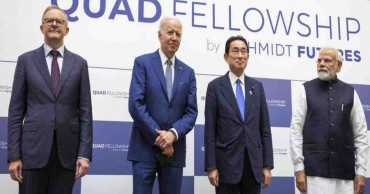
Hours after being sworn in as Australia’s new prime minister, Anthony Albanese found himself fresh off a jet and thrown into the glare of a global spotlight Tuesday. He was rewarded with a warm welcome, as well as a bit of a gentle ribbing, from U.S. President Joe Biden and other leaders at an international summit in Japan.
“You were sworn in and got on a plane, and if you fall asleep while you’re here, it’s OK,” Biden joked as the leaders met at the Quad, an Indo-Pacific security and economic coalition meant as a counterweight to China’s growing influence in the region. Biden marveled at Albanese’s stamina. “I don’t know how you’re doing it. But it is really quite extraordinary, just getting off the campaign trail as well.”
The weekend election win for Albanese, from the center-left Labor Party, was a vivid change in Australian politics, ending nine years of conservative rule, the last several under former leader Scott Morrison.
Albanese has described himself as Australia’s first-ever political candidate with a “non-Anglo Celtic name.” He and Malaysian-born Penny Wong, Australia’s first foreign minister who was born overseas, were sworn into office Monday just before they flew to Tokyo for the meeting with Biden, Japanese Prime Minister Fumio Kishida and Indian Prime Minister Narendra Modi.
Albanese’s election came after a hard-fought campaign during which he caught COVID-19. Because his predecessor set the election date a week later than expected, Albanese had little time to prepare for the Tokyo summit.
For his efforts, however, he received friendly greetings from other leaders.
Also Read: Albanese sworn in as PM in Australia ahead of Tokyo summit
Kishida, in his opening remarks, took note of Albanese’s tight schedule, offering his “heartfelt appreciation for coming all the way to Japan right after the elections.” Modi said Albanese’s presence in Tokyo within 24 hours of his swearing-in “demonstrates the strength of our friendship within the Quad and your commitment to it.”
At the summit, Albanese stressed Australia’s unwavering commitment to the regional forum and stressed his country’s efforts to deal with climate change and look for greater engagement with Southeast Asian countries. He did not mention aggressive security moves by China, which many countries in Asia view with worry.
During the summit, Chinese and Russian strategic bombers conducted joint flights near Japan, Defense Minister Nobuo Kishi said, calling it an “increased level of provocation” and a threat to the Quad.
Chinese H-6 bombers joined Russian TU-95s over the Sea of Japan and flew to areas over the East China Sea, but did not violate Japanese airspace, Kishi said. Separately, a Russian IL-20 reconnaissance plane was spotted flying off the northern Japanese coast.
Kishi said Japan conveyed “serious concern” to both Beijing and Moscow.
China’s Ministry of Defense said the Chinese and Russian militaries carried out joint strategic air patrols above the Sea of Japan, the East China Sea and the western Pacific.
In a meeting later Tuesday, Albanese and Kishida shared concern about China’s new security pact with the Solomon Islands, the Japanese Foreign Ministry said. They also agreed to further cooperation in defense, a new U.S-led regional economic framework, clean energy and supply chain resilience, it said.
4 years ago

Albanese sworn in as PM in Australia ahead of Tokyo summit
Australia’s new prime minister was sworn in Monday ahead of a Tokyo summit with President Joe Biden while vote counting continued to determine whether he will control a majority in a Parliament that is demanding tougher action on climate change.
Prime Minister Anthony Albanese’s center-left Labor Party ousted predecessor Scott Morrison’s conservative coalition at Saturday’s election. The coalition had been in power under three prime ministers for nine years.
“I want to lead a government that has the same sentiment of optimism and hope that I think defines the Australian people,” Albanese said in his hometown of Sydney before flying to the national capital Canberra to be sworn in.
Albanese, who describes himself as the first ever candidate for the office of prime minister with a “non-Anglo Celtic name” and Malaysian-born Penny Wong, Australia’s first foreign minister to be born overseas, were sworn into office by Governor-General David Hurley before the pair flew to Tokyo for a security summit on Tuesday with Biden, Japanese Prime Minister Fumio Kishida and Indian Prime Minister Narendra Modi.
Biden rang Albanese to congratulate him on his election win and express the president’s wish to make the countries’ alliance stronger, the White House said.
Morrison’s decision to resign as prime minister during the early vote counting enabled Hurley, who represents Australia’s head of state, British monarch Queen Elizabeth II, to appoint his replacement without evidence that Albanese can control a majority of seats in parliament’s lower chamber where governments are formed.
Read: Global Covid cases near 528 million
Deputy Prime Minister Richard Marles was also sworn in and will act as prime minister while Albanese is in Japan. Katy Gallagher and Jim Chalmers were sworn into economic ministries.
Labor appears assured of 75 seats, one short of the majority in the 151-seat House of Representatives needed to form an administration. The conservative coalition was on track for 58, unaligned lawmakers 12 and six seats were too close to call, the Australian Electoral Commission said.
Australia’s two major parties, Labor and the conservative Liberal Party, bled votes to independents and fringe parties in Saturday’s election, continuing a trend of dissatisfaction with the political establishment.
Terri Butler, who would have been the new government’s environment minister, was replaced by Max Chandler-Mather, of the climate-focused Greens party that now holds as least three seats in the house, two more than in the last parliament.
Former New South Wales state Premier Kristina Keneally’s bid to move from the senate to the house in what was considered a safe Labor seat in Sydney was defeated by Vietnam-born independent candidate Dai Le, who became the first refugee ever elected to parliament.
Greens leader Adam Bandt supported a Labor minority government from 2010 until its election defeat in 2013 and was prepared to negotiate with Albanese again.
Albanese had been the government’s chief negotiator with its outside supporters in the house during those three years and was praised for his collegial approach.
“Liberal and Labor’s vote went backwards this election. Labor may get over the line with a majority and may not but their vote went backwards,“ Bandt said.
“The Greens and independents said we need to take action on coal and gas which are the main causes of the climate crisis and people agree,’ Bandt added, referring to Australia’s major fossil fuel exports.
“It’s the end of the two-party system as we know it,” he said.
The conservative former government lost six traditionally safe seats to so-called teal independents, greener versions of the Liberal Party’s blue color.
The teals want a more ambitious target that Labor’s promise to reduce greenhouse gas emissions by 43% below the 2005 level by the end of the decade.
Read: Russia presses Donbas attacks as Polish leader praises Kyiv
The previous government had stuck with the same commitment they made at the Paris Agreement in 2015: 26% to 28% below 2005 levels by 2030.
The Greens’ 2030 target is 75%.
4 years ago

Australia's next prime minister came from humble beginnings
Australia's Prime Minister-elect Anthony Albanese is a politician molded by his humble start to life as the only child of a single mother who raised him on a pension in gritty inner-Sydney suburbia.
He is also a hero of multicultural Australia, describing himself as the only candidate with a “non-Anglo Celtic name” to run for prime minister in the 121 years that the office has existed.
He has promised to rehabilitate Australia's international reputation as a climate change laggard with steeper cuts to greenhouse gas emissions.
His financially precarious upbringing in government-owned housing in suburban Camperdown fundamentally formed the politician who has lead the center-left Australian Labor Party into government for the first time since 2007. He is still widely known by his childhood nickname, Albo.
"It says a lot about our great country that a son of a single mom who was a disability pensioner, who grew up in public housing down the road in Camperdown can stand before you tonight as Australia’s prime minister,” Albanese said in his election victory speech on Saturday.
“Every parent wants more for the next generation than they had. My mother dreamt of a better life for me. And I hope that my journey in life inspires Australians to reach for the stars,” he added.
Albanese repeatedly referred during the six-week election campaign to the life lessons he learned from his disadvantaged childhood. Labor’s campaign has focused on policies including financial assistance for first home buyers grappling with soaring real estate prices and sluggish wage growth.
Also read: Australian prime minister concedes election defeat
Labor also promised cheaper child care for working parents and better nursing home care for the elderly.
Albanese this week promised to begin rebuilding trust in Australia when he attends a Tokyo summit on Tuesday with U.S. President Joe Biden, Japanese Prime Minister Fumio Kishida and Indian Prime Minister Narendra Modi.
Albanese said he will be “completely consistent” with Prime Minister Scott Morrison's current administration on Chinese strategic competition in the region.
But he said Australia had been placed in the “naughty corner” in United Nations' climate change negotiations by refusing to adopt more ambitious emissions reduction targets at a November conference.
“One of the ways that we increase our standing in the region, and in particular in the Pacific, is by taking climate change seriously,” Albanese told the National Press Club.
Biden’s administration and Australia “will have a strengthened relationship in our common view about climate change and the opportunity that it represents,” Albanese said.
Albanese blamed Morrison for a “whole series of Australia’s international relations being damaged.”
He said Morrison misled the United States that a secret plan to provide Australia with a fleet of submarines powered with U.S. nuclear technology had the support of Albanese’s Labor Party. In fact, Labor wasn’t told of the plan until the day before it was announced in September.
Albanese also accused Morrison of leaking to the media personal text messages from Emmanuel Macron to discredit the French president’s complaint that Australia had given no warning that a French submarine contract would be canceled.
Also read: Int'l visitors reach two year high as tourists pour back into Australia
In November, French Ambassador to Australia Jean-Pierre Thebault described the leak a “new low” and a warning to other world leaders that their private communications with the Australian government could be weaponized and used against them.
Labor also has described a new security pact been China and the Solomon Islands as Australia’s worst foreign policy failure in the Pacific since World War II.
Morrison's government had aimed to reduce Australia’s emissions by 26% to 28% below 2005 levels by 2030. Labor's goal is 43%.
As a young child, to spare Albanese the scandal of being “illegitimate” in a working-class Roman Catholic family in socially conservative 1960s Australia, he was told that his Italian father, Carlo Albanese, had died in a car accident shortly after marrying his Irish-Australian mother, Maryanne Ellery, in Europe.
His mother, who became an invalid pensioner because of chronic rheumatoid arthritis, told him the truth when he was 14 years old: His father was not dead and his parents had never married.
Carlo Albanese had been a steward on a cruise ship when the couple met in 1962 during the only overseas trip of her life. She returned to Sydney from her seven-month journey through Asia to Britain and continental Europe almost four months pregnant, according to Anthony Albanese’s 2016 biography, “Albanese: Telling it Straight.”
She was living with her parents in their local government-owned house in inner-suburban Camperdown when her only child was born on March 2, 1963.
Out of loyalty to his mother and a fear of hurting her feelings, Albanese waited until after her death in 2002 before searching for his father.
Father and son were happily united in 2009 in the father’s hometown of Barletta in southern Italy. The son was in Italy for business meetings as Australia‘s minister for transport and infrastructure.
Anthony Albanese was a minister throughout Labor’s most recent six years in power and reached his highest office — deputy prime minister — in his government’s final three months, which ended with the 2013 election.
But Albanese’s critics argue that it’s not his humble background but his left-wing politics that make him unsuitable to be prime minister.
The conservative government argued he would be the most left-wing Australian leader in almost 50 years since the crash-or-crash-through reformer Gough Whitlam, a flawed hero of the Labor Party.
In 1975, Whitlam became the only Australian prime minister to be ousted from office by a British monarch’s representative in what is described as a constitutional crisis.
Whitlam had introduced during his brief but tumultuous three years in power free university education, which enabled Albanese to graduate from Sydney University with an economics degree despite his meager financial resources.
Albanese’s supporters say that while he was from Labor’s so-called Socialist Left faction, he was a pragmatist with a proven ability to deal with more conservative elements of the party.
Albanese had undergone what has been described as a makeover in the past year, opting for more fashionable suits and glasses. He has also shed 18 kilograms (40 pounds) in what many assume is an effort to make himself more attractive to voters.
Albanese says he believed he was about to die in a two-car collision in Sydney in January last year and that was the catalyst for his healthier life choices. He had briefly resigned himself to a fate he once believed had been his father’s.
After the accident, Albanese spent a night in a hospital and suffered what he described as external and internal injuries that he has not detailed. The 17-year-old boy behind the wheel of the Range Rover SUV that collided with Albanese’s much smaller Toyota Camry sedan was charged with negligent driving.
Albanese said he was 12 when he became involved in his first political campaign. His fellow public housing tenants successfully defeated a local council proposal to sell their homes — a move that would have increased their rent — in a campaign that involved refusing to pay the council in a so-called rent strike
The unpaid rent debt was forgiven, which Albanese described as a “lesson for those people who weren’t part of the rent strike: Solidarity works.”
“As I grew up, I understood the impact that government had, can have, on making a difference to people’s lives,” Albanese said. “And in particular, to opportunity.”
4 years ago

Australian prime minister concedes election defeat
Australia’s prime minister conceded defeat after an election Saturday that could deliver a minority government.
Scott Morrison acted quickly despite millions of votes yet to be counted because an Australian prime minister must attended a Tokyo summit on Tuesday with U.S., Japanese and Indian leaders.
“I believe it’s very important that this country has certainty. I think it’s very important this country can move forward,” Morrison said.
“And particularly over the course of this week with the important meetings that are being held, I think it’s vitally important there’s a very clear understanding about the government of this country,” he added.
Opposition leader Anthony Albanese will be sworn in as prime minister after his Labor party clenched its first electoral win since 2007.
Labor has promised more financial assistance and a robust social safety net as Australia grapples with the highest inflation since 2001 and soaring housing prices.
Also read: Int'l visitors reach two year high as tourists pour back into Australia
The party also plans to increase minimal wages, and on the foreign policy front, it proposed to establish a Pacific defense school to train neighboring armies in response to China’s potential military presence on the Solomon Islands on Australia’s doorstep.
It also wants to tackle climate change with a more ambitious 43% reduction in greenhouse gas emissions by 2050.
Morrison's Liberal party-led coalition was seeking a fourth three-year term. It holds the narrowest of majorities — 76 seats in the 151-member House of Representatives, where parties need a majority to form a government.
In early counting on Saturday, the coalition was on track to win 38 seats, Labor 71, seven were unaligned lawmakers and 23 were too close to call.
Minor parties and independents appeared to be taking votes from the major parties, which increases the likelihood of a hung parliament and a minority government.
Australia most recent hung parliaments were from 2010-13, and during World War II.
A record proportion of postal votes because of the pandemic, which won’t be added to the count until Sunday, adds to the uncertainty in early counting.
As well as campaigning against Labor, Morrison’s conservative Liberals fought off a new challenge from so-called teal independent candidates to key government lawmakers’ reelection in party strongholds.
At least four Liberal lawmakers appeared to have lost their seats to teal independents including Liberal Party deputy leader Josh Frydenberg, who had been considered Morrison’s most likely successor.
“What we have achieved here is extraordinary,” teal candidate and former foreign correspondent Zoe Daniels said in her victory speech. “Safe Liberal seat. Two-term incumbent. Independent,” she added.
The teal independents are marketed as a greener shade than the Liberal Party’s traditional blue color and want stronger government action on reducing Australia’s greenhouse gas emissions than either the government or Labor are proposing.
Also read: Australia to send armored vehicles to Ukraine after request
The government’s Senate leader Simon Birmingham was concerned by big swings toward several teal candidates.
“It is a clear problem that we are losing seats that are heartland seats, that have defined the Liberal Party for generations,” Birmingham said.
“If we lose those seats — it is not certain that we will — but there is clearly a big movement against us and there is clearly a big message in it,” Birmingham added.
Due to the pandemic, around half of Australia’s 17 million electors have voted early or applied for postal votes, which will likely slow the count.
Voting is compulsory for adult citizens and 92% of registered voters cast ballots at the last election.
Early polling for reasons of travel or work began two weeks ago and the Australian Electoral Commission will continue collecting postal votes for another two weeks.
The government changed regulations on Friday to enable people recently infected with COVID-19 to vote over the phone.
Electoral Commissioner Tom Rogers said more than 7,000 polling stations opened as planned and on time across Australia despite 15% of polling staff falling sick this week with COVID-19 and flu.
Albanese said he had thought Morrison would have called the election last weekend because Australia’s prime minister is expected at a Tokyo summit on Tuesday with U.S. President Joe Biden, Japanese Prime Minister Fumio Kishida and Indian Prime Minister Narendra Modi.
“If we get a clear outcome today then whoever is prime minister will be on a plane to Tokyo on Monday, which isn’t ideal, I’ve got to say, immediately after a campaign,” Albanese said.
Analysts have said that Morrison left the election until the latest date available to him to give himself more time to reduce Labor’s lead in opinion polls.
4 years ago

New Zealand PM tests positive for COVID-19
New Zealand Prime Minister Jacinda Ardern confirmed on Saturday that she had tested positive for COVID-19.
"Despite best efforts, unfortunately, I've joined the rest of my family and tested positive for COVID-19," Ardern posted on social media on Saturday morning.
Ardern has been isolating at home with her family since Sunday when her fiancée Clarke Gayford tested positive.
"We've been isolating since Sunday when Clarke first tested positive. Neve (Ardern's daughter) tested positive on Wednesday, and I returned a weak positive last night and a strong one this morning," said Ardern.
Also Read: New Zealand welcomes back tourists as pandemic rules eased
"To anyone else out there, isolating or dealing with COVID, I hope you take good care of yourselves," said Ardern.
New Zealand recorded 7,441 new community cases of COVID-19, 2,503 of which were reported in the largest city Auckland, the ministry of health said on Friday.
To date, the country has reported 1,026,715 confirmed cases of COVID-19 since the beginning of the pandemic.
4 years ago

Int'l visitors reach two year high as tourists pour back into Australia
With borders opening, Australia's reeling tourism industry has begun to see its first influx of international tourists in over two years.
Managing director of the Australian Tourism Export Council (ATEC), Australia's peak tourism body, Peter Shelley said on Friday that a long period of uncertainty was beginning to come to an end.
Australia's export tourism industry has endured two years of debilitating conditions where many businesses simply had no income or vision on when it would end, Shelley said.
According to data released by Australian Bureau of Statistics (ABS) on Thursday, Australia's international visitors had reached their highest levels since February of 2020, when an estimated 647,000 international travelers arrived in Australia before its borders were shut in March.
In April this year, 575,530 visitors arrived in Australia, 200,000 more visitors than the previous month.
Also Read: Australian researchers make breakthrough in rare blood cancer treatment
As a result, the pandemic has all but decimated Australia's 45 billion Australian dollars (about 31 billion U.S. dollars) export tourism industry, however, the ATEC said that government and industry would need to play an active role in its recovery.
"Now we have our borders open we are seeing the green shoots of recovery and with export tourism businesses looking to rebuild their markets, this (is) an important time for government focus on investing in getting the industry back on its feet," said Shelley.
The ATEC launched a tourism campaign dubbed "its time for tourism," which called for greater funding for peak tourism marketing body, Tourism Australia, and greater training for workers in the tourism industry.
"While we rebuild our industry we also have the opportunity to innovate and improve business practices, support a more sustainable industry and create a tourism industry of the future," said Shelley.
4 years ago

New Zealand welcomes back tourists as pandemic rules eased
New Zealand welcomed tourists from the U.S., Canada, Britain, Japan and more than 50 other countries for the first time in more than two years Monday after dropping most of its remaining pandemic border restrictions.
The country has long been renowned for its breathtaking scenery and adventure tourism offerings such as bungy jumping and skiing. Before the spread of COVID-19, more than 3 million tourists visited each year, accounting for 20% of New Zealand’s foreign income and more than 5% of the overall economy.
But international tourism stopped altogether in early 2020 after New Zealand imposed some of the world’s toughest border restrictions.
Also Read: New Zealand to remove pandemic mandates as Omicron wanes
The border rules remained in place as the government at first pursued an elimination strategy and then tried to tightly control the spread of the virus. The spread of omicron and vaccinations of more than 80% of New Zealand’s 5 million population prompted the gradual easing of restrictions.
New Zealand reopened to tourists from Australia three weeks ago and on Monday to about 60 visa-waiver countries, including much of Europe. Most tourists from India, China and other non-waiver countries are still not allowed to enter.
Tourists will need to be vaccinated and to test themselves for the virus before and after arriving.
“Today is a day to celebrate, and is a big moment in our reconnection with the world,” said Tourism Minister Stuart Nash.
At Auckland Airport, flights bringing in tourists began landing from early in the morning, coming in direct from places including Los Angeles, San Francisco, Kuala Lumpur, and Singapore.
The border reopening will help boost tourism ahead of New Zealand’s upcoming ski season. But the real test of how much the tourism industry rebounds will come in December, when the peak summer season begins in the Southern Hemisphere nation.
Also Read: New Zealand reports the 1st Omicron XE variant
Prime Minister Jacinda Ardern said more than 90,000 people had booked flights to New Zealand in the seven weeks since the reopening was announced and 21 international flights were scheduled to land Monday in Auckland.
“Our tourism industry have felt the effects of the global pandemic acutely, and are working hard to prepare,” she said.
4 years ago