australia

Australian banknotes will no longer feature the British monarchy
Australia is removing the British monarchy from its bank notes.
The nation's central bank said Thursday its new $5 bill would feature an Indigenous design rather than an image of King Charles III. But the king is still expected to appear on coins.
The $5 bill was Australia’s only remaining bank note to still feature an image of the monarch.
The bank said the decision followed consultation with the government, which supported the change. Opponents say the move is politically motivated.
The British monarch remains Australia's head of state, although these days that role is largely symbolic. Like many former British colonies, Australia is debating to what extent it should retain its constitutional ties to Britain.
Australia's Reserve Bank said the new $5 bill would feature a design to replace a portrait of Queen Elizabeth II, who died last year. The bank said the move would honor “the culture and history of the First Australians.”
“The other side of the $5 banknote will continue to feature the Australian parliament," the bank said in a statement.
Treasurer Jim Chalmers said the change was an opportunity to strike a good balance.
“The monarch will still be on the coins, but the $5 note will say more about our history and our heritage and our country, and I see that as a good thing,” he told reporters in Melbourne.
Opposition Leader Peter Dutton likened the move to changing the date of the national day, Australia Day.
“I know the silent majority don’t agree with a lot of the woke nonsense that goes on but we’ve got to hear more from those people online,” he told 2GB Radio.
Dutton said Prime Minister Anthony Albanese was central to the decision for the king not to appear on the note, urging him to “own up to it."
The bank plans to consult with Indigenous groups in designing the $5 note, a process it expects will take several years before the new note goes public.
The current $5 will continue to be issued until the new design is introduced and will remain legal tender even after the new bill goes into circulation.
The face of King Charles III is expected to be seen on Australian coins later this year.
One Australian dollar is worth about 71 cents in U.S. currency.
Read more: France, Australia to supply Ukraine with artillery shells
3 years ago

New Zealand's Ardern has many possibilities for a second act
When Jacinda Ardern announced this week she was stepping down as New Zealand's prime minister, speculation began almost immediately about what she might do for a second act.
When she leaves, she will have accumulated 15 years experience as a lawmaker and five-and-a-half years as leader. She will also be just 42 years old. Observers say she has all sorts of career possibilities open to her.
Ardern said she was leaving the job because she no longer has “enough in the tank to do it justice” and has no immediate plans for her own future other than to spend more time with her fiancé and 4-year-old daughter.
Read more: New Zealand's Ardern, an icon to many, to step down
“I’ll have to admit I slept well for the first time in a long time last night," Ardern told reporters Friday, adding that she felt both sadness and relief.
Stephen Hoadley, an assistant professor of politics and international relations at the University of Auckland, said he couldn't imagine Ardern would remain at home over the long term, given her energy and skills.
“She has the potential, she has the ability, she has the profile, she has the acceptability to do a whole lot of things," Hoadley said. “Give her a few weeks to rest up, and to refill the tank, to use her phrase. But I would imagine by the end of this year, she’ll be off and running on a whole new career line.”
Hoadley pointed to the career path of Helen Clark, another former New Zealand prime minister who went on to become a top administrator at the U.N., leading the development program.
“Jacinda could be tapped by any number of United Nations, or charitable, or philanthropical, or other kinds of organizations,” Hoadley said.
“There are many, many possibilities, and her profile is so high that I think she would have her pick.”
Climate Change Minister James Shaw, who first met Ardern in about 2007 and has remained friends, said he was in shock but also not wholly surprised when Ardern told him of her plans to resign.
“It's been a really intense five years,” Shaw said.
On top of a busy legislative program, Shaw said, Ardern had needed to steer the country through a series of crises, including a mass-shooting at two Christchurch mosques that left 51 people dead, a volcanic eruption that killed 22, and the coronavirus pandemic.
On top of that, Ardern also bore the brunt of a growing number of threats, Shaw said, and a toxic, misogynistic online culture that had grown worse in recent years.
Read more: New Zealand PM Jacinda Ardern to leave office next month, sets October election
“What I hope is that she can get some time at the beach with her family, uninterrupted, for a while,” Shaw said.
He said he believes Ardern when she says she doesn’t yet have firm plans for the future.
“I think she could do pretty much whatever she wants from this point,” Shaw said.
“Jacinda is one of the most selfless, determined, publicly-minded people I have ever met," Shaw added. "So I would imagine that whatever it is, it will be in the public interest.”
3 years ago

New Zealand's Ardern, an icon to many, to step down
New Zealand Prime Minister Jacinda Ardern, who was praised around the world for her handling of the nation’s worst mass shooting and the early stages of the coronavirus pandemic, said Thursday she was leaving office.
Ardern was facing mounting political pressures at home and a level of vitriol from some that hadn’t been experienced by previous New Zealand leaders. Still, her announcement came as a shock to people throughout the nation of 5 million people.
Fighting back tears, Ardern told reporters in Napier that Feb. 7 would be her last day as prime minister.
“I am entering now my sixth year in office, and for each of those years, I have given my absolute all,” she said.
Ardern became an inspiration to women around the world after first winning the top job in 2017 at the relatively young age of 37. She seemed to herald a new generation of leadership — she was on the verge of being a millennial, had spun some records as a part-time DJ, and wasn’t married like most politicians.
To many, she was the antithesis of U.S. President Donald Trump.
Read more: New Zealand PM Jacinda Ardern to leave office next month, sets October election
In 2018, she became just the second world leader to give birth while holding office. Later that year, she brought her infant daughter to the floor of the U.N. General Assembly in New York.
In March 2019, Ardern faced one of the darkest days in New Zealand’s history when a white supremacist gunman stormed two mosques in Christchurch and slaughtered 51 people. She was widely praised for the way she empathized with the survivors and New Zealand’s Muslim community in the aftermath.
Less than nine months later, she faced another tragedy when 22 tourists and guides were killed when the White Island volcano erupted.
Ardern was lauded globally for her country’s initial handling of the coronavirus pandemic. after New Zealand managed to stop the virus at its borders for months. But she was forced to abandon that zero-tolerance strategy as more contagious variants spread and vaccines became widely available.
Ardern faced growing anger at home from those who opposed coronavirus mandates and rules. A protest against vaccine mandates that began on Parliament’s grounds last year lasted for more than three weeks and ended with protesters hurling rocks at police and setting fires to tents and mattresses as they were forced to leave. This year, Ardern was forced to cancel an annual barbecue she hosts due to security fears.
Ardern last month announced a wide-ranging Royal Commission of Inquiry would look into whether the government made the right decisions in battling COVID-19 and how it could better prepare for future pandemics. A report is due next year.
Some experts said that sexist attitudes played a role in the anger directed at Ardern.
But her government also faced criticism that it had been big on ideas but lacking on execution. Supporters worried it hadn’t made promised gains on increasing housing supply and reducing child poverty, while opponents said it was not focusing enough on crime and the struggling economy.
Farmers protested against plans to tax cow burps and other greenhouse gas emissions.
Ardern had been facing tough reelection prospects. Her center-left Labour Party won reelection in 2020 with a landslide of historic proportions, but recent polls have put her party behind its conservative rivals.
Ardern said the role required having a reserve to face the unexpected.
“But I am not leaving because it was hard. Had that been the case I probably would have departed two months into the job,” she said. “I am leaving because with such a privileged role comes responsibility. The responsibility to know when you are the right person to lead, and also, when you are not.”
She said her time in office had been fulfilling but challenging.
Read more: Ardern, rival turn her hot-mic vulgarity into charity’s win
“I know what this job takes, and I know that I no longer have enough in the tank to do it justice. It is that simple,” she said.
Australian Prime Minister Anthony Albanese said Ardern “has shown the world how to lead with intellect and strength.”
“She has demonstrated that empathy and insight are powerful leadership qualities,” Albanese tweeted.
“Jacinda has been a fierce advocate for New Zealand, an inspiration to so many and a great friend to me,” he added.
Canadian Prime Minister Justin Trudeau thanked Ardern on Twitter for her friendship and “empathic, compassionate, strong, and steady leadership.”
Ardern charted an independent course for New Zealand. She tried to take a more diplomatic approach to China than neighboring Australia, which had ended up feuding with Beijing. In an interview with The Associated Press last month, she’d said that building relationships with small Pacific nations shouldn’t become a game of one-upmanship with China.
Ardern on Thursday also announced that New Zealand’s 2023 general elections would be held on Oct. 14, and that she would remain a lawmaker until then.
It’s unclear who will take over as prime minister until the election. Deputy Prime Minister Grant Robertson announced that he won’t contest the leadership of the Labour Party, throwing the competition open.
Labour Party lawmakers will vote for a new leader on Sunday. If no candidate gets at least two-thirds support from the caucus, then the leadership contest will go to the wider party membership. Ardern has recommended the party chose her replacement by the time she finishes in the role on Feb. 7.
New Zealand Opposition Leader Christopher Luxon said Ardern had been a strong ambassador for the country on the world stage. He said that for his party “nothing changes” and it remains intent on winning the election and to "deliver a government that can get things done for the New Zealand people.”
Ardern said she didn’t have any immediate plans after leaving office, other than family commitments with her daughter, Neve, and her fiancé Clarke Gayford, after an outbreak of the virus thwarted their earlier wedding plans.
“And so to Neve, Mum is looking forward to being there when you start school this year,” Ardern said. “And to Clarke, let’s finally get married.”
3 years ago

Pilot, 2 British visitors among 4 killed in Australia crash
A pilot, two British visitors and a Sydney woman have been identified as the four people killed in a collision of two helicopters over the waterfront at an Australian tourist hotspot.
Authorities say it was fortunate the death toll in the crash of two aircraft operated by Sea World Helicopters was not higher. The pilot of the second helicopter managed to land safely on a sandy outcrop despite the aircraft being damaged in the collision Monday afternoon near Main Beach on Australia’s Gold Coast.
“Considering the damage that was done to the front left-hand section of the helicopter, where the pilot was sitting, that has been a remarkable achievement,” said Australian Transport Safety Bureau Chief Commissioner Angus Mitchell, whose office is investigating the crash.
“So whilst it has been very tragic that four people have lost their lives and many people are mourning this morning, we could have had a far worse situation here and the fact that one helicopter managed to land has been quite remarkable.”
The pilot who died, Ashley Jenkinson, had worked as a chief pilot at Sea World Helicopters since 2019, and friends praised his mentorship and the assistance he provided during catastrophic floods in the New South Wales town of Ballina last year. The Gold Coast Bulletin reported he was 40 and had become a father in September.
Canada, Australia impose COVID rules on travelers from China Ruud begins 2023 on a winning note at United Cup His helicopter had been in the air for less than 20 seconds when it collided with the second Sea World Helicopter attempting to land.
Mitchell said the main rotor blade of the aircraft made contact with the front cockpit of the descending helicopter.
“That in itself has led to the main rotor and the gearbox separating from that helicopter, which has meant that, tragically, it’s then had no lift and has fallen heavily to the ground,” he said.
Investigators remain at the scene of the crash site, but a rising sea tide was adding to the difficulty of collecting evidence from the scene.
Mitchell said investigators wanted to identify what was occurring in the “cockpits at the time” of the collision.
The Foreign, Commonwealth and Development Office said it is supporting the family of the deceased 57-year-old woman and 65-year-old man from Britain who had been visiting Australia’s Queensland state on holiday.
Read more:
Airplane crash in Gulf of Mexico leaves 2 dead, 1 missing
The other passenger who died was a 36-year-old woman from the Sydney suburb of Glenmore Park.
Three passengers from the flight remain hospitalized: A 10-year-old boy, also from Glenmore Park, in critical condition, a 33-year-old woman from Geelong in critical condition, and a 9-year-old boy from Victoria state whose condition was stable.
The passengers from the helicopter that landed safely included two couples in their 40s from New Zealand and a 27-year-old woman from Western Australia. Three of the five passengers remain hospitalized after being showered in glass.
Holiday visitors and people enjoying the water had rushed to assist emergency service workers when the crash occurred near the Sea World marine park, during Australia’s peak summer holiday period.
Authorities praised members of the public who rushed to the aid of those in the helicopters.
“Our thoughts do go out to all those who were affected here, not only those on the helicopter and their extended families, but also those who were on the broadwater yesterday and have witnessed the confronting scenes of those helicopters coming down, particularly those people who were the first responders,” Mitchell said.
Read more: Small plane crashes into Tanzania's Lake Victoria, 19 dead
Village Roadshow Theme Parks, which owns Sea World Helicopters, said in a statement it was working with authorities while “offering its deepest condolences to those impacted” by the tragedy.
Australian Prime Minister Anthony Albanese also offered his “deepest sympathies to those who are grieving.”
“Australia is shocked by the news of the terrible and tragic helicopter incident … on the Gold Coast,” he wrote on social media.
3 years ago

Helicopters collide over Australian beach, 4 passengers dead
Two helicopters collided in an Australian tourist hotspot Monday afternoon, killing four passengers and critically injuring three others in a crash that drew emergency aid from beachgoers enjoying the water during the southern summer.
One helicopter appeared to have been taking off and the other landing when they collided near the Sea World theme park in Main Beach, a northern beach on the Gold Coast, Gary Worrell, Queensland state police acting inspector, said at a news conference.
Read more: Helicopter crash kills 3 in Kabul during training session
One helicopter landed safely on a sandbank, but debris from the other was spread across an area police described as difficult to access.
The dead and three most seriously injured people were all passengers in the crashed helicopter.
“Members of the public and police tried to remove the people and they commenced first aid and tried to get those people to safety from an airframe that was upside down,” Worrell said.
“(People on) Jet Skis, family boaters, ordinary members of the public rushed to assist these people.”
Passengers in the other helicopter, which lost its windscreen in the crash, are also receiving medical assistance.
Footage of the crash showed a helicopter shortly after takeoff being clipped by another helicopter flying over the water.
A witness named John told Melbourne radio station 3AW that patrons at Sea World heard the crash.
Read more: Pakistan says army general, 5 others die in helicopter crash
He said staff at the theme park moved swiftly to close off areas closest to the crash.
“There was a massive, massive bang,” he said. “It was just huge. I’m not sure if it was the propellers or whatever hitting against each other. But there was this poor lady and her son near the helipad in tears.”
Queensland Premier Annastacia Palaszczuk said the accident was an “unthinkable tragedy.
“My deepest sympathies are with each of the families and everyone affected by this terrible accident,” she said.
Australian Transport Safety Bureau chief commissioner Angus Mitchell said an investigation into the cause of the crash was underway.
Queensland Ambulance Service said earlier that 13 people were being assessed for injuries.
The Gold Coast region is at its busiest in January, the peak time for holidays in Australia's summer.
3 years ago

Fiji calls in military after close election is disputed
Fijian police on Thursday said they were calling in the military to help maintain security following a close election last week that is now being disputed.
It was an alarming development in a Pacific nation where democracy remains fragile and there have been four military coups in the past 35 years. The two main contenders for prime minister this year were former coup leaders themselves.
Police Commissioner Brig. Gen. Sitiveni Qiliho said in a statement that after police and military leaders met with Prime Minister Frank Bainimarama they collectively decided to call in army and navy personnel to assist.
The commissioner said there had been threats made against minority groups who were “now living in fear following recent political developments.”
Reporters in the capital, Suva, said there were no immediate signs of any military presence on city streets.
The military move came after Bainimarama’s Fiji First party refused to concede the election, despite rival Sitiveni Rabuka’s party and two other parties announcing they had the numbers to form a majority coalition and would serve as the next government.
Fiji First Gen. Sec. Aiyaz Sayed-Khaiyum told media Wednesday that under the nation’s constitution, Bainimarama would remain prime minister until lawmakers returned to Parliament within two weeks to vote on the next leader.
Read more: Vote counting finishes in Fiji election with no clear winner
Sayed-Khaiyum questioned the validity of the internal voting which had led to one of the parties joining Rabuka’s coalition. And he lashed out at Rabuka, accusing him of sowing division in Fiji.
“The entire rationale of this man has been to divide Fiji to gain political supremacy,” Sayed-Khaiyum said. “And we can see that simmering through again. In fact it’s not simmering, it’s boiling.”
A day earlier, Rabuka and two other party leaders announced they were forming a coalition with a total of 29 seats against Fiji First’s 26 and would form the next government.
“A government we hope that will bring the change that people had been calling out for over the last few years,” Rabuka said at a news conference. “It’s going to be an onerous task. It will not be easy, and it was never easy to try and dislodge an incumbent government. We have done that, collectively.”
Rabuka’s announcement prompted New Zealand Foreign Minister Nanaia Mahuta to send her congratulations on Twitter, saying New Zealand “looks forward to working together to continue strengthening our warm relationship.”
But New Zealand Prime Minister Jacinda Ardern took a more cautious approach, saying she was waiting until the dust settled.
Bainimarama has been in power for 16 years. He led a 2006 military coup and later refashioned himself as a democratic leader by introducing a new constitution and winning elections in 2014 and 2018.
Rabuka, meanwhile, led Fiji’s first military takeover in 1987 and later served seven years as an elected prime minister in the 1990s.
Bainimarama and Rabuka were initially deadlocked after the election. Rabuka’s People’s Alliance Party won 21 seats and the affiliated National Federation Party won five seats, while Bainimarama’s Fiji First party secured 26 seats.
That left the Social Democratic Liberal Party, which won three seats, holding the balance of power. The party decided Tuesday in a close 16-14 internal vote to go with Rabuka — a vote that Fiji First is now questioning.
3 years ago
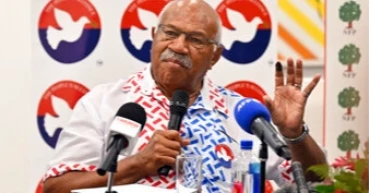
Vote counting finishes in Fiji election with no clear winner
Vote counting finished in Fiji's general election Sunday but there was no clear winner, and various political parties are now negotiating to form a coalition government.
The election had pitted two former coup leaders against each other.
Sitiveni Rabuka, who led a coup back in 1987 and later served as an elected prime minister in the 1990s, emerged as the main challenger to Prime Minister Frank Bainimarama, who has held power for the past 16 years.
Rabuka’s People’s Alliance Party and allies the National Federation Party won about 45% of the vote combined. Bainimarama's Fiji's First party, meanwhile, won about 43%.
That has left both sides seeking to form a coalition with the Social Democrat Liberal Party.
The liberal party's general secretary Lenaitasi Duru told media they were having meetings with both sides.
“The first round of negotiations was done yesterday,” Duru said. "We are expecting more negotiations later this afternoon.”
He said the party's priorities included Indigenous affairs and education.
“Right now we’re sitting in the middle," Duru said. "We’re watching and waiting for what is on offer, then we’ll make the decision based on what’s best for the nation.”
Earlier, on Friday, Rabuka's party and four others had said they were launching a nationwide petition because they had no faith in the integrity of election officials.
Read more: Peru s presidential runoff election too close to call
But an international group that monitored the election said Friday it did not observe any voting irregularities and the process was transparent and credible.
The dispute had threatened to destabilize the Pacific nation’s fragile democracy, which has been marred by four military coups in the past 35 years.
Rebekha Sharkie, an Australian lawmaker and co-chair of the 90-strong Multinational Observer Group, told reporters in Fiji they had unrestricted access to the election process and didn't observe any irregularities. She said the group had assessed that Fijians were able to vote freely.
Rabuka’s concerns came after his party had been leading in preliminary results posted online after polls closed, but then the results app stopped working.
Election officials said they’d found an anomaly in the system and needed to reload the results. When the next batch of results was posted, Bainimarama’s party was in front.
Election officials later stopped their provisional count and switched to a final count.
Bainimarama first seized the top job by force in 2006 and later refashioned himself as a democratic leader by introducing a new constitution and winning elections in 2014 and again in 2018.
Fiji is known abroad as a tourist paradise that is dotted with pristine beaches and filled with friendly, relaxed people.
Read more: Congress removes Peru's president amid political unrest
However, the past few years have proved tough for many people in the nation of just under 1 million, after tourism evaporated when COVID-19 hit and the economy tanked. The World Bank estimates the nation’s poverty rate is about 24%.
3 years ago

2002 Bali terrorist attack: Australia wants Indonesia to monitor released bombmaker
Australia’s government on Thursday said it was seeking assurances from Indonesia that the man convicted of making the bombs used in the 2002 Bali terrorist attacks would continue to be monitored after his release from prison.
Islamic militant Hisyam bin Alizein, also known as Umar Patek, was paroled Wednesday after serving about half of his original 20-year sentence, despite strong objections from Australia.
The attacks killed 202 people, including 88 Australians.
Australia’s Deputy Prime Minister Richard Marles said it was a difficult day for those who lost loved ones in the bombings.
Also read: Indian police detain man accused of killing Australian woman because ‘her dog barked at him’
He told the Australian Broadcasting Corp. that his government had advocated against Patek’s early release and would urge the Indonesian government to ensure he was under constant surveillance while on parole.
Indonesian authorities have said Patek, 55, was successfully reformed in prison and they will use him to influence other militants to turn away from terrorism.
Home Affairs Minister Clare O’Neil said it was a horrible day for the victims and their families.
“This is a person who was in the Indonesian justice system. My personal view is his actions are inexcusable and completely abhorrent,” O’Neil said at the National Press Club in Canberra. ”We don’t control the Indonesian justice system, and that is the way of the world.”
Bombing survivor Peter Hughes, who gave evidence at Patek’s trial, said he and other survivors were skeptical the bomber was a changed man.
“There is a history of people like him, they won’t stop. For him to be let out is laughable,” Hughes told the ABC.
Another survivor, Jan Laczynski, said he was shocked and appalled at Patek’s release.
“I still can’t understand how this person that created so much loss of life, and not just for 88 Australians — 202 people — could be walking free this morning,” he told Channel 9.
Lawmaker Chris Bowen said Patek’s release was concerning but the Australian government respected Indonesia’s legal system.
“Indonesians and Australians were killed by these terrible murders, Indonesians and Australians went through this terrible ordeal together,” he told the ABC.
Patek was a leading member of Jemaah Islamiah, which was blamed for the blasts at two nightclubs in Kuta Beach. He was found guilty by the West Jakarta District Court of helping build a car bomb that was detonated by another person outside the Sari Club in Kuta on the night of October 12, 2002.
Moments earlier, a smaller bomb in a backpack was detonated by a suicide bomber in the nearby Paddy’s Pub nightclub.
3 years ago

Australia argues against 'endangered' Barrier Reef status
Australia’s environment minister said Tuesday her government will lobby against UNESCO adding the Great Barrier Reef to a list of endangered World Heritage sites.
Officials from the U.N. cultural agency and the International Union for Conservation of Nature released a report on Monday warning that without “ambitious, rapid and sustained” climate action, the world’s largest coral reef is in peril.
The report, which recommended shifting the Great Barrier Reef to endangered status, followed a 10-day mission in March to the famed reef system off Australia’s northeast coast that was added to the World Heritage list in 1981.
Environment Minister Tanya Plibersek said the report was a reflection on Australia’s previous conservative government, which was voted out of office in May elections after nine years in power.
She said the new center-left Labor Party government has already addressed several of the report’s concerns, including action on climate change.
“We’ll very clearly make the point to UNESCO that there is no need to single the Great Barrier Reef out in this way" with an endangered listing, Plibersek told reporters.
read more: Coral reefs' survival at stake: Unesco
“The reason that UNESCO in the past has singled out a place as at risk is because they wanted to see greater government investment or greater government action and, since the change of government, both of those things have happened,” she added.
The new government has legislated to commit Australia to reducing its greenhouse gas emissions by 43% below the 2005 level by 2030.
The previous government only committed to a reduction of 26% to 28% by the end of the decade.
Plibersek said her government has also committed 1.2 billion Australian dollars ($798 million) to caring for the reef and has canceled the previous government’s plans to build two major dams in Queensland state that would have affected the reef’s water quality.
“If the Great Barrier Reef is in danger, then every coral reef in the world is in danger,” Plibersek said. “If this World Heritage site is in danger, then most World Heritage sites around the world are in danger from climate change.”
The report said Australia’s federal government and Queensland authorities should adopt more ambitious emission reduction targets in line with international efforts to limit future warming to 1.5 degrees Celsius (2.7 degrees Fahrenheit) since pre-industrial times.
Read more: Great Barrier Reef enters crucial period in coral bleaching
The minor Greens party, which wants Australia to slash its emissions by 75% by the end of the decade, called for the government to do more to fight climate change in light of the report.
Jodie Rummer, a marine biologist at James Cook University in Townville who has worked on the reef for more than a decade, supported calls for Australia to aim for a 75% emissions reduction.
“We are taking action, but that action needs to be much more rapid and much more urgent,” Rummer told Australian Broadcasting Corp.
“We cannot claim to be doing all we can for the reef at this point. We aren’t. We need to be sending that message to the rest of the world that we are doing everything that we possibly can for the reef and that means we need to take urgent action on emissions immediately,” she added.
Feedback from Australian officials, both at the federal and state level, will be reviewed before Paris-based UNESCO makes any official proposal to the World Heritage committee.
In July last year, the previous Australian government garnered enough international support to defer an attempt by UNESCO to downgrade the reef’s status to “in danger” because of damage caused by climate change.
The Great Barrier Reef accounts for around 10% of the world’s coral reef ecosystems. The network of more than 2,500 reefs covers 348,000 square kilometers (134,000 square miles).
Australian government scientists reported in May that more than 90% of Great Barrier Reef coral surveyed in the latest year was bleached, in the fourth such mass event in seven years.
Bleaching is caused by global warming, but this is the reef’s first bleaching event during a La Niña weather pattern, which is associated with cooler Pacific Ocean temperatures, the Great Barrier Reef Marine Authority said in its annual report.
Bleaching in 2016, 2017 and 2020 damaged two-thirds of the coral.
Coral bleaches as a response to heat stress and scientists hope most of the coral will recover from the latest event.
3 years ago

New Zealand to decide on lowering voting age from 18 to 16
New Zealand lawmakers will take a vote on whether to lower the national voting age from 18 to 16, Prime Minister Jacinda Ardern said Monday.
Her announcement came hours after the country's Supreme Court ruled that not allowing 16- and 17-year-olds to vote amounted to age discrimination.
But while Ardern said she personally favors lowering the age, such a change would require a 75% supermajority of lawmakers to agree. And even proponents acknowledge they don't currently have the numbers.
A number of countries are debating whether to lower their voting age. Some that allow people to vote at 16 include Austria, Malta, Brazil, Cuba and Ecuador.
Sanat Singh, co-director of New Zealand's Make It 16 campaign, said he was absolutely thrilled with the court's decision.
Read more: Climate change in New Zealand to cause sperm, blue whales to seek higher latitudes
“It's a huge day,” he said. “This is historic not only for our campaign, but for the country.”
Singh, 18, said existential issues like climate change — as well as issues like pandemic recovery and the state of democracy — will most affect young people.
“That's why I think it's really important to get all hands on deck to make sure we can have a stronger future,” he said.
Ardern, who leads the liberal Labour Party, said all lawmakers should have a say on the issue.
“I personally support a decrease in the voting age but it is not a matter simply for me or even the government,” Ardern said. “Any change in electoral law of this nature requires 75% of parliamentarians' support.”
Ardern said the vote would likely take place within the coming months but any change would not take effect until after next year's general election.
The liberal Green Party said it supported a change.
“Young people deserve to have a say in the decisions that affect them, both now and in the future,” said Golriz Ghahraman, the party’s electoral reform spokesperson.
But New Zealand's two main conservative opposition parties said they oppose a change.
Read more: New Zealand welcomes back first cruise ship since COVID hit
“It's not something we support,” Opposition Leader Christopher Luxon told reporters. “Ultimately, you've got to draw the line somewhere, and we're comfortable with the line being 18.”
At the Supreme Court, four judges found in favor of the lobby group's appeal with a fifth judge dissenting to some aspects of the decision.
In New Zealand, the protection against age discrimination begins at 16, and the judges ruled that the attorney-general had failed to show why 18 had been chosen as the age to vote rather than 16.
The nature of the court’s ruling compelled New Zealand lawmakers to at least debate the issue, but it didn’t compel them to take a vote or to make a change.
Singh said he's hopeful that while his group may not yet have the 75% support it needs in Parliament, it will get there within the next few years. He said a possible first step would be to get the voting age lowered to 16 for local council elections, as that change requires only a regular majority of lawmakers.
New Zealand's voting age was previously lowered from 21 to 20 in 1969, and then to 18 in 1974.
3 years ago