Europe

Russian drones kill 4 at Ukraine dorm, as rival summits end
Russia launched exploding drones that killed at least four people at a student dormitory near Kyiv before dawn Wednesday, just hours after Japan's prime minister left the Ukrainian capital following a show of support for the country. The same day, Chinese leader Xi Jinping left Moscow after discussing his proposal for ending the war, which has been rejected by the West as a non-starter.
A high school and two dormitories were partially destroyed in an overnight drone attack in the city of Rzhyshchiv, south of the Ukrainian capital, local officials said. It wasn't clear how many people were in the dormitories at the time.
The body of a 40-year-old man was pulled from the rubble on a dormitory's fifth floor, according to regional police chief Andrii Nebytov.
More than 20 people were hospitalized, Nebytov said, and a few others were unaccounted for.
Ukrainian air defenses downed 16 of the 21 drones launched by Russia, the Ukraine General Staff said. Eight of them were shot down near the capital, according to the city's military administration. Other drone attacks struck central-western Khmelnytskyi province.
The drone barrage and other Russian overnight attacks that struck civilian infrastructure drew a scathing response from President Volodymyr Zelenskyy, a day after Xi and Russian President Vladimir Putin discussed China's proposals for negotiating an end to the war.
"Over 20 Iranian murderous drones, plus missiles, numerous shelling occasions, and that's just in one last night of Russian terror," Zelenskyy wrote in English on Twitter.
"Every time someone tries to hear the word 'peace' in Moscow, another order is given there for such criminal strikes," he wrote.
Japanese Prime Minister Fumio Kishida, who is the current chair of the Group of Seven countries, made a surprise visit to Kyiv on Tuesday, throwing his support behind Zelenskyy's government as his Asian rival Xi sided with Putin.
After returning to Poland Wednesday morning, Kishida said he had expressed the "unwavering determination of solidarity" of Japan and G-7 to Ukraine during his talks with Zelenskyy.
Kishida's visit to Ukraine was "very meaningful" for Japan's future support for that country, Japan's top government spokesman said Wednesday.
"Through Prime Minister Kishida's visit to Ukraine, Japan was able to show not only to other members of the G-7 but also the international society including the Global South (nations) its determination to defend the rules-based international society," Hirokazu Matsuno said.
Kishida's visit snatched away some of the attention from Xi's trip to Moscow where he promoted Beijing's peace proposal for Ukraine, which Western nations had already dismissed as a way to consolidate Moscow's gains. Xi left Moscow early Wednesday.
The visits by Xi and Kishida, about 800 kilometers (500 miles) apart, highlighted how countries are lining up behind Moscow or Kyiv during the nearly 13-month-old war.
In a joint statement, Russia and China emphasized the need to "respect legitimate security concerns of all countries" to settle the conflict, echoing Moscow's argument that it sent in troops to prevent the U.S. and its NATO allies from turning the country into an anti-Russian bulwark.
Kishida, by contrast, called Russia's invasion a "disgrace that undermines the foundations of the international legal order" and pledged to "continue to support Ukraine until peace is back on the beautiful Ukrainian lands."
Ukraine's finance ministry said Wednesday said it has agreed with the International Monetary Fund on a $15.6 billion loan package aimed at shoring up Kyiv's finances. Russia's invasion has crippled the economy, and Ukrainian officials hope the IMF deal will encourage their allies to provide financial support, too.
3 years ago

For the first time, London’s West End lights up for Ramadan
For the first time in UK, West End district of London has been lit up with 30,000 lights to mark the holy month of Ramadan.
Coventry Street, which links Leicester Square with Piccadilly, is illuminated with "Happy Ramadan”, BBC reports.
London’s Mayor Sadiq Khan, one of the 1.3 million Muslims in the capital of United Kingdom celebrating Ramadan, switched on the lights.
The installation was created by Ayshea Desai, who was motivated by her love of Christmas lights, according to BBC.
Read More: UNICEF launching first large-scale fundraising campaign in Bangladesh this Ramadan
She said: "I just had the ambition to do it like the Christmas lights.”
"I remembered going to visit the Christmas lights with my sister when I was growing up and I also had an opportunity to live in the Middle East and I wanted to bring that joy and magic to London, the city that I'm from," she told BBC.
Desai began the project three years ago.
"It looks incredible, I'm so overwhelmed with the response," she said.
Read More: Muslim authorities say Ramadan fasting to begin Thursday
"I wanted to raise that awareness as well to let our neighbours know that this is a really important month for us, it's my favourite month of the year and I'm just grateful that we're here today."
According to BBC, a public Iftar will be organized at the Victoria and Albert Museum in South Kensington, where a temporary mosque and Ramadan pavilion have been constructed for Muslims and non-Muslims.
Meanwhile, Chelsea football club will also organize open Iftar at the side of the pitch at Stamford Bridge, in what will be a first for the club and a Premier League stadium.
Wembley stadium will do the same later in the month, BBC reported.
Read More: Ministry to sell meat, eggs at lower prices in Dhaka during Ramadan
3 years ago

UK inflation jumps to 10.4%, surprising analysts
Britain’s inflation rate rose for the first time in four months in February, surprising analysts and increasing pressure on the Bank of England to raise interest rates at its meeting on Thursday.
The consumer price index jumped to 10.4% in the 12 months through February from 10.1% the previous month, as high energy prices continued to squeeze household budgets, the Office for National Statistics said Wednesday.
While economists expect prices to drop rapidly later this year, inflation is more than five times higher than the Bank of England’s 2% target.
The central bank will weigh the need to control inflation against concerns about the fallout from global banking troubles when it decides whether to raise interest rates on Thursday. The bank has approved 10 consecutive rate increases since December 2021, pushing its key bank rate to 4%.
Michael Hewson, chief analyst at CMC Markets UK, said he expects the Bank of England to raise rates by at least a quarter of a percentage point.
“A base rate of 4% barely seems adequate to act as a drag on this measure of price rises and will still increase the pressure on the Bank of England” to raise rates on Thursday, Hewson said in a note to clients before the inflation figures were released.
3 years ago

Boris Johnson says 'partygate' untruths were honest mistake
Former UK Prime Minister Boris Johnson acknowledged Tuesday that he misled Parliament about rule-breaking government parties during the coronavirus pandemic — but insisted he never intentionally lied.
Johnson said it never occurred to him that the gatherings — which variously included cake, wine, cheese and a “secret Santa" festive gift exchange — broke the restrictions his own government had imposed on the country.
Britain’s boisterous former leader is set to be grilled by lawmakers on Wednesday over whether he lied when he denied there had been parties in his Downing Street offices in violation of COVID-19 lockdown rules that barred socializing. If found to have lied deliberately, he could be suspended or even lose his seat in Parliament.
In a dossier of written evidence to the House of Commons Committee of Privileges, Johnson acknowledged that “my statements to Parliament that the Rules and Guidance had been followed at all times did not turn out to be correct.”
But he said his statements “were made in good faith and on the basis of what I honestly knew and believed at the time. I did not intentionally or recklessly mislead the House.”
The committee will quiz Johnson in person on Wednesday afternoon about “partygate,” the scandal over a string of gatherings in government offices in 2020 and 2021. Police eventually issued 126 fines over the late-night soirees, boozy parties and “wine time Fridays,” including one to Johnson, and the scandal helped hasten the end of his three years in office.
Revelations about the gatherings sparked anger among Britons who had followed rules imposed to curb the spread of the coronavirus, unable to visit friends and family or even say goodbye to dying relatives in hospitals.
Becky Kummer, spokesperson for the group COVID-19 Bereaved Families for Justice, said Johnson’s claim to have acted in good faith was “sickening.”
“He isn’t fit for public office,” Kummer said.
When reports of the parties first emerged in late 2021, Johnson initially said that no rules had been broken. He later apologized and said there had been “misjudgments.”
But in the 52-page dossier he said he “honestly believed” the five events he attended, including a sendoff for a staffer and his own surprise birthday party, were “lawful work gatherings.”
”No cake was eaten, and no one even sang ‘Happy Birthday,’" he said of the June 19, 2020, celebration, for which he received a police fine. “The primary topic of conversation was the response to COVID-19.”
Johnson said suggestions that people in government considered themselves to be "in a guidance-free bubble where the requirements we imposed on the rest of the country did not apply” could not be further from the truth.
“Drinking wine or exchanging gifts at work and whilst working did not, in my view, turn an otherwise lawful workplace gathering into an unlawful one," he said.
Johnson said he was assured by “trusted advisers” that no rules had been broken — assurances that turned out to be wrong. He said he was later “genuinely shocked” by the rule-breaking uncovered by police and by senior civil servant Sue Gray, who led an investigation into partygate.
Johnson and his supporters have also questioned the impartiality of Gray because she has now accepted a job as chief of staff to the leader of the opposition Labour Party.
If the committee finds Johnson in contempt, it could recommend punishments ranging from an oral apology to suspension or even expulsion from Parliament, or it could recommend no sanction at all. Any punishment would have to be approved by the House of Commons.
Johnson was forced to resign in July after a slew of scandals over money and ethics finally proved too much for Conservative colleagues, dozens of whom quit the government.
For Prime Minister Rishi Sunak, Wednesday's televised hearing will be an unwelcome reminder of the turmoil that engulfed the Conservative government under Johnson — just as the party’s poll ratings are starting to edge upward.
Sunak took office in October, replacing Liz Truss, who stepped down within weeks of becoming prime minister after her tax-cutting budget plans caused turmoil on financial markets.
Johnson, once considered a secret weapon with voters, is now a liability, said Robert Hayward, a polling expert and Conservative member of the House of Lords.
“He is a serious negative for most people," Hayward said. "Boris’s polling is far worse than is the case for Rishi (Sunak).”
3 years ago

Japan, China leaders visit rival capitals in Ukraine war
Japanese Prime Minister Fumio Kishida began a surprise visit to Ukraine early Tuesday, hours after Chinese President Xi Jinping arrived in neighboring Russia for a three-day visit. The dueling summits come as the longtime rivals are on diplomatic offensives.
Kishida will meet President Volodymyr Zelenskyy in the Ukrainian capital.
He will “show respect to the courage and patience of the Ukrainian people who are standing up to defend their homeland under President Zelenskyy’s leadership, and show solidarity and unwavering support for Ukraine as head of Japan and chairman of G-7,” during his visit to Ukraine, the Japanese Foreign Ministry said in announcing his trip to Kyiv.
At the talks, Kishida will show his “absolute rejection of Russia’s one-sided change to the status quo by invasion and force, and to affirm his commitment to defend the rules-based international order,” the ministry’s statement said.
Russian President Vladimir Putin warmly welcomed Xi to the Kremlin on a visit both nations describe as an opportunity to deepen their “no-limits friendship.”
Japanese public television channel NTV showed Kishida riding a train from Poland heading to Kyiv. His surprise trip to Ukraine comes just hours after he met with Indian Prime Minister Narendra Modi in New Delhi, and the week after a breakthrough summit with South Korean President Yoon Suk Yoel.
In New Delhi, Kishida called for developing and Global South countries to raise their voices to defend the rules-based international order and help stop Russia’s war.
Japan, which has territorial disputes over islands with both China and Russia, is particularly concerned about the close relationship between Beijing and Moscow, which have conducted joint military exercises near Japan’s coasts.
Kishida, who is to chair the Group of Seven summit in May, is the only G-7 leader who hasn’t visited Ukraine and was under pressure to do so at home. U.S. President Joe Biden took a similar route to visit Kyiv last month, just before the first anniversary of Russia’s invasion of Ukraine.
Due to limitations of Japan’s pacifist constitution, his trip was arranged secretly. Kishida is Japan’s first postwar leader to enter a war zone. Kishida, invited by Zelenskyy in January to visit Kyiv, was also asked before his trip to India about a rumor of his possible trip at the end of March, denied it and said nothing concrete has been decided.
Read more: Japan PM Kishida heading to Ukraine for talks with Zelenskyy
Japan has joined the United States and European nations in sanctioning Russia over its invasion and providing humanitarian and economic support for Ukraine.
Japan was quick to react because it fears the possible impact of a war in East Asia, where China’s military has grown increasingly assertive and has escalated tensions around self-ruled Taiwan, which Beijing claims as its territory.
Kishida is expected to offer continuing support for Ukraine when he meets with Zelenskyy.
Television footage on NTV showed Kishida getting on a train from the Polish station of Przemysl near the border with Ukraine, with a number of officials.
Due to its pacifist principles, Japan’s support for Ukraine has also been limited to non-combative military equipment such as helmets, bulletproof vests and drones, and humanitarian supplies including generators.
Japan has contributed more than $7 billion to Ukraine, and accepted more than 2,000 displaced Ukrainians and helped them with housing assistance and support for jobs and education, a rare move in a country that is known for its strict immigration policy.
3 years ago

Credit Suisse, UBS shares plunge after takeover announcement
Shares of Credit Suisse plunged 63% in early trading Monday after the announcement that banking giant UBS would buy its troubled rival for almost $3.25 billion in a deal orchestrated by regulators to stave off further market-shaking turmoil in the global banking system.
UBS shares were down 14% in early trading on the Swiss stock exchange.
Swiss authorities urged UBS to take over its smaller rival after a plan for Credit Suisse to borrow up to 50 billion francs ($54 billion) failed to reassure investors and the bank’s customers. Shares of Credit Suisse and other banks plunged after the failure of two banks in the U.S. raised questions about other potentially shaky global financial institutions.
Credit Suisse is among 30 financial institutions known as globally systemically important banks, and authorities worried about the fallout if it were to fail.
The deal was “one of great breadth for the stability of international finance,” Swiss President Alain Berset said as he announced it Sunday night. “An uncontrolled collapse of Credit Suisse would lead to incalculable consequences for the country and the international financial system.”
Switzerland’s executive branch, a seven-member governing body that includes Berset, passed an emergency ordinance allowing the merger to go through without shareholder approval.
Markets remain jittery despite the best efforts of regulators to restore calm. Global stock markets sank Monday, with Hong Kong’s main index sliding more than 3%. Market benchmarks in Frankfurt and Paris opened down more than 1%. Shanghai, Tokyo and Sydney also declined. Wall Street futures were off 1%. Oil prices plunged more than $2 per barrel.
Credit Suisse Chairman Axel Lehmann called the sale to UBS “a clear turning point.”
“It is a historic, sad and very challenging day for Credit Suisse, for Switzerland and for the global financial markets,” Lehmann said, adding that the focus is now on the future and on Credit Suisse’s 50,000 employees, 17,000 in Switzerland.
Following news of the Swiss deal, the world’s central banks announced coordinated moves to stabilize banks, including access to a lending facility for banks to borrow U.S. dollars if they need them, a practice widely used during the 2008 crisis. Three months after Lehman Brothers collapsed in September of 2008, such swap lines had been tapped for $580 billion. Swap lines also were rolled out during market turmoil in the early stages of the COVID-19 pandemic.
“Today is one of the most significant days in European banking since 2008, with far-reaching repercussions for the industry,” said Max Georgiou, an analyst at Third Bridge. “These events could alter the course of not only European banking but also the wealth management industry more generally.”
Colm Kelleher, the UBS chairman, hailed “enormous opportunities” from the takeover and highlighted his bank’s “conservative risk culture” — a subtle swipe at Credit Suisse’s reputation for more swashbuckling gambles in search of bigger returns. He said the combined group would create a wealth manager with over $5 trillion in total invested assets.
UBS officials said they plan to sell off parts of Credit Suisse or reduce the bank’s size.
Swiss Finance Minister Karin Keller-Sutter said the council “regrets that the bank, which was once a model institution in Switzerland and part of our strong location, was able to get into this situation at all.”
The combination of the two biggest and best-known Swiss banks, each with storied histories dating to the mid-19th century, amounts to a thunderclap for Switzerland’s reputation as a global financial center — putting it on the cusp of having a single national banking champion.
The deal follows the collapse of two large U.S. banks last week that spurred a frantic, broad response from the U.S. government to prevent further panic.
European Central Bank President Christine Lagarde lauded the “swift action” by Swiss officials, saying they were “instrumental for restoring orderly market conditions and ensuring financial stability.”
She reiterated that the European banking sector is resilient, with strong financial reserves and plenty of ready cash. The banks “are in a completely different position from 2008” during the financial crisis, partly because of stricter government regulation, she said.
The Swiss government is providing more than 100 billion francs to support the takeover.
As part of the deal, approximately 16 billion francs ($17.3 billion) in Credit Suisse bonds will be wiped out. European bank regulators use a special type of bond designed to provide a capital cushion to banks in times of distress. The bonds are designed to be wiped out if a bank’s capital falls below a certain level, and that was triggered by the government-brokered deal.
That has triggered concern the market for those bonds and for other banks that hold them.
Berset said the Federal Council had been discussing Credit Suisse’s troubles since early this year and held urgent meetings last week.
Investors and banking industry analysts were still digesting the deal, but at least one analyst suggested the deal might tarnish Switzerland’s global banking image.
“A country-wide reputation with prudent financial management, sound regulatory oversight, and, frankly, for being somewhat dour and boring regarding investments, has been wiped away,” said Octavio Marenzi, CEO of consulting firm Opimas LLC, in an email.
The Financial Stability Board, an international body that monitors the global financial system, designated Credit Suisse as one of the world’s important banks, meaning that regulators feared a collapse could ripple throughout the financial system like that of Lehman Brothers 15 years ago.
The Credit Suisse parent bank is not part of European Union supervision, but it has entities in several European countries that are.
Credit Suisse’s troubles resurfaced after it reported managers had identified “material weaknesses” in its internal controls on financial reporting. That fanned fears it would be the next domino to fall. Many of its problems are unique and unlike the weaknesses that brought down Silicon Valley Bank and Signature Bank. Their failures led to significant rescue efforts by the Federal Deposit Insurance Corp. and the Federal Reserve to prevent a crisis similar to what occurred in 2008.
Credit Suisse’s shares plunged Wednesday to a record low after its largest investor, the Saudi National Bank, said it wouldn’t invest any more money in the bank to avoid tripping regulations that would kick in if its stake rose about 10%.
On Friday, its shares dropped 8% to close at 1.86 francs ($2) on the Swiss exchange. The stock has seen a long downward slide: It traded at more than 80 francs in 2007.
UBS is bigger but Credit Suisse still wields considerable influence, with $1.4 trillion assets under management. It has significant trading desks around the world, caters to the rich through its wealth management business, and is a major mergers and acquisitions advisor. The bank did weather the 2008 financial crisis without assistance, unlike UBS.
Credit Suisse is seeking to raise money from investors and roll out a new strategy to overcome an array of troubles, including bad bets on hedge funds, repeated shake-ups of its top management and a spying scandal involving UBS.
3 years ago

Russian President Putin visits occupied city of Mariupol
Russian President Vladimir Putin has visited the occupied port city of Mariupol, Russian state news agencies reported on Sunday morning, in his first trip to the Ukrainian territory that Moscow illegally annexed in September.
Mariupol became a worldwide symbol of defiance after outgunned and outmanned Ukrainian forces held out in a steel mill there for nearly three months before Moscow finally took control of it in May.
Earlier, on Saturday, Putin traveled to Crimea, a short distance southwest of Mariupol, to mark the ninth anniversary of the Black Sea peninsula’s annexation from Ukraine.
The visits came days after the International Criminal Court issued an arrest warrant for the Russian leader accusing him of war crimes.
Putin arrived in Mariupol by helicopter and then drove himself around the city’s “memorial sites,” concert hall and coastline, the Russian reports said, without specifying exactly when the visit took place. They said Putin also met with local residents in the city’s Nevskyi district.
Speaking to the state RIA agency Sunday, Russian Deputy Prime Minister Marat Khusnulin made clear that Russia was in Mariupol to stay. He said the government hoped to finish the reconstruction of its blasted downtown by the end of the year.
“People have started to return. When they saw that reconstruction is under way, people started actively returning,” Khusnulin told RIA.
When Moscow fully captured the city in May, an estimated 100,000 people remained out of a prewar population of 450,000. Many were trapped without food, water, heat or electricity. Relentless bombardment left rows upon rows of shattered or hollowed-out buildings.
Read more: Impact of Russia-Ukraine War on Asia’s climate goals
Mariupol’s plight first came into focus with a Russian airstrike on a maternity hospital on March 9 last year, less than two weeks after Russian troops moved into Ukraine. A week later, about 300 people were reported killed in the bombing of a theater that was serving as the city’s largest bomb shelter. Evidence obtained by the AP last spring suggested that the real death toll could be closer to 600.
A small group of Ukrainian fighters held out for 83 days in the sprawling Azovstal steel works in eastern Mariupol before surrendering, their dogged defense tying down Russian forces and coming to symbolize Ukrainian tenacity in the face of Moscow’s aggression.
Russia annexed Crimea from Ukraine in 2014, a move that most of the world denounced as illegal, and moved on last September to officially claim four regions in Ukraine’s south and east as Russian territory, following referendums that Kyiv and the West described as a sham.
3 years ago

UN commission calls for closing the gender digital divide
The U.N.'s premiere global body fighting for gender equality on Saturday called for wide-ranging efforts to close the gap between men and women in today's technology-driven world and urged zero tolerance for gender-based violence and harassment online.
In a document approved by consensus after all-night negotiations at the end of a two-week meeting, the Commission on the Status of Women expressed grave concern at the interrelation between offline and online violence, harassment and discrimination against women and girls — and it condemned the increase in these acts.
It called for a significant increase in investments by the public and private sector to bridge the gender digital divide. It also called for the removal of barriers to equal access to digital technology for all women and girls, and new policies and programs to achieve gender parity in emerging scientific and technological fields.
Sima Bahous, executive director of UN Women, an entity of the United Nations focusing on gender equality and the empowerment, called the document "game-changing" in promoting a blueprint for a more equal and connected world for women and girls. The challenge now, she said, is for governments, the private sector, civil society and young people to turn the blueprint "into reality for all women and girls."
At the start of the commission's two-week meeting, U.N. Secretary-General Antonio Guterres said its focus was very timely because women and girls are being left behind as technology races ahead.
"Three billion people are still unconnected to the internet, the majority of them women and girls in developing countries, (and) in least developed countries just 19% of women are online," Guterres said. "Globally, girls and women make up just one-third of students in science, technology, engineering and mathematics" and men outnumber women two to one in the tech industry.
Bahous told the opening meeting that "the digital divide has become the new face of gender inequality," with 259 million more men than women online last year. She also cited a survey of female journalists from 125 countries that found three-quarters had experienced online harassment in the course of their work and a third had engaged in self-censorship in response.
The "agreed conclusions" document adopted Saturday by the 45-member commission calls for equal quality education for women and girls in science, technology, engineering, mathematics, information and communications technology, and digital literacy so they can thrive in the rapidly changing world.
During lengthy negotiations on the document, which has 93 paragraphs, U.N. diplomats said language on women's rights was challenged by Russia, Indonesia, Malaysia and the Holy See and human rights language was also challenged by those countries as well as Cuba and China. There were also intense debates over language on gender-based violence facilitated by technology, they said, speaking on condition of anonymity because negotiations were closed.
The final document reaffirms the 1995 Beijing platform adopted by 189 countries which said for the first time in a U.N. document, that women's human rights include the right to control and decide "on matters relating to their sexuality, including their sexual and reproductive health, free of discrimination, coercion and violence."
The final issue blocking consensus was Pakistan's insistence on adding a reference to "foreign occupation" to the document, and Israel's strong opposition, diplomats said. The reference was not included and before the document's adoption Pakistan's representative expressed regret that the needs and priorities of women belonging to developing countries and facing humanitarian crisis including foreign occupation were not included.
3 years ago
Facing arrest warrant, Russia's Putin visits annexed Crimea
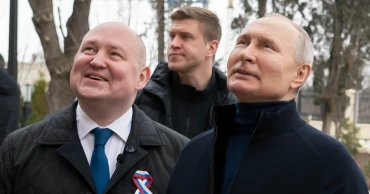
Russian President Vladimir Putin traveled to Crimea to mark the ninth anniversary of the Black Sea peninsula's annexation from Ukraine on Saturday, the day after the International Criminal Court issued an arrest warrant for the Russian leader accusing him of war crimes.
Putin visited an art school and a children's center that are part of a project to develop a historical park on the site of an ancient Greek colony, Russian state news agencies said.
The ICC accused him Friday of bearing personal responsibility for the abductions of children from Ukraine during Russia's full-scale invasion of the neighboring country that started almost 13 months ago.
Russia annexed Crimea from Ukraine in 2014, a move that most of the world denounced as illegal. Ukrainian President Volodymyr Zelenskyy has demanded that Russia withdraw from the peninsula as well as the areas it has occupied since last year.
Putin has shown no intention of relinquishing the Kremlin's gains. Instead, he stressed Friday the importance of holding Crimea.
"Obviously, security issues take top priority for Crimea and Sevastopol now," he said, referring to Crimea's largest city. "We will do everything needed to fend off any threats."
Putin took a plane to travel the 1,821 kilometers (1,132 miles) from Moscow to Sevastopol, where he took the wheel of the car that transported him around the city, according to Moscow-installed governor Mikhail Razvozhaev.
The ICC's arrest warrant was the first issued against a leader of one of the five permanent members of the U.N. Security Council. The court, which is based in The Hague, Netherlands, also issued a warrant for the arrest of Maria Lvova-Belova, the commissioner for Children's Rights in the Office of the President of the Russian Federation.
The move was immediately dismissed by Moscow — and welcomed by Ukraine as a major breakthrough. However, the chances of Putin facing trial at the ICC are highly unlikely because Moscow does not recognize the court's jurisdiction or extradite its nationals.
Despite the court's action and its implication's for Putin, the United Nations and Turkish President Recep Tayyip Erdogan announced Saturday that a wartime deal that allowed grain to flow from Ukraine to countries in Africa, the Middle East and Asia was extended, although neither said for how long.
Ukrainian Deputy Prime Minister Oleksandr Kubrakov tweeted that the deal had been renewed for 120 days, the period that Ukraine, Turkey and the U.N. wanted. But Russian Foreign Ministry spokeswoman Maria Zakharova told Russian news agency Tass that Moscow agreed to a 60-day extension.
Russia and Ukraine are both major global suppliers of wheat, barley, sunflower oil and other affordable food products that developing nations depend on. They signed separate agreements with the U.N. and Turkey last year to allow food to leave Ukraine's blockaded ports.
Russia has complained that shipments of its fertilizers — which its deal was supposed to facilitate — are not getting to global markets. The country briefly pulled out of the agreement in November before rejoining and agreeing to a 120-day renewal.
Read more: Russia, Ukraine extend grain deal to aid world's poor
Putin signed a law Saturday that imposes stiff fines for discrediting or spreading misleading information about volunteers or mercenaries fighting in Ukraine. The law calls for a fining individuals 50,000 rubles ($660) for a first offense and up to 15 years in prison for repeated offenses.
The measure mirrors one passed in the early days of the war that applied to speaking negatively about soldiers or the Russian military in general.
Fighters from the Wagner Group, a private Russian military company known for fierce tactics, have taken key roles in Ukraine, particularly in Russia's grinding campaign to seize the eastern Donetsk province town of Bakhmut.
In Ukraine, authorities reported widespread Russian attacks between Friday night and Saturday morning. Writing on Telegram, the Ukrainian air force command said 11 out of 16 drones were shot down during attacks that targeted the capital, Kyiv, and the western Lviv province, among other areas.
The head of the Kyiv city administration, Serhii Popko, said Ukrainian air defenses shot down all drones heading for the capital. Lviv Gov. Maksym Kozytskyi said Saturday that three of six drones were shot down, with the other three hitting a district that borders Poland.
According to the Ukrainian air force, the attacks were carried out from the eastern coast of the Sea of Azov and Russia's Bryansk province, which also borders Ukraine.
The Ukrainian military reported that between Friday morning and Saturday morning, Russian forces launched 34 airstrikes, one missile strike and 57 rounds of anti-aircraft fire. It said falling debris hit southern Ukraine's Kherson province, damaging seven houses and a kindergarten.
Russia is still concentrating the bulk of its offensive operations in Ukraine's industrial east, focusing attacks on Bakhmut and other parts of Donetsk province.
Regional Gov. Pavlo Kyrylenko said one person was killed and three wounded when 11 towns and villages in the province were shelled Friday.
Further west, Russian rockets hit a residential area overnight in the city of Zaporizhzhia, the regional capital of the partially occupied province of the same name. No casualties were reported, but houses were damaged, Anatoliy Kurtev of the Zaporizhzhia City Council said.
British military officials said Saturday that Russia was likely to expand mandatory conscription to replenish its troops fighting in Ukraine. The U.K. Defense Ministry said in its latest analysis that deputies in the Russian Duma, the lower house of Russia's parliament, introduced a bill to change the draft ages for men to 21-30, from the current 18-27.
The ministry said many Russian men ages 18-21 claim exemptions from military service because they are enrolled in higher education institutions. The wider age range would mean they would have to serve eventually. British officials said the law would likely pass and take effect in January 2024.
3 years ago

Russia, Ukraine extend grain deal to aid world's poor
An unprecedented wartime deal that allowed grain to flow from Ukraine to countries in Africa, the Middle East and Asia where hunger is a growing threat and high food prices are pushing more people into poverty was extended just before its expiration date, officials said Saturday.
The United Nations and Turkish President Recep Tayyip Erdogan announced the extension, but neither confirmed how long it would last. The U.N., Turkey and Ukraine had pushed for 120 days, while Russia said it was willing to agree to 60 days.
Ukrainian Deputy Prime Minister Oleksandr Kubrakov tweeted Saturday that the deal would remain in effect for the longer, four-month period. But Russian Foreign Ministry spokeswoman Maria Zakharova told Russian news agency Tass that Moscow "agreed to extend the deal for 60 days."
"Any claim that it's prolonged for more than 60 days is either wishful thinking or deliberate manipulation," Russia's deputy ambassador to the U.N., Dmitry Polyansky, said.
Ukraine and Russia are both major global suppliers of wheat, barley, sunflower oil and other affordable food products that developing nations depend on. Two ships carrying more than 96,000 metric tons of corn left Ukrainian ports on Saturday bound for China and Tunisia, according to U.N. data.
This is the second renewal of the agreement that Ukraine and Russia signed with the United Nations and Turkey last July to allow food shipments from three Black Sea ports following a halt to shipping after Russia invaded its neighbor over a year ago on Feb. 24, 2022.
Russia has complained that a separate agreement with the United Nations to overcome obstacles to shipments of its fertilizers that was part of the July package has not produced results.
Russia's U.N. Ambassador Vassily Nebenzia told the U.N. Security Council on Friday that the United Nations has to recognize it has "no leverage to exempt Russian agricultural export operations from Western sanctions," and therefore Russia would only extend the deal until May 18.
"If Brussels, Washington and London are genuinely interested to continue the export of food from Ukraine through the maritime humanitarian corridor, then they have two months to exempt from their sanctions the entire chain of operations which accompany the Russian agricultural sector," Nebenzia said. "Otherwise, we fail to understand how the package concept of the secretary-general of the United Nations will work through these simple agreements."
The International Rescue Committee expressed disappointment Saturday that the deal is only for 60 days, stressing that countries in East Africa in particular will be entering the lean grain season at the time of its expiration in May, including Somalia which receives over 90% of its grain from Ukraine and is beset by unprecedented drought and on the verge of famine.
Stéphane Dujarric, the spokesman for U.N. Secretary-General Antonio Guterres, said in a statement that 25 million metric tonnes (about 28 millions tons) of grain and foodstuffs had moved to 45 countries under the initiative, helping to bring down global food prices and stabilizing markets.
"We remain strongly committed to both agreements, and we urge all sides to redouble their efforts to implement them fully," Dujarric said.
The war in Ukraine sent food prices surging to record highs last year and helped contribute to a global food crisis also tied to the lingering effects of the COVID-19 pandemic and climate factors like drought.
The disruption in shipments of grain needed for staples of diets in places like Egypt, Lebanon and Nigeria exacerbated economic challenges and helped push millions more people into poverty or food insecurity. People in developing countries spend more of their money on basics like food.
The crisis left an estimated 345 million people facing food insecurity, according to the U.N.'s World Food Program.
Food prices have fallen for 11 straight months. But food was already expensive before the war because of droughts from the Americas to the Middle East — most devastating in the Horn of Africa, with thousands dying in Somalia. Poorer nations that depend on imported food priced in dollars are spending more as their currencies weaken.
The agreements also faced setbacks since it was brokered by the U.N. and Turkey: Russia pulled out briefly in November before rejoining and extending the deal. In the past few months, inspections meant to ensure ships only carry grain and not weapons have slowed down significantly.
That has helped lead to backlogs in vessels waiting in the waters of Turkey and a recent drop in the amount of grain getting out of Ukraine.
Ukrainian and some U.S. officials have blamed Russia for the slowdowns, which the country denies.
While fertilizers have been stuck, Russia has exported huge amounts of wheat after a record crop. Figures from financial data provider Refinitiv showed that Russian wheat exports more than doubled to 3.8 million tons in January from the same month a year ago, before the invasion.
Russian wheat shipments were at or near record highs in November, December and January, increasing 24% over the same three months a year earlier, according to Refinitiv. It estimated Russia would export 44 million tons of wheat in 2022-2023.
3 years ago