Europe
Protest outside UK asylum-seeker hotel ends in 15 arrest
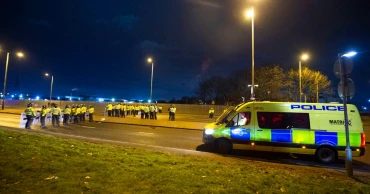
An anti-migration protest outside a hotel housing asylum-seekers in northwest England turned violent and resulted in the arrests of 15 people, local police said Saturday.
The Merseyside Police department said a police officer and two civilians sustained minor injuries during the disturbance on Friday night in Knowsley, a village located 13.5 kilometers (8.4 miles) from the city of Liverpool.
The police force said some protesters threw objects and set a police van on fire. The people arrested, who ranged in age from 13 to 54, were detained “following violent disorder.”
“A number of individuals who turned up at the Suites Hotel last night were intent on using a planned protest to carry out violent and despicable behavior," Merseyside Chief Constable Serena Kennedy said. "They turned up armed with hammers and fireworks to cause as much trouble as they could, and their actions could have resulted in members of the public and police officers being seriously injured, or worse,"
Speculation on social media about a man accused of making inappropriate advances toward a teenage girl in a nearby town might have triggered the demonstration outside the hotel, Kennedy said. The man in his 20s was arrested elsewhere in England on Thursday “on suspicion of a public order offense” but later released on the advice of child protective services, she said.
George Howarth, who represents Knowsley in the U.K. Parliament, said the violence on Friday night did not reflect the community.
“The people of Knowsley are not bigots and are welcoming to people escaping from some of the most dangerous places in the world in search of a place of safety,” he said. “Those demonstrating against refugees at this protest tonight do not represent this community.”
Britain takes in fewer asylum-seekers than some other European countries, including France and Germany, but has seen a sharp increase in the number of people trying to reach the U.K. across the English Channel in dinghies and other small boats.
More than 45,000 people reached Britain by that route in 2022, and most applied for asylum. The system for considering asylum applications has slowed to a crawl because of political turmoil and bureaucratic delays, leaving many migrants stuck in hotels or other temporary accommodation.
The Channel crossings have become a hot political issue, with the Conservative government promising to “stop the boats.” Opponents accuse the government of demonizing desperate people fleeing war and poverty.
In October, a man firebombed a processing center for new arrivals in the Channel port of Dover. Police said he was motivated by far-right ideology. He killed himself after the attack.
3 years ago

Wagner owner says war in Ukraine could drag on for years
The owner of the Russian Wagner Group private military contractor actively involved in the fighting in Ukraine has predicted that the war could drag on for years.
Yevgeny Prigozhin said in a video interview released late Friday that it could take 18 months to two years for Russia to fully secure control of Ukraine's eastern industrial heartland of Donbas. He added that the war could go on for three years if Moscow decides to capture broader territories east of the Dnieper River.
The statement from Prigozhin, a millionaire who has close links to Russian President Vladimir Putin and was dubbed “Putin’s chef” for his lucrative Kremlin catering contracts, marked a recognition of the difficulties that the Kremlin has faced in the campaign, which it initially expected to wrap up within weeks when Russian troops invaded Ukraine on Feb. 24.
Russia suffered a series of humiliating setbacks in the fall when the Ukrainian military launched successful counteroffensives to reclaim broad swaths of territory in the east and the south. The Kremlin has avoided making forecasts on how long the fighting could continue, saying that what it called the “special military operation” will continue until its goals are fulfilled.
The Russian forces have focused on Ukraine’s Luhansk and Donetsk provinces that make up the Donbas region where Moscow-backed separatists have been fighting Ukrainian forces since 2014.
Ukrainian and Western officials have warned that Russia could launch a new broad offensive to try to turn the tide of the conflict as the war approaches the one-year mark. But Ukraine's military intelligence spokesman, Andriy Chernyak, told Kyiv Post that “Russian command does not have enough resources for large-scale offensive actions.”
“The main goal of Russian troops remains to achieve at least some tactical success in eastern Ukraine,” he said.
Prigozhin said that the Wagner Group mercenaries were continuing fierce battles for control of the Ukrainian stronghold of Bakhmut in the Donetsk region. He acknowledged that the Ukrainian troops were mounting fierce resistance.
As Russian troops have pushed their attacks in the Donbas, Moscow has also sought to demoralize Ukrainians by leaving them without heat and water in the bitter winter.
On Friday, Russia launched the 14th round of massive strikes on Ukrainian energy facilities and other vital infrastructure. High-voltage infrastructure facilities were hit in the eastern, western and southern regions, resulting in power outages in some areas.
Ukraine's energy company, Ukrenergo, said Saturday that the situation was “difficult but controllable,” adding that involved backups to keep up power supplies but noting that power rationing will continue in some areas. Head of Ukraine's state nuclear operator Energoatom Petro Kotin said Saturday that more power will come into the country's energy system after two nuclear reactors have been repaired.
Ukraine's military chief, Gen. Valerii Zaluzhnyi, said that Russian forces launched 71 cruise missiles, 35 S-300 missiles and seven Shahed drones between late Thursday and midday Friday, adding that Ukrainian air defenses downed 61 cruise missiles and five drones.
The Ukrainian authorities reported more attacks by killer drones later on Friday. The Ukrainian air force said the military downed 20 Shahed drones in the evening.
Russia's Defense Ministry said that Friday's strikes hit all the designated targets, halting the operation of Ukraine's defense factories and blocking the delivery of supplies of Western weapons and ammunition. The claim couldn't be independently verified.
Late Friday, Russian military bloggers and some Ukrainian news outlets posted a video showing an attack by a sea drone on a strategic railway bridge in the Odesa region. The grainy video showed a fast-moving object on the surface of the water approaching the bridge in Zatoka, about 50 kilometers (30 miles) southwest of Odesa, and exploding in a powerful blast.
The authenticity of the video couldn't be verified, but the Ukrainian military on Saturday confirmed the use of sea drones by Russian forces.
Ukraine’s military chief Zaluzhnyi said in an online statement that he has expressed concern about the use of such drones in a phone conversation with the U.S. Chairman of the Joint Chiefs of Staff, Gen. Mark Milley, on Saturday, adding that it “poses a threat to civilian navigation in the Black Sea.”
The attack marks the first combat use of a sea drone by Russia in the conflict. Igor Korotchenko, a retired colonel of the Russian armed forces who frequently comments on the conflict on Russian state TV, noted Saturday that such drones should be equipped with a more powerful load of explosives to inflict more significant damage.
The bridge, which was targeted by Russian missile strikes early in the war, serves the railway link to Romania, which is a key conduit for Western arms supplies.
In other developments, the governor of Russia's Kursk region along the border with Ukraine said that a group of construction workers was hit by Ukrainian shelling that killed one of them and wounded another.
The governor of another Russian border region, Belgorod, reported the shelling of the town of Shebekino, saying it damaged two buildings but no one was hurt.
3 years ago

Nearly 1 million French march in 4th day of pension protests
Police were out in force across France on Saturday as protesters held a sometimes restive fourth round of nationwide demonstrations against President Emmanuel Macron’s plans to reform the country's pension system.
Over 960,000 people marched in Paris, Nice, Marseille, Toulouse, Nantes and other cities, according to the Interior Ministry. Protesters hoped to keep up the pressure on the government to back down, and further action is planned for Feb. 16.
In the French capital, authorities counted some 93,000 participants, the most to demonstrate in Paris against the pension changes since the protests started last month.
The weekend demonstrations drew young people and others opposed to the pension proposals who weren’t able to attend the previous three days of action, all held on weekdays.
This time, though, rail worker strikes did not accompany the demonstrations, allowing trains and the Paris Metro to run Saturday. However, an unexpected strike by air traffic controllers meant that up to half of flights to and from Paris’ second largest airport, Orly, were canceled Saturday afternoon.
In Paris, some workers and students who wanted to voice opposition attended the protests for the first time, owing to heavy weekday workloads.
“We often hear that we should be too young to care, but with rising inflation, soaring electricity prices, this reform will impact our families,” Elisa Haddad, 18. said. “It is my first demonstration because I couldn’t attend with uni. It is important that the voice of (France’s) parents and students is heard.”
French lawmakers began a rowdy debate earlier this week on the pension bill to raise the minimum retirement age for a full state pension from 62 to 64. It’s the flagship legislation of Macron’s second term.
Saturday’s protests featured flashes of unrest. One car and several trash bins were set on fire on a central Parisian boulevard as police charged the crowd and dispersed protesters with tear gas. Paris police said officers they arrested eight people for infractions ranging from possession of a firearm to vandalism.
Some demonstrators walked as families through the French capital's Place de la Republique and carried emotional banners. “I don’t want my parents to die at work,” read one, held by a teenage boy.
The protests are a crucial test both for Macron and his opponents. The government has insisted it’s determined to push through Macron’s election pledge to reform France’s generous pension system. Of the 38 member nations of Organization for Economic Co-operation and Development, France is among countries that spend the most years in retirement.
The president has called the reforms “indispensable” for ensuring the long-term survival of the country’s pension system and noted that workers in neighboring countries retire years later.
Despite opinion polls consistently showing growing opposition to the reform and his own popularity shrinking, Macron insisted that he’s living up to a key campaign pledge he made when he swept to power in 2017 and before his April 2022 reelection.
His government is now facing a harsh political battle in parliament that could span weeks or months.
Strong popular resentment will strengthen efforts by labor unions and left-wing legislators to try to block the bill.
Unions issued a joint statement Saturday, calling the government “deaf” and demanding French officials scrap the bill. They threatened to cause a nationwide “shutdown” from March 7, if their demands were not met.
During the previous day of protests four days ago, over 750,000 people marched in many French cities, significantly fewer than on the previous two protest days in January in which over a million people took to the streets.
___
Nico Garriga in Paris contributed
3 years ago

Finnish president wants Finland, Sweden in NATO by summer
The Finnish president said in an interview published Saturday that he trusts that Finland and Sweden will be admitted into NATO by July, and hinted that he wants the United States to put pressure on Turkey to approve their membership bids.
If the issue drags on, the entire process of admitting new members into the military alliance will become questionable, President Sauli Niinistö said in an interview with the Finnish news agency STT.
“If it doesn’t happen by the Vilnius meeting, why should it happen afterwards?” Niinistö said.
Lithuania is set to host a NATO summit in the Baltic nation’s capital on July 11-12.
NATO requires unanimous approval from its existing members to admit new ones. Turkey and Hungary are the only nations in the 30-member military alliance that haven’t formally endorsed Sweden and Finland’s accession.
While Hungary has pledged to do so in February, Turkey hasn’t indicated willingness to ratify the two countries’ accession any time soon. Niinistö stressed that the final Turkish decision is up to Turkish President Recep Tayyip Erdogan.
“I think that under no circumstances will he allow himself to be influenced by any public pressure,” Niinistö said. ” But if something opens up during the bilateral talks between Turkey and the United States, it might have an impact.”
Turkey has been holding off approving Sweden and Finland’s membership into NATO as it has been infuriated, among other things, by a recent series of demonstrations in Stockholm by activists who have burned the Quran outside the Turkish Embassy and hanged an effigy of Erdogan.
In January, Ankara indefinitely postponed a key meeting in Brussels that would have discussed the two Nordic countries’ entry into NATO.
Niinistö said that Finland and Sweden heard many encouraging statements from NATO last spring — the Nordic duo had stated their intention to join NATO in May — about smooth and painless progress of membership.
He said that did not happen, adding that the delay isn’t only a headache for the two applicant countries.
“I can see that this has already become a problem for NATO. Clearly, NATO countries have also been surprised,” Niinistö said.
3 years ago

Hilltop coal-mining town a tactical prize in Ukraine war
In a small coal-mining town on Ukraine’s eastern front line, a fight for strategic superiority is being waged in a battlefield steeped with symbolism as the one-year anniversary of Russia’s invasion nears.
The town of Vuhledar — meaning “gift of coal” — has emerged as a critical hot spot in the fight for Donetsk province that would give both sides, the Ukrainian forces who hold the urban center, and the Russians positioned in the suburbs, a tactical upper hand in the greater battle for the Donbas region.
Located on an elevated plane that is one of the few high-terrain spots in the area, its capture would be an important step for Russia to disrupt Ukrainian supply lines. Securing Vuhledar would give Ukraine a potential launching pad for future counter-offensives south.
Then there is the symbolic weight: Vuhledar is close to the administrative border of Donetsk province, and winning it would play into Russia’s greater aim of controlling the region as a whole.
“The center of gravity of the Russian military effort is in Donetsk, and Vuhledar is basically the southern flank of that,” said Gustav Gressel, a senior policy fellow with the European Council on Foreign Relation’s Berlin office.
Also read: UN draft resolution: Any peace must keep Ukraine intact
The grinding fight to win the area has cost Russia manpower and weapons, as Ukrainians continue to hold up defensive lines. Russia sends battalion-sized scout groups to probe Ukrainian lines and shoot artillery toward their positions with an eye to pushing north toward the critical N15 highway, a key supply route.
In remarks this week, Russian Defense Minister Sergei Shoigu said Russian troops were advancing “with success” in Vuhledar. Meanwhile, a British defense intelligence briefing said Russia's aim was to capture unoccupied areas of Ukrainian-held Donetsk but it was unlikely to build up the forces required to change the outcome of the war.
Vuhledar’s pre-war population of 14,000 has dwindled to about 300. The majority of the town’s residents worked in the coal mine and nearby factories before the war.
Olha Kyseliova, who was recently evacuated, worked in a brick factory before the fighting upended her life.
Russian forces ramped up attacks beginning on Jan. 24, residents said. That day, a missile tore through Kyseliova's nine-story building. She was sheltering in the basement with her three children and emerged to find a gaping hole through the roof of her third-floor apartment.
That was the moment she decided she had to leave her hometown. “I cried the entire way out, I didn’t want to leave,” she said.
Three Ukrainian brigades are positioned in Vuhledar and on the outskirts of the town. The Associated Press spoke to five commanders in units from all three, who provided only their first names in keeping with Ukraine's military policy. Russia’s 155 Marine infantry troops are positioned just four kilometers (two miles) away in Vuhledar’s suburbs.
For both sides, the town is tactically important.
“It’s one of the main logistics points of the Donbas region, and also one of the main points of elevation,” said Maksym, the deputy commander of a Ukrainian marine infantry battalion. “By capturing Vuhledar, Russians can easily occupy the entire Donetsk region.”
Seizing Vuhledar would would enable Russia to push forward and threaten Ukrainian supply lines feeding into the fierce Marinka front line to the north, said Gressel of the European Council on Foreign Relations. For Ukraine, Vuhledar would be a launching pad for future counter-offensives toward Mariupol and Berdiansk.
From their perch in the town, Ukrainian forces can see into Russian lines and have so far been able to repel Russian attempts to encircle Vuhledar. Columns of Russian tanks and armored vehicles transporting infantrymen continuously assault and attempt to break Ukrainian defenses. Aviation, rockets and artillery target the town.
“But with our fighters and anti-tank equipment their attempts have not been successful,” said Maksym, the Ukrainian deputy commander. “The situation is strained, but controlled.”
Similar to other front lines along the east, the Russians are losing scores of infantrymen in an attempt to tire and weaken Ukrainian defensive lines. Serhii, the commander of a Ukrainian intelligence unit, said he saw Russian soldiers sent straight through fields mined by the Ukrainians following Russia’s capture of the village of Pavlivka, south of Vuhledar, in November.
“They de-mine our fields by using their own people,” he said.
Ukrainian commanders said some of their units are suffering from dire ammunition shortages.
That view was not shared across brigades, suggesting some are better supplied than others. Taras, the commander of a mortar unit, said his forces were suffering very serious shortages. Faced with orders to target an enemy position, he said, “I have just two or three rounds of ammunition to do it. It’s nothing.”
Two commanders of a brigade inside Vuhledar reported the Russians hurled gas-laden projectiles that caused severe disorientation for hours, and burning of the throat and skin. Higher-ranking commanders did not comment on the type of gas used and said an investigation was ongoing.
“They are probing and testing us across the eastern front line, including in Vuhledar,” said Oleksandr, a commander who was recently rotated out of the town. “They are trying to find our points of weakness.”
For now, Russia’s activities around Vuhledar are not “operationally significant,” said Kateryna Stepanenko, a Russia analyst with the U.S.-based think tank Institute for the Study of War. More combat power is required to execute breakthroughs that would achieve the stated aim of the Russian invasion — the capture of the entire Donetsk province.
Even in the event of victory in Vuhledar, Russia would still need a lot of combat power to push north. Three months after capturing the village of Pavlivka in November, Russian forces have yet to make breakthroughs in Vuhledar, which is only four kilometers — a six-minute drive — away.
“It’s not operationally significant because Russians will still have to fight for more territory to make a meaningful disruption of Ukrainian ground lines of communication to western Donetsk,” Stepanenko said. Vuhledar is just "one settlement on their way, where they are already suffering significant losses and where they already seem to have suffered losses in the area before.”
Meanwhile, the last of Vuhledar’s residents said they are staying put.
Oleksandra Havrylko, police press officer for the Donetsk region, pleads with those who remain to leave the devastated area. Most spend their days hiding in basements, coming out when there are lulls in fighting to charge phones and gather supplies in the town’s points of refuge, called “invincibility centers”.
All but one of the town's children have been evacuated. The father of a 15-year-old, the last remaining minor in the town, refuses to part with his son or leave the area, she said.
“There are people in the city who don’t want to be evacuated, we tried many times,” she said. Most have never ventured far from their hometown.
3 years ago

Russia hits targets across Ukraine with missiles, drones
KYIV, Ukraine, Feb 11 (AP/UNB) — Russia used strategic bombers, cruise missiles and killer drones in a wave of attacks across Ukraine early Friday, while Moscow's military push that Kyiv says has been brewing for days appeared to pick up pace in eastern areas ahead of the one-year anniversary of its invasion.
Russian forces have launched 71 cruise missiles, 35 S-300 missiles and seven Shahed drones since late Thursday, Ukraine’s military chief, Gen. Valerii Zaluzhnyi said.
Ukrainian forces downed 61 cruise missiles and five drones, he added.
Ukrainian President Volodymyr Zelenskyy, who has campaigned for more Western support against Russia's military ambitions, said: “This is terror that can and must be stopped.”
Meanwhile, the Kremlin’s ground forces were focusing on Ukraine’s industrial east, especially the Luhansk and Donetsk provinces that make up the industrial Donbas region where recent fighting has been most intense, the Ukrainian military said. Moscow-backed separatists have been fighting Ukrainian forces there since 2014.
Kremlin is striving to secure areas it illegally annexed last September — the Donetsk, Kherson, Luhansk and Zaporizhzhia regions — and where it claims its rule is welcomed, according to Kyiv officials.
Moscow’s goals have narrowed since it launched its full-scale invasion on Feb. 24 2022, military analysts say. At that time, the capital, Kyiv, and the installation of a puppet government were among its targets, but numerous battlefield setbacks, including yielding Donbas areas it had initially captured, have embarrassed Russian President Vladimir Putin.
The Kremin is currently concentrating its efforts on gaining full control of the Donbas, Kyiv claims, and is pushing at key points on several fronts, though Russian progress is reportedly slow.
In the Donetsk region, local Ukrainian officials reported that the Russian military deployed additional troops and launched offensive operations. “There is a daily escalation and Russian attacks are becoming active throughout the region,” Gov. Pavlo Kyrylenko said.
In Luhansk province, the Russian army is trying to punch through Ukrainian defenses, according to regional Gov. Serhii Haidai.
Read more: Russian attacks on Ukraine reported; at least 11 dead
“The situation is deteriorating, the enemy is constantly attacking, the Russians are bringing in a large amount of heavy equipment and aircraft,” Haidai said.
There has been little change in battlefield positions for weeks amid freezing winter conditions.
Denis Pushilin, the Moscow-appointed head of the Donetsk region, said that Russian forces had secured positions on the southern outskirts of Vuhledar. He added that Ukraine has sent additional reinforcements to the city that slowed the Russian advance.
Pushilin’s claim couldn’t be independently verified.
Vuhledar is a strategically important town that sits next to a railway link crossing the region on the way to Crimea. Capturing the town is important for Russia to secure the safety of the railway connection to Crimea and advance its goal of seizing the entire Donetsk region.
The cruise missiles aimed at Ukraine were launched by Russian Tu-95 strategic bombers and from Russian navy ships in the Black Sea, military chief Zaluzhnyi said, while the S-300 missiles were launched from the Belgorod region just inside Russia and the occupied part of Ukraine’s Zaporizhzhia region.
Ukraine’s Prime Minister Denys Shmyhal said Moscow once again targeted the power supply in “another attempt to destroy the Ukrainian energy system and deprive Ukrainians of light, heat, water.” The International Atomic Energy Agency said two of Ukraine’s three operating nuclear power plants reduced power “due to renewed shelling of the country’s energy infrastructure.”
The barrage was broad, also taking aim at the capital, Kyiv, and Lviv, near Ukraine's Western border with Poland. It also struck critical infrastructure in Kharkiv, Ukraine's second-largest city in the northeast. Seven people were wounded there, two of them seriously, regional Governor Oleh Syniehubov said.
Air raid sirens sounded across much of the country.
Also Friday, Moldova’s Ministry of Defense said that a missile was detected traversing its airspace near the border with Ukraine. Moldova’s foreign ministry said in a statement that the Russian ambassador in Chisinau has been summoned for talks over the “unacceptable violation”.
The ministry said that the missile was detected in its airspace at around 10 a.m. and flew over two border villages before heading toward Ukraine.
The spokesperson for Ukraine’s Air Forces, Yurii Ihnat, told The Associated Press that another missile crossed the airspace of Romania, a NATO member country. Romania’s defense ministry denied that, however, saying the closest the missile came to Romania’s airspace was approximately 35 kilometers (20 miles).
High-voltage infrastructure facilities were hit in the eastern, western and southern regions, Ukraine’s energy company, Ukrenergo, said, resulting in power outages in some areas. It was the 14th round of massive strikes on the country’s power supply, the company said. The last one occurred on Jan. 26 as Moscow seeks to demoralize Ukrainians by leaving them without heat and water in the bitter winter.
Zaporizhzhia City Council Secretary Anatolii Kurtiev said the city had been hit 17 times in one hour, which he said made it the most intense period of attacks since the beginning of the full-scale invasion on Feb. 24, 2022.
Ukraine’s Air Force shot down 10 Russian missiles over Kyiv, according to the Kyiv City Administration. The fragments of one missile damaged two cars, a house and electricity wires. No casualties were reported.
The Ukraine Air Force said Russia launched S-300 anti-aircraft guided missiles on the Kharkiv and Zaporizhzhia provinces. Those missiles cannot be destroyed in mid-air by air defenses but they have a relatively short range so the Russians have used them for attacks on areas not far from Russian-controlled territory.
The Khmelnytskyi province in Western Ukraine was also attacked with Shahed drones, according to regional Gov. Serhii Hamalii.
Russia has in the past used Iranian-made Shahed drones to strike at key Ukrainian infrastructure and sow fear among civilians, according to Western analysts. They are known as suicide drones because they nosedive into targets and explode on impact like a missile.
3 years ago

Ukraine’s Zelenskyy makes emotional appeal for EU membership
President Volodymyr Zelenskyy asked his Western allies Thursday for more weapons and said “a Ukraine that is winning” its war with Russia should become a member of the European Union, arguing the bloc won’t be complete without it.
And at the close of a 16-hour summit that ended when Zelenskyy was already gone, the EU leaders pledged they would do all it takes to back Ukraine but offered no firm timetable for membership talks to start, as Zelenskyy had hoped for.
French President Emmanuel Macron said the leaders agreed to support Ukraine “tirelessly, over the long term … to win the war.”
President Volodymyr Zelenskyy asked his Western allies Thursday for more weapons and said “a Ukraine that is winning” its war with Russia should become a member of the European Union, arguing the bloc won’t be complete without it.
Zelenskyy made his appeal during an emotional day at EU headquarters in Brussels as he wrapped up a rare, two-day trip outside Ukraine to seek new weaponry from the West to repel the invasion that Moscow has been waging for nearly a year. As he spoke, a new offensive by Russia in eastern Ukraine was under way.
Zelenskyy, who also visited the U.K. and France, received rapturous applause and cheers from the European Parliament and a summit of the 27 EU leaders, insisting in his speech that the fight with Russia was one for the freedom of all of Europe.
“A Ukraine that is winning is going to be member of the European Union,” Zelenskyy said, building his appeal around the common destiny that Ukraine and the bloc face in confronting Russia.
“Europe will always be, and remain Europe as long as we ... take care of the European way of life,” he said.
EU membership talks should start later this year, Zelenskyy said, an ambitious request given the huge task ahead. Such a move would help motivate Ukrainian soldiers in their defense of the country, he said.
“Of course we need it this year,“ he said, then looked at European Council head Charles Michel, and insisted, tongue-in-cheek: “When I say this year, I mean this year. Two, zero, 23.”
EU Commission President Ursula von der Leyen, however, said “there is no rigid timeline.” In practice, membership often has taken decades to complete.
He held up an EU flag after his address and the lawmakers stood in somber silence as the Ukrainian national anthem and the European anthem “Ode to Joy” were played in succession.
Before his speech, European Parliament President Roberta Metsola said allies should consider “quickly, as a next step, providing long-range systems” and fighter jets to Ukraine. The response to Russian President Vladimir Putin’s war against Ukraine “must be proportional to the threat, and the threat is existential,” she said.
Metsola also told Zelenskyy that “we have your back. We were with you then, we are with you now, we will be with you for as long as it takes.”
A draft of the summit’s conclusions seen by The Associated Press said “the European Union will stand by Ukraine with steadfast support for as long as it takes.”
During his time in Brussels, Zelenskyy asked Slovakia’s Prime Minister Eduard Heger to give Ukraine its Soviet-era MiG-29 fighter jets, and he replied: “We will work on” the request. Slovakia grounded its fleet of MiG-29s last year.
German Chancellor Olaf Scholz said the bloc will send Zelenskyy “this signal of unity and solidarity, and can show that we will continue our support for Ukraine in defending its independence and integrity.”
Military analysts say Putin is hoping that Europe’s support for Ukraine will wane as Russia is believed to be preparing a new offensive.
RUSSIA-UKRAINE WAR
Musk deputy's words on Starlink 'weaponization' vex Ukraine
Russian FM, Sudan's military leaders kindle ties in Khartoum
Zelenskyy seeks weaponry in surprise trips to London, Paris
US approves $10B arms sale to Poland as Ukraine war rages on
“Of course we need it this year,“ he said, then looked at European Council head Charles Michel, and insisted, tongue-in-cheek: “When I say this year, I mean this year. Two, zero, 23.”
EU Commission President Ursula von der Leyen, however, said “there is no rigid timeline.” In practice, membership often has taken decades to complete.
He held up an EU flag after his address and the lawmakers stood in somber silence as the Ukrainian national anthem and the European anthem “Ode to Joy” were played in succession.
Before his speech, European Parliament President Roberta Metsola said allies should consider “quickly, as a next step, providing long-range systems” and fighter jets to Ukraine. The response to Russian President Vladimir Putin’s war against Ukraine “must be proportional to the threat, and the threat is existential,” she said.
Metsola also told Zelenskyy that “we have your back. We were with you then, we are with you now, we will be with you for as long as it takes.”
A draft of the summit’s conclusions seen by The Associated Press said “the European Union will stand by Ukraine with steadfast support for as long as it takes.”
During his time in Brussels, Zelenskyy asked Slovakia’s Prime Minister Eduard Heger to give Ukraine its Soviet-era MiG-29 fighter jets, and he replied: “We will work on” the request. Slovakia grounded its fleet of MiG-29s last year.
German Chancellor Olaf Scholz said the bloc will send Zelenskyy “this signal of unity and solidarity, and can show that we will continue our support for Ukraine in defending its independence and integrity.”
Military analysts say Putin is hoping that Europe’s support for Ukraine will wane as Russia is believed to be preparing a new offensive.
The Kremlin’s forces “have regained the initiative in Ukraine and have begun their next major offensive” in the eastern Luhansk region, most of which is occupied by Russia, the Institute for the Study of War, said in its latest assessment. “Russian forces are gradually beginning an offensive, but its success is not inherent or predetermined.”
Zelenskyy used the dais of the European Parliament hoping to match Wednesday’s speech to Britain’s legislature when he thanked the nation for its unrelenting support.
That same support has come from the EU. The bloc and its member states have already backed Kyiv with about 50 billion euros ($53.6 billion) in aid, provided military hardware and imposed nine packages of sanctions on the Kremlin.
The EU is in the midst of brokering a new sanctions package worth about 10 billion euros ($10.7 billion) before the war’s anniversary. And there is still plenty of scope for exporting more military hardware to Ukraine as a Russian spring offensive is expected.
Russia is watching Zelenskyy’s movements closely. On Wednesday, Russian state television showed the flight path of a British air force plane that Zelenskyy used to travel to London, taken from a flight monitoring site. The anchor noted the plane flew from an air base in Rzeszow, Poland, that is a hub for Western arms deliveries to Ukraine.
Dmitry Medvedev, deputy head of Russia’s Security Council chaired by Putin, visited a Siberian arms factory Thursday and said his country will respond to the Western aid by churning out thousands of tanks.
“Our enemy was begging for aircraft, missiles and tanks on a trip abroad,” Medvedev said during a visit to the аactory in Omsk. “We will naturally increase the output of various types of weapons and military equipment, including modern tanks. We are talking about production and modernization of thousands of tanks.”
Fighting in Ukraine intensified Thursday, with Kyiv’s military intelligence agency saying Russian forces have launched an offensive in the the partially occupied Donetsk and Luhansk regions, with the aim to grab full control of the entire industrial region, known as the Donbas. Moscow-backed separatists have been fighting Ukrainian forces there since 2014.
“An escalation is underway and the main goal is to seize Donbas by the end of March,” Main Intelligence Directorate spokesman Andriy Yusov told Ukrainian television.
In Donetsk, the front line expanded significantly over the previous day, with fierce battles taking place as Moscow’s forces closed in on key Ukrainian-held towns, according to regional Gov. Pavlo Kyrylenko. Russian shelling struck a kindergarten, hospital, cultural center, factory and apartment buildings, he said.
“The intensity of the shelling has increased dramatically and we are seeing a significant intensification of activity by the Russian army immediately in the south, center and north of the region,” Kyrylenko said. “Russia is again actively using combat aircraft to shell our cities and villages.”
Russian forces also stepped up attacks in neighboring Luhansk province, launching “a broad offensive,” regional Gov. Serhii Haidai said.
In Ukraine’s northeastern Kharkiv province, 23 cities and villages came under shelling. In the border city of Vovchansk, shelling damaged about 10 apartment buildings.
3 years ago

Rescuers push to find survivors of 'disaster of the century'
Rescue workers made a final push Thursday to find survivors of the earthquake in Turkey and Syria that rendered many communities unrecognizable to their inhabitants and led the Turkish president to declare it “the disaster of the century." The death toll topped 20,000.
The earthquake affected an area that is home to 13.5 million people in Turkey and an unknown number in Syria and stretches farther than the distance from London to Paris or Boston to Philadelphia. Even with an army of people taking part in the rescue effort, crews had to pick and choose where to help.
The scene from the air showed the scope of devastation, with entire neighborhoods of high-rises reduced to twisted metal, pulverized concrete and exposed wires.
In Adiyaman, Associated Press journalists saw someone plead with rescuers to look through the rubble of a building where relatives were trapped. They refused, saying no one was alive there and that they had to prioritize areas with possible survivors.
A man who gave his name only as Ahmet out of fear of government retribution later asked the AP: “How can I go home and sleep? My brother is there. He may still be alive.”
The death toll from Monday’s 7.8 magnitude catastrophe rose to nearly 21,000, eclipsing the more than 18,400 who died in the 2011 earthquake off Fukushima, Japan, that triggered a tsunami and the estimated 18,000 people who died in a temblor near the Turkish capital, Istanbul, in 1999.
The new figure, which is certain to rise, included over 17,600 people in Turkey and more than 3,300 in civil war-torn Syria. Tens of thousands were also injured.
Even though experts say people could survive for a week or more, the chances of finding survivors in the freezing temperatures were dimming. As emergency crews and panicked relatives dug through the rubble — and occasionally found people alive — the focus began to shift to demolishing dangerously unstable structures.
The DHA news agency broadcast the rescue of a 10-year-old in Antakya. The agency said medics had to amputate an arm to free her and that her parents and three siblings had died. A 17-year-old girl emerged alive in Adıyaman, and a 20-year-old was found in Kahramanmaras by rescuers who shouted “God is great.”
In Nurdagi, a city of around 40,000 nestled between snowy mountains some 35 miles (56 kilometers) from the quake's epicenter, vast swaths of the city were leveled, with scarcely a building unaffected. Even those that did not collapse were heavily damaged, making them unsafe.
Throngs of onlookers, mostly family members of people trapped inside, watched as heavy machines ripped at one building that had collapsed, its floors pancaked together with little more than a few inches in between.
Mehmet Yilmaz, 67, watched from a distance as bulldozers and other demolition equipment began to bring down what remained of the building where six of his family members had been trapped, including four children.
He estimated that about 80 people were still beneath the rubble and doubted that anyone would be found alive.
“There’s no hope. We can’t give up our hope in God, but they entered the building with listening devices and dogs, and there was nothing,” Yilmaz said.
Mehmet Nasir Dusan, 67, sat watching as the remnants of the nine-story building were brought down in billowing clouds of dust. He said he held no hope of reuniting with his five family members trapped under the debris.
Still, he said, recovering their bodies would bring some small comfort.
“We’re not leaving this site until we can recover their bodies, even if it takes 10 days,” Dusan said. “My family is destroyed now.”
In Kahramanmaras, the city closest to the epicenter, a sports hall the size of a basketball court served as a makeshift morgue to accommodate and identify bodies.
On the floor lay dozens of bodies wrapped in blankets or black shrouds. At least one appeared to be that of a 5- or 6-year-old.
At the entrance, a man wept over a black body bag that lay next to another in the bed of a small truck. “I’m 70 years old. God should have taken me, not my son,” he cried.
Workers continued to conduct rescue operations in Kahramanmaras, but it was clear that many who were trapped in collapsed buildings had already died. One rescue worker was heard saying that his psychological state was declining and that the smell of death was becoming too much to bear.
In northwestern Syria, the first U.N. aid trucks since the quake to enter the rebel-controlled area from Turkey arrived, underscoring the difficulty of getting help to people there. In the Turkish city of Antakya, dozens scrambled for aid in front of a truck distributing children's coats and other supplies.
One survivor, Ahmet Tokgoz, called for the government to evacuate people from the region. Many of those who have lost their homes found shelter in tents, stadiums and other temporary accommodation, but others have slept outdoors.
“Especially in this cold, it is not possible to live here,” he said. “If people haven’t died from being stuck under the rubble, they’ll die from the cold.”
The winter weather and damage to roads and airports have hampered the response. Some in Turkey have complained that the government was slow to respond — a perception that could hurt Turkish President Recep Tayyip Erdogan at a time when he faces a tough battle for reelection in May.
“As you know, the earthquake hit an area of 500-kilometer (311-mile) diameter where 13.5 million of our people live, and that made our job difficult,” Erdogan said Thursday.
In the Turkish town of Elbistan, rescuers stood atop the rubble from a collapsed home and pulled out an elderly woman.
Rescue teams urged quiet in the hopes of hearing stifled pleas for help, and the Syrian paramedic group known as the White Helmets noted that “every second could mean saving a life.”
But more and more often, the teams pulled out dead bodies. In Antakya, more than 100 bodies were awaiting identification in a makeshift morgue outside a hospital.
With the chances of finding people alive dwindling, crews in some places began demolishing buildings. Authorities called off search-and-rescue operations in the cities of Kilis and Sanliurfa, where destruction was not as severe as in other areas. Vice President Fuat Oktay said rescue work was mostly complete in Diyarbakir, Adana and Osmaniye.
Across the border in Syria, assistance trickled in. The U.N. is authorized to deliver aid through only one border crossing, and road damage has prevented that thus far. U.N. officials pleaded for humanitarian concerns to take precedence over wartime politics.
It wasn't clear how many people were still unaccounted for in both countries.
Turkey’s disaster-management agency said more than 110,000 rescue personnel were now taking part in the effort and more than 5,500 vehicles, including tractors, cranes, bulldozers and excavators had been shipped. The Foreign Ministry said 95 countries have offered help.
3 years ago

Hope dims for families in Turkey as rescue turns to recovery
Precious hours have turned to tense days across earthquake-hit southern Turkey as fewer people are pulled alive from the rubble. While family members watch rescue workers shift to recovery, they also face an awful truth: that it's unlikely they'll ever be reunited with their missing loved ones.
In Nurdagi, a city of around 40,000 nestled between snowy mountains some 35 miles (56 kilometers) from the epicenter of the quake, throngs of onlookers — mostly family members of people trapped inside — watched on Thursday as heavy machines ripped at one building which had collapsed, its floors pancaked together with little more than a few inches in between.
Mehmet Yilmaz, 67, watched from a distance as bulldozers and other demolition equipment began to bring down what remained of the building where six members of his family — including three children and a three-month-old baby — were trapped.
The operation there had become one not of rescue, but of demolition.
“There’s no hope. We can’t give up our hope in God, but they entered the building with listening devices and dogs and there was nothing,” said Yilmaz. He hasn't moved from his hopeful perch beside the building for three days.
He estimated about 80 people were still trapped within the collapsed structure, but said he didn’t believe any of them would be recovered alive.
“The building looks like stacks of paper and cardboard, the fifth floor and the first floor have collided into one,” he said grimly, his eyes full of resignation.
Scarcely a building remains in Nurdagi that has not suffered major damage. In those where it was believed there could still be survivors, workers used pick axes, jackhammers and shovels to carefully chip away at the hunks of concrete and twisted knots of rebar in hopes of discovering a sign of life. In other buildings, like the one where Yilmaz's family was trapped, it became more about recovery.
In Kahramanmaras, the nearest city to the earthquake’s epicenter, workers on Thursday continued to search for survivors, but most of their discoveries were comprised of the dead. Standing atop a tall mound of debris, three men reached into a crevice and pulled out a body wrapped in a red blanket, its bare feet protruding.
The body was placed in the bucket of a backhoe and slowly lowered to the ground.
One rescue worker was heard saying that his psychological state was in decline after days of searching, and that the smell of death among the rubble was becoming too much to bear.
Nearby, an indoor sports hall serves as a makeshift morgue to accommodate and identify bodies that were recovered from the debris. On the basketball court-sized floor of the hall lay dozens of bodies wrapped in blankets or black shrouds, at least one of which seemed to be the small body of a five or six-year-old child.
At the entrance to the morgue, a man wept aloud over a black body bag that lie next to another in the bed of a small truck.
“I’m 70 years old! God should have taken me, not my son!” he cried.
Erdal Usta, an assistant to the provincial prosecutor, said the bodies that are dug from the rubble are brought to the building and catalogued, and await identification by relatives who can then transport them to receive burial.
One woman, who did not wish to give her name, said she had brought the body of her father-in-law to the morgue to be formally registered as deceased. She and her family, she said, had dug the man out of the debris with their own hands, but he had been crushed in the collapse.
In Nurdagi, 67-year-old Mehmet Nasir Dusan sat in a chair watching as the remnants of a 9-floor building were brought down by excavators in billowing clouds of dust. He said he held no hope, either, of reuniting with his five family members trapped beneath the debris.
Still, he said, recovering their bodies would bring some small comfort.
“We’re not leaving this site until we can recover their bodies, even if it takes ten days,” he said. “My family is destroyed now.”
3 years ago

Ghana soccer player Atsu's well-being, whereabouts unknown
Ghana international soccer player Christian Atsu is missing after the earthquake in Turkey, his club and agent said Thursday, following earlier reports he was rescued from the rubble of a collapsed building and taken to a hospital.
Atsu's well-being and whereabouts were unknown. Aydin Toksoz, the deputy head of Hatayspor soccer club, told Turkey's state-run Anadolu Agency news service that club sporting director Taner Savut was also missing after the massive earthquake that struck southern Turkey and Syria and has now killed more than 19,000 people, with that number expected to rise.
The 31-year-old Atsu, who previously played for English clubs Chelsea and Newcastle, signed for Hatayspor late last year. The club is based in the southern city of Antakya, near the epicenter of the earthquake that struck in the early hours of Monday and devastated the region. Atsu and Savut were believed to have been in buildings that collapsed, the club had said.
Nana Sechere, the agent for Atsu, said in messages to The Associated Press that he traveled to Turkey to try to find Atsu but the player “is yet to be found.”
Hatayspor and the Ghana soccer association announced on Tuesday that Atsu was rescued from a ruined building on Monday night and taken to a medical facility for treatment.
Toksoz said Hatayspor was now "not able to confirm this information.”
"We have not been able to reach Atsu or Taner Savut,” Toksoz told the Anadolu Agency.
Ghana's ambassador to Turkey said she was also searching for Atsu. Francisca Ahsitey-Odunton told Ghanaian radio she was given a list of 200 hospitals or medical facilities that Atsu could have been sent to if he was rescued and she had also been unable to confirm where the player was.
She said she hoped he was in one of those hospitals and his location hadn't been confirmed “in all the confusion, which is understandable under the circumstances."
Antakya is one of the cities hardest hit by the 7.8 magnitude earthquake, which has destroyed thousands of buildings in Turkey alone and sent more than 110,000 rescue personnel scrambling to find survivors trapped under wreckage. More than 63,000 people have been injured in Turkey.
Atsu scored late in injury time to give Hatayspor a 1-0 win over Istanblul-based Kasimpaşa S.K. in the Turkish league on Sunday, earning him praise from his new club hours before the earthquake struck.
3 years ago