Europe
Russia official warns West of destruction for arming Ukraine
The speaker of the lower house of Russia’s parliament warned Sunday that countries supplying Ukraine with more powerful weapons risked their own destruction, a message that followed new pledges of armored vehicles, air defense systems and other equipment but not the battle tanks Kyiv requested.
Ukraine’s supporters pledged billions of dollars in military aid to Ukraine on Friday, though the new commitments were overshadowed by defense leaders failing at an international meeting in the Ramstein air base in Germany, to agree on Ukraine’s urgent request for German-made Leopard 2 battle tanks.
State Duma Chairman Vyacheslav Volodin said that governments giving more powerful weapons to Ukraine could cause a “global tragedy that would destroy their countries.”
“Supplies of offensive weapons to the Kyiv regime would lead to a global catastrophe,” he said. “If Washington and NATO supply weapons that would be used for striking peaceful cities and making attempts to seize our territory as they threaten to do, it would trigger a retaliation with more powerful weapons.”
Germany is one of the main donors of weapons to Ukraine, and it ordered a review of its Leopard 2 stocks in preparation for a possible green light. Nonetheless, the government in Berlin has shown caution at each step of increasing its commitments to Ukraine, a hesitancy seen as rooted in its history and political culture.
France and Germany committed to show “unwavering support” to Ukraine during ceremonies and talks Sunday celebrating the 60th anniversary of their post-World War II friendship treaty. In a joint declaration, the countries said they would “stand with Ukraine for as long as it takes.”
Germany’s tentativeness has drawn heavy criticism, particularly from Poland and the Baltic states, countries on NATO’s eastern flank controlled by Moscow in the past and which feel especially threatened by Russia’s renewed imperial ambitions.
Polish Prime Minister Mateusz Morawiecki said that if Germany does not consent to transferring Leopard tanks to Ukraine, his country was prepared to build a “smaller coalition” of countries that would send theirs anyway.
“Almost a year had passed since the outbreak of war,” Morawiecki said in an interview with Polish state news agency PAP published Sunday. “Evidence of the Russian army’s war crimes can be seen on television and on YouTube. What more does Germany need to open its eyes and start to act in line with the potential of the German state?”
“Above all, Berlin should not weaken or sabotage the activities of other countries,” Morawiecki said.
In Washington, two leading lawmakers urged the U.S. on Sunday to send some of its Abrams tanks to Ukraine, in the interests of overcoming Germany’s reluctance to share its own, more suitable Leopard 2 tanks.
“If we announced we were giving an Abrams tank, just one, that would unleash” the flow of tanks from Germany, Rep. Michael McCaul, the Republican chairman of the House Foreign Affairs Committee, told ABC’s “This Week on Sunday.” “What I hear is that Germany’s waiting on us to take the lead.”
Sen. Chris Coons, a Democrat who is on the Senate Foreign Relations Committee and considered close to President Joe Biden, also spoke up for the U.S. sending Abrams.
“I am concerned that Russia is rearming and preparing for a spring offensive,” Coons, said. “If it requires our sending some Abrams tanks in order to unlock getting the Leopard tanks from Germany, from Poland, from other allies, I would support that.”
Dmitry Medvedev, the deputy head of the Russian Security Council, said the meeting in Ramstein “left no doubt that our enemies will try to exhaust or better destroy us,” adding that “they have enough weapons” to achieve the purpose.
Medvedev, a former Russian president, warned on his messaging app channel that Russia could seek to form a military alliance with foes of the United States. He didn’t name the nations he had in mind, but Russia has defense cooperation with Iran and Venezuela, an existing military alliance with Belarus and strong ties with North Korea.. Since invading Ukraine, Russia also has increased both the scope and the number of its joint military drills with China.
“In case of a protracted conflict, a new military alliance will emerge that will include the nations that are fed up with the Americans and a pack of their castrated dogs,” Medvedev said.
Ukraine is asking for more weapons as it anticipates Russia’s forces launching a new offensive in the spring.
Oleksii Danilov, the secretary of Ukraine’s Security and Defense Council, warned that Russia may try to intensify its attacks in the south and in the east and to cut supply channels of Western weapons, while conquering Kyiv “remains the main dream” in President Vladimir Putin’s “fantasies,” he said.
In a column published by online newspaper Ukrainska Pravda. he described the Kremlin’s goal in the conflict as a “total and absolute genocide, a total war of destruction”
Among those calling for more arms for Ukraine was the former British prime minister, Boris Johnson, who made a surprise trip to Ukraine on Sunday.
“This is the moment to double down and to give the Ukrainians all the tools they need to finish the job. The sooner Putin fails, the better for Ukraine and for the whole world,” Johnson said in a statement.
Johnson, who faces fresh questions at home over his personal finances, was pictured in the Kyiv region town of Borodyanka. He said he traveled to Ukraine at the invitation of President Volodymyr Zelenskyy.
The last week was especially tragic for Ukraine even by the standards of a brutal war that has gone on for nearly a year, killing tens of thousands of people, uprooting millions more and creating vast destruction of Ukrainian cities.
A barrage of Russian missiles struck an apartment complex in the southeastern city of Dnipro on Jan. 14, killing at least 45 civilians, including six children. On Wednesday, a government helicopter carrying the interior minister and other officials crashed into a building housing a kindergarten in a suburb of Kyiv. The minister and a child on the ground were among the 14 people killed.
Zelenskyy, who on Saturday mourned the victims of the helicopter crash, vowed Sunday that Ukraine would prevail in the war.
“We are united because we are strong. We are strong because we are united,” the Ukrainian leader said in a video address as he marked Ukraine Unity Day, which commemorates the day in 1919 when East and West Ukraine were united.
3 years ago

France, Germany renew alliance strained amid war in Ukraine
France and Germany are seeking to overcome differences laid bare by Russia's war in Ukraine and shore up their alliance with a day of ceremonies and talks Sunday on Europe’s security, energy and other challenges.
Germany’s entire Cabinet is in Paris for joint meetings, and 300 lawmakers from both countries are coming together at the Sorbonne University to mark 60 years since a landmark treaty sealed a bond between the longtime enemies that underpins today’s European Union.
French President Emmanuel Macron and German Chancellor Olaf Scholz will oversee two rounds of talks at the Elysee Palace, focusing first on energy and economic policy, and then on defense.
Read more: German caution on Ukraine arms rooted in political culture
A top priority is working out Europe’s response to the subsidies for U.S. electric car makers and other businesses in the Biden administration’s Inflation Reduction Act, according to senior French and German officials.
France wants Europe to counter what it considers an unfair move by Washington. Paris is pushing for the EU to relax rules on state subsidies in order to accelerate their allocation, simplify the bloc's support for investments and create an EU sovereign fund to boost green industries. Berlin, however, warns against protectionism.
On defense, the neighbors are expected to discuss military aid to Ukraine, according to French and German officials who weren't authorized to be publicly named according to their governments’ policies.
Both countries have contributed significant weaponry, but Ukraine is asking for tanks and more powerful arms as Russia’s war drags on.
Read more: Russia claims progress in eastern Ukraine; Kyiv craves tanks
The war has exposed differences in strategy between the two countries, notably in European talks on how to deal with the resulting energy crisis and punishing inflation, as well as over future military investment.
Sunday’s gathering is the first such in-person joint government meeting since 2019. It was originally scheduled for October, but was repeatedly delayed.
The officials are marking the 60th anniversary of the Elysee Treaty signed by French President and wartime anti-Nazi resistance leader Charles de Gaulle and West German Chancellor Konrad Adenauer on Jan. 22, 1963.
3 years ago

Turkey condemns Sweden protests, cancels ministers' meeting
Turkey on Saturday canceled a planned visit by Sweden’s defense minister in response to anti-Turkish protests that increased tension between the two countries as Sweden seeks Turkey's approval to join NATO.
A far-right activist from Denmark received permission from police to stage a protest outside the Turkish Embassy in Stockholm where he burned the Quran, Islam’s holy book. A separate pro-Kurdish demonstration was held later Saturday in the Swedish capital.
Turkish Defense Minister Hulusi Akar said the scheduled Jan. 27 visit by his Swedish counterpart Pål Jonson no longer held “any importance or point,” because Sweden continued to allow “disgusting” demonstrations against Turkey.
Jonson tweeted that he had met Akar on Friday in Ramstein, Germany, where they “agreed to postpone” the meeting in Ankara.
Read more: PM seeks cooperation from Turkey in defence sector
“Relations with Turkey are very important for Sweden and we look forward to continuing the dialogue on common security and defense issues at a later date,” he wrote.
The bid by historically nonaligned Sweden and Finland to join NATO in the wake of Russia's invasion of Ukraine has been held up by Ankara, which has accused Sweden in particular of being soft on Kurdish militants and other groups that Turkey considers security threats.
The Swedish government's efforts to improve relations with Turkey have been complicated by demonstrations by pro-Kurdish activists, which have infuriated Turkey's government. On Saturday, anti-Islam activist Rasmus Paludan added to the tensions by staging a Quran-burning protest outside the Turkish Embassy.
Surrounded by police, Paludan carried out his protest while making disparaging remarks about immigrants and Islam. About 100 people gathered nearby for a peaceful counterdemonstration.
In a separate protest later Saturday, a few hundred pro-Kurdish and anti-NATO activists marched through downtown Stockholm. Demonstrators waved flags of various Kurdish groups, including the Kurdistan Workers’ Party, or PKK, which has waged a decades-long insurgency against Turkey. The PKK is considered a terrorist group in Turkey, the European Union and the United States, but its symbols aren't banned in Sweden.
The protesters also held up flags with the face of imprisoned Kurdish rebel leader Abdullah Ocalan and walked over a photo of Turkish President Recep Tayyip Erdogan.
Swedish officials have stressed that freedom of expression is guaranteed by the Swedish Constitution and gives people extensive rights to express their views publicly, though incitement to violence or hate speech isn't allowed. Demonstrators must apply to police for a permit for a public gathering. Police can deny such permits only on exceptional grounds, such as risks to public safety.
Turkish officials condemned the Quran-burning protest and Swedish authorities for allowing it.
“Permitting this anti-Islam act, which targets Muslims and insults our sacred values, under the guise of ‘freedom of expression’ is completely unacceptable. This is an outright hate crime,” Turkey’s Foreign Ministry said in a statement. In another statement, following the pro-Kurdish protest, Ankara said that Sweden was in “clear violation” of the joint memorandum signed between Turkey, Sweden and Finland in June by not preventing “terror organization propaganda."
Read more: Turkiye-Bangladesh trade, investment to see high prospect in future: DCCI
Ibrahim Kalin, Erdogan’s spokesman, called the Quran-burning a hateful crime against humanity, while Erdogan’s nationalist ally, Devlet Bahceli, said parliament wouldn’t ratify Sweden’s NATO membership “under these conditions.”
“Sweden has a far-reaching freedom of expression, but it does not imply that the Swedish Government, or myself, support the opinions expressed,” Foreign Minister Tobias Billström tweeted.
About 100 people gathered outside the Swedish Consulate in Istanbul on Saturday night, where demonstrators burned a Swedish flag and shouted slogans like “hands raised against the Quran will be broken.” A small group also gathered outside the Swedish Embassy in Ankara.
Earlier in January, an effigy of Erdogan was hung from a lamppost during a protest by Kurds. Turkey denounced a decision by a Swedish prosecutor not to investigate and Swedish Prime Minister Ulf Kristersson called the protest an act of “sabotage” against Sweden’s bid to join NATO. Turkey summoned the Swedish ambassador earlier this week and canceled a visit by the speaker of the Swedish parliament in reaction to the incident.
All NATO members need to ratify in their parliaments the accession requests by Sweden and Finland, which were made after Russia's war on Ukraine prompted the Nordic countries to drop their longstanding policies of military nonalignment. While Turkey says it has no objection to NATO's growth, it won't ratify the bids until its demands, which include extraditions of alleged terror suspects, are met.
3 years ago
German caution on Ukraine arms rooted in political culture
Germany has become one of Ukraine's leading weapons suppliers in the 11 months since Russia's invasion, but Chancellor Olaf Scholz also has gained a reputation for hesitating to take each new step — generating impatience among allies.
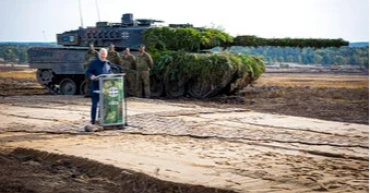
Berlin’s perceived foot-dragging, most recently on the Leopard 2 battle tanks that Kyiv has long sought, is rooted at least partly in a post-World War II political culture of military caution, along with present-day worries about a possible escalation in the war.
On Friday, Germany inched closer to a decision to deliver the tanks, ordering a review of its Leopard stocks in preparation for a possible green light.
There was still no commitment, however. Defense Minister Boris Pistorius rejected the suggestion that Germany was standing in the way but said, “we have to balance all the pros and contras before we decide things like that, just like that.”
It's a pattern that has been repeated over the months as Scholz first held off pledging new, heavier equipment, then eventually agreed to do so.
Most recently, Germany said in early January that it would send 40 Marder armored personnel carriers to Ukraine — doing so in a joint announcement with the U.S., which pledged 50 Bradley armored vehicles.
That decision followed months of calls for Berlin to send the Marder and stoked pressure for it to move up another step to the Leopard tank.
“There is a discrepancy between the actual size of the commitment and weapons deliveries — it’s the second-largest European supplier — and the hesitancy with which it is done,” said Thomas Kleine-Brockhoff, a Berlin-based senior analyst with the German Marshall Fund of the United States think tank.
Scholz, an unshakably self-confident politician with a stubborn streak and little taste for bowing to public calls for action, has stuck resolutely to his approach. He has said that Germany won’t go it alone on weapons decisions and pointed to the need to avoid NATO becoming a direct party to the war with Russia.
As pressure mounted last week, he declared that he wouldn't be rushed into important security decisions by “excited comments.” And he insisted that a majority in Germany supports his government’s “calm, well-considered and careful” decision-making.
Speaking at the World Economic Forum in Davos, Switzerland, on Wednesday, Scholz listed some of the equipment Germany has sent to Ukraine, declaring that it marks “a profound turning point in German foreign and security policy.”
Read more: US military's expanded combat training for Ukrainian forces begins in Germany
That is, at least to some extent, true. Germany refused to provide lethal weapons before the invasion started, reflecting a political culture rooted in part in the memory of Germany's own history of aggression during the 20th century — including the Nazi invasion of the Soviet Union.
“No German chancellor, of no party, wants to be seen out front in pushing a military agenda — you want to try all other options before you resort to that,” Kleine-Brockhoff said. “And therefore for domestic consumption, it is seen as a positive thing for a German chancellor not to lead on this, to be cautious, to be resistant, to have tried all other options.”
Scholz does face calls from Germany's center-right opposition and some in his three-party governing coalition to be more proactive on military aid; less so from his own center-left Social Democratic Party, which for decades was steeped in the legacy of Cold War rapprochement pursued by predecessor Willy Brandt in the early 1970s.
Scholz “decided early on that he does not want to lead militarily on Ukraine assistance,” Kleine-Brockhoff said, though “he wants to be a good ally and part of the alliance and in the middle of the pack.”
But the cautious approach “drives allies crazy” and raises questions over whether they can count on the Germans, Kleine-Brockhoff acknowledged.
Berlin kept up its caution on the Leopard tank even after Britain announced last week that it would provide Ukraine its own Challenger 2 tanks.
The hesitancy isn't just an issue between Berlin and Kyiv, since other countries would need Germany's permission to send their own stocks of German-made Leopards to Ukraine. On Wednesday, Polish Prime Minister Mateusz Morawiecki said Warsaw would consider giving its tanks even without Berlin's permission.
“Consent is of secondary importance here. We will either obtain it quickly, or we will do the right thing ourselves,” Morawiecki said.
British historian Timothy Garton Ash wrote in The Guardian and other newspapers this week that “to its credit, the German government’s position on military support for Ukraine has moved a very long way since the eve of the Russian invasion.”
Read more: Russia claims progress in eastern Ukraine; Kyiv craves tanks
But he argued that the tank issue has become “a litmus test of Germany’s courage to resist (Russian President Vladimir) Putin’s nuclear blackmail, overcome its own domestic cocktail of fears and doubts, and defend a free and sovereign Ukraine,” and that Scholz should lead a “European Leopard plan.”
Whether that will eventually happen remains to be seen. Scholz's government has insisted on close coordination with the United States, a possible reflection in part of the fact that Germany — unlike Britain and France — relies on the U.S. nuclear deterrent.
On Friday, Scholz's spokesman, Steffen Hebestreit, denied reports that Germany had insisted it would only deliver Leopard tanks if the U.S. sends its own Abrams tanks. He rejected the notion that Berlin is trailing others and insisted it is taking the right approach.
“These are not easy decisions, and they need to be well-weighed," he said. "And this is about them being sustainable, that all can go along with them and stand behind them — and part of a leadership performance is keeping an alliance together.”
3 years ago
Defense leaders meet amid dissent over tanks for Ukraine
Defense leaders are gathering at Ramstein Air Base in Germany Friday to hammer out future military aid to Ukraine, amid ongoing dissent over who will provide the battle tanks that Ukrainian leaders say they desperately need to recapture territory from Russia.
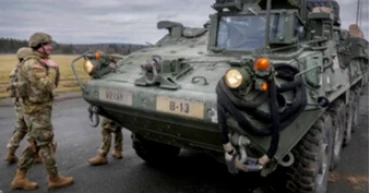
U.S. Defense Secretary Lloyd Austin and Army Gen. Mark Milley, chairman of the Joint Chiefs of Staff, are expected to discuss the latest massive package of aid the U.S. is sending — which totals $2.5 billion and includes Stryker armored vehicles for the first time.
But broader hesitation over sending tanks to Ukraine has roiled the coalition, as Germany facees mounting pressure to supply Leopard 2 tanks to Kyiv, or at least clear the way for others — such as Poland — to deliver German-made Leopards from their own stock.
The U.S. has also declined, at least so far, to provide M1 Abrams tanks, citing the extensive and complex maintenance and logistical challenges with the high-tech vehicle. The U.S. believes it would be more productive to send Leopards since many allies have them and Ukrainian troops would only have to get trained on that one, versus needing far more training on the more difficult Abrams.
The United Kingdom announced last week that it will send Challenger 2 tanks, and has said it's a natural progression of military aid to Ukraine.
At a Pentagon briefing Thursday, spokeswoman Sabrina Singh said the Leopard and Challenger aren’t comparable to the Abrams because the Abrams is much harder to maintain and wouldn’t be a good fit.
“It’s more of a sustainment issue. I mean, this is a tank that requires jet fuel, whereas the Leopard and the Challenger, it’s a different engine.” The Leopard and Challenger are “a little bit easier to maintain,” Singh said. “They can maneuver across large portions of territory before they need to refuel. The maintenance and the high cost that it would take to maintain an Abrams — it just doesn’t make sense to provide that to the Ukrainians at this moment.”
Read more: NATO vows to aid Ukraine ‘for as long as it takes’
The package of aid being sent by the U.S. includes eight Avenger air defense systems, 350 Humvees, 53 Mine Resistant Ambush Protected (MRAP) vehicles, more than 100,000 rounds of artillery ammunition and rockets, and missiles for the High Mobility Artillery Rocket System. It was announced Thursday by the Pentagon.
Germany’s new defense minister, Boris Pistorius, who took office just an hour before he met with Austin on Thursday, is among those likely to attend the Ramstein meeting. Referring to the tanks, he told ARD television he was “pretty sure we will get a decision on this in the coming days, but I can’t yet tell you today how it will look.”
It wasn't clear if the tank issue came up during his initial session with Austin. During brief comments before the meeting began, Austin said, "we’ll renew our united commitment to support Ukraine’s self-defense for the long haul,” but didn’t mention any specific new equipment.
Nearly 11 months into the Russian invasion, Ukrainian President Volodymyr Zelenskyy has expressed frustration about not obtaining enough weaponry from the Western allies.
Speaking by video link on the sidelines of the World Economic Forum’s annual meeting in Davos, Switzerland, Zelenskyy offered a veiled critique of major supporters such as Germany and the U.S. that have hesitated about sending tanks.
Bemoaning a “lack of specific weaponry,” he said, through an interpreter, “There are times where we shouldn’t hesitate or we shouldn’t compare when someone says, ‘I will give tanks if someone else will also share his tanks.’”
German officials have conveyed their hesitancy to allow allies to give Leopards unless the U.S. also sends Ukraine the Abrams, according to a U.S. official who wasn’t authorized to comment and spoke on condition of anonymity. But there have been no signs that the U.S. decision to not send Abrams is shifting.
Read more: Deadly missile strike adds to Ukraine war fears in Poland
Milley told reporters traveling with him this week that complex new U.S. training of Ukrainian troops, combined with an array of new weapons, artillery, armored vehicles heading to Ukraine, will be key to helping the country’s forces take back territory that has been captured by Russia in the nearly 11-month-old war.
The goal, he said, is to deliver needed weapons and equipment to Ukraine so the newly trained forces will be able to use it “sometime before the spring rains show up. That would be ideal.”
Under Secretary of Defense for Policy Colin Kahl also said this week that a new phase of the war is shaping up as Russia gets more deeply entrenched, and that Ukraine will need mechanized infantry to break through those lines.
The influx of new weapons, tanks and armored carriers comes as Ukraine faces intense combat in eastern Ukraine around the city of Bakhmut and the nearby salt mining town of Soledar. The battles are expected to intensify in the spring.
3 years ago
Prince Harry's memoir 'Spare' sells 3.2M copies in 1st week
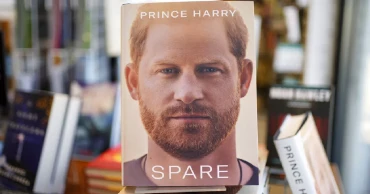
Prince Harry's “Spare” sold more than 3.2 million copies worldwide after just one week of publication and will likely rank among the bestselling memoirs of all time.
Penguin Random House announced Thursday that Prince Harry's headline-making memoir sold 1.6 million copies in the U.S. alone. It's a number comparable to first week sales for blockbusters such as former President Barack Obama's “A Promised Land” and former first lady Michelle Obama's “Becoming," which has sold more than 17 million copies since coming out in 2018.
Read more: Memoir is about saving royals from themselves: Prince Harry
The British publisher announced last week that “Spare” sold 400,000 copies in the United Kingdom in all formats — hardback, e-book and audio — on its first day.
The total sales announced for “Spare” are for print, audio and digital editions in the major English-language markets: the U.S., U.K., Canada and Australia. The book has come out in 15 other languages, and editions in 10 additional languages are expected.
“Spare” may set records for nonfiction, but no book in memory approaches the pace of the final Harry Potter novel, “Harry Potter and the Deathly Hallows,” which in 2007 sold more than 10 million copies in its first 24 hours.
Read more: Harry’s memoir, detailing toxic relationship between the monarchy and press, could accelerate change
Prince Harry, the Duke of Sussex, worked on his book with American novelist J.R. Moehringer, who also helped write Andre Agassi's acclaimed “Open" and is the author of “The Tender Bar," a memoir adapted by George Clooney into a movie starring Ben Affleck.
3 years ago

Cyprus protests portrayal as safe haven for Russian money
Cyprus has frozen about 1.5 billion euros ($1.6 billion) in Russian-linked deposits and assets in accordance with European Union sanctions over the war in Ukraine, the island nation's finance minister said Thursday.
Constantinos Petrides also told a press conference that Russian deposits in Cypriot banks have fallen from a stunning 40% of the total before the 2013 financial crisis — when big depositors were forced to take a cut on their money under a so-called "bail-in" deal — to 3.8%.
Read more: Death toll from Russian strike reaches 45, including 6 children
He was responding to a report this week in the CBS 60 Minutes show, which suggested Cyprus still hosts a maze of shell companies concealing assets of sanctioned Russians, and that such assets Cyprus has frozen are a fraction of the total.
“We don’t live in an unsupervised environment, especially a European Union member country with such a sinful past,” Petrides said. He was referring to lax banking and financial services supervision that earned Cyprus much criticism as a money-laundering heaven.
Petrides added that much had been “corrected” following three years of strict supervision by the International Monetary Fund, and European creditors as part of a multibillion euro bailout program following the 2013 crisis.
The minister said Russian deposits in Cypriot banks are less than 1 billion euros ($1.08 billion), about a fifth of what he said the TV report claimed was deposited by Russians last year.
Read more: Rifts in Russian military command seen amid Ukraine fighting
Under EU sanctions adopted since last year's Russian invasion of Ukraine, Petrides said, Cypriot authorities have frozen 105 million euros in Russian-linked bank deposits, 720 million euros in funds managed by Cyprus-registered investment companies and 719 million euros in assets held by administrative services.
He also said tougher vetting for money laundering in recent years has made it harder to open a bank account in Cyprus and resulted in the closure of 80,000 bank accounts, while thousands more have been prevented from being opened.
Petrides said the names of sanctioned individuals cannot be disclosed.
3 years ago

Kyiv helicopter crash kills 18, including Ukraine’s interior minister, his two children
A helicopter crash in a Kyiv suburb Wednesday killed 18 people, including Ukraine’s interior minister and three children, Ukrainian authorities said.
Interior Minister Denys Monastyrskyi, his deputy Yevhen Yenin and State Secretary of the Ministry of Internal Affairs Yurii Lubkovych were among those killed, according to Ihor Klymenko, chief of Ukraine’s National Police. Monastyrskyi is the most senior Ukrainian official to have died since the start of the war with Russia almost 11 months ago.
Nine of those killed were aboard the emergency services helicopter that crashed in Brovary, an eastern suburb of the Ukrainian capital, Klymenko said.
Kyiv Regional Governor Oleksii Kuleba said three children were also killed. Earlier, officials and media reports said the helicopter crashed near a kindergarten.
Read more: Death toll from Russian strike reaches 45, including 6 children
There was no immediate word on whether the crash was an accident or a result of the war with Russia. No fighting has been reported recently in the Kyiv area.
A total of 29 people were injured, including 15 children, the regional governor said.
Ukraine first lady Olena Zelenska daubed teary eyes and pinched her nose in emotion minutes before attending a World Economic Forum session in Davos, Switzerland.
Forum President Borge Brende requested 15 seconds of silence after opening the session to honor the Ukrainian officials killed in the crash.
3 years ago

Death toll from Russian strike reaches 45, including 6 children
The death toll from the Ukraine war’s deadliest attack on civilians at one location since last spring reached 45 at an apartment building a Russian missile blasted in the southeastern city of Dnipro, officials said Tuesday.
Those killed in the Saturday afternoon strike included six children, with 79 people injured, President Volodymyr Zelenskyy wrote on the Telegram messaging app. The toll included two dozen people initially listed as missing at the multistory building, which housed about 1,700, according to Kyrylo Tymoshenko, deputy head of the Ukrainian president’s office.
Emergency crews cleared some 9 metric tons (9.9 tons) of rubble during a non-stop search and rescue operation, the Dnipro City Council said. About 400 people lost their homes, with 72 apartments completely ruined and another 236 damaged beyond repair, it added.
People converged at the site Tuesday to lay flowers, light candles and bring plush toys. For a third day in a row, Dnipro resident Oleksandr Pohorielov came to mourn.
Read more: Death toll in Russian strike on Ukrainian building up to 35
“It’s like coming to the cemetery to your family. It’s a memory, to say a proper goodbye. To remain a human after all,” he explained as an intense reek of burning emanated from the building’s ruins.
Volunteers helped Nadiia Yaroshenko’s son escape from their third floor apartment on a makeshift ladder but their white cat Beliash refused to leave. He remains in his favorite place at a window that is now blown out, Yaroshenko said, desperately trying to see him from the courtyard with a flashlight.
“We cannot reach the apartment even with rescuers because the apartment is in an emergency and dangerous condition. Walls could collapse there every minute,” she said.
The latest deadly Russian strike on a civilian target in the almost 11-month wa r triggered outrage. It also prompted the surprise resignation on Tuesday of a Ukrainian presidential adviser who had said the Russian missile exploded and fell after the Ukrainian air defense system shot it down, a version that would take some of the blame off the Kremlin's forces.
Oleksii Arestovych's comments in a Saturday interview caused an outcry. He said as he quit that his remarks were “a fundamental mistake.” Ukraine’s air force had stressed that the country's military did not have a system that could down Russia's Kh-22 supersonic missiles, the type that hit the apartment building.
Zelenskyy vowed “to ensure that all Russian murderers, everyone who gives and executes orders on missile terror against our people, face legal sentences. And to ensure that they serve their punishment.”
The British Defense Ministry said Tuesday that the weekend barrage of long-range missiles, the first of its kind in two weeks, targeted Ukraine’s power grid.
The Kh-22 was designed during Soviet times to strike enemy ships. It can also be used against ground targets, but with much less precision. Observers have said that Russia has increasingly used older weapons, including those intended for other purposes, to attack targets in Ukraine in what could be a sign of the depletion of Russian stockpiles of modern precision weapons. The U.K. ministry noted that the Kh-22 “is notoriously inaccurate when used against ground targets as its radar guidance system is poor at differentiating targets in urban areas,” suggesting that might have been a factor in the deaths in the Dnipro.
Similar missiles were used in other incidents that caused high civilian casualties, it said, including a strike on a shopping mall in Ukraine’s central city of Kremenchuk in June that officials said killed more than 20 people.
The deadliest attack involving civilians before Saturday was an April 9 strike on a train station in the eastern city of Kramatorsk that left at least 52 people dead, according to The Associated Press-Frontline War Crimes Watch project.
In Moscow, a makeshift memorial to the Dnipro attack’s victims appeared in front of an apartment building, an unusual act in Russia, where even a hint of criticism of the government’s “special military operation” in Ukraine is often suppressed. Amid snow, flowers and toy stuffed animals were laid at the monument of prominent Ukrainian writer Lesya Ukrainka, along with a photo of the destroyed building and a sign that read in Russian: “Dnipro. 14.01.2023.”
Attacks on civilians have helped stiffen international support for Ukraine as it battles to fend off the Kremlin’s invasion. The winter has brought a slowdown in fighting, but military analysts say a new push by both sides is likely once the weather improves.
Underscoring Russia’s growing military needs, Defense Minister Sergei Shoigu said Tuesday that the country’s military would increase the number of troops from 1.15 million to 1.5 million in the coming years.
As part of the buildup, the military will form an army corps in the northwestern region of Karelia, near Finland, as well as three new motorized infantry and two airborne divisions. The military will also beef up seven motorized infantry brigades into divisions.
On the side of Ukraine, the top U.S. military officer, Army Gen. Mark Milley, traveled to the Ukraine-Poland border on Tuesday to meet with his Ukrainian counterpart for the first time. Milley, the chairman of the Joint Chiefs of Staff, met with Gen. Valerii Zaluzhnyi, in southeastern Poland. On Monday, Milley visited troops from Ukraine training at a military base in Germany under U.S. commanders.
Read more: Ukraine strike deaths hit 40; Russia seen preparing long war
Aid is also on the way from the Netherlands. Prime Minister Mark Rutte said Tuesday in Washington that his country plans to “join” the U.S. and Germany’s efforts to train and arm Ukraine with advanced Patriot missile defense systems.
It remains unclear if the Dutch will ultimately send Patriot systems, although Zelenskyy said in his nightly address Tuesday that the Netherlands had agreed to send Ukraine a battery of the equipment. “So, there are now three guaranteed batteries. But this is only the beginning. We are working on new solutions to strengthen our air defense,” Zelenskyy said.
Ukrainian troops are at Oklahoma’s Fort Sill Army base learning how to operate and maintain the Patriot, the most advanced surface-to-air missile system the West has pledged to provide to Ukraine to help repel Russian aerial attacks.
Ukraine’s first lady was doing her part Tuesday to help. She pressed world leaders and corporate executives at the World Economic Forum’s annual gathering in Switzerland to exercise their influence against a Russian invasion she said is leaving children dying and the world struggling with food insecurity.
As the first anniversary of the war nears, Olena Zelenska said parents in Ukraine are in tears watching doctors trying to save their children, farmers are afraid to return to their fields filled with mines and “we cannot allow a new Chernobyl to happen,” referring to the 1986 nuclear power plant disaster.
“What you all have in common is that you are genuinely influential,” Zelenska told attendees. “But there is something that separates you, namely that not all of you use this influence, or sometimes use it in a way that separates you even more.”
Meanwhile, the head of the U.N. nuclear agency is visiting several of Ukraine’s four nuclear power plants this week to oversee the establishment of a permanent presence of inspectors at each of them to oversee operations and ensure safety.
Rafael Grossi, director-general of the International Atomic Energy Agency, said Tuesday the missions “will make a very real difference through supporting the Ukrainian operators and regulator in fulfilling their national responsibility of ensuring nuclear safety and security.”
3 years ago

Netherlands says it will send Patriot assistance to Ukraine
Netherlands Prime Minister Mark Rutte during a meeting with President Joe Biden on Tuesday said that the Netherlands plans to "join” the U.S. and Germany's efforts to train and arm Ukraine with advanced Patriot defense systems.
Rutte in a brief appearance with Biden did not detail whether the Dutch are expected to send Patriot systems, take part in training or offer some other assistance related to deployment of Patriots. Rutte said he also spoke with German Chancellor Olaf Scholz on Tuesday about the Netherland’s efforts.
“We have the intention to join what you are doing with Germany on the Patriot project," Rutte said. "I think that it’s important we join that and I discussed it also this morning with Olaf Scholz of Germany.”
White House press secretary Karine Jean-Pierre confirmed that Biden and Rutte discussed ongoing efforts with Patriots, but referred questions about the Netherlands' intentions to the Dutch government, which did not immediately provide clarity.
Rutte spoke about the potential assistance as Ukrainian troops arrived at Oklahoma’s Fort Sill Army base to begin training on operating and maintaining the Patriot missile defense system. The Patriot is the most advanced surface-to-air missile system the West has provided to Ukraine to help repel Russian aerial attacks.
“Training has begun," Pentagon spokesman Air Force Brig. Gen. Pat Ryder said. "As we’ve talked about before, that training will last for several months, and train upwards of 90 to 100 Ukrainians on use of the Patriot missile system.”
Biden was also looking to use Tuesday's meeting with Rutte to nudge the Netherlands to further limit China’s access to advanced semiconductors with export restrictions.
Read more: Ukraine hails US military aid as cease-fire said to falter
The Biden administration has been trying to get the Netherlands on the same page since the U.S. Commerce Department announced in October new export controls aimed at China. The restrictions are intended to limit China’s ability to access advanced computing chips, develop and maintain supercomputers, and make advanced semiconductors.
“Together we’re working on how to keep a free and open Indo Pacific, and quite frankly the challenges of China," Biden said at the start of their meeting.
Administration officials have reasoned that the export restrictions are necessary because China can use semiconductors to create advanced military systems including weapons of mass destruction; commit human rights abuses; and improve the speed and accuracy of its military decision making, planning and logistics.
Slowing Beijing's access, however, will take plenty of help from allies for the U.S. export controls to have maximum impact. The Netherlands-based tech giant ASML is a major manufacturer of lithography machines that design and produce semiconductors. China is one of ASML's biggest clients.
CEO Peter Wennink played down the impact of the U.S. export control regulations soon after the administration unveiled them last fall. ASML said last year that it expected company-wide 2022 sales to be around 21 billion euros.
The U.S. has also been in talks with Japan on tougher export restrictions to limit the sale of semiconductor manufacturing technology to China. Rutte's visit comes after Biden hosted Japanese Prime Minister Fumio Kishida last week for talks.
The U.S. and Japan, in a joint statement following the Oval Office meeting, said the two sides agreed to “sharpen our shared edge on economic security, including protection and promotion of critical and emerging technologies.”
China’s Foreign Ministry spokesperson Wang Wenbin last week called on Japan and the Netherlands to resist U.S. pressure.
“We hope the relevant countries will do the right thing and work together to uphold the multilateral trade regime and safeguard the stability of the global industrial and supply chains,” he said. “This will also serve to protect their own long-term interests.”
Rutte spoke by phone on Monday with Ukraine President Volodymyr Zelenskyy about Saturday's Russian missile strike on an apartment building in Dnipro — one of the deadliest attacks on civilians in the nearly 11-month-old war. Authorities said the death toll from the strike rose to 40 and that 30 people remained missing Monday.
“These are horrible pictures and I think it strengthens even more our resolve to stay with Ukraine,” Rutte told reporters at the start of his meeting with Biden.
Biden praised Netherlands as one of the United States “strongest” allies, one that's proven “very, very stalwart” in its support for Ukraine since Russia launched in its invasion in February. The Netherlands has committed about $2.7 billion (2.5 billion euros) in support for Ukraine this year. The money will be spent on military equipment, humanitarian and diplomatic efforts.
Read more: US to send $3.75B in military aid to Ukraine, its neighbors
The Netherlands providing Ukraine with Patriot assistance — whether the weapons systems, missiles or training — would be a major move for the NATO ally.
The training of Ukraine forces now underway in Oklahoma is to focus, in part, on how to maintain the battery that will be sent by the U.S. to Ukraine once training is complete. Each system has multiple components, including a phased array radar, a control station, computers and generators, and typically requires about 90 soldiers to operate and maintain, however only three soldiers are needed to actually fire it, according to the Army.
Some of the ongoing maintenance support, once the Patriot is on the battlefield, will be done remotely, Ryder said.
The Dutch prime minister, for his part, praised Biden for leading the international effort to back Ukraine.
“I am convinced history will judge in 2022 if the United States had not stepped up like you did things would have been very different,” Rutte said.
The two leaders were also to discuss plans for the Summit for Democracy, which they are co-hosting with Costa Rica, South Korea and Zambia in late March.
Biden hosted the inaugural democracy summit in December 2021, which the administration billed as the start of a global conversation about how best to halt the backsliding of democracy.
Biden is the third U.S. president visited by Rutte, the Netherlands’ longest-serving prime minister. He earlier met with Barack Obama and Donald Trump.
3 years ago