Europe

Child’s body found in Dnipro building, strike deaths hit 41
The death toll from a weekend Russian missile strike on an apartment building in southeastern Ukraine climbed to 41 on Tuesday after the body of a child was pulled from the rubble, officials said, in what was the deadliest attack of the war on civilians at one location since the spring.
Another 25 residents of the building city of Dnipro were still missing, according to Valentyn Reznichenko, the governor of the Dnipropetrovsk region, whose capital is Dnipro.
Emergency crews have cleared about 90% of the rubble during a 63-hour search since the Saturday afternoon strike, he said.
Read more: Top US general visits training site for Ukrainian soldiers
There are 79 wounded people, he said, with 28 of them hospitalized and 10 in serious condition. About 1,700 people lived in the multistory building. Some people were trapped on upper floors, with some signaling for help with lights on their cellphones.
The latest deadly Russian strike on a civilian target in the almost 11-month war triggered outrage. It also prompted the surprise resignation on Tuesday of a Ukrainian presidential adviser who said the Russian missile was shot down by the Ukrainian air defense system and exploded when it fell — a version that would take some of the blame off the Kremlin's forces.
Oleksii Arestovich's comments in an interview Saturday night caused an outcry. He said as he quit that his remarks were “a fundamental mistake.”
Ukrainian President Volodymyr Zelenskyy vowed to bring those responsible for the strike to justice, saying it's “a fundamental task” for Ukraine and its Western allies.
“This strike at Dnipro, as well as other similar strikes, falls, in particular, under the jurisdiction of the International Criminal Court,” he said in a video address late Monday.
“And we will use all available opportunities — both national and international — to ensure that all Russian murderers, everyone who gives and executes orders on missile terror against our people, face legal sentences. And to ensure that they serve their punishment,” he said.
The U.K. Defense Ministry said Tuesday that the weekend barrage of long-range missiles, the first of its kind in two weeks, targeted Ukraine’s power grid.
But the ministry identified the missile that slammed into the Dnipro apartment building as an anti-ship missile that “is notoriously inaccurate when used against ground targets as its radar guidance system is poor at differentiating targets in urban areas.”
Similar missiles were used in other incidents that caused high civilian casualties, it said, including a strike on a shopping mall in Ukraine’s central city of Kremenchuk last June.
Such incidents have helped stiffen international support for Ukraine as it battles to fend off the Kremlin’s invasion. The winter has brought a slowdown in fighting, but military analysts say a new push by both sides is likely once the weather improves.
Russian Defense Minister Sergei Shoigu said Tuesday that the country's military would increase its readiness from the current 1.15 million to 1.5 million in coming years.
Read more: Ukraine strike deaths hit 40; Russia seen preparing long war
As part of the buildup, the military will form an army corps in the northwestern region of Karelia, near Finland, as well as three new motorized infantry and two airborne divisions. The military will also beef up seven existing motorized infantry brigades into divisions.
That announcement came a day after U.S. Deputy Secretary of State Wendy Sherman and other U.S. officials met in Kyiv with Zelenskyy. They reiterated Washington's “strong and steadfast commitment to Ukraine,” U.S. State Department spokesperson Ned Price said.
U.S. Army Gen. Mark Milley, chairman of the Joint Chiefs of Staff, on Monday visited Ukraine troops who are training at a military base in Germany under U.S. commanders.
More than 600 Ukrainian troops began the expanded training program at the camp the previous day.
“This is not a run of the mill rotation,” Milley told commanders. “This is one of those moments in time where if you want to make a difference, this is it.”
Ukraine’s first lady was also helping to cement Western support and acquire more foreign weapons, as she was scheduled to give a rare international address at the World Economic Forum’s annual gathering in the Swiss town of Davos.
Meanwhile, the head of the U.N. nuclear agency on Monday visited the South Ukraine Nuclear Power Plant and announced the organization’s permanent presence there to oversee operations and ensure safety.
Rafael Grossi, director general of the International Atomic Energy Agency, tweeted late Monday that the agency’s flag was flying over the power plant.
“We are here to stay to help ensure nuclear safety (and) security during ongoing conflict,” Grossi said, adding that “soon, IAEA will be permanently present” at all of Ukraine’s nuclear power plants.
Ukraine has a total of four nuclear power plants with 16 reactors. One of them, the Zaporizhzhia nuclear power plant, was taken over by Russian forces in the first months of the war and remains under their control.
3 years ago

Top US general visits training site for Ukrainian soldiers
Monday was just Day Two for Ukrainian soldiers at the U.S. military’s new training program, but the message was coming through loud and clear.
These are urgent times. And the lessons they will get in the next five weeks on weapons, armored vehicles and more sophisticated combat techniques are critical as they prepare to defend their country against the Russian invasion.
“This is not a run of the mill rotation,” U.S. Army Gen. Mark Milley, chairman of the Joint Chiefs of Staff, said Monday afternoon as he met with commanders. “This is one of those moments in time where if you want to make a difference, this is it.”
Milley, who visited the sprawling Grafenwoehr training area to get his first look at the new, so-called combined arms instruction, has said it will better prepare Ukrainian troops to launch an offensive or counter any surge in Russian attacks.
Read more: Ukraine building suffers deadliest civilian attack in months
He spent a bit less than two hours at “Camp Kherson” — a section of the base named after a city in Ukraine where Ukrainian troops scored a key victory against Russia last year. More than 600 Ukrainian troops began the expanded training program at the camp just a day before Milley arrived.
For the first time since the war began nearly a year ago, reporters were given broad access to watch various portions of the training. The reporters were allowed to follow Milley and watch his interactions with Ukrainian and U.S. troops and commanders, but were not allowed to report specific conversations with the Ukraine forces or take any photos or video. The restrictions reflect ongoing U.S. concerns about escalating Russian anger over the West’s involvement in the war or triggering a wider conflict.
The U.S. has conducted training at Grafenwoehr for years, including for allied forces in Europe. But limited instruction for Ukrainian forces began last year, shortly after the Russian invasion. At the time it was focused specifically on various weapons systems that were being supplied by the U.S., such as the howitzer.
Last month, the Pentagon announced it would expand the training in an effort to hone the skills of the Ukrainian forces. The five-week course will teach them to effectively move and coordinate their company- and battalion-size units in battle, using combined artillery, armor and ground forces.
It will include classroom instruction and field work that will begin with small squads and gradually grow to involve larger units. It will culminate with a more complex combat exercise bringing an entire battalion and a headquarters unit together.
The training at Grafenwoehr is being done by the 7th Army Training Command.
Speaking to two reporters traveling with him to Europe on Sunday, Milley said the complex training — combined with an array of new weapons, artillery, tanks and other vehicles heading to Ukraine — will be key to helping the country’s forces take back territory that has been captured by Russia in the nearly 11-month-old war.
Read more: US military's expanded combat training for Ukrainian forces begins in Germany
On Monday, as he walked through the training area, Milley bantered with troops, asking them about their combat experience and talking to them about their mission.
“The urgency was clear,” said Army Col. Dave Butler, Milley's spokesman. “These soldiers are going off to defend their country in combat.”
Milley said Sunday that the goal is for incoming weapons and equipment to be delivered to Ukraine so the newly trained forces will be able to use it “sometime before the spring rains show up. That would be ideal.”
The new instruction comes as Western analysts point to signs that the Kremlin is digging in for a drawn-out war, and say the Russian military command is preparing for an expanded mobilization effort.
Across the battlefield, Ukrainian forces face fierce fighting in the eastern Donetsk province, where the Russian military has claimed it has control of the small salt-mining town of Soledar. Ukraine asserts that its troops are still fighting, but if Moscow’s troops take control of Soledar it would allow them to inch closer to the bigger city of Bakhmut, where fighting has raged for months.
Russia also launched a widespread barrage of missile strikes over the weekend, including in Kyiv, the northeastern city of Kharkiv and the southeastern city of Dnipro, where the death toll in one apartment building rose to 40.
3 years ago

Ukraine strike deaths hit 40; Russia seen preparing long war
Ukrainian emergency crews on Monday sifted through what was left of a Dnipro apartment building destroyed by a Russian missile, placing bodies from one of the war’s deadliest single attacks in months in black bags and gingerly carrying them across steep piles of rubble.
Authorities said the death toll from Saturday’s strike rose to 40 and that 30 people remained missing Monday. Tall cranes swung across the jagged gaps in a row of residential towers, the engines growling as residents of one of Ukraine’s largest cities watched largely in silence under a gray sky.
About 1,700 people lived in the multistory building, and search and rescue crews have worked nonstop since the missile strike to locate victims and survivors in the wreckage. The regional administration said 39 people have been rescued and at least 75 were wounded.
The reported death toll put it among the deadliest attacks on Ukrainian civilians since before the summer, according to The Associated Press-Frontline War Crimes Watch project. Residents said the apartment tower did not house any military facilities.
Oleksander Anyskevych said he was in his apartment when the missile struck.
“Boom — and that’s it. We saw that we were alive and that’s all,” Anyskevych said Monday as he went to the site to see his wrecked apartment.
He told The Associated Press that he knew people who died under the rubble. One of his son’s classmates lost her parents.
Read more: Death toll in Russian strike on Ukrainian building up to 35
Dnipro residents took flowers, candles and toys to the ruins.
“All of us could be in that place,” local resident Iryna Skrypnyk said.
The European Union’s foreign policy chief, Josep Borrell, called the strike, and others like it, “inhumane aggression” because it directly targeted civilians. “There will be no impunity for these crimes,” he said in a tweet Sunday.
Asked about the strike Monday, Kremlin spokesman Dmitry Peskov said the Russian military doesn’t target residential buildings and suggested the Dnipro building was hit as a result of Ukrainian air defense actions.
The strike on the building came amid a wider barrage of Russian cruise missiles across Ukraine. The Ukrainian military said Sunday that it did not have the means to intercept the type of Russian missile that hit the residential building in Dnipro.
Fierce fighting continued to rage Monday in Ukraine’s eastern Donetsk province, where military analysts have said both sides are likely suffering heavy troop casualties. No independent verification of developments was possible.
Donetsk and neighboring Luhansk province make up the Donbas, an expansive industrial region bordering Russia that Russian President Vladimir Putin identified as a focus from the war’s outset. Moscow-backed separatists have been fighting Kyiv’s forces there since 2014.
The Russian and Belarusian air forces began a joint exercise Monday in Belarus, which borders Ukraine and served as a staging ground for Russia’s Feb. 24 invasion of Ukraine.The drills are set to run through Feb. 1, the Belarusian Defense Ministry said. Russia has sent its warplanes to Belarus for the drills.
The Institute for the Study of War, a Washington think tank, reported signs of the Kremlin taking steps to turn its Ukraine invasion into “a major conventional war” after months of embarrassing military reversals.
What Moscow calls “a special military operation” aimed to capture the Ukrainian capital, Kyiv, within weeks and to install a Kremlin-friendly regime there, but Russian forces ultimately withdrew from around Kyiv, the think tank said. Then came a successful Ukrainian counteroffensive in recent months before the onset of winter slowed military advances.
“The Kremlin is likely preparing to conduct a decisive strategic action in the next six months intended to regain the initiative and end Ukraine’s current string of operational successes,” the Institute for the Study of War said in a report late Sunday.
It noted reports indicating the Russian military command was in “serious preparations” for an expanded mobilization effort, conserving mobilized personnel for future use, while seeking to boost military industrial production and reshuffling its command structure.
That means Ukraine’s Western allies “will need to continue supporting Ukraine in the long run,” the think tank said.
Read more: Deaths from strike on Ukraine apartment building rise to 29
NATO member nations have sought in recent days to reassure Ukraine that they will stay the course. The United Kingdom has pledged tanks and the U.S. military’s new, expanded combat training of Ukrainian forces began in Germany on Sunday.
Poland’s prime minister urged the German government to supply a wide range of weapons to Kyiv and voiced hope that Berlin would soon approve a transfer of battle tanks.
Other developments on Monday:
— Russian forces shelled the city of Kherson and the Kherson region, killing three people and wounding 14 others over the last 24 hours, regional Gov. Yaroslav Yanushevych said. In the city of Kherson, the shelling damaged a hospital, a children disability center, a shipyard, critical infrastructure and apartment buildings.
— Russian forces struck the city of Zaporizhzhia, damaging industrial infrastructure and wounding five people, two of them children, the deputy head of Ukraine’s presidential office Kyrylo Tymoshenko reported.
— Russian air defenses downed 10 drones Monday over the Black Sea near the port of Sevastopol in annexed Crimea, Mikhail Razvozhayev, the Russian-installed head of Sevastopol, reported.
3 years ago

Death toll in Russian strike on Ukrainian building up to 35
The death toll from the weekend Russian missile strike on the apartment building in the southeastern Ukrainian city of Dnipro has risen to 35, an official said Monday.
Rescuers continued searching through the rubble for more victims, regional Gov. Valentyn Reznichenko said. At least 75 people were wounded and 35 others were still missing after Saturday’s strike.
About 1,700 people lived in the multi-story building, with residents saying there were no military facilities at the site. The reported death toll made it the deadliest attack in one place since a Sept. 30 strike in Ukraine’s Zaporizhzhia region, according to The Associated Press-Frontline War Crimes Watch project.
Read: Flight data, voice recorders retrieved from Nepal site after deadly plane crash
The strike on the building on Saturday came amid a major barrage of Russian cruise missiles across Ukraine.
Russia’s renewed air attacks came as fierce fighting raged in Ukraine’s eastern Donetsk province, where the Russian military has claimed it has control of the small salt-mining town of Soledar but Ukraine asserts that its troops are still fighting.
If the Russian forces win full control of Soledar, it would allow them to inch closer to the bigger city of Bakhmut. The battle for Bakhmut has raged for months, causing substantial casualties on both sides.
With the grinding war nearing the 11-month mark, the U.K. government announced it would deliver tanks to Ukraine, its first donation of such heavy-duty weaponry. Although the pledge of 14 Challenger 2 tanks appeared modest, Ukrainian officials expect it will encourage other Western nations to supply more tanks.
Read: Cars collide on icy road in South Korea; 1 dead, dozens hurt
Other developments on Monday:
— Russian forces shelled the city of Kherson and the Kherson region, killing three people and wounding 14 others over the last 24 hours, regional Gov. Yaroslav Yanushevych said. In the city of Kherson, the shelling damaged a hospital, a children disability center, a shipyard, critical infrastructure and apartment buildings.
— Russian forces struck the city of Zaporizhzhia, damaging industrial infrastructure and wounding three people, two of them children, the regional administration said.
— The Russian and Belarusian air forces launched a joint exercise in Belarus that will run through Feb. 1, the Belarusian Defense Ministry said. Russia has sent its warplanes to Belarus for the drills.
— Air defenses shot down a drone over the bay of the port of Sevastopol in Crimea, Sevastopol head Mikhail Razvozhayev said.
3 years ago

Palestinians say Israeli troops kill man in West Bank
Israeli troops shot and killed a Palestinian man in the occupied West Bank on Sunday following a struggle at a military checkpoint, the Palestinian Health Ministry said, the latest death in a monthslong spiral of violence between Israelis and Palestinians.
The circumstances of the shooting were in dispute. The Israeli army claimed the man tried to grab a soldier's weapon, while witnesses and relatives said he was shot while trying to defend himself during an inspection that turned violent.
Read more: Thousands of Israelis rally against Netanyahu government
The Israeli military said soldiers spotted what they deemed a suspicious vehicle that refused to stop for a “routine inspection” near the West Bank town of Silwad. A clash broke out when the soldiers attempted to detain one of the people in the vehicle, and soldiers opened fire when a passenger tried to grab a soldier's weapon.
Maher Shafiq, a Palestinian witness, said the violence erupted after motorists began honking their horns due to lengthy delays in allowing cars to pass through the checkpoint. He said soldiers fired a stun grenade that hit the man's car, prompting him to yell at them.
He said soldiers began beating the man and dragged him out of the car. “He tried to defend himself, so one of the soldiers shot him in cold blood,” Shafiq said.
A video circulating on social media showed what appeared to be an altercation, with a man struggling and jostling with a soldier, and the sounds of two gunshots before he falls to the ground.
The Palestinian Health Ministry identified the man killed as Ahmad Kahla, 45.
Rights groups accuse Israel of using excessive force against Palestinians. The military says it contends with complex, life-threatening situations.
Tensions have been surging for months in the occupied territory, where the Israeli military has been staging nightly arrest raids since last spring. The raids were prompted by a wave of Palestinian attacks against Israelis that killed 19 people, while another 10 Israelis were killed in a second string of attacks later last year.
Nearly 150 Palestinians were killed by Israeli fire in the West Bank and east Jerusalem in 2022, according to figures by the Israeli rights group B'Tselem, making it the deadliest year since 2004. Since the start of this year, 13 Palestinians have been killed, according to a tally by The Associated Press.
Read more: Palestinian man succumbs to wounds in Israeli West Bank raid
Israel says most of the dead were militants. But Palestinian stone-throwers, youths protesting the incursions and others not involved in confrontations also have been killed.
Israel says the raids are meant to dismantle militant networks and thwart future attacks. The Palestinians see them as further entrenchment of Israel's open-ended, 55-year occupation of lands they seek for their future independent state.
Israel captured the West Bank in the 1967 Mideast war, along with the Gaza Strip and east Jerusalem, territories the Palestinians want for their hoped-for state. Israel has since settled 500,000 people in about 130 settlements across the West Bank, which the Palestinians and much of the international community view as an obstacle to peace.
3 years ago

Ukraine building suffers deadliest civilian attack in months
The death toll from a Russian missile strike on an apartment building in the southeastern Ukrainian city of Dnipro rose to 30 Sunday, the national emergencies service reported as rescue workers scrambled to reach survivors in the rubble.
Emergency crews worked through the frigid night and all day at the multi-story residential building, where officials said about 1,700 people lived before Saturday's strike. The reported death toll made it the deadliest attack in one place since a Sept. 30 strike in Ukraine's Zaporizhzhia region, according to The Associated Press-Frontline War Crimes Watch project.
Russia also targeted the capital, Kyiv, and the northeastern city of Kharkiv during a widespread barrage the same day, ending a two-week lull in the airstrikes it has launched against Ukraine's power infrastructure and urban centers almost weekly since October.
Russia on Sunday acknowledged the missile strikes but did not mention the Dnipro apartment building. Russia has repeatedly denied targeting civilians in the war.
Read more: US military's expanded combat training for Ukrainian forces begins in Germany
Russia fired 33 cruise missiles on Saturday, of which 21 were shot down, according to Gen. Valerii Zaluzhny, the commander-in-chief of the Ukrainian armed forces. The missile that hit the apartment building was a Kh-22 launched from Russia's Kursk region, according to the military's air force command, adding that Ukraine does not have a system capable of intercepting that type of weapon.
In Dnipro, workers used a crane as they tried to rescue people trapped on upper floors of the apartment tower. Some residents signaled for help with lights on their mobile phones.
Ukrainian President Volodymyr Zelenskyy reported that at least 73 people were wounded and 39 people had been rescued as of Sunday afternoon. The city government in Dnipro said 43 people were reported missing.
“Search and rescue operations and the dismantling of dangerous structural elements continues. Around the clock. We continue to fight for every life,” Zelenskyy said.
Ivan Garnuk was in his apartment when the building was hit and said he felt lucky to have survived. He described his shock that the Russians would strike a residential building with no strategic value.
“There are no military facilities here. There is nothing here,” he said. “There is no air defense, there are no military bases here. It just hit civilians, innocent people.”
Dnipro residents joined rescue workers at the scene to help clear the rubble. Others brought food and warm clothes for those who had lost their homes.
“This is clearly terrorism and all this is simply not human,” one local, Artem Myzychenko, said as he cleared rubble.
Claiming responsibility for the missile strikes across Ukraine, Russia’s Defense Ministry said Sunday that it achieved its goal.
“All designated targets have been hit. The goal of the attack has been achieved,” a ministry statement posted on Telegram said. It said missiles were fired “on the military command and control system of Ukraine and related energy facilities,” and did not mention the attack on the Dnipro residential building.
Read more: Deaths from strike on Ukraine apartment building rise to 29
On Sunday, Russian forces attacked a residential area in the southern Ukrainian city of Kherson, regional Gov. Yaroslav Yanushevych said in a Telegram post. According to preliminary information, two people were wounded.
Russia's renewed air attacks came as fierce fighting raged in Ukraine's eastern Donetsk province, where the Russian military has claimed it has control of the small salt-mining town of Soledar but Ukraine asserts that its troops are still fighting.
If the Russian forces win full control of Soledar it would allow them to inch closer to the bigger city of Bakhmut. The battle for Bakhmut has raged for months, causing substantial casualties on both sides.
With the grinding war nearing the 11-month mark, Britain announced it would deliver tanks to Ukraine, its first donation of such heavy-duty weaponry. Although the pledge of 14 Challenger 2 tanks appeared modest, Ukrainian officials expect it will encourage other Western nations to supply more tanks.
“Sending Challenger 2 tanks to Ukraine is the start of a gear change in the U.K.’s support," British Prime Minister Rishi Sunak's office said in a statement late Saturday. "A squadron of 14 tanks will go into the country in the coming weeks after the prime minister told President Zelenskyy that the U.K. would provide additional support to aid Ukraine’s land war. Around 30 AS90s, which are large, self-propelled guns, operated by five gunners, are expected to follow.”
Sunak is hoping other Western allies follow suit as part of a coordinated international effort to boost support for Ukraine in the lead-up to the 1-year anniversary of the invasion next month, according to officials.
The U.K. defense secretary plans to travel to Estonia and Germany this week to work with NATO allies, and the foreign secretary is scheduled to visit the U.S. and Canada to discuss closer coordination.
3 years ago
US military's expanded combat training for Ukrainian forces begins in Germany
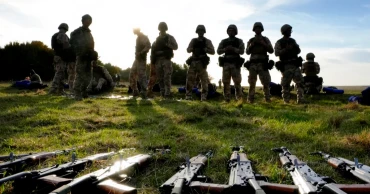
The U.S. military's new, expanded combat training of Ukrainian forces began in Germany on Sunday, with a goal of getting a battalion of about 500 troops back on the battlefield to fight the Russians in the next five to eight weeks, said Gen. Mark Milley, chairman of the Joint Chiefs of Staff.
Milley, who plans to visit the Grafenwoehr training area on Monday to get a first-hand look at the program, said the troops being trained left Ukraine a few days ago. In Germany is a full set of weapons and equipment for them to use.
Read more: In Ukraine, power plant workers fight to save their 'child'
Until now the Pentagon had declined to say exactly when the training would start.
The so-called combined arms training is aimed at honing the skills of the Ukrainian forces so they will be better prepared to launch an offensive or counter any surge in Russian attacks. They will learn how to better move and coordinate their company- and battalion-size units in battle, using combined artillery, armor and ground forces.
Speaking to two reporters traveling with him to Europe on Sunday, Milley said the complex training — combined with an array of new weapons, artillery, tanks and other vehicles heading to Ukraine — will be key to helping the country's forces take back territory that has been captured by Russia in the nearly 11-month-old war.
“This support is really important for Ukraine to be able to defend itself,” Milley said. “And we’re hoping to be able to pull this together here in short order.”
The goal, he said, is for all the incoming weapons and equipment to be delivered to Ukraine so that the newly trained forces will be able to use it “sometime before the spring rains show up. That would be ideal.”
The new instruction comes as Ukrainian forces face fierce fighting in the eastern Donetsk province, where the Russian military has claimed it has control of the small salt-mining town of Soledar. Ukraine asserts that its troops are still fighting, but if Moscow’s troops take control of Soledar it would allow them to inch closer to the bigger city of Bakhmut, where fighting has raged for months.
Read more: Russian envoy hopes war in Ukraine ends soon: Hasan
Russia also launched a widespread barrage of missile strikes, including in Kyiv, the northeastern city of Kharkiv and the southeastern city of Dnipro, where the death toll in one apartment building rose to 30.
Milley said he wants to make sure the training is on track and whether anything else is needed, and also ensure that it will line up well with the equipment deliveries.
The program will include classroom instruction and field work that will begin with small squads and gradually grow to involve larger units. It would culminate with a more complex combat exercise bringing an entire battalion and a headquarters unit together.
Until now, the U.S. focus has been on providing Ukrainian forces with more immediate battlefield needs, particularly on how to use the wide array of Western weapons systems pouring into the country.
The U.S. has already trained more than 3,100 Ukrainian troops on how to use and maintain certain weapons and other equipment, including howitzers, armored vehicles and the High Mobility Artillery Rocket System, known as HIMARS. Other nations are also conducting training on the weapons they provide.
In announcing the new program last month, Air Force Brig. Gen. Pat Ryder, Pentagon press secretary, said the idea “is to be able to give them this advanced level of collective training that enables them to conduct effective combined arms operations and maneuver on the battlefield.”
Milley said the U.S. was doing this type of training prior to the Russian invasion last February. But once the war began, U.S. National Guard and special operations forces that were doing training inside Ukraine all left the country. This new effort, which is being done by U.S. Army Europe Africa’s 7th Army Training Command, will be a continuation of what they had been doing prior to the invasion. Other European allies are also providing training.
3 years ago

Deaths from strike on Ukraine apartment building rise to 29
The death toll from a Russian missile strike on an apartment building in the southeastern Ukrainian city of Dnipro rose to 29 Sunday, the regional governor reported as rescue workers scrambled to pull survivors from the rubble.
Emergency crews worked through the frigid night at the wrecked multi-story residential building, the site of the worst casualties from a widespread Russian barrage Saturday. The deaths reported in Dnipro were the most civilians killed in one place since a Sept. 30 strike in Ukraine’s Zaporizhzhia region, according to The Associated Press-Frontline War Crimes Watch project.
Russia also targeted the capital, Kyiv, and the northeastern city of Kharkiv on Saturday, ending a two-week lull in the airstrikes it has launched against Ukraine’s power infrastructure and urban centers almost weekly since October.
Russia on Sunday acknowledged the missile strikes but did not mention the Dnipro apartment building. Russia has repeatedly denied targeting civilians in the war.
Russia fired 33 cruise missiles on Saturday, of which 21 were shot down, according to Gen. Valerii Zaluzhny, the commander-in-chief of the Ukrainian armed forces. The missile that hit the apartment building was a Kh-22 launched from Russia’s Kursk region, according to the military’s air force command, adding that Ukraine does not have a system capable of intercepting that type of weapon.
In Dnipro, workers used a crane as they tried to rescue people trapped on upper floors of the apartment tower where about 1,700 were living. Some residents signaled for help with lights on their mobile phones.
President Volodymyr Zelenskyy reported that at least 73 people were wounded and 39 people had been rescued as of Sunday afternoon. The city government in Dnipro said 43 people were reported missing.
“Search and rescue operations and the dismantling of dangerous structural elements continues. Around the clock. We continue to fight for every life,” the Ukrainian leader said.
Ivan Garnuk was in his apartment when the building was hit and said he felt lucky to have survived. He described his shock that the Russians would strike a residential building with no strategic value.
Sorry, the video player failed to load.(Error Code: 101102)“There are no military facilities here. There is nothing here,” he said. “There is no air defense, there are no military bases here. It just hit civilians, innocent people.”
Dnipro residents joined rescue workers at the scene to help clear the rubble. Others brought food and warm clothes for those who had lost their homes.
“This is clearly terrorism and all this is simply not human,” one local, Artem Myzychenko, said as he cleared rubble.
Claiming responsibility for the missile strikes across Ukraine, Russia’s Defense Ministry said Sunday that it achieved its goal.
“All designated targets have been hit. The goal of the attack has been achieved,” a ministry statement posted on Telegram said. It said missiles were fired “on the military command and control system of Ukraine and related energy facilities,” and did not mention the attack on the Dnipro residential building.
On Sunday, Russian forces attacked a residential area in the southern Ukrainian city of Kherson, regional Gov. Yaroslav Yanushevych said in a Telegram post. According to preliminary information, two people were wounded.
Russia’s renewed air attacks came as fierce fighting raged in Ukraine’s eastern Donetsk province, where the Russian military has claimed it has control of the small salt-mining town of Soledar but Ukraine asserts that its troops are still fighting.
If the Russian forces win full control of Soledar it would allow them to inch closer to the bigger city of Bakhmut. The battle for Bakhmut has raged for months, causing substantial casualties on both sides.
With the grinding war nearing the 11-month mark, Britain announced it would deliver tanks to Ukraine, its first donation of such heavy-duty weaponry. Although the pledge of 14 Challenger 2 tanks appeared modest, Ukrainian officials expect it will encourage other Western nations to supply more tanks.
“Sending Challenger 2 tanks to Ukraine is the start of a gear change in the U.K.’s support,” British Prime Minister Rishi Sunak’s office said in a statement late Saturday. “A squadron of 14 tanks will go into the country in the coming weeks after the prime minister told President Zelenskyy that the U.K. would provide additional support to aid Ukraine’s land war. Around 30 AS90s, which are large, self-propelled guns, operated by five gunners, are expected to follow.”
Sunak is hoping other Western allies follow suit as part of a coordinated international effort to boost support for Ukraine in the lead-up to the 1-year anniversary of the invasion next month, according to officials.
The U.K. defense secretary plans to travel to Estonia and Germany this week to work with NATO allies, and the foreign secretary is scheduled to visit the U.S. and Canada to discuss closer coordination.
3 years ago

Memoir is about saving royals from themselves: Prince Harry
Prince Harry has said he had enough material for two memoirs, but that he held back because he didn't think his father and brother would “ever forgive" him.
In an interview with British newspaper The Telegraph published Saturday, he also said that releasing his memoir wasn't an attempt “to collapse the monarchy. This is about trying to save them from themselves."
“And I know that I will get crucified by numerous people for saying that,” he said.
Harry's candid autobiography, “Spare,” sold 1.4 million English-language copies on the first day it was published. Many of its revelations and accusations were splashed across the global media this week. In the book, the 38-year-old revealed how his grief at the death of his mother, Princess Diana, affected him, and saw Harry detail his resentment at being the “spare to the heir."
“It could have been two books, put it that way,” Harry said in the interview. “But there are some things that have happened, especially between me and my brother, and to some extent between me and my father, that I just don’t want the world to know. Because I don’t think they would ever forgive me.”
Harry also said in the interview that he worried about William's children, saying he felt “a responsibility knowing that out of those three children, at least one will end up like me, the spare. And that hurts, that worries me.”
He said he felt this way despite William making it clear to him that “his kids are not my responsibility.”
Buckingham Palace and Kensington Palace haven't commented on Harry's book or his string of media interviews to publicize it.
3 years ago

UK to supply tanks to Ukraine as Russian missiles hit Kyiv
British Prime Minister Rishi Sunak on Saturday promised to provide tanks and artillery systems to Ukraine, amid renewed missile attacks by Moscow targeting the Ukrainian capital and other cities.
Sunak’s Downing Street office said in a statement that he made the pledge to provide Challenger 2 tanks and other artillery systems after speaking to Ukrainian President Volodymyr Zelenskyy on Saturday.
It did not say when the tanks were to be delivered or how many. British media has reported that four British Army Challenger 2 main battle tanks will be sent to eastern Europe immediately, with eight more to follow shortly after, without citing sources.
Zelenskyy in a tweet Saturday thanked Sunak “for the decisions that will not only strengthen us on the battlefield, but also send the right signal to other partners.”
Ukraine has for months sought to be supplied with heavier tanks, including the U.S. Abrams and the German Leopard 2 tanks, but Western leaders have been treading carefully.
Read: Russia says it took Soledar in bloody fight in east Ukraine
The Czech Republic and Poland have provided Soviet-era T-72 tanks to Ukrainian forces. Poland has also expressed readiness to provide a company of Leopard tanks, but President Andrzej Duda stressed during his recent visit to the Ukrainian city of Lviv that the move would be possible only as an element in a larger international coalition of tank aid to Kyiv.
Earlier this month, France pledged to supply its AMX-10 RC armored combat vehicles — designated as “light tanks” in French — to Ukraine as well.
Sunak’s announcement came several hours after a series of explosions rocked Kyiv on Saturday morning. An infrastructure target was hit in what Ukrainian officials said was a missile attack.
Explosions were heard in the Dniprovskyi district, a residential area on the left bank of the Dnieper River, Kyiv Mayor Vitali Klitschko said. Klitschko also said that fragments of a missile fell on a non-residential area in the Holosiivskyi district on the right bank, and a fire briefly broke out in a building there. No casualties have been reported so far.
It wasn’t immediately clear whether several facilities in Kyiv were targeted or just the one that was reported hit. The Ukrainian capital hasn’t been attacked by missiles since New Year’s night, Jan. 1.
In the outlying Kyiv region, a residential building in the village of Kopyliv was hit, and windows of the houses nearby were blown out, Tymoshenko said.
Read: Rifts in Russian military command seen amid Ukraine fighting
A total of 18 private houses were damaged in the region, according to regional Gov. Oleksii Kuleba. “There are damaged roofs and windows,” but no casualties, Kuleba said in a Telegram post. He added that a fire has been contained at a “critical infrastructure facility” in the region.
Earlier on Saturday, two Russian missiles hit Kharkiv, Ukraine’s second-largest city, the governor of the Kharkiv region reported.
Oleh Syniehubov said Russian forces fired two S-300 missiles at the industrial district of Kharkiv. The strikes targeted “energy and industrial objects of Kharkiv and the (outlying) region,” Syniehubov said. No casualties have been reported, but emergency power cuts in the city and other settlements of the region were possible, the official said.
The attacks follow conflicting reports on the fate of the fiercely contested salt mining town of Soledar, in Ukraine’s embattled east. Russia claims that its forces have captured the town, a development that would mark a rare victory for the Kremlin after a series of humiliating setbacks on the battlefield.
Ukrainian authorities and President Zelenskyy insist the fight for Soledar continues.
Moscow has painted the battle for the town and the nearby city of Bakhmut as key to capturing the eastern region of the Donbas, which comprises of partially occupied Donetsk and Luhansk regions, and as a way to grind down the best Ukrainian forces and prevent them from launching counterattacks elsewhere.
But that cuts both ways, as Ukraine says its fierce defense of the eastern strongholds has helped tie up Russian forces. Western officials and analysts say the two towns’ importance is more symbolic than strategic.
3 years ago