Europe
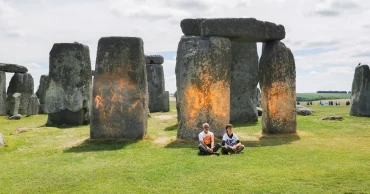
Climate protesters arrested over spraying orange paint over Stonehenge monument
Two climate protesters were arrested Wednesday for spraying orange paint on the ancient Stonehenge monument in southern England, police said.
The latest act by Just Stop Oil was quickly condemned by Prime Minister Rishi Sunak as a “disgraceful act of vandalism.” Labour leader Keir Starmer, his main opponent in the election next month, called the group “pathetic" and said the damage was “outrageous.”
The incident came just a day before thousands are expected to gather at the 4,500-year-old stone circle to celebrate the summer solstice — the longest day of the year in the Northern Hemisphere.
English Heritage, which manages the site, said it was “extremely upsetting” and said curators were investigating the damage. Just Stop Oil said on the social media platform X that the paint was made of cornstarch and would dissolve in the rain.
Wiltshire Police said the pair were arrested on suspicion of damaging one of the world’s most famous prehistoric monuments and a UNESCO World Heritage Site.
Stonehenge was built on the flat lands of Salisbury Plain in stages starting 5,000 years ago, with the unique stone circle erected in the late Neolithic period about 2,500 B.C. Some of the stones, the so-called bluestones, are known to have come from southwest Wales, nearly 150 miles (240 kilometers) away, but the origins of others remain a mystery.
Just Stop Oil is one of many groups around Europe that have gained attention — and received a lot of blowback — for disrupting sporting events, splashing paint and food on famous works of art and interrupting traffic to draw attention to global warming.
The group said it acted in response to the Labour Party's recent election manifesto. Labour has said that if it wins the election on July 4, it would not issue further licenses for oil and gas exploration. Just Stop Oil backs the moratorium but said it is not enough.
In a statement, the group said Labour, which is leading in polls and widely expected by pundits and politicians to lead the next government, needs to go further and sign a treaty to phase out fossil fuels by 2030.
“Continuing to burn coal, oil and gas will result in the death of millions,” the group said in a statement.
1 year ago
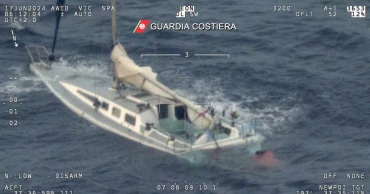
11 people dead, 64 people missing from 2 shipwrecks in Mediterranean Sea
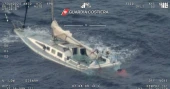
Sixty-four people were missing in the Mediterranean Sea and several were rescued after their ship wrecked off Italy’s southern coast Monday, United Nations’ agencies said in a statement.
In a separate shipwreck, rescue workers evacuated dozens of suspected migrants but found 10 bodies trapped below the deck of a wooden boat off Italy’s tiny Lampedusa island, the German aid group Resqship wrote on Monday on the X social media platform.
Greece: 32 migrants dead, more than 100 rescued after fishing vessel capsizes
The boat that wrecked about 200 kilometers (125 miles) off Calabria had set off from Turkey eight days earlier, but caught fire and overturned, the U.N. agencies said, citing survivors.
The search-and-rescue operation started following a mayday call by a French boat, the Italian coast guard said in a statement. The boat was sailing in a border area where Greece and Italy carry out search-and-rescue operations. The survivors and people still missing at sea came from Iran, Syria and Iraq, the U.N. agencies said.
Deadly shipwreck: How it happened, and unanswered questions
The Italian Maritime Rescue Coordination Center immediately diverted two merchant vessels sailing nearby to the scene of the rescue. Assets from the European border and coast guard agency Frontex also helped.
The survivors were brought to the Calabrian port of Roccella Jonica, where they were disembarked and entrusted to the care of medical personnel. One of the 11 rescued migrants died soon after, the coast guard said.
In the second shipwreck, the crew aboard Resqship’s boat, the Nadir, found 61 people on the wooden boat, which was full of water.
“Our crew was able to evacuate 51 people, two of whom were unconscious,” it added. “The 10 dead were in the flooded lower deck of the boat.”
1 year ago
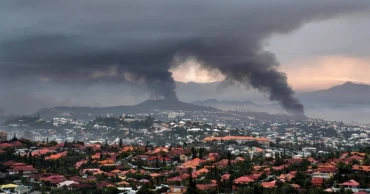
New Caledonia reopening its international airport and shortening curfew as unrest continues to ebb
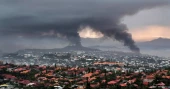
The French Pacific territory of New Caledonia is shortening its overnight curfew and reopening its international airport that was closed to commercial flights for more than a month because of deadly violence that wracked the archipelago where pro-independence Indigenous Kanaks want to break from France.
La Tontouta airport that links New Caledonia's capital, Nouméa, to Sydney, Tokyo, Singapore and other Pacific hubs will reopen Monday, the territory's high commissioner announced in a statement Sunday.
The overnight curfew is also being shortened by two hours, its start pushed back from 6 p.m. to 8 p.m., because of “the improvement in the situation and in order to facilitate the gradual return to normal life,” the high commissioner said.
Violence that flared on May 13 over controversial voting reforms led to nine deaths, including two gendarmes, and widespread destruction of shops, businesses and homes. Tourists trapped by the airport's closure were evacuated on military flights.
With France now plunged into frenzied campaigning for snap parliamentary elections, French President Emmanuel Macron has suspended the reforms that would have altered voting rights in New Caledonia. The revolt prompted France on May 15 to impose a state of emergency on the archipelago and rush in reinforcements for police who were overwhelmed by armed clashes, looting and arson.
Both sides of New Caledonia’s bitter divide — Indigenous Kanaks who want independence and those loyal to France — erected barricades, either to revolt against authorities or to protect homes and properties. Pro-independence protesters erected barricades of charred vehicles and other debris, turning parts of Nouméa into no-go zones.
1 year ago
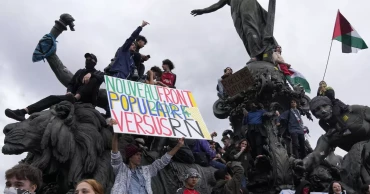
French protesters are standing up to the far right ahead of the country's snap elections
Anti-racism groups joined French unions and a brand-new left-wing coalition in protests in Paris and across France on Saturday against the surging nationalist far right as frenzied campaigning is underway ahead of snap parliamentary elections.
The French Interior Ministry said 21,000 police and gendarmes would be deployed at the rallies with authorities expecting between 300,000 and 500,000 protesters nationwide.
In Paris, those who fear that the elections will produce France's first far-right government since World War II gathered at Place de la Republique before marching through eastern Paris.
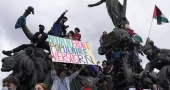
According to the Paris police, 75,000 people turned out, in spite of rainy and windy weather. They held placards reading “Liberty for all, Equality for all and Fraternity with all” — a reference to France's national motto — and “Let’s break frontiers, documents for all, no to the immigration bill.” Some chanted “Free Palestine, viva Palestina,” and wore keffiyeh scarves.
Among them was Nour Cekar, a 16 year-old high school student from the Paris region, who has French and Algerian parents and wears the hijab.
“To me, the extreme right is a danger because it supports an ideology based on the fear of the other, whereas we are all French citizens despite our differences,” she told The Associated Press.
Cekar said she will vote for the left-wing coalition because “it is the only political party that addresses racism and Islamophobia.”
“I fear the rise of the National Rally because I am afraid that they will ban the hijab in name of women's liberty. I am a woman and I should be able to decide what I want to wear. I am a free woman,” she said, adding that she is insulted on social media and in the streets on a daily basis because of her headscarf.
Macron urges moderate politicians to regroup to defeat the far right in French elections
Against the backdrop of music of French-Malian singer Aya Nakamura, the crowd chanted “Everyone hates racism.”
“France is made up of people of different origins. It is its strength. The National Rally wants to break that,” 68-year-old Mohamed Benammar, a French doctor with Tunisian roots who works in a Paris public hospital, told AP.
“We provide medical care to everyone, without worrying about their nationality, the color of their skin or their religion, unlike the fascists (extreme-right leaders) that single out Black, Arabs or Muslim people,” he said.
Although his son told him that it was useless to protest, Bennamar said he's convinced that it is important to make his voice heard. “I am here to send a strong signal to politicians. We won’t stay silent in front of the far right,” he said.
Police in Paris reported “numerous attempts at damage” by protesters. At least one person was arrested on suspicion of criminal damage. An AP journalist said police used tear gas against demonstrators who tried to vandalize a bus stop and advertising boards.
In the French Riviera city of Nice, protesters marched down Jean Médecin Avenue, the city’s main shopping street, chanting against the National Rally, its leader Jordan Bardella as well as against President Emmanuel Macron. Organizers said 3,000 took part, while the police put the number at 2,500.
UK economy flatlined in April in a blow to the governing Conservatives ahead of the July 4 election
Nice is traditionally a conservative stronghold, but has over the past decade turned firmly in favor of Marine Le Pen’s National Rally and her far-right rival Eric Zemmour.
Crowds have been gathering daily ever since the anti-immigration National Rally made historic gains in the European Parliament elections on Sunday, crushing Macron's pro-business moderates and prompting him to dissolve the National Assembly.
New elections for the lower house of parliament were set in two rounds, for June 30 and July 7. Macron remains president until 2027 and in charge of foreign policy and defense, but his presidency would be weakened if the National Rally wins and takes power of the government and domestic policy.
"We need a democratic and social upsurge — if not the extreme right will take power,'' French unions said in a statement Friday. "Our Republic and our democracy are in danger.''
They noted that in Europe and across the world, extreme-right leaders have passed laws detrimental to women, the LGBTQ+ community, and people of color.
To prevent the National Rally party from winning the upcoming elections, left-wing parties finally agreed Friday to set aside differences over the wars in Gaza and Ukraine and form a coalition. They urged French citizens to defeat the far right.
Macron dissolves the French parliament and calls a snap election after defeat in EU vote
French opinion polls suggest the National Rally — whose founder has been repeatedly convicted of racism and antisemitism — is expected to be ahead in the first round of the parliamentary elections. The party came out on top in the European elections, garnering more than 30% of the vote cast in France, almost twice as many votes as Macron’s party Renaissance.
Macron's term is still on for three more years, and he would retain control over foreign affairs and defense regardless of the result of the French parliamentary elections.
But his presidency would be weakened if the National Rally wins, which could put its 28-year-old party leader Bardella on track to become the next prime minister, with authority over domestic and economic affairs.
1 year ago

Fistfight erupts in Italian Parliament as tensions rise over expanding regional autonomy
Tensions in Italy's lower house erupted into a fistfight, sending an opposition lawmaker to hospital, over a controversial government proposal that opponents say will further impoverish the poor south.
Video of the fight Wednesday shows lawmakers converging on 5-Star Movement lawmaker Leonardo Donno, who opposes the changes, after he tried to hand an Italian flag to regional affairs minister Roberto Calderoli. Calderoli, a firebrand lawmaker from the Lega party with northern roots, drafted the contested expansion of regional autonomy that would mostly benefit regions like Lega strongholds of Veneto and Lombardy.
Italian media reported that Donno was taken to the hospital for evaluation after being hit in the head and the chest.
Foreign Minister Antonio Tajani, interviewed on Sky TG24, expressed disappointment at the scene.
“I have no words,'' Tajani said. “We need to set another example, not punches to resolve political problems. It’s not braggadocio, it’s not shouting, it’s ideas that need to be explained well to persuade voters.”
The proposal would give additional regions expanded autonomy in specific functions, a move that the opposition says will further increase the north-south divide in Italy.
Currently, five regions are granted autonomy, which in part reduces the tax revenue due to the central government in Rome. They range from Trento-South Tyrol in the north, which is comprised of the autonomous provinces of Trento and South Tyrol, to Sicily in the south. The other three are Friuli-Venezia Giulia in the northeast, Aosta in the northwest, and the island of Sardinia.
1 year ago
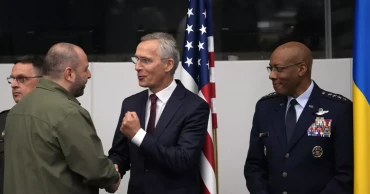
NATO defense ministers thrash out new security aid and training support plan for Ukraine
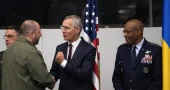
NATO defense ministers gathered Thursday hoping to agree on a new plan to provide long-term security assistance and military training to Ukraine amid Russia's full-scale invasion, after Hungary promised not to veto the proposal as long as it’s not forced to take part.
The ministers are meeting over two days at NATO headquarters in Brussels in the last high-level talks before a summit hosted by U.S. President Joe Biden in Washington on July 9-11, where the military organization’s leaders are expected to announce financial support for Ukraine.
Ukraine’s Western allies are trying to bolster their military support as Russian troops launch attacks along the more than 1,000-kilometer (620-mile) front line, taking advantage of a lengthy delay in U.S. military aid. European Union money was also held up by political infighting.
NATO Secretary-General Jens Stoltenberg, who is chairing Thursday’s meeting, said that Ukraine’s beleaguered armed forces need longer-term predictability about the kinds of weapons, ammunition and funds they can expect to receive.
“The whole idea is to minimize the risk for gaps and delays as we saw earlier this year,” Stoltenberg told reporters. The hold-up, he said, “is one of the reasons why the Russians are now able to push and to actually occupy more land in Ukraine.”
Since Russia’s full-fledged invasion in February 2022, Ukraine’s Western backers have routinely met as part of the Ukraine Defense Contact Group, run by the Pentagon, to drum up weapons and ammunition for Kyiv. A fresh meeting was held at NATO headquarters on Thursday.
Canadian Defence Minister Bill Blair said that his country would send Ukraine 2,300 rocket motors, and that 80,000 more of the devices are being tested. "Pending the results of those tests, we intend to ship more packages of these motors to our Ukrainian partners in the future,” he told reporters.
While the contact group meetings have resulted in significant battlefield support, they have been of an ad-hoc and unpredictable nature. Stoltenberg has spearheaded an effort to have NATO take up some of the slack.
The idea is for the 32-nation military alliance to coordinate the security assistance and training process, partly by using NATO’s command structure and drawing on funds from its common budget.
Stoltenberg said he hopes Biden and his counterparts will agree in Washington to maintain the funding level for military support they have provided Ukraine since Russia launched its full-fledged invasion in February 2022.
He estimates this at around 40 billion euros ($43 billion) worth of equipment each year.
On Wednesday, Hungary announced that it would not veto the plan as long as it’s not forced to take part.
“I asked the Secretary-General to make it clear that all military action outside NATO territory can only be voluntary in nature, according to NATO rules and our traditions,” Prime Minister Viktor Orbán said. “Hungary has received the guarantees we need.”
The world’s biggest security alliance does not send weapons or ammunition to Ukraine as an organization, and has no plans to put troops on the ground. But many of its members give help on a bilateral basis, and jointly provide more than 90% of the country’s military support.
The other 31 allies see Russia’s war on Ukraine as an existential security threat to Europe, but most of them, including Biden, have been extremely cautious to ensure that NATO is not drawn into a wider conflict with Russia.
NATO operates on the basis that an attack on any single ally will be met with a response from them all.
1 year ago

Macron urges moderate politicians to regroup to defeat the far right in French elections
French President Emmanuel Macron on Wednesday urged moderate politicians from the left and the right to regroup to defeat the far right in the upcoming national legislative elections he had called for after his party's crushing defeat in the European parliamentary vote.
A somber-looking Macron addressed French voters for the first time since his stunning decision on Sunday to dissolve the National Assembly, France’s lower house of parliament.
His move triggered an early legislative election that will take place in two rounds on June 30 and July 7, three weeks after the far-right National Rally party of Marine Le Pen triumphed at the vote for the European Union Parliament.
During a press conference on Wednesday, Macron said he decided on the risky move because he could not ignore the new political reality after his pro-European party was handed a chastening defeat and garnered less than half the support of the National Rally with its star leader, Jordan Bardella.
Unlike in his recent national addresses in which Macron focused on Russia’s war in Ukraine and ways Europe should forge a common defense policy, independent of the United States, and shore up trade protections against China, the French president stuck to his country’s internal issues favored by the surging right, including curbing immigration, fighting crime and Islamic separatism in France.
Macron, who has three years left of his second presidential term, hopes voters will band together to contain the far right in national elections in a way they didn’t in European ones. He called on “men and women of goodwill who were able to say ‘no’ to extremes on the left and the right to join together to be able to build a joint project” for the country.
“Things are simple today: we have unnatural alliances at both extremes, who quite agree on nothing except the jobs to be shared, and who will not be able to implement any program," Macron said during a press conference in Paris.
While he seemed to project the kind of enthusiasm that helped bring him to the presidency in 2017, analysts say French voters are more pessimistic about their future, and see Macron as increasingly out of touch with real life and pocketbook problems.
Macron acknowledged some faults committed by his pro-business centrist party while harshly criticizing parties on the right for teaming up with Le Pen’s National Rally, which has a history of racism and xenophobia. He scathingly called an alliance formed by parties on the left as “unusual and incoherent” after they included the hard-left France Unbowed of Jean-Luc Mélenchon who, Macon said “justified anti-Semitic policies” in the wake of the Israel-Hamas war.
“We’re not perfect, we haven’t done everything right, but we have results... and above all, we know how to act,” Macron said of his Renaissance party, adding that the “far right (is) the main danger” in the upcoming election.
“The question is who will govern the country tomorrow?" he asked. “The far right and a few associates, or the democratic, progressive bloc? That’s the fundamental question.”
The decision to send to the polls voters who just expressed their discontent with Macron’s politics was a risky move that could result in the French far-right leading a government for the first time since World War II.
Potential alliances and France’s two-round voting system in national elections make the outcome of the vote highly uncertain. Macron was adamant in his faith in the French voters' intent to refuse to choose the extremes of both sides of the political spectrum. He assured that he was not falling into defeatism and said he would serve out his second presidential term regardless of the outcome of the legislative vote.
“I think the French are intelligent, they see what’s being done, what’s coherent and what’s not, and they know what to do," Macron said. He added: "I don’t believe at all that the worst can happen. You see, I’m an indefatigable optimist.”
He rebuffed accusations that his move to call snap elections would help the far-right take power in France.
“It’s about allowing political forces chosen by the French to be able to govern,” he said, He added that it’s “awkward to think it has to be the extreme right or political extremes. Or maybe you’ve got the spirit of defeat spread everywhere.”
“If that’s what people are afraid of, it’s time now to take action,” he said.
Opposition parties on the left and right have been scrambling to form alliances and field candidates in the early legislative balloting.
While sharp differences between parties remain on either side of the political spectrum, prominent figures calling for a united front appear to have one thing in common: They don’t want to cooperate with Macron.
Despite their divisions, left-wing parties agreed late Monday to form an alliance that includes the Greens, the Socialists, the Communists and the far-left France Unbowed.
National Rally leader Marine Le Pen is working to consolidate power on the right in efforts to translate the European triumph into a national win and come closer to claiming power. Her party is expected to win the most French seats in the European Parliament, potentially as many as 30 of France’s 81.
1 year ago
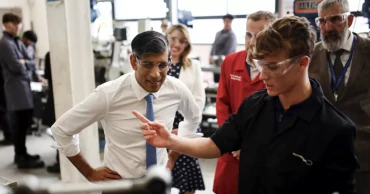
UK economy flatlined in April in a blow to the governing Conservatives ahead of the July 4 election
The British economy failed to grow in April, official figures showed Wednesday, in a blow to Prime Minister Rishi Sunak who has made the return of growth and a generally calmer economic backdrop a central pillar of the Conservative Party's election campaign.
The Office for National Statistics said wet weather dampened consumer spending and construction during the month. The flat monthly reading came after a 0.6% increase during the first quarter of the year, which Sunak has made much of on the campaign trail following a period of muted growth.
Though monthly figures are vulnerable to short-term factors, the flat reading is likely to be used by opponents of the Conservatives in the run-up to the election on July 4.
While Treasury chief Jeremy Hunt insisted the “economy is turning a corner,” his opposite number in the Labour Party Rachel Reeves said the “economy has stalled.”
The latest growth figures come a week before the next round of inflation data and the Bank of England makes its next interest rate decision.
Hopes within the Conservative Party that the bank would lower its main interest rate from the 16-year high of 5.25% have diminished after inflation failed to fall as much as hoped in April. Though inflation is down at an annual rate of 2.3%, it remains slightly above the bank's target and is expected to tick up slightly in coming months.
High interest rates — which cool the economy by making it more expensive to borrow — have helped ease inflation, but they’ve also weighed on the British economy.
“A June interest rate cut looks improbable, with the Bank of England likely to be a little wary of shifting policy in the middle of a general election campaign," said Suren Thiru, economics director at the Institute of Chartered Accountants in England and Wales.
On Tuesday, Sunak pledged to cut taxes and reduce immigration in the Conservative Party's manifesto for government if reelected. Labour, which is ahead in opinion polls, is due to publish its manifesto on Thursday.
1 year ago
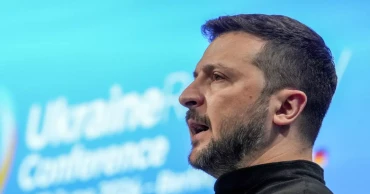
Zelenskyy appeals for help with Ukraine's energy network as recovery conference opens
Ukrainian President Volodymyr Zelenskyy appealed for short-term help in repairing his country's electricity network and long-term investment in its energy system as a conference to gather support for Ukraine's recovery from the destruction wreaked by Russia’s war opened Tuesday.
Starting a week of intense diplomacy that will also see him travel to the Group of Seven summit of Ukraine's leading Western allies in Italy and a global peace summit in Switzerland, Zelenskyy also renewed his calls for more help in repelling missile attacks by Russian forces.
The two-day Ukraine Recovery Conference in Berlin follows up on a similar gathering in London a year ago.
The German hosts say it is bringing together 2,000 people from national and local politics, business and other areas, arguing that the task of supporting Ukraine’s recovery is too big for governments alone.
Among other immediate problems, sustained Russian attacks on Ukraine's power grid in recent weeks have forced energy companies to institute nationwide rolling blackouts.
Zelenskyy told the conference that, in the coming month, Ukraine needs equipment for heating and electricity plants that are currently out of action. “This will allow us to respond to the situation here and now,” he said.
According to the president, nine gigawatts of electricity generating capacity have been destroyed — including 80% of thermal power and one-third of hydroelectric power — while the peak consumption in Ukraine last winter was 18 gigawatts. Energy, he said, continues to be “one of (Russian President Vladimir) Putin’s main targets.”
Looking beyond Ukraine's immediate problems, Zelenskyy said foreign investments in energy would be mutually beneficial.
“Ukraine has all the natural foundations for modern energy, but without your financing and investments, we won’t be able to realize this,” he said.
“This is not about grants, but about high-yield investments for your companies, about a large market for your equipment, about loan programs for your institutions,” all of which could create tens of thousands of new jobs, he added.
That message was echoed by German Chancellor Olaf Scholz, who said the World Bank has estimated that rebuilding and modernizing Ukraine will require investments of nearly $500 billion over the next 10 years.
“The reconstruction of Ukraine is and also must be a business case,” Scholz told participants. He said that is illustrated by Ukraine having exported excess electricity to the European Union since 2022 — “that makes clear what goes for the reconstruction of Ukraine as a whole: it benefits all concerned.”
Scholz, whose country has become Ukraine's second-biggest weapons supplier after the United States, appealed anew to other allies to help strengthen Ukraine's air defense, “because the best reconstruction is that which doesn't have to take place.”
Since Russia launched a spring offensive around Kharkiv, Zelenskyy has insisted Ukraine urgently needs seven more U.S.-made Patriot air defense systems.
The Berlin conference also focuses on support for reforms that Ukraine has embarked on in its bid to join the EU.
On Monday, the head of the State Agency for Restoration of Ukraine, Mustafa Nayyem, announced his resignation on Facebook. He cited “systemic obstacles that prevent me from exercising my powers effectively” and accused the government of bogging his agency down in red tape.
Ukraine hasn’t had a minister dedicated to reconstruction since Oleksandr Kubrakov was dismissed in May. Nayyem complained that Ukraine’s prime minister barred him from attending the Berlin conference.
Zelenskyy, making his third visit to Berlin since Russia's full-scale invasion started in February 2022, is also expected to make a speech to the German parliament, or Bundestag. He made a video address to lawmakers a few weeks after the war started.
The Ukrainian president last visited in mid-February, when he signed a bilateral security agreement with Scholz, one of a string of such accords that allies have reached with Kyiv to signal their long-term backing.
1 year ago
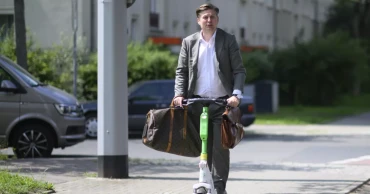
These candidates who won seats in the European Parliament this week aren't who you might expect
He has no political experience. No high-profile endorsements. No party affiliation.
What Fidias Panayiotou does have are 2.6 million followers on YouTube and more on TikTok. And now he has won a seat in the European Parliament representing Cyprus, one of several unusual candidates who launched improbable campaigns only to snag membership in the 720-seat legislature.
"I wasn't planning on voting, but since I've been seeing you on TikTok, I'll vote for you," said a driver Panayioutou stops, interviews and posts about.
Social media played an outsized role in the victories of a few candidates, prompting chatter in the political classes about its apparent role as an equalizer for unknown hopefuls as voters in dozens of democracies go to the polls this year, including in Britain, France and the United States.
Voters in the parliament's 27 countries in recent days also elected candidates who are in prison, have been kicked out of their delegation and withdrew from the election only to win seats, anyway.
Here's a closer look at unusual candidates-turned-MEPs — members of the European Parliament, representing some 400 million eligible voters.
Stranded migrants confront violence and despair as Tunisia partners to keep them from Europe
CyprusPanayiotou's initial claim to fame was a hug he gave to billionaire entrepreneur Elon Musk, plus an assortment of humorous videos. His election, fueled only by his popularity on social media posts, shook up the island nation's political class in what many saw as a snub to deep-rooted party culture.
The 24-year-old who goes only by his first name, Fidias, won almost a fifth of the votes in Sunday's election, placing him third behind traditional party candidates of the center-right DISY party and the communist-rooted AKEL. It's a first in a country where the mighty political parties have long earned iron-clad loyalty by meting out favors.
AKEL Secretary-General Stefanos Stefanou lamented the outcome, which he called a "new reality in which citizens opt for non-politics as a political choice" to register their disenchantment with the country's political culture.
SpainArmed with a pair of social media accounts and staunch anti-immigrant discourse, a social media influencer rocked Spain's far right by snatching up three of the country's 61 seats in the European Parliament.
The driver was a national-populist figure known by the pen name of Alvise Perez, 34, founder of the "Party is Over" party. The 34-year-old was completely unknown to Spaniards outside the tight internet circles of the country's far-right until election eve.
Now he'll take along two allies to fill the seats he has won in the powerful European legislature that meets in Strasbourg, France and Brussels.
Perez celebrated with some loud supporters in front of a backdrop covered with his party's unorthodox logo: a cartoon drawing of a squirrel wearing a Guy Fawkes mask popularized by the 2005 movie "V for Vendetta." Fawkes is the best-known member of the foiled 1605 plot to blow up the British Parliament and has since been associated with protest movements.
Slovenia becomes latest European country to recognize a Palestinian state after a parliamentary vote
"The party is over because, I am sad to say, Spain has become a party for criminals. Spain has become a party for the corrupt, mercenaries, pedophiles and rapists," Alvise told the hooting crowd.
"The Party Is Over" won over 4% of the ballots cast in Spain and pulled in 800,000 votes. It matched the three seats won by other established parties, including the junior member of Spain's leftist coalition government. Spain's far-right Vox party scored six seats on Monday, doubling its 2019 share, but it would have likely done better if Alvise had not launched his rogue effort.
GermanyMaximilian Krah, the top candidate for Germany's far-right Alternative for Germany, was kicked out of his delegation for a series of campaign scandals — and was elected anyway.
The 47-year-old MEP since 2019 announced Monday on X, formerly known as Twitter, that the newly elected lawmakers from his party voted to exclude him from their group.
"I think this is wrong and sends a devastating signal to our voters, especially our young voters," Krah said.
The Alternative for Germany, or AfD, finished second in Germany with 15.9% of the votes. That's better than its showing of 11% in 2019, but still some way short of its poll ratings at the beginning of the year. The party has seen a string of setbacks since then, including scandals surrounding Krah and the party's other top candidate for the European Parliament, Petr Bystron.
Krah, who works at a law firm and lives in the eastern German city of Dresden, was under scrutiny after authorities in Brussels searched his offices at the European Parliament in connection with an assistant who was arrested last month on suspicion of spying for China. German media have also alleged that he, as well as Bystron, has close links to Russia.
Last month, Krah raised the ire of his party and beyond when he told an Italian newspaper that not all members of the Nazis' elite SS unit, which was involved in major war crimes during World War II, were war criminals. The party said said at the time that his missteps had led to "massive damage" and that he would resign from its board. Krah tried to downplay the decision.
"It's not the end of the world," he said.
GreeceA jailed politician won one of seven European Parliament seats earned by Greece's governing conservative New Democracy party.
Fredi Beleris, a member of Albania's ethnic Greek minority who has dual citizenship, had been elected mayor of the Albanian town of Himare last year. But he was never sworn in because he was arrested on charges and sentenced to two years beginning in March.
Beleris has denied the charges, and allies have described his detention as politically motivated.
ItalyItalian activist Ilaria Salis, 40, was elected to the European Parliament as a candidate from the Green and Left Alliance (Italian acronym AVS) from house arrest in Hungary, where she is on trial and charged with assaulting far-right demonstrators.
More than 170,000 voters wrote Salis' name in on the ballot in a bid to bring her home from Hungary, where she has been detained for a year and four months.
Police break up pro-Palestinian camp at Amsterdam university as campus protests spread to Europe
"She can't believe it. We need to complete the job, and do everything possible to bring her home as soon as possible,'' said Angelo Bonelli, spokesman for the European Greens and lawmaker for the AVS party.
Salis became a cause célèbre in Italy after images emerged of her handcuffed and chained in a Hungarian courtroom.
PolandTwo candidates from the opposition Law and Justice party won seats despite their previous convictions on abuse of power charges.
Former Interior Minister Mariusz Kaminski, 54, and his former deputy, Maciej Wasik, 58, were briefly imprisoned earlier this year before being pardoned by President Andrzej Duda, who is aligned with the conservative party.
A third, Grzegorz Braun of the far-right, anti-Ukraine Confederation party, won a seat after extinguishing candles on a menorah that were lit for the Jewish holiday of Hanukkah in the halls of the Polish Parliament in December.
1 year ago