Europe
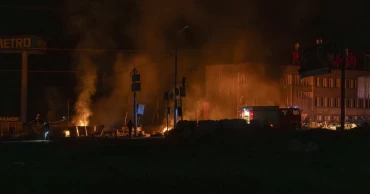
Russian missile strikes on the Ukrainian city of Kharkiv kill 6 and wound 11
Russian forces overnight attacked Ukraine with drones and missiles, killing at least six people and wounding 11 more in Kharkiv, Ukraine's second largest city, officials said Saturday.
Governor of the Kharkiv region Oleh Syniehubov said missile strikes on the city damaged residential buildings, a gas station, a kindergarten, a cafe, a shop and cars.
Overall, Russia fired 32 Iranian-made Shahed drones and six missiles at Ukraine overnight, according to the air force commander. Ukrainian air defense forces shot down three cruise missiles and 28 drones, Lt. Gen. Mykola Oleshchuk said in a statement. “Russian killers continue to terrorize Ukrainians and attack Kharkiv and other peaceful cities,” he said.
The Russian military has not commented on the strikes, but said that Ukraine on Saturday morning fired Vampire rockets at Russia. All 10 of them were shot down over Russia's border region of Belgorod by air defense systems, the Russian Defense Ministry said.
Battles on the ground
On the ground in Ukraine, Russian forces were advancing, and pushing back against them was “difficult,” said Oleksandr Syrskyi, commander of Ukraine's armed forces.
Syrksyi said the situation in the Bakhmut area in the partially occupied eastern Donetsk region was particularly challenging. He said Russian forces are carrying out offensive operations day and night, using assault groups with the support of armored vehicles, as well as assaults on foot.
Fierce battles are taking place east of the town of Chasiv Yar, which Ukraine still controls and which is located near the occupied city of Bakhmut.
Russian forces are trying to break through defensive lines there, Syrskyi said on the messaging app Telegram, adding that “Chasiv Yar remains under our control, all enemy attempts to break through to the settlement have failed.”
Near Avdiivka, another city in the Donetsk region held by the Russians, the fiercest battles were occurring in Pervomaiskyi and Vodyanyi, according to the official. He also said the situation is tense on the southern and northeastern parts of the front line.
2 years ago

Russia renews big attacks on Ukrainian power grid using better intelligence and new tactics
When the Russian barrage hit the Ukrainian power plant, a worker named Taras was manning the control panel — a crucial task that required him to stay as the air-raid siren blared and his colleagues ran for safety.
After the deafening explosions came a cloud of smoke, then darkness. Fires blazed, and shrapnel pierced the roof of the huge complex, causing debris to rain down on workers. Following protocols, Taras shut down the coal-fired plant, his heart racing.
In the March 22 attack, Russia unleashed more than 60 exploding drones and 90 missiles across Ukraine — the worst assault on the country’s energy infrastructure since the full-scale invasion began in early 2022.
The fusillade reflected Russia's renewed focus on striking Ukrainian energy facilities. The volume and accuracy of recent attacks have alarmed the country's defenders, who say Kremlin forces now have better intelligence and fresh tactics in their campaign to annihilate Ukraine's electrical grid and bring its economy to a halt. Moscow has also apparently learned how to exploit gaps in Ukrainian air defenses.
With more assaults inevitable, officials are scrambling for ways to better defend the country's energy assets.
The March 22 attack — which left 1.9 million people without power, according to analysts — was among the most intense in Russia's springtime air campaign targeting civilian infrastructure.
DTEK, Ukraine’s largest private energy company, lost 80% of its power generation capacity in attacks on March 22 and 29, the company said. Plants were destroyed across the country. Russia targeted transmission networks as well.
The bombardment blacked out large parts of Ukraine — a level of darkness not seen since the first days of the full-scale invasion. The strikes also tested Ukraine’s ability to make quick repairs.
The Associated Press was given access to two DTEK power plants damaged in the March 22 attack on the condition that the names and locations of the facilities and the full names of workers not be mentioned due to security concerns. The AP was not permitted to provide technical details of damage, including the number of missiles that struck each plant or whether the plant could still function.
After previous assaults, power station workers were able to restore service fairly quickly. But that became harder after March 22 because of continuing strikes that prevent rebuilding.
The Kharkiv region, which borders Russia and was the hardest hit, is still enduring power outages weeks later. On Thursday, drones struck the region's Zmiivska power plant, plunging 350,000 people into the dark.
“They are trying to take us back to the 17th century,” said Serhii, a manager in one of the power plants that was attacked.
Maksym Timchenko, the CEO of DTEK, inspected the grounds of one of the two power stations. Gazing up at the titanic complex, his eyes rested on a gaping hole in the building’s scorched facade.
Inside, workers collected debris in wheelbarrows, their faces blackened by floating dust. Cranes removed giant shards of twisted metal and blocks of fallen concrete. In the dark bowels of the plant’s interior, where an intricate network of large pipes connect to industrial boilers, the steel roof was so pockmarked with shrapnel it resembled a starry night sky.
“I’ve never seen in my life this level of destruction in a power station, and unfortunately it happened to us,” Timchenko said.
He estimates that the company can restore half of the damaged units in two to three months. It’s a Sisyphean task: Workers must repair damage over and over again.
This particular plant was targeted late last year, and one unit was destroyed. Timchenko said DTEK planned to repair it by the end of this year.
“But now the same level of destruction has happened to several power units,” he said, bringing the plant and the company’s strategic plans back to square one.
During the agonizing wait for more strikes, Ukrainian officials are discussing how to better protect power generators. One solution may be decentralizing them by creating a network of small facilities that are harder to hit than large plants.
The timing of the attacks perplexed many observers.
Russia usually reserves large-scale attacks on energy infrastructure for the peak winter months, when demand for heat is highest. A spring campaign suggests Russia was behind schedule in unleashing new tactics, said Oleksandr Kharchenko, director of the Kyiv-based Energy Industry Research Center.
“I am absolutely sure that they wanted to do this one month before,” he said.
Russia, as expected, targeted energy infrastructure in the last three months of last year, when temperatures dropped below freezing. But the high-voltage grid was prepared to sustain the attacks, and damaged sites were quickly repaired. In December, Russia accepted that the old tactics were not working.
As the winter months went by, Russia began concocting a new scheme.
“They did a huge intelligence job,” Kharchenko said, pointing to the precise nature of the attacks and the damage done. The Russian military seemed to “know everything about the current status of many energy infrastructure objects," including their defenses.
Once the targets were chosen, Russia swarmed them with missiles at an unprecedented scale. If before they launched three drones and two missiles per target, now they send six missiles and up to 15 drones, he said.
Air-defense systems could not stop everything. "It was too much,” he said.
Before the March 22 attacks, workers operated under the assumption that air defenses would take down 70% of air attacks. The strikes that got through often fell on the periphery of the plant, said Serhii, a plant manager.
"But now the circle is smaller and smaller, reaching our power units and control rooms,” Serhii said.
The result is dire. According to Kharchenko’s figures, Ukraine lost up to 15 percent of its power generation. That means, for now, it cannot cover the demand expected during the peak summer months of July and August.
In the aftermath of the attack on his power station, Taras was traumatized more by the scale of the destruction than the explosions that caused it.
“I wasn’t scared at first, but we got scared when we saw the consequences,” he said.
On the night of March 22, an injured worker was brought into the control room as fires blazed across the complex.
“With one hand, we conducted the shutdown, with the other we bandaged his injured leg,” he said. They left the plant using flashlights to navigate through pitch darkness.
“If the skies were protected, I would feel calmer,” he said. “Power infrastructure is something everything depends on. If there’s no power, nothing works: Plants don’t work. People are left without internet. You won’t even know when the missiles are flying at you.”
2 years ago

Deadly Istanbul nightclub fire was likely caused by welding sparks, Turkish media reports say
A fire that spread through an Istanbul nightclub during renovations, killing 29 people, was likely caused by welding sparks igniting combustible material, a newspaper reported Wednesday, citing fire department officials.
The fire engulfed the popular Masquerade nightclub on Tuesday, trapping workers and club employees inside. It left 29 people dead and another person with serious injuries.
Authorities have detained nine people for questioning, including club managers and people in charge of the renovation work.
The club, which was closed for renovations during the holy month of Ramadan, was located on the ground and basement floors of a 16-story residential building in the Besiktas district on the European side of the city bisected by the Bosphorus Strait. It had planned to reopen on April 10.
Gov. Davut Gul told reporters that the cause of the fire was under investigation. The government assigned prosecutors and investigators to probe the incident.
The Yeni Safak newspaper, which is close to President Recep Tayyip Erdogan’s government, said the fire is believed to have been caused by sparks from a welding machine being used to install sound insulation and decoration material. It reportedly set off an explosion which in turn set other construction material ablaze.
The newspaper cited unidentified fire department officials in its report. The Sabah newspaper published a similar report. Officials have not publicly commented on the fire's cause.
HaberTurk television reported that the area where the renovation work was taking place was like a “labyrinth,” making it difficult for the victims to find their way out.
The victims included Gokhan Tevlek, a club DJ, Atanur Aladag, who was employed as a cook, and Akin and Yilmaz Kihri, a father-and-son team of welders, according to Turkish media reports.
Video from the scene showed flames billowing from the side of the building, firefighters dousing an entrance to the club and people carrying a victim on a stretcher toward an ambulance.
“After the fire brigade arrived, bodies started to come out of the nightclub,” state-run Anadolu quoted witness Sema Soganci as saying. “People were screaming, everything happened so suddenly. The flames were like crazy.”
“I started to cry, I was nervous,” she said.
Another witness, Mehmet Cengiz, told Anadolu, “We saw firefighters entering and coming out all blackened.”
The nightclub had a capacity of 4,000 guests, according to its website. The manager of the residential building told reporters Wednesday that the premise was originally designed as a cinema.
Istanbul Mayor Ekrem Imamoglu said the club had not obtained the required permits to conduct renovations.
2 years ago

NATO weighs a plan to provide long-term military help to Ukraine as Russian troops assert control
NATO is debating a plan to provide more predictable military support to Ukraine in coming years as better armed Russian troops assert control on the battlefield, the organization’s top civilian official said Wednesday.
“We strongly believe that support to Ukraine should be less dependent on short-term, voluntary offers and more dependent on long-term NATO commitments,” NATO Secretary-General Jens Stoltenberg said before chairing a meeting of the alliance’s foreign ministers in Brussels.
Earlier on Wednesday, Ukraine lowered the military conscription age from 27 to 25 to help replenish its depleted ranks after more than two years of war. A shortage of infantry combined with a severe ammunition shortfall has helped hand Russian troops the initiative.
“The reason why we do this is the situation on the battlefield in Ukraine. It is serious,” Stoltenberg told reporters. “We see how Russia is pushing, and we see how they try to win this war by just waiting us out.”
The plan is to have NATO coordinate the work of the Ukraine Defense Contact Group — a forum of around 50 countries that has regularly gathered during the war to drum up weapons and ammunition for Ukraine — rather than the U.S. European Command.
U.S. Gen. Christopher Cavoli is NATO’s top military commander as well as the head of U.S. European Command, so the person in charge would not change. But Stoltenberg said a formal “institutional framework” is needed as the war drags on and that NATO can provide it.
While the move would not see NATO directly providing weapons to Ukraine — as an organization with 32 members that functions by consensus, the allies only agree to send non-lethal aid like demining equipment, fuel and medical supplies -– it would mark a new phase in its involvement in the war.
NATO is desperate to do more for Ukraine, particularly while Russia holds a military advantage, but its members are not ready to offer the country their ultimate security guarantee: membership. Nor do they want to be dragged into a wider war with a nuclear-armed military power like Russia.
Under the new plan, which is expected to be endorsed by U.S. President Joe Biden and his counterparts at their next summit in Washington in July, NATO would coordinate the military side of Ukraine support efforts by assessing Ukraine’s needs, collecting pledges and running meetings.
The Financial Times newspaper reported that the multi-year plan could involve up to $100 billion, but Stoltenberg declined to provide details.
Western pledges of support to Ukraine have been marred by broken promises. A European vow to provide 1 million rounds of ammunition fell woefully short, and financial aid meant for Ukraine’s war-stricken economy was delayed by political infighting in Europe and is still blocked in the U.S.
“It’s dangerous to make promises that we can’t keep,” Belgian Foreign Minister Hadja Lahbib told reporters when asked how much her country might be willing to contribute to a $100-billion fund. She said the plan requires more discussion.
Stoltenberg again urged Congress to overcome its differences and pass a supplemental spending bill, which includes roughly $60 billion in military aid for Ukraine, saying that the continued delay “has consequences” on the battlefield.
“That’s one of the reasons why the Ukrainians have to ration the number of artillery shells, why they have problems standing up against the Russian force with overwhelming military power," he said. Russian troops, he added, "are able to outgun them with more ammunition and more artillery.”
2 years ago

Ukraine lowers its conscription age to 25 to plug a shortfall in troop numbers fighting Russia
Ukraine on Wednesday lowered the military conscription age from 27 to 25 in an effort to replenish its depleted ranks after more than two years of war following Russia’s full-scale invasion.
The new mobilization law came into force a day after Ukraine President Volodymyr Zelenskyy signed it. Ukraine’s parliament, the Verkhovna Rada, passed it last year.
It was not immediately clear why Zelenskyy took so long to sign the measure into law. He didn’t make any public comment about it, and officials did not say how many new soldiers the country expected to gain or for which units.
Conscription has been a sensitive matter in Ukraine for many months amid a growing shortage of infantry on top of a severe ammunition shortfall that has handed Russia the battlefield initiative. Russia’s own problems with manpower and planning have so far prevented it from taking full advantage of its edge.
But the Russian military on Wednesday said it has experienced a recent surge in enlistments, attributing it to public outrage over last month’s terror attack on a Moscow concert hall that killed more than 140 people.
About 16,000 people have signed up in the last 10 days, Russia’s Defense Ministry said. Its claim could not be independently verified.
An affiliate of the Islamic State group claimed responsibility for the attack. The Kremlin has insisted, without providing evidence, that Ukraine and the West played a role in the killings, despite their strong denials.
The law Zelenskyy signed to lower the conscription age, known as 9281, is distinct from a more controversial and expansive draft mobilization law which is still being considered in parliament. That bill, known as 10449, would not only lower the conscription age, but also spell out who has the right to exemptions, among many other issues. This legislation, expected to be deeply unpopular, has proven harder to pass in parliament, with over 1,000 amendments submitted by lawmakers.
Zelenskyy also signed two other laws pertaining to mobilization, including one that creates an online registry for recruits.
“These laws introduce changes only to some aspects of the mobilization process. But still there are many other issues that have to be resolved,” said Oksana Zabolotna, an analyst with the Center for United Actions, a government watchdog in Kyiv.
Lowering the conscription age likely will not meet the military's goal of 500,000 new recruits, she said.
“There are about half a million men aged 25-27. Some of them are unfit for service, some have left, some are (in the) reserve or have the right to deferment,” she said. She estimated the new law may achieve about 10% of the goal.
That is still a step forward. The average age of Ukrainian soldiers, like those on the Russian side, is around 40, military analysts say. Some Ukrainians worry that taking young adults out of the workforce will backfire by further harming the war-ravaged economy, but the problem reportedly has become acute as Kyiv girds for an expected summer offensive by the Kremlin’s forces.
The initial enthusiasm for going out to fight against the Kremlin’s forces has waned, though public support for the war remains high.
Ukraine currently forbids men younger than 60 from traveling abroad. Many Ukrainian men are evading the draft by hiding at home or trying to bribe their way out of the battle. Commanders say they don’t have enough soldiers to launch offensives, and barely enough to hold positions during intensifying Russian assaults.
Russia’s population is more than three times as large as Ukraine’s, and President Vladimir Putin has shown a willingness to force men to the front if not enough volunteer.
Zelenskyy has rarely mentioned the mobilization issue. Last December, he said Ukraine’s military wanted to mobilize up to 500,000 more troops. But he said he had asked the top brass to spell out the details on what is “a very sensitive matter” before deciding whether to grant their wish.
Such a major mobilization would cost Ukraine the equivalent of $13.4 billion, Zelenskyy said at the time. Other aspects to be considered include whether troops currently on the front would be rotated or allowed home leave, he said.
The need for a broad mobilization to beef up the number of Ukrainian troops reportedly was one of the areas of disagreement between Zelenskyy and Gen. Valerii Zaluzhnyi, the popular commander in chief of Ukraine’s armed forces whom the president replaced in February.
Ukrainian Defense Ministry statistics say the Ukrainian military had nearly 800,000 troops in October. That doesn’t include National Guard or other units. In total, 1 million Ukrainians are in uniform.
Meanwhile, Ukraine’s air force said it shot down four drones that Russia launched overnight over central provinces.
An 11-year-old boy died in a hospital from injuries sustained during Russia’s attack in the Kupiansk area on Tuesday, according to Kharkiv regional Gov. Oleh Syniehubov. His 58-year-old father was killed in the attack.
Russian attacks all across the country are “wreaking havoc,” Zelenskyy wrote on X, formerly Twitter, in an appeal for Ukraine's Western partners to supply more air defense systems.
In March alone, the Kremlin’s forces launched more than 400 missiles of various types, 600 Iranian-designed Shahed drones, and more than 3,000 guided aerial bombs against Ukraine, he said.
2 years ago

Zelenskyy fires more aides in a reshuffle as Russia launches drones and missiles across Ukraine
Ukrainian President Volodymyr Zelenskyy dismissed a longtime aide and several advisers on Saturday in a continuing reshuffle while Russia unleashed fresh attacks overnight.
Zelenskyy dismissed top aide Serhiy Shefir from his post of first assistant, where he had served since 2019. The Ukrainian president also let go three advisers, and two presidential representatives overseeing volunteer activities and soldiers’ rights.
No explanation was given immediately for the latest changes in a wide-reaching personnel shakeup over recent months. It included the dismissal on Tuesday of Oleksii Danilov, who served as secretary of the National Security and Defense Council, and Valerii Zaluzhnyi as head of the armed forces on Feb. 8. Zaluzhnyi was appointed Ukraine’s ambassador to the United Kingdom earlier this month.
Ukraine's air force said Saturday that Russia launched 12 Shahed drones overnight, nine of which were shot down, and fired four missiles into eastern Ukraine.
Russia unleashed a barrage of 38 missiles, 75 airstrikes and 98 attacks from multiple rocket launchers over the last 24 hours, Ukraine's armed forces said in social media posts.
Two people were killed and one wounded in Russian shelling in Ukraine’s partially occupied Donetsk province, regional Gov. Vadym Filashkin said Saturday.
Ukrainian energy company Centrenergo announced Saturday that the Zmiiv Thermal Power Plant, one of the largest thermal power plants in the eastern Kharkiv region, was completely destroyed following Russian shelling last week. Power outage schedules were still in place for around 120,000 people in the region, where 700,000 people had lost electricity after the plant was hit on March 22.
Russia has escalated its attacks on Ukrainian energy infrastructure in recent days, causing significant damage in several regions.
Officials in the Poltava region said Saturday there had been “several hits” to an infrastructure facility, without specifying whether it was an energy facility.
Meanwhile, the toll of Friday’s mass barrage of 99 drones and missiles hitting regions across Ukraine came to light on Saturday, with local officials in the Kherson region on Saturday morning announcing the death of one civilian. A resident of the Dnipropetrovsk region died in a hospital from shell wounds, according to regional Gov. Serhiy Lisak.
2 years ago

Does your dog understand when you say 'fetch the ball'? A new study in Hungary says yes
Many dog owners believe their pets understand and respond not only to commands such as “sit” and “stay,” but also to words referring to their favorite objects. “Bring me your ball” will often result in exactly that.
But science has had trouble determining whether dogs and other animals genuinely activate a mental image in their minds when they hear the name of an object, something that would suggest a deeper grasp of language, similar to the kind that humans have.
A new study in Hungary has found that beyond being able to respond to commands like “roll over,” dogs can learn to associate words with specific objects — a relationship with language called referential understanding that had been unproven in dogs until now.
"When we are talking about objects, objects are external to the dogs, and dogs have to learn that words refer, they stand for something that is external to them,” said Marianna Boros, a cognitive neuroscientist and co-lead author of the study conducted by the Department of Ethology of the Eotvos Lorand University in Budapest.
The study, which has been peer reviewed, was published last Friday in the science journal “Current Biology.” It involved 18 dogs and a non-invasive EEG procedure using electrodes attached to dogs' heads to measure brain activity and register brain waves.
Dog owners participating in the study would play an audio clip in which they said the name of their dog's toy — like “ball” or “frisbee” — and then they would show the dog an object. The researchers measured the dogs' brain activity when the object in the recording matched the object that was displayed, and also when it differed.
"We expected that if a dog really understands the meaning of the object's word, it will expect to see that object. And if the owner shows a different one, there will be a so-called surprise reaction in the brain," Boros said. “And this is exactly what we found.”
The study found a different brain pattern when the dogs were shown an object that matched the word, compared to when it didn't — suggesting the animals conjured a mental image of an object based on hearing the word for it.
Lilla Magyari, also a cognitive neuroscientist and co-lead author of the study, said that while other animals have been shown to have some degree of referential understanding of language, those animals have typically been highly trained to do so.
In dogs, she said, the findings show that such capacities appear to be inborn and require no special training or talent.
The study supports "theories of language evolution which actually say that referential understanding is not necessarily unique to humans,” added Magyari, who is also an associate professor at the University of Stavanger in Norway.
While the study has received praise, some experts have expressed doubts about its findings. Behavioral scientist and professor of psychology at Arizona State University, Clive Wynne, said in a post on Facebook that he believes that all the study shows is that dogs respond to stimuli — but that they don’t actually understand the meaning of specific words.
Scientists believe the first dogs began to be domesticated by humans up to 30,000 years ago, and have lived closely alongside us ever since.
But whether dogs acquired their apparent capacity to understand referential language during that evolution remains unclear.
Budapest resident Emese Doroszlai said during a walk with her dog in a city park on Wednesday that she usually teaches him commands for specific actions.
When told about the study, she said she hasn’t given much thought to building her dog’s vocabulary or teaching him names for objects.
But, she said, maybe the results of the study would change that.
2 years ago

‘This is not just an institution, it's a family...they're human beings’
Former British royal spokesman Paddy Harverson has urged the public to allow the Prince and Princess of Wales, William and Catherine, the necessary time and space to recuperate following Catherine's recent cancer diagnosis.
Harverson, who had worked for the couple, defended how Kensington Palace handled the news, reports BBC.
Worldwide support pours in for Kate after shocking cancer reveal
"This is not just an institution, it's a family... you also have to remember they're human beings," he said while speaking on the BBC's Sunday with Laura Kuenssberg.
Catherine, 42, disclosed her cancer diagnosis on Friday, revealing that treatment had commenced subsequent to abdominal surgery. While specifics about her condition remain undisclosed, Kensington Palace has expressed confidence in her full recovery.
Prince Harry, Meghan hope Kate and family can heal ‘privately and in peace’
The revelation followed a period of intense speculation surrounding Catherine's health, compounded by her absence from official events since Christmas. Speculation peaked following a photograph released on Mother's Day, which triggered social media frenzy due to perceived inconsistencies.
Addressing concerns about the timing of the announcement, Victoria Newton, editor of The Sun, explained that Catherine had strategically chosen to disclose her diagnosis on the last day of her children's school term to shield them from unwanted attention, it said.
Princess of Wales Kate through the years
Harverson defended the royal family's handling of the situation, denouncing the incessant speculation propagated by social media platforms. He emphasized the need for understanding and support during this challenging time, dismissing notions of the family's fragility in light of recent health issues.
The announcement prompted an outpouring of support from well-wishers, with a Kensington Palace spokesman expressing gratitude for the understanding of the couple's request for privacy. The Duke and Duchess of Sussex have reportedly reached out to offer their support to William and Catherine, the report also said.
As the royal family navigates Catherine's diagnosis, Buckingham Palace remains hopeful that King Charles will join them for Easter Sunday service, underscoring the monarch's pride in his daughter-in-law and the family's close-knit bond during this trying period.
2 years ago

Worldwide support pours in for Kate after shocking cancer reveal
Support poured in from around the world Saturday for Kate, the Princess of Wales, after she revealed in a candid video message that she is undergoing chemotherapy for cancer following major abdominal surgery.
The princess's poignant video, in which she spoke about the “huge shock” and “incredibly tough couple of months” for her family after her diagnosis, came after weeks of frenzied speculation on social media about her health and well-being.
“This of course came as a huge shock, and William and I have been doing everything we can to process and manage this privately for the sake of our young family,” Kate said in the video, which was recorded Wednesday in Windsor.
“It has taken us time to explain everything to George, Charlotte and Louis in a way that is appropriate for them, and to reassure them that I am going to be OK," she added, referring to her three young children.
Kate, 42, did not say what type of cancer was discovered after she underwent what she described as “major” abdominal surgery. She said she is now in the early stages of preventative chemotherapy, and is “getting stronger every day.”
The royal said it had been thought that her condition was non-cancerous, until post-surgery tests revealed the diagnosis.
The announcement will at least partly tamp down the intense and sometimes fantastical speculation and conspiracy theories about Kate's condition that have multiplied on social media since Kensington Palace announced in mid-January that she had been hospitalized for unspecified abdominal surgery.
Hashtags including “WeLoveYouCatherine” and “GetWellSoonCatherine” were trending Friday on X, formerly Twitter, while political leaders, celebrities and cancer survivors sent messages of support.
“She has been subjected to intense scrutiny and has been unfairly treated by certain sections of the media around the world and on social media,” Prime Minister Rishi Sunak said. “She has shown tremendous bravery with her statement.”
U.S. President Joe Biden posted on social media, saying he and first lady Jill Biden “join millions around the world in praying for your full recovery, Princess Kate.”
King Charles III, who is also undergoing treatment for an unspecified type of cancer, said in a statement that he was “so proud of Catherine for her courage in speaking as she did." Prince Harry and his wife Meghan, who have been estranged from the royal family since their move to California in 2020, said they wished “health and healing for Kate and the family."
Until Friday there had been little information about Kate's condition, and her months-long disappearance from public view fueled a flurry of rumor-mongering about the “missing” future queen.
Officials had only said that Kate's surgery in January was successful and recuperation would keep the princess away from public duties until April.
Feelings of distrust about the royals gained ground earlier this month after Kate acknowledged that she had edited an official photo released to mark Mother’s Day in the U.K.
The photo, which was meant to calm and reassure the public, triggered a backlash after The Associated Press and other news agencies retracted the image over concerns it was manipulated.
Even a video published last week by The Sun and TMZ that appeared to show Kate and William shopping near their home did not dispel the negative coverage, with some armchair detectives refusing to believe the video showed Kate at all.
In contrast, many of Saturday's newspaper frontpages featured sympathetic headlines, with The Sun proclaiming: “Kate, you are not alone.” The Daily Telegraph featured an opinion piece that read: “Sickening online trolls revelling in Princess's misery ought to be ashamed.” The news also featured prominently in international newspapers from Italy to France.
“I understand why she was keeping it a secret, but I am glad everyone knows now so they can not make assumptions," said Madeleine Pullitzer, an American student in Paris.
Well-wishers and royal fans visiting Windsor and Kensington Palace expressed their support for Kate and the royal family.
“I hope that they can find hope and some togetherness in their family,” said Andrea Stunz, who was visiting London from Texas when she heard the news. "We’ll be praying for them. We will be praying for the family.”
Like Charles before her, Kate's decision to disclose her condition was praised for encouraging the public to think more about their own health and get worrying symptoms checked.
Kate directly addressed all those affected by cancer in her video, saying: “Please do not lose faith or hope.”
“This announcement is a stark and shocking reminder that cancer is no respecter of age or social status," said oncologist and cancer awareness campaigner Pat Price. “A cancer diagnosis is always deeply concerning, but the fact that the princess is so young and very much in the prime of her life makes this news all the more upsetting and unsettling.”
It's not immediately clear when Kate will be able to return to public life.
Kate and William are not expected to join other royals for the traditional Easter Sunday service in Windsor.
“The Princess will return to official duties when she is cleared to do so by her medical team," a Kensington Palace spokesperson said. “She is in good spirits and is focused on making a full recovery.”
2 years ago

Russia detains 11 in Moscow concert hall attack that killed at least 133
Russian President Vladimir Putin said Saturday that authorities have detained 11 people in the attack on a suburban Moscow concert hall that killed at least 133 people and left the sprawling venue a smoldering ruin.
In an address to the nation, Putin called it “a bloody, barbaric terrorist act” and said all four people who were directly involved had been taken into custody. He suggested they had been trying to cross the border into Ukraine which, he said, tried to create a “window” to help them escape.
Ukraine has strongly denied any involvement in the attack. Putin said Saturday that additional security measures have been imposed throughout the country and declared March 24 a day of national mourning.
The Islamic State group’s Afghanistan branch claimed responsibility for Friday’s attack in a statement posted on affiliated channels on social media. A U.S. intelligence official told The Associated Press that U.S. agencies had confirmed that the group was responsible for the attack.
The attack, which was the deadliest in Russia in years, came just days after Putin cemented his grip on power in a highly orchestrated electoral landslide and as the country’s war in Ukraine dragged into a third year.
Some Russian lawmakers pointed the finger at Ukraine immediately after the attack. But Mykhailo Podolyak, an adviser to Ukrainian President Volodymyr Zelenskyy, denied any involvement.
“Ukraine has never resorted to the use of terrorist methods,” he posted on X, formerly Twitter. “Everything in this war will be decided only on the battlefield.”
Ukraine’s foreign ministry also denied that the country had any involvement and accused Moscow of using the attack to try to stoke fervor for its war efforts.
“We consider such accusations to be a planned provocation by the Kremlin to further fuel anti-Ukrainian hysteria in Russian society, create conditions for increased mobilization of Russian citizens to participate in the criminal aggression against our country and discredit Ukraine in the eyes of the international community,” a ministry said in a statement.
Images shared by Russian state media Saturday showed a fleet of emergency vehicles still gathered outside the ruins of Crocus City Hall, which had a maximum capacity of more than 6,000 people.
Videos posted online showed gunmen in the venue shooting civilians at point-blank range. Russian news reports cited authorities and witnesses as saying the attackers threw explosive devices that started the fire. The roof of the theater, where crowds had gathered for a performance by the Russian rock band Picnic, collapsed early Saturday as firefighters spent hours fighting the blaze.
In a statement posted by its Aamaq news agency, the IS's Afghanistan affiliate said it had attacked a large gathering of “Christians” in Krasnogorsk. It was not immediately possible to verify the authenticity of the claim.
A U.S. intelligence official told the AP that American intelligence agencies had gathered information in recent weeks that the IS branch was planning an attack in Moscow, and that U.S. officials had privately shared the intelligence earlier this month with Russian officials.
The official was briefed on the matter but was not authorized to publicly discuss the intelligence information and spoke to the AP on condition of anonymity.
Messages of outrage, shock and support for the victims and their families have streamed in from around the world.
On Friday, the U.N. Security Council condemned “the heinous and cowardly terrorist attack” and underlined the need for the perpetrators to be held accountable. U.N. Secretary-General Antonio Guterres also condemned the terrorist attack “in the strongest possible terms,” his spokesman said.
Meanwhile hundreds of people stood in line on Saturday in Moscow to donate blood and plasma, Russia’s health ministry said.
Putin, who extended his grip on Russia for another six years in this week’s presidential vote after a sweeping crackdown on dissent, had publicly denounced the Western warnings of a potential terrorist attack as an attempt to intimidate Russians. “All that resembles open blackmail and an attempt to frighten and destabilize our society,” he said earlier this week.
In October 2015, a bomb planted by IS downed a Russian passenger plane over Sinai, killing all 224 people on board, most of them Russian vacation-goers returning from Egypt. The group, which operates mainly in Syria and Iraq but also in Afghanistan and Africa, also has claimed several attacks in Russia’s volatile Caucasus and other regions in the past years. It recruited fighters from Russia and other parts of the former Soviet Union.
2 years ago