Europe

Russia missile attack on Ukraine injures 34, damages homes
Russia launched its second large salvo of missiles at Ukraine in recent days early Monday, damaging buildings and wounding at least 34 people in the eastern city of Pavlohrad but failing to hit Kyiv, officials said.
Air raid sirens began blaring across the capital at about 3:45 a.m., followed by the sounds of explosions as missiles were intercepted by Ukrainian defense systems.
Eighteen cruise missiles were fired in total from the Murmansk region and the Caspian region, and 15 of them were intercepted, said Ukrainian Armed Forces Commander-in-Chief Valerii Zaluzhnyi.
The head of Kyiv’s city administration, Serhii Popko, said all missiles fired at the city were shot down, as well as some drones. He didn’t provide further details, but said more information would be available later.
The attack follows Friday’s launch of more than 20 cruise missiles and two explosive drones at Ukraine, which was the first to target Kyiv in nearly two months.
In that attack, Russian missiles hit an apartment building in Uman, a city about 215 kilometers (135 miles) south of Kyiv, killing 21 people including three children.
In Monday’s attack, missiles hit Pavlohrad, in the eastern Dnipropetrovsk region, wounding 34 people, including five children, according to Serhii Lysak, the region’s top official.
Seven missiles shot at the city and “some were intercepted” but others hit an industrial facility, sparking a fire, and a residential neighborhood where 19 apartment buildings, 25 homes, six schools and five shops were damaged, he said.
Missiles also hit three other areas in the region, damaging residential buildings and a school, he said.
Russian Defense Ministry spokesman Igor Konashenkov said Monday that Russia conducted “a group missile strike with long-range precision-guided airborne and seaborne weapons on facilities of Ukraine’s defense industry ... all designated facilities were struck.”
The attacks also damaged Ukraine’s power network infrastructure, which will take several days to repair, according to Energy Minister Herman Haluschenko.
He said that nearly 20,000 people in the city of Kherson and wider region had been left without power, along with an unspecified number of people in the Dnipropetrovsk region, including the city of Dnipro.
Moscow has frequently launched long-range missile attacks during the 14-month war, often indiscriminately hitting civilian areas.
Ukraine has recently taken delivery of American-made Patriot missiles, providing improved anti-missile defenses, but it was not clear whether any of them were employed in trying to stop Monday morning’s attack.
Ukraine has also been building up its mechanized brigades with armor supplied by its Western allies, who have also been training Ukrainian troops and sending ammunition, as Kyiv prepares for an expected counteroffensive this spring.
On Saturday, two Ukrainian drones hit a Russian oil depot in Crimea in the latest attack on the annexed peninsula.
Ukrainian President Volodymyr Zelenskyy said in an interview last week that his country would seek to reclaim the peninsula, which was annexed by Russia in 2014, in the upcoming counteroffensive.
In what has become a grinding war of attrition, the fiercest battles have been in the eastern Donetsk region, where Russia is struggling to encircle the city of Bakhmut in the face of dogged Ukrainian defense.
Troops from Russia’s Wagner mercenary group and other forces are fighting Ukrainian troops house-to-house to try and gain control of what has become known as the “road of life” — the last remaining road west still in Ukrainian hands, which makes it critical for supplies and fresh troops.
Col. Gen. Oleksandr Syrskyi, the head of Ukrainian ground forces, said that Russia continued to exert “maximum effort” to take the city but that it so far had failed.
“In some parts of the city, the enemy was counterattacked by our units and left some positions,” he said.
In Russia’s Bryansk region, which borders northern Ukraine, a freight train was derailed by an explosive device, regional governor Alexander Bogomaz said.
There were no immediate indications of who set off the explosive, but Bryansk has suffered sporadic cross-border shelling during the war and in March two people were reported killed in what Bryansk officials said was an incursion by Ukrainian saboteurs.
3 years ago

Russian official: Ukrainian drones strike Crimea oil depot
A massive fire erupted at an oil depot in Crimea after it was hit by two of Ukraine's drones, a Russia-appointed official there reported Saturday, the latest in a series of attacks on the annexed peninsula as Russia braces for an expected Ukrainian counteroffensive.
Mikhail Razvozhayev, the Moscow-installed governor of Sevastopol, a port city in Crimea, posted videos and photos of the blaze on his Telegram channel.
Razvozhayev said the fire at the city's harbor was assigned the highest ranking in terms of how complicated it will be to extinguish. However, he reported that the open blaze had been contained.
Razvozhayev said the oil depot was attacked by “two enemy drones," and four oil tanks burned down. A third drone was shot down from the sky, and one more was deactivated through radio-electronic means, according to Crimea's Moscow-appointed governor, Sergei Aksyonov.
Russia annexed Crimea from Ukraine in 2014, a move that most of the world considered illegal. Ukrainian President Volodymyr Zelenskyy said in an interview this week that his country will seeking to reclaim the peninsula in the upcoming counteroffensive.
Russian President Vladimir Putin traveled to Crimea last month to mark the ninth anniversary of the Black Sea peninsula’s annexation from Ukraine. Putin's visit took place the day after the International Criminal Court issued an arrest warrant for the Russian leader accusing him of war crimes.
The attack reported in Sevastopol comes a day after Russia fired more than 20 cruise missiles and two drones at Ukraine, killing at least 23 people. Almost all of the victims died when two missiles slammed into an apartment building in the city of Uman, located in central Ukraine.
Six children were among the dead, Ukrainian Interior Minister Ihor Klymenko said Saturday, adding that 22 of the 23 bodies recovered have been identified. Two women remained missing, Klymenko said.
Russian forces launched more drones at Ukraine overnight. Ukraine's Air Force Command said two Iranian-made self-exploding Shahed drones were intercepted, and a reconnaissance drone was shot down on Saturday morning.
Razvozhayev said the oil depot fire did not cause any casualties and would not hinder fuel supplies in Sevastopol. The city has been subject to regular attack attempts with drones, especially in recent weeks.
Earlier this week, Razvozhayev reported that the Russian military destroyed a Ukrainian sea drone that attempted to attack the harbor and another one blew up, shattering windows in several apartment buildings, but not inflicting any other damage.
Ukraine's military intelligence spokesperson, Andriy Yusov, told the RBC Ukraine news site on Saturday that the oil depot fire was “God's punishment” for “the murdered civilians in Uman, including five children.”
He said that more than 10 tanks containing oil products for Russia's Black Sea Fleet were destroyed in Sevastopol, but stopped short of acknowledging Ukraine's responsibility for a drone attack. The difference between the number of tanks Yusov and Razvozhayev gave could not be immediately reconciled.
After previous attacks on Crimea, Kyiv also wouldn't openly claim responsibility, but emphasized that the country had the right to strike any target in response to Russian aggression.
Elsewhere, Ukrainian forces shelled the city of Nova Kakhovka, according to Moscow-installed authorities in the Russian-occupied part of southern Ukraine's Kherson province. “Severe artillery fire” cut off power in the city, the officials said.
The Ukrainian-controlled part of the province also came under fire on Saturday. Russian shelling in the area of the village of Bilozerka killed one person and wounded another, according to the Kherson prosecutor’s office.
3 years ago

Russia fires cruise missiles at Kyiv, other parts of Ukraine
Russia fired more than a dozen cruise missiles at Kyiv and other parts of Ukraine early Friday, killing at least two people in an eastern city and striking a residential building in central Ukraine, officials said.
Air raid sirens sounded around the capital in the first attack against the city in nearly two months and Ukraine's air force intercepted 11 cruise missiles and two unmanned aerial vehicles over Kyiv, according to the Kyiv City Administration.
There were no immediate reports of any successful strikes in Kyiv but fragments from intercepted missiles or drones damaged power lines and a road in one neighborhood. No casualties were reported.
But a young woman and her 3-year-old child were killed in the eastern city of Dnipro in another attack, according to the city's Mayor Borys Filatov in a Facebook post. He said more details would be provided later.
Two cruise missiles also hit a residential building and storage facilities in Uman, around 215 kilometers (134 miles) south of Kyiv, said Ihor Taburets, the regional governor of Cherkasy, the region where the city is located. Five people were wounded in Uman, he added, and all were hospitalized.
Cherkasy added that emergency service workers were at the site and didn't provide any more details on the casualties. Local media shared footage and photos from the multi-story building that caught fire with several floors destroyed.
In Kyiv, the anti-aircraft system was activated, according to the Kyiv City Administration. Air raid sirens stopped just before dawn.
The attack was the first on the capital since March 9.
The missiles were fired from "strategic aviation," according to the Kyiv City Administration, which didn't provide further details.
The attacks came as NATO announced that its allies and partner countries have delivered more than 98% of the combat vehicles promised to Ukraine during Russia's invasion and war, strengthening Kyiv's capabilities as it contemplates launching a counteroffensive.
Along with more than 1,550 armored vehicles, 230 tanks and other equipment, Ukraine's allies have sent "vast amounts of ammunition" and trained and equipped more than nine new Ukrainian brigades, NATO Secretary-General Jens Stoltenberg said.
More than 30,000 troops are estimated to make up the new brigades. Some NATO partner countries, such as Sweden and Australia, have also provided armored vehicles.
"This will put Ukraine in a strong position to continue to retake occupied territory," Stoltenberg told reporters in Brussels.
The overnight attacks and comments came as Ukrainian President Volodymyr Zelenskyy said he and Chinese leader Xi Jinping held a "long and meaningful" phone call on Wednesday in their first known contact since Russia's full-scale invasion more than a year ago.
Though Zelenskyy said he was encouraged by Wednesday's call and Western officials welcomed Xi's move, it didn't appear to improve peace prospects.
Russia and Ukraine are far apart in their terms for peace, and Beijing — while looking to position itself as a global diplomatic power — has refused to criticize Moscow's invasion. The Chinese government sees Russia as a diplomatic ally in opposing U.S. influence in global affairs, and Xi visited Moscow last month.
3 years ago

NATO: Ukraine allies sent 1,550 combat vehicles, 230 tanks
NATO allies and partner countries have delivered more than 98% of the combat vehicles promised to Ukraine during Russia's invasion and war, the military alliance's chief said Thursday, giving Kyiv a bigger punch as it contemplates launching a counteroffensive.
Along with more than 1,550 armored vehicles, 230 tanks and other equipment, Ukraine's allies have sent "vast amounts of ammunition" and also trained and equipped more than nine new Ukrainian brigades, NATO Secretary-General Jens Stoltenberg said.
More than 30,000 troops are estimated to make up the new brigades. Some NATO partner countries, such as Sweden and Australia, have also provided armored vehicles.
"This will put Ukraine in a strong position to continue to retake occupied territory," Stoltenberg told reporters in Brussels.
His comments came a day after Ukrainian President Volodymyr Zelenskyy said he and Chinese leader Xi Jinping held a "long and meaningful" phone call in their first known contact since Russia's full-scale invasion more than a year ago.
Though Zelenskyy said he was encouraged by Wednesday's call and Western officials welcomed Xi's move, it didn't appear to improve peace prospects.
Russia and Ukraine are far apart in their terms for peace, and Beijing — while looking to position itself as a global diplomatic power — has refused to criticize Moscow's invasion. The Chinese government sees Russia as a diplomatic ally in opposing U.S. influence in global affairs, and Xi visited Moscow last month.
Stoltenberg said the 31 NATO allies were committed to shoring up Ukraine's military, adding that taking back land the Kremlin's forces occupied would give Kyiv a stronger negotiating position if peace talks occur.
Ukrainian officials said China's overture was encouraging. Prime Minister Denys Shmyhal on Thursday described the call between Xi and Zelenskyy as "very productive."
"I'm convinced it is a good beginning for our relations in the future," Shmyhal said after visiting Pope Francis at the Vatican.
But the Kremlin's response was lukewarm.
Asked if the call could help end the fighting, Kremlin spokesman Dmitry Peskov told reporters: "We are ready to welcome anything that could lead to the termination of the conflict in Ukraine and the achievement of all the goals set by Russia."
Peskov said the conversation between the Chinese and Ukrainian leaders was "the sovereign business of those countries and the issue of their bilateral dialogue."
With battlefield positions in Ukraine largely static in what's become a war of attrition, Russian forces have kept up their bombardment of Ukrainian areas, often hitting apartment buildings and other civilian infrastructure.
At least seven civilians were killed and 33 were injured between Wednesday and Thursday, Ukraine's presidential office said Thursday.
They included one person killed and 23 wounded, including a child, when four Kalibr cruise missiles hit the southern city of Mykolaiv, a regional official said. The governor of Mykolaiv province, Vitalii Kim, said 22 multi-story buildings, 12 private houses and other residential buildings were damaged.
Kalibr missiles are launched from ships or submarines, The ones that hit Mykolaiv were fired from the Black Sea, according to Ukraine's Operational Command South.
3 years ago

China's Xi talks with Ukraine's Zelenskyy by phone
Chinese leader Xi Jinping appealed for negotiations between Russia and Ukraine in a phone call Wednesday with Ukrainian President Volodymyr Zelenskyy, warning "there is no winner in a nuclear war," state media said, in a long-anticipated conversation after Beijing said it wanted to act as peace mediator.
Xi's government will send a "special representative" to Ukraine for talks about a possible "political settlement," said a government statement reported by state TV.
China has tried to appear neutral in the war but refused to criticize Moscow's invasion of Ukraine. Xi and Russian President Vladimir Putin issued a joint statement before the February 2020 invasion saying their governments had a "no limits friendship."
Xi's government released a peace proposal in February and called for a cease-fire and talks.
"Negotiation is the only viable way out," state TV said in a report on Xi's comments to Zelenskyy.
"There is no winner in a nuclear war," the report said. "All parties concerned should remain calm and restrained in dealing with the nuclear issue and truly look at the future and destiny of themselves and humanity as a whole and work together to manage the crisis."
3 years ago

Long days of gravediggers tell story of Ukraine’s war dead
The graves are dug in the morning. Four plots, each two meters deep in the section of a cemetery in a central Ukrainian city devoted to the nation’s fallen soldiers.
The day begins for Oleh Itsenko, 29, and Andrii Kuznetsov, 23, shortly after dawn, when the two diggers report for the grueling work. A day in their lives tells the story of Ukraine’s mounting war dead. They won’t be finished until sunset.
With a tractor equipped with an earth auger they bore into the ground. Armed with shovels, they go about carving out perfect rectangles with precision, the final resting place for the country’s soldiers killed in fierce battles on Ukraine’s eastern front.
There will be four funerals today in the main cemetery of Kryvyi Rih, an iron-mining city 400 kilometers (250 miles) from the capital, Kyiv.
Also Read: UN chief, representatives of the West berate Russian Foreign Minister Lavrov over Ukraine war
“It’s hard,” says Itsenko, a former metal worker. “But someone’s got to do it.”
In Ukraine, even the business of death has become routine as funerals are held for soldiers across the country almost every day, at times multiple times a day. The war’s death toll is kept a closely guarded secret by government and military officials, but it can be measured in other ways: through the long working hours of the two young men, the repetitive rhythm of shovels and spades scooping up soil, the daily processions of weeping mourners.
Western officials estimate there have been at least 100,000 Ukrainians soldiers killed or wounded since Russia’s full-scale invasion began last year. Estimates for Moscow’s war dead and wounded are double that as Ukrainian military officials report Russia is using wave tactics to exhaust resources and deplete their morale.
Many soldiers have died fighting in Bakhmut, in what has become the war’s longest battle, and among the deadliest. Ukrainian forces in the city are surrounded from three directions by advancing Russian invaders, and are determined to hold on to the city to deprive Moscow of any territorial victories. In the process many Ukrainian servicemen have died.
Also Read: NATO head defiantly says Ukraine belongs in alliance one day
At 11 a.m., when the first coffin arrives, the two men lean back, exhausted, under the late morning sun. Shovels to the side, they peer from under baseball caps as the familiar scene, now a routine, unfolds.
The family of Andrii Vorobiov, 51, weep as they enter the premises. Dozens more mourners arrive in buses. The deceased’s fellow servicemen weep as the coffin, draped in the yellow and blue of the national flag, is placed on the gravel. Vorobiov died in an aerial bomb attack in Bakmut, leaving behind three children.
When the priest is done reciting the funeral rites, Vorobiov’s wife throws her hands over his coffin and wails. His daughter holds his medals, won for acts of bravery in the battlefield.
“I won’t see you again,” she screams. “You won’t come to breakfast. I can’t bear it!”
Between tears and screams, Itsenko and Kuznetsov wait for the last handful of dirt to be tossed onto the lowered coffin. Then they can begin the work of filling Vorobiov’s grave.
The outpouring of grief is normal, Kuznetsov said. He isn’t affected most of the time because they are strangers.
But once, he was asked to help carry the coffin because there weren’t enough pallbearers. He couldn’t hold back his anguish in the middle of that crowd.
He didn’t even know the guy, he reflected.
Kuznetsov never imagined he would be a gravedigger. He has a university degree in Technology. A good degree, he was told by his teachers.
“If it’s so good then why am I doing this?” he asked, panting as he shoveled dirt into Vorobiov’s grave.
There were no jobs, and he needed the money, he said finally.
Itsenko lost his job when the war broke out, and learned the local cemetery needed diggers. Without any options, he didn’t need to think twice.
It is 1:30 p.m. While the two young men are still working to fill the first grave, another funeral is starting.
The family of Andrii Romanenko, 31, erects a tent to protect the coffin from the afternoon sun. The priest reads the rites and the wailing starts again.
Romanenko died when he was hit by a mortar defending the city of Bakhmut. A fellow servicemen, Valery, says they had served together in Zaporizhzhia and Donetsk but parted ways in December.
“He went too soon,” says Valery, sighing deeply. He speaks on the condition his last name be withheld, citing Ukrainian military protocols for active soldiers.
As mourners bid their last farewell and toss earth into Romanenko’s grave, Itsenko and Kuznetsov still have not finished filling the first.
“Got to hurry,” says Itsenko, wiping the sweat from his brow.
There will be two more funerals in the next hour. And tomorrow, there will be another three funerals. Neither man can afford to stop.
“What we are doing is for the greater good,” Itsenko says. “Our heroes deserve a proper resting place.”
But he, his family’s only breadwinner, wouldn’t want to be fighting alongside them.
“It’s better here,” he says, patting Vorobiov’s grave with his shovel. Kuznetsov plunges the cross into the earth, the last step before the flowers are laid.
One done, three more to go.
3 years ago

Germany detains Syrian suspected of planning Islamist attack
German authorities have detained a Syrian man on suspicion of planning to carry out an explosives attack motivated by Islamic extremism, officials said Tuesday.
Federal police said officers detained the 28-year-old man early Tuesday in the northern city of Hamburg.
Investigators say the man is suspected of trying to obtain substances online that would have allowed him to manufacturer an explosive belt “in order to carry out an attack against civilian targets.”
Police say the man was encouraged and supported in his action by his 24-year-old brother, who lives in the southern town of Kempten. The men, whose names weren't immediately released, are described as being motivated by “radical Islamist and jihadist” views.
Authorities said they had no information indicating a concrete target for the planned attack.
Police searched properties in Hamburg and Kempten, seizing large amounts of evidence including chemical substances, officials said. Some 250 officers were involved in the operation.
Germany's top security official thanked police, saying their actions “have prevented possible Islamist attack plans.”
Interior Minister Nancy Faeser said the case showed that the danger of Islamic extremism remained high and pledged that German security agencies would continue to take all information about such threats seriously.
“Germany remains a direct target of Islamist terrorist organizations," she said. "Islamist-motivated lone perpetrators are another significant threat.”
3 years ago

1 killed, 10 wounded as Russian forces hit Ukrainian museum
A Russian missile hit a museum building in a Ukrainian city on Tuesday, killing one of its workers and wounding 10 other people, part of a relentless barrage that comes as Ukraine is readying its forces for an expected spring counteroffensive.
Ukrainian officials said the Russian military used S-300 air defense missiles to attack Kupiansk in the Kharkiv region, hitting the museum of local history in the center of the city.
Ukrainian President Volodymyr Zelenskyy posted a video from the site that shows the ruined building and emergency responders examining the damage.
“The terrorist country is doing everything to destroy us completely," Zelenskyy said. “Our history, our culture, our people. Killing Ukrainians with absolutely barbaric methods.”
Also Read: Russia's invasion of Ukraine reveals US ammunition stockpile was unprepared to support a major, ongoing land war
Kharkiv regional Gov. Oleh Syniehubov said that three people were hospitalized, seven received minor injuries and two others were still believed to be under the debris. Emergency responders were working to recover them.
Kupiansk was captured by Russian forces in the earlier stages of the Russian invasion and was reclaimed by Ukrainian forces in a surprise counteroffensive in September that saw the Russians driven out of broad swaths of the Kharkiv region.
A woman also died in Russian shelling of the town of Dvorichna, near Kupiansk, and two civilians were killed in the eastern Donetsk region, according to the Ukrainian presidential office.
Also Read: Russia's air force accidentally bombs its own city
The Ukrainian military is now preparing for a new massive counteroffensive, relying on the latest supplies of Western battle tanks and other weapons and fresh troops that were trained in the West.
Ukraine’s military intelligence chief, Maj. Gen. Kyrylo Budanov, in an interview with RBC-Ukraine released Monday, described the planned counteroffensive as a “landmark battle in Ukraine’s modern history” that will see the country “reclaim significant areas.”
3 years ago
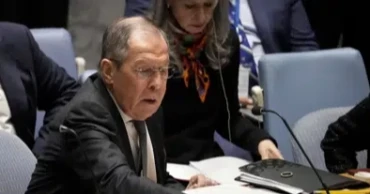
UN chief, representatives of the West berate Russian Foreign Minister Lavrov over Ukraine war
The United Nations chief and representatives from Western nations berated Russia’s top diplomat as he chaired a U.N. meeting Monday, accusing Moscow of violating the U.N. Charter by attacking Ukraine and occupying part of its territory.
Russian Foreign Minister Sergey Lavrov responded by defending his country’s military action and accusing the U.S. and its allies of undercutting global diplomacy, the foundation of the United Nations, which was created to prevent a third world war.
Secretary-General Antonio Guterres called cooperation among the U.N.’s 193 member nations the organization’s “beating heart” and “guiding vision,” and he warned the Security Council that global collaboration is under the greatest strain since the creation of the United Nations in 1945 on the ashes of World War II.
Tensions between major powers are at a “historic high” and so are the risks of conflict “through misadventure or miscalculation,” he said, pointing first and foremost to the war in Ukraine.
The U.N. secretary-general and the ambassadors of the U.S., Britain, France and their allies all pointed to the U.N. Charter’s underlying principle requiring all countries to support the sovereignty, territorial integrity and political independence of every nation — which Russia violated by invading its smaller neighbor on Feb. 24, 2022, and illegally annexing several regions.
Russia convened the ministerial meeting on making “multilateralism” — when countries work together — more effective through the defense of the U.N. Charter, calling it the high point of its month-long presidency of the Security Council. It has been the most contentious presidency in the memory of longtime U.N. diplomats and officials, and Monday’s meeting added to the antagonism.
U.S. Ambassador Linda Thomas-Greenfield called Russia a “hypocritical convener” of the meeting whose “illegal, unprovoked and unnecessary” war in Ukraine “struck at the heart of the U.N. Charter and all that we hold dear.”
Britain’s U.N. Ambassador Barbara Woodward said the world has seen “what Russia’s idea of multilateralism means for the world” — the trampling of the U.N. Charter and a war that has brought unimaginable suffering to Ukraine and been “an unmitigated disaster for Russia, too.”
The 27-member European Union called Russia’s attempt to portray itself as a defender of the U.N. Charter and multilateralism “cynical,” saying it is “in contempt” not only of the U.N. Charter but U.N. General Assembly resolutions demanding the withdrawal of Russian forces.
But Lavrov defended what Moscow calls its “special military operation,” reiterating accusations that Ukraine was promoting “Nazi practices” and banning the Russian language and culture, and NATO was planning to expand into Ukraine. He stressed, however, that “it’s not all about Ukraine” but what he called the West’s plans to leverage the Ukrainian government in the hope of weakening Russia.
“We cannot consider the Ukrainian issue separately from the geopolitical context,” Lavrov said. “It’s about how international relations will continue to be shaped through the establishment of a sound consensus on the basis of balance of interests, or through aggressive and volatile advancement of Washington’s hegemony.”
Lavrov strongly criticized NATO members’ activities in the Western Pacific, specifically the alliance between Australia, Britain and the U.S., and also strengthening U.S. ties with Japan, South Korea and a number of Southeast Asian countries.
Lavrov also accused the U.S. Embassy in Moscow of blocking Russian journalists from accompanying him to New York by approving their visas only after his plane left.
The Russian minister stressed that multilateralism is a key part of the U.N. Charter and accused the United States and its allies of “destroying globalization” despite touting its benefits.
Lavrov said the West is promoting a “rules-based order” where nobody has seen the rules and which bars access to modern technologies and financial services to punish countries it disagrees with. The West has imposed a series of economic sanctions on Russia in response to the invasion of Ukraine.
“Let’s call a spade a spade. Nobody allowed the Western minority to speak on behalf of all humankind,” he said.
Thomas-Greenfield, the U.S. ambassador, told the council that Russia’s actions during the 14-month war show that the invasion of Ukraine isn’t an isolated incident.
“This does not just concern Ukraine or Europe,” she said. “It concerns all of us. Because today it’s Ukraine, But tomorrow it could be another country, another small nation that is invaded by its larger neighbor.”
There were about 50 countries that spoke, and many pointed to the increasing confrontation among U.N. member nations. They stressed the importance of preserving multilateralism, including by reforming the Security Council to reflect the 21st century world instead of the post-World War II power structure.
“The world is standing at a historic crossroads now,” China’s U.N. Ambassador Zhang Jun told the council. “Humanity is facing unprecedented global challenges. Acts of hegemony and bullying are causing colossal harm to the world. Politics are creating huge divisions and confrontations. It has become all the more urgent and important to uphold the U.N. Charter.”
3 years ago

Some 1,200 migrants end up on tiny Italian island, 23 reported missing
With the return of calm seas, migrant smugglers launched dozens of boats from Tunisia during the weekend and some 1,200 people ended up on a tiny Italian island while several were reported missing at sea, the Italian Coast Guard said Monday.
Coast guard officials said in a statement that they responded to 35 boats that had left Tunisia, three of which came to grief.
In one shipwreck some 20 nautical miles off Lampedusa island coast guard and border police vessels said three migrants were missing. In a second, in Malta’s search-and-rescue area, survivors said some 20 people were missing, while in the third, also in Malta’s rescue area, Italian rescuers recovered a man’s body, the Coast Guard said.
Some 20 more boats crowded with migrants were in the sea Monday night, it said.
The coast guard said air and naval assets of the Coast Guard, the Border Police, the European border protection agency Frontex as well as a humanitarian organization were involved in the assistance.
Dozens of the migrants sat Monday morning near Lampedusa’s port, awaiting transfer to the island’s overcrowded shelter or eventually to Sicily or the Italian mainland.
Earlier Monday, a Tunisian fishing boat off Lampedusa aided a distressed migrant boat carrying 34 people and a body, and the survivors were later transferred to an Italian coast guard vessel, Italian news reports said.
On Sunday, with seas calm after four days of rough conditions, a total of 640 migrants reached Lampedusa, and hundreds more on Monday.
Last week, Italian authorities used commercial ferries and military vessels to transfer migrants from Lampedusa to Sicily or the mainland — bringing Lampedusa’s migrant center below its approximately 400-person capacity. But with the slew of boats arriving from Sunday, the number of migrants there quickly swelled, and authorities were scrambling anew to make arrangement for more transfers off the island.
Separately, the humanitarian group Doctors Without Borders said its rescue vessel Geo Barents came to the aid of 75 migrants — including 40 minors — in a wooden boat foundering in international waters off Libya on Monday.
The rescue vessel must now wait for Italian authorities to assign it a port to disembark the migrants. The right-wing government has been sending charity vessels to ports in northern Italy, far from the rescue area, to try to limit their time at sea. Government officials contend that the vessels encourage illegal migration by providing safety to the smugglers’ passengers.
Although far-right Premier Giorgia Meloni has led a crackdown both on smugglers and on the charity vessels, migrants keep risking dangerous voyages in the Central Mediterranean — departing from Tunisia, Libya and Turkey — in hopes of finding work or relatives in Europe.
According to Italian Interior Ministry figures, by Monday morning more than 36,600 migrants had arrived in Italy since the start of the year. That’s more than four times the number for the same period in each of the two previous years.
Italy rejects most of their asylum bids because they are fleeing poverty, not war or persecution. But, since barely a handful of countries have repatriation accords with Italy, the migrants who lose asylum bids often stay on for years in a legal limbo, or try to make their way to northern European countries.
Italy’s pleas to fellow European Union nations to take on some of the migrants have largely gone unheeded for years now.
3 years ago