Europe
Finland prime minister ousted, conservatives win tight vote
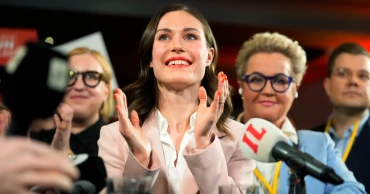
Finland's main conservative party claimed victory in parliamentary elections Sunday in a tight three-way race that saw right-wing populists take second place, leaving Prime Minister Sanna Marin's Social Democratic Party in third, dashing her hopes for reelection.
The center-right National Coalition Party (NCP) claimed victory with all of the votes counted, coming out on top at 20.8%. They were followed by right-wing populist party The Finns with 20.1%, while the Social Democrats garnered 19.9%.
With the top three parties each getting around 20% of the vote, no party is in position to form a government alone. Over 2,400 candidates from 22 parties were vying for the 200 seats in the Nordic country’s parliament.
“Based on this result, talks over forming a new government to Finland will be initiated under the leadership of the National Coalition Party,” said the party's elated leader Petteri Orpo, as he claimed victory surrounded by supporters gathered in a restaurant in the capital, Helsinki.
Marin, who at age 37 is one of Europe’s youngest leaders, has received international praise for her vocal support of Ukraine and her prominent role, along with President Sauli Niinistö, in advocating for Finland’s successful application to join NATO.
Also Read: Hungarian parliament approves Finland’s bid to join NATO
The 53-year-old Orpo, Finland's former finance minister and likely new prime minister, assured that the Nordic country's solidarity with Kyiv would remain strong during his tenure.
“First to Ukraine: we stand by you, with you," Orpo told the Associated Press at NCP's victory event. “We cannot accept this terrible war. And we will do all that is needed to help Ukraine, Ukrainian people because they fight for us. This is clear.”
"And the message to (Russian President Vladimir) Putin is: go away from Ukraine because you will lose,” Orpo said.
Finland, which shares a long border with Russia, cleared the last hurdles of becoming a NATO member earlier in the week as alliance members Turkey and Hungary signed off the country's membership bid.
Also Read: Erdogan hints Turkey may ratify Finland's NATO membership
NCP's share of votes translates into 48 seats in the Eduskunta, Finland's Parliament, while The Finns, a nationalist party running largely on an anti-immigration and anti-European Union agenda, is to get 46 seats and Marin's Social Democrats 43 seats respectively.
Observers say the result means a power shift in Finland's political scene as the nation is now likely to get a new center-right government with nationalist tones. The government will replace the center-left Cabinet by Marin, a highly popular prime minister at home and abroad since 2019.
Government formation talks led by the NCP are expected to start in the coming days with goal of putting together a Cabinet enjoying a majority at the Parliament.
“I trust the Finnish tradition of negotiating with all parties, and trying to find the best possible majority government for Finland," Orpo told the AP.
“And you know what is important for us? It’s that we are an active member of the European Union. We build up NATO-Finland, and we fix our economy. We boost our economic growth and create new jobs. These are the crucial, main, important issues we have to write into the government program,” he said.
The positions of Marin's party on the Finnish economy emerged as a main campaign theme and were challenged by conservatives, who remain critical of the Social Democrats' economic policies and are unlikely to partner with them.
Orpo had hammered on Finland's growing government debt and the need to make budget cuts throughout the election. NCP is open to cooperation with The Finns as the two parties largely share view on developing Finland's economy though have differences in climate policies and EU issues.
While Russia’s invasion of Ukraine prompted Finland to seek NATO membership in May 2022, neither the historic decision to abandon the nation’s non-alignment policy nor the war emerged as major campaign issues as there was a large consensus among the parties on membership.
Finland, which is expected to join NATO in the coming weeks, is a European Union member.
The initial voter turnout in the election was 71.9%, slightly down from the 2019 election.
3 years ago

Pope Francis leaves hospital; 'Still alive,' he quips
A chipper-sounding Pope Francis was discharged Saturday from the Rome hospital where he was treated for bronchitis, quipping to journalists before being driven away that he's “still alive.”
Francis, 86, was hospitalized at Gemelli Polyclinic on Wednesday following his weekly public audience in St. Peter's Square after reportedly experiencing breathing difficulties. The pontiff received antibiotics administered intravenously during his stay, the Vatican said.
In a sign of his improved health, the Vatican released details of Francis' Holy Week schedule. It said he would preside at this weekend's Palm Sunday Mass and at Easter Mass on April 9, both held in St. Peter's Square and expected to draw tens of thousands of faithful. A Vatican cardinal will be at the altar to celebrate both Masses, a recent practice due to the pontiff having a troublesome knee issue.
But Francis is scheduled to celebrate Holy Thursday Mass, which this year will be held in a juvenile prison in Rome. Still unclear was whether he would attend the late-night, torch-lit Way of the Cross procession at Rome's Colosseum to mark Good Friday.
Before departing Gemelli Polyclinic late Saturday morning, Francis comforted a Rome couple whose 5-year-old daughter died Friday night at the Catholic hospital. Outside, Serena Subania, mother of Angelica, sobbed as she pressed her head into the chest of the pope, who held her close and whispered words of comfort.
Francis seemed eager to linger with well-wishers. When a boy showed him his arm cast, the pope made a gesture as if to ask “Do you have a pen?” Three papal aides whipped out theirs. Francis took one of the pens and added his signature to the child's already well-autographed cast.
The pontiff answered in a low voice that was close to a whisper when reporters peppered him with questions, indicating he had felt unwell — “I felt sick," he said, pointing to his mid-section — a symptom that convinced his medical staff to take him to the hospital Wednesday.
Asked how he felt now, Francis joked, “Still alive, you know.” He gave a thumbs-up sign.
Francis exited the hospital from a side entrance, but his car stopped in front of the main entrance, where a gaggle of journalists waited. He opened the car door himself and got out from the front passenger seat. Francis had a cane ready to lean on.
After chatting, he got back into the white Fiat 500 car that drove him away from Gemelli Polyclinic. But instead of heading straight home, his motorcade sped right past Vatican City and went to St. Mary Major Basilica, a Rome landmark that is one of his favorites.
There, startled tourists rushed to snap photos of him as he sat in a wheelchair, which he has used often to navigate longer distances in recent years due to a chronic knee problem. When he emerged after praying, residents and tourists in the street called out repeatedly, “Long live the pope!” and clapped.
Francis spent 10 days at the same hospital in July 2021 following intestinal surgery for a bowel narrowing, After his release back then, he also stopped to offer prayers of thanksgiving at St. Mary Major Basilica, which is home to an icon depicting the Virgin Mary. He also visits the church upon returning from trips abroad.
Before leaving the hospital Saturday, Francis, while chatting with journalists, praised medical workers, saying they "show great tenderness."
“We sick are capricious. I much admire the people who work in hospitals,” he said. Francis also said he read journalists' accounts of his illness, including in a Rome daily newspaper, and pronounced them well done.
Francis stopped to talk to reporters again before he was driven into the Vatican through a gate of the tiny walled city-state, where he lives at a Holy See hotel. Speaking through an open car window, he said: “Happy Easter to all, and pray for me.''
Then, indicating he was eager to resume his routine, he said, “Forward, thanks.”
In response to a shouted question from a reporter, who asked if the pope would visit Hungary at the end of April as scheduled, Francis answered , “Yes.”
On yet another stop, he got out of his car to distribute chocolate Easter eggs to the police officers who drove the motorcycles at the head of his motorcade.
Given his strained voice, it was unclear if the pope would read the homily at the Palm Sunday service or deliver the usually lengthy “Urbi et Orbi” (Latin for to the city and to the world) address, a review of the globe's conflicts, at the end of Easter Mass.
He told reporters that after Palm Sunday Mass, he would keep his weekly appointment to greet and bless the public in St. Peter's Square.
As a young man in his native Argentina, Francis had part of a lung removed, leaving him particularly vulnerable to any respiratory illness.
3 years ago

Russia arrests Wall Street Journal reporter on spying charge
Russia's security service arrested an American reporter for The Wall Street Journal on espionage charges, the first time a U.S. correspondent has been detained on spying accusations since the Cold War. The newspaper denied the allegations and demanded his release.
Evan Gershkovich, 31, was detained in Yekaterinburg, Russia's fourth-largest city, about 1,670 kilometers (1,035 miles) east of Moscow. Russia's Federal Security Service accused him of trying to obtain classified information.
Known by the acronym FSB, the service is the top domestic security agency and main successor to the Soviet-era KGB. It alleged that Gershkovich "was acting on instructions from the American side to collect information about the activities of one of the enterprises of the Russian military-industrial complex that constitutes a state secret."
The Journal "vehemently denies the allegations from the FSB and seeks the immediate release of our trusted and dedicated reporter, Evan Gershkovich," the newspaper said. "We stand in solidarity with Evan and his family."
The arrest comes at a moment of bitter tensions between the West and Moscow over its war in Ukraine and as the Kremlin intensifies a crackdown on opposition activists, independent journalists and civil society groups.
The sweeping campaign of repression is unprecedented since the Soviet era. Activists say it often means the very profession of journalism is criminalized, along with the activities of ordinary Russians who oppose the war.
Earlier this week, a Russian court convicted a father over social media posts critical of the war and sentenced him to two years in prison. His 13-year-old daughter was sent to an orphanage.
Gershkovich is the first American reporter to be arrested on espionage charges in Russia since September 1986, when Nicholas Daniloff, a Moscow correspondent for U.S. News and World Report, was arrested by the KGB. Daniloff was released without charge 20 days later in a swap for an employee of the Soviet Union's United Nations mission who was arrested by the FBI, also on spying charges.
At a hearing Thursday, a Moscow court quickly ruled that Gershkovich would be kept behind bars pending the investigation.
While previous American detainees have been freed in prisoner swaps, a top Russian official said it was too early to talk about any such deal.
In Washington, the Biden administration said it had spoken with the Journal and Gershkovich's family. White House press secretary Karine Jean-Pierre condemned the arrest "in the strongest terms" and urged Americans to heed government warnings not to travel to Russia.
The State Department was in direct touch with the Russian government and seeking access to Gershkovich, Jean-Pierre said. The administration has no "specific indication" that journalists in Russia are being targeted, she said.
Gershkovich, who covers Russia, Ukraine and other ex-Soviet nations as a correspondent in the Journal's Moscow bureau, could face up to 20 years in prison if convicted of espionage. Prominent lawyers noted that past investigations into espionage cases took a year to 18 months, during which time he may have little contact with the outside world.
The FSB noted that Gershkovich had accreditation from the Russian Foreign Ministry to work as a journalist, but ministry spokeswoman Maria Zakharova alleged that Gershkovich was using his credentials as cover for "activities that have nothing to do with journalism."
Kremlin spokesman Dmitry Peskov told reporters: "It is not about a suspicion, it is about the fact that he was caught red-handed."
Gershkovich speaks fluent Russian and had previously worked for the French news agency Agence France-Presse and The New York Times. He was a 2014 graduate of Bowdoin College in Maine, where he was a philosophy major who cooperated with local papers and championed a free press, according to Clayton Rose, the college's president.
His last report from Moscow, published earlier this week, focused on the Russian economy's slowdown amid Western sanctions imposed after Russian troops invaded Ukraine last year.
Ivan Pavlov, a prominent Russian defense attorney who has worked on many espionage and treason cases, said Gershkovich's case is the first criminal espionage charge against a foreign journalist in post-Soviet Russia.
"That unwritten rule not to touch accredited foreign journalists, has stopped working," said Pavlov, a member of the First Department legal aid group.
Pavlov said the case against Gershkovich was built to give Russia "trump cards" for a future prisoner exchange and will likely be resolved "not by the means of the law, but by political, diplomatic means."
Russian Deputy Foreign Minister Sergei Ryabkov ruled out any quick swap.
"I wouldn't even consider this issue now because people who were previously swapped had already served their sentences," Ryabkov said, according to Russian news agencies.
In December, WNBA star Brittney Griner was freed after 10 months behind bars in exchange for Russian arms dealer Viktor Bout.
Another American, Paul Whelan, a Michigan corporate security executive, has been imprisoned in Russia since December 2018 on espionage charges that his family and the U.S. government have said are baseless.
"Our family is sorry to hear that another American family will have to experience the same trauma that we have had to endure for the past 1,553 days," Whelan's brother David said in an emailed statement. "It sounds as though the frame-up of Mr. Gershkovich was the same as it was in Paul's case."
Jeanne Cavelier, of the press freedom group Reporters Without Borders, said Gershkovich's arrest "looks like a retaliation measure of Russia against the United States."
"We are very alarmed because it is probably a way to intimidate all Western journalists that are trying to investigate aspects of the war on the ground in Russia," said Cavelier, head of Eastern Europe and Central Asia desk at the Paris-based group.
Another prominent lawyer with the First Department group, Yevgeny Smirnov, said that those arrested on espionage and treason charges are usually held at the FSB's Lefortovo prison, where they are usually placed in total isolation, without phone calls, visitors or even access to newspapers. At most, they can receive letters, often delayed by weeks. Smirnov called these conditions "tools of suppression."
Smirnov and Pavlov both said that any trial would be held behind closed doors. According to Pavlov, there have been no acquittals in treason and espionage cases in Russia since 1999.
3 years ago

'I want to speak with him': Ukraine’s Zelenskyy invites China's Xi Jinping
Ukraine's president invited his powerful Chinese counterpart, Xi Jinping, to visit his nation, saying they haven't been in contact since the war began and he is "ready to see him here."
"I want to speak with him," Volodymyr Zelenskyy told The Associated Press on Tuesday, the week after Xi visited Russian President Vladimir Putin last week. China had no immediate response about whether a Xi visit to Ukraine would happen.
China has been economically aligned and politically favorable toward neighboring Russia across many decades and Beijing has provided Putin diplomatic cover by staking out an official position of neutrality in the war. Xi, a powerful leader who commands the resources of the world's most populous nation, is an important player in the Russia-Ukraine conflict, and even China's lack of involvement is a potent statement.
Zelenskyy spoke to the AP aboard a train shuttling him across Ukraine, to cities near some of the fiercest fighting and others where his country's forces have successfully repelled Russia's invasion. Zelenskyy rarely travels with journalists, and the president's office said AP's two night train trip with him was the most extensive since the war began.
Zelenskyy has extended invitations to Xi before in recent months, but this explicit call to visit comes days after the Chinese leader visited Putin in Russia last week. But the Ukrainian leader said he hasn't communicated with Xi for the duration of the conflict.
"We are ready to see him here," Zelenskyy said. "I had contact with him before full-scale war. But during all this year, more than one year, I didn't have."
In Beijing, Chinese Foreign Ministry spokeswoman Mao Ning was asked whether Xi would accept an invitation from Zelenskyy — or whether one had been officially extended. She told reporters she had no information to give. She did say that Beijing maintains "communication with all parties concerned, including Ukraine."
Kremlin spokesman Dmitry Peskov, asked whether a meeting between Xi and Zelenskyy would be useful to resolve the conflict in Ukraine, said Russian authorities "highly appreciate" China's balanced position on the issue and "have no right to come up with any advice" on whether the two should meet. "The Chinese leader himself decides the appropriateness of certain contacts," Peskov said during his daily conference call with reporters Wednesday.
In Washington, White House National Security Council spokesman John Kirby said the United States supports talks between Xi and Zelenskyy, "and my goodness, we've been saying that for weeks."
Xi's Russia visit last week raised the prospect that Beijing might be ready to provide Moscow with the weapons and ammunition it needs to refill its depleted stockpile. But Xi's trip ended without any such announcement. Days later, Putin announced that he would be deploying tactical nuclear weapons to Belarus, which neighbors Russia and pushes the Kremlin's nuclear stockpile closer to NATO territory.
Zelenskyy suggested Putin's move was intended to distract from the lack of guarantees he received from China.
"What does it mean? It means that the visit was not good for Russia," Zelenskyy speculated.
3 years ago

Russia stops sharing nuclear forces information with US
A senior Russian diplomat said Wednesday that Moscow has suspended sharing information about its nuclear forces with the United States, including notices about missile tests.
Russian Deputy Foreign Minister Sergei Ryabkov said in remarks carried by Russian news agencies that Moscow has halted all information exchanges with Washington after previously suspending its participation in the last remaining nuclear arms pact with the U.S.
Last month, Russian President Vladimir Putin suspended the New START treaty, charging that Russia can't accept U.S. inspections of its nuclear sites under the agreement at a time when Washington and its NATO allies have openly declared Russia's defeat in Ukraine as their goal.
Moscow emphasized that it wasn't withdrawing from the pact altogether and would continue to respect the caps on nuclear weapons.
The Russian Foreign Ministry initially said Moscow would keep notifying the U.S. about planned test launches of its ballistic missiles.
Meanwhile, The Russian military was conducting drills of its strategic missile forces Wednesday, deploying mobile launchers in Siberia in a show of the country's massive nuclear capability amid the fighting in Ukraine.
As part of the drills, the Yars mobile missile launchers will maneuver across three regions of Siberia, Russia's Defense Ministry said. The movements will involve measures to conceal the deployment from foreign satellites and other intelligence assets, the ministry said.
The Defense Ministry didn't say how long the drills would last or mention plans for any practice launches. The Yars is a nuclear-tipped intercontinental ballistic missile with a range of about 11,000 kilometers (over 6,800 miles). It forms the backbone of Russia's strategic missile forces.
The Defense Ministry released a video showing massive trucks carrying the missiles driving out from a base to go on patrol. The maneuvers involve about 300 vehicles and 3,000 troops in eastern Siberia, according to the ministry.
The massive exercise took place days after Russian President Vladimir Putin announced a plan to deploy tactical nuclear weapons to Belarus, Russia's neighbor and ally.
Tactical nuclear weapons are intended for use on the battlefield and have a relatively short range and a much lower yield compared to the long-range strategic missiles fitted with nuclear warheads that are capable of obliterating whole cities.
Putin's decision to put the tactical weapons in Belarus followed his repeated warnings that Moscow was ready to use "all available means" — a reference to its nuclear arsenal — to fend off attacks on Russian territory.
Russian officials have issued a barrage of hawkish statements since their troops entered Ukraine, warning that the continuing Western support for Ukraine raised the threat of a nuclear conflict.
In remarks published Tuesday, Nikolai Patrushev, the secretary of Russia's Security Council, which Putin chairs, warned the United States and its allies against harboring hopes for Russia's defeat in Ukraine.
Patrushev alleged that some American politicians believe the U.S. could launch a preventative missile strike on Russia to which Moscow would be unable to respond, a purported belief that he described as "short-sighted stupidity, which is very dangerous."
"Russia is patient and isn't trying to scare anyone with its military superiority, but it has unique modern weapons capable of destroying any adversary, including the United States, in case of a threat to its existence," Patrushev said.
3 years ago

Ukraine’s Zelenskyy: Any Russian victory could be perilous
Ukrainian President Volodymyr Zelenskyy warned Tuesday that unless his nation wins a drawn-out battle in a key eastern city, Russia could begin building international support for a deal that could require Ukraine to make unacceptable compromises. He also invited the leader of China, long aligned with Russia, to visit.
If Bakhmut fell to Russian forces, their president, Vladimir Putin, would “sell this victory to the West, to his society, to China, to Iran,” Zelenskyy said in an exclusive interview with The Associated Press.
“If he will feel some blood — smell that we are weak — he will push, push, push," Zelenskyy said in English, which he used for virtually all of the interview.
The Ukrainian leader spoke to the AP aboard a train shuttling him across Ukraine, to cities near some of the fiercest fighting and others where his country’s forces have successfully repelled Russia’s invasion. The AP is the first news organization to travel extensively with Zelenskyy since the war began just over a year ago.
Since then, Ukraine — backed by much of the West — has surprised the world with the strength of its resistance against the larger, better equipped Russian military. Ukrainian forces have held their capital, Kyiv, and pushed Russia back from other strategically important areas.
But as the war enters its second year, Zelenskyy finds himself focused on keeping motivation high in both his military and the general Ukrainian population — particularly the millions who have fled abroad and those living in relative comfort and security far from the front lines.
Zelenskyy is also well aware that his country's success has been in great part due to waves of international military support, particularly from the United States and Western Europe. But some in the United States — including Republican Donald Trump, the former American president and current 2024 candidate — have questioned whether Washington should continue to supply Ukraine with billions of dollars in military aid.
Trump's likely Republican rival, Florida Gov. Ron DeSantis, also suggested that defending Ukraine in a “territorial dispute” with Russia was not a significant U.S. national security priority. He later walked that statement back after facing criticism from other corners of the GOP.
Zelenskyy didn't mention the names of Trump or any other Republican politicians — figures he might have to deal with if they prevailed in 2024 elections. But he did say that he worries the war could be impacted by shifting political forces in Washington.
“The United States really understands that if they stop helping us, we will not win,” he said in the interview. He sipped tea as he sat on a narrow bed in the cramped, unadorned sleeper cabin on a state railway train.
The president's carefully calibrated railroad trip was a remarkable journey across land through a country at war. Zelenskyy, who has become a recognizable face across the world as he doggedly tells his side of the story to nation after nation, used the morale-building journey to carry his considerable clout to regions close to the front lines.
He traveled with a small cadre of advisers and a large group of heavily armed security officials dressed in battlefield fatigues. His destinations included ceremonies marking the one-year anniversary of the liberation of towns in the Sumy region and visits with troops stationed at front-line positions near Zaporizhzhia. Each visit was kept under wraps until after he departed.
Zelenskyy recently made a similar visit near Bakhmut, where Ukrainian and Russian forces have been locked for months in a grinding and bloody battle. While some Western military analysts have suggested that the city is not of significant strategic importance, Zelenskyy warned that a loss anywhere at this stage in the war could put Ukraine’s hard-fought momentum at risk.
“We can’t lose the steps because the war is a pie — pieces of victories. Small victories, small steps,” he said.
Zelensky’s comments were an acknowledgement that losing the seven month-long battle for Bakhmut – the longest of the war thus far – would be more of a costly political defeat than a tactical one.
He predicted that the pressure from a defeat in Bakhmut would come quickly — both from the international community and within his own country. “Our society will feel tired,” he said. “Our society will push me to have compromise with them.”
So far, Zelenskyy says he hasn't felt that pressure. The international community has largely rallied around Ukraine following Russia’s Feb. 24, 2022, invasion. In recent months, a parade of world leaders have visited Zelenskyy in Ukraine, most traveling in on trains similar to the ones Zelenskyy uses to crisscross the country.
In his AP interview, Zelenskyy extended an invitation to Ukraine to one notable and strategically important leader who has not made the journey — Chinese President Xi Jinping. "We are ready to see him here,” he said. “I want to speak with him. I had contact with him before full-scale war. But during all this year, more than one year, I didn’t have.”
China, economically aligned and politically favorable toward Russia across many decades, has provided Putin diplomatic cover by staking out an official position of neutrality in the war.
Xi visited Putin in Russia last week, raising the prospect that Beijing might be ready to provide Moscow with the weapons and ammunition it needs to refill its depleted stockpile. But Xi’s trip ended without any such announcement. Days later, Putin announced that he would be deploying tactical nuclear weapons to Belarus, which neighbors Russia and pushes the Kremlin’s nuclear stockpile closer to NATO territory.
Zelenskyy suggested Putin’s move was intended to distract from the lack of guarantees he received from China.
“What does it mean? It means that the visit was not good for Russia,” Zelenskyy speculated.
The president makes few predictions about the biggest question hanging over the war: how it will end. He expressed confidence, however, that his nation will prevail through a series of “small victories" and "small steps" against a “very big country, big enemy, big army” — but an army, he said, with “small hearts.”
And Ukraine itself? While Zelenskyy acknowledged that the war has “changed us,” he said that in the end, it has made his society stronger.
“It could’ve gone one way, to divide the country, or another way — to unite us,” he said. “I'm so thankful. I’m thankful to everybody — every single partner, our people, thank God, everybody — that we found this way in this critical moment for the nation. Finding this way was the thing that saved our nation, and we saved our land. We are together.”
3 years ago

Why does Russia want tactical nuclear weapons in Belarus?
Russian President Vladimir Putin's announcement that he intends to deploy tactical nuclear weapons on the territory of Belarus appears to be another attempt to raise the stakes in the conflict in Ukraine.
It follows Putin's warnings that Moscow is ready to use "all available means" to fend off attacks on Russian territory, a reference to its nuclear arsenal.
A look at Putin's statement and its implications:
How did Putin explain his move?
Putin said that President Alexander Lukashenko of Belarus has long urged Moscow to station its nuclear weapons in his country, which has close military ties with Russia and was a staging ground for the invasion of neighboring Ukraine on Feb. 24, 2022.
Russia already has helped modernize Belarusian warplanes to make them capable of carrying nuclear weapons — something that Belarus' authoritarian leader has repeatedly mentioned.
In remarks broadcast Saturday, Putin said the immediate trigger for the deployment of Russia's tactical nuclear weapons to Belarus was the U.K. government's decision to provide Ukraine with armor-piercing shells containing depleted uranium. Putin toned down his language after first falsely claiming that such rounds have nuclear components, but he insisted they pose an additional danger to the civilian population and could contaminate the environment.
Putin also said that by stationing tactical nuclear weapons in Belarus, Russia will be doing what the United States has done for decades by putting its nuclear weapons in Belgium, Germany, Italy, the Netherlands and Turkey. He alleged the Russian move doesn't violate an international treaty banning the proliferation of nuclear weapons, even though Moscow has argued before that Washington has breached the pact by deploying them on the territory of its NATO allies.
Putin's move contrasted with a statement that he and Chinese President Xi Jinping issued after their talks in the Kremlin last week, which spoke against nuclear powers deploying atomic weapons outside their territories, in an apparent jab at the U.S.
What are tactical nuclear weapons?
Tactical nuclear weapons are intended to destroy enemy troops and weapons on the battlefield. They have a relatively short range and a much lower yield than nuclear warheads fitted to long-range strategic missiles that are capable of obliterating whole cities.
Unlike strategic weapons, which have been subject to arms control agreements between Moscow and Washington, tactical weapons never have been limited by any such pacts, and Russia hasn't released their numbers or any other specifics related to them.
The U.S. government believes Russia has about 2,000 tactical nuclear weapons, which include bombs that can be carried by aircraft, warheads for short-range missiles and artillery rounds.
While strategic nuclear weapons are fitted to land- or submarine-based intercontinental ballistic missiles that are constantly ready for launch, tactical nuclear weapons are stored at a few tightly guarded storage facilities in Russia, and it takes time to deliver them to combat units.
Some Russian hawks long have urged the Kremlin to send a warning to the West by moving some tactical nuclear weapons closer to the aircraft and missiles intended to deliver them.
What exactly will Russia do?
Putin said that Russia already has helped upgrade 10 Belarusian aircraft to allow them to carry nuclear weapons and their crews will start training to use them from April 3. He noted Russia also has given Belarus the Iskander short-range missile systems that can be fitted with conventional or nuclear warheads.
He said the construction of storage facilities for nuclear weapons in Belarus will be completed by July 1. He didn't say how many nuclear weapons will be stationed there or when they will be deployed.
Putin emphasized that Russia will retain control over any nuclear weapons deployed to Belarus, just like the U.S. controls its tactical nuclear weapons on the territory of its NATO allies.
If Moscow sends nuclear weapons to Belarus, it will mark their first deployment outside Russian borders since the early 1990s. Belarus, Ukraine and Kazakhstan inherited massive nuclear arsenals after the collapse of the Soviet Union in 1991 but agreed to ship them to Russia in the following years.
What are the possible consequences behind Putin’s move?
With his latest statement, Putin again is dangling the nuclear threat to signal Moscow's readiness to escalate the war in Ukraine.
The deployment of tactical nuclear weapons to Belarus, which has a 1,084-kilometer (673-mile) border with Ukraine, would allow Russian aircraft and missiles to reach potential targets there more easily and quickly if Moscow decides to use them. It would also extend Russia's capability to target several NATO members in Eastern and Central Europe.
The move comes as Kyiv is poised for a counteroffensive to reclaim territory occupied by Russia.
Dmitry Medvedev, deputy head of Russia's Security Council, warned last week that attempts by Ukraine to reclaim control over the Crimean Peninsula was a threat to "the very existence of the Russian state," something that warrants a nuclear response under the country's security doctrine. Russia illegally annexed Crimea from Ukraine in 2014.
"Every day of supplying Western weapons to Ukraine makes the nuclear apocalypse closer," Medvedev said.
Ukrainian military analyst Oleh Zhdanov said that Putin's goal is to discourage Ukraine's Western allies from providing Kyiv with more weapons before any counteroffensive.
Putin is "using nuclear blackmail in a bid to influence the situation on the battlefield and force Western partners to reduce supplies of weapons and equipment under the threat of nuclear escalation," Zhdanov said. "The Belarusian nuclear balcony will be looming over not only Ukraine, but Europe as well, creating a constant threat, raising tensions and rattling the nerves of Ukrainians and their Western partners."
What are Ukraine and the West saying?
Ukraine has responded to Putin's move by calling for an emergency meeting of the U.N. Security Council. A U.N. spokesman referred questions on the issue to the Security Council, which had announced no meeting on it by Monday afternoon.
"The world must be united against someone who endangers the future of human civilization," the Ukrainian Foreign Ministry said.
White House National Security Council spokesman John Kirby said Monday that U.S. officials "haven't seen any movement of any tactical nuclear weapons or anything of that kind" since Putin's announcement on Belarus. He has said Washington has seen nothing to prompt a change in its strategic deterrent posture.
NATO rejects Putin's claim that Russia only is doing what the U.S. has done for decades, saying that Western allies act with full respect for their international commitments.
"Russia's nuclear rhetoric is dangerous and irresponsible," NATO spokesperson Oana Lungescu said, adding that the alliance hasn't yet seen any change in Russia's nuclear posture.
Lithuania, which borders Belarus, described Putin's statement as "yet another attempt by two unpredictable dictatorial regimes to threaten their neighbors and the entire European continent," calling them "desperate moves by Putin and Lukashenko to create another wave of tension and destabilization in Europe."
Belarus' Foreign Ministry rejected Western criticism Tuesday, casting the deployment of Russian nuclear weapons as a response to "unprecedented" Western pressure and arguing that the move wouldn't contradict the international agreements because Russia will retain control of them.
The Russian Foreign Ministry pointed out that Washington and its allies had ignored Russia's calls for the withdrawal of U.S. nuclear weapons from Europe. It reaffirmed Moscow's right to take "the necessary additional steps to ensure security of Russia and its allies."
3 years ago

2 dead, several injured in Portugal Muslim center stabbing
Portuguese police shot and injured a man suspected of stabbing two women to death at an Ismaili Muslim center in Lisbon Tuesday, authorities said.
The women were Portuguese staff members at the center, Ismaili community leader Narzim Ahmad told Portuguese TV channel S.I.C.
Police were called to the center late Tuesday morning where they encountered a suspect "armed with a large knife," a police statement said.
Police ordered him to surrender but he advanced toward them and was "neutralized," the statement said. The suspect was taken to a Lisbon hospital where he was in police custody.
Several other people were wounded, according to the statement, but it provided no further details.
Prime Minister António Costa said police shot the suspect and told reporters the attack was "a criminal act."
"Everything points to this being an isolated incident," Costa said, without elaborating.
There was no immediate word on the identity of those killed.
Armed police from a special operations unit could be seen forming a perimeter outside the building.
Costa said police were investigating the attack and it was too soon to speculate about a motive.
The Shia Imami Ismaili Muslims, generally known as the Ismailis, belong to the Shia branch of Islam. The Ismaili Muslims are a culturally diverse community living in more than 25 countries around the world.
Portugal hasn't recorded any significant terror attacks in recent decades, and religious violence is virtually unheard of.
3 years ago

Hungarian parliament approves Finland’s bid to join NATO
Hungary’s parliament on Monday approved Finland’s bid to join NATO, ending months of delays and bringing the Nordic country one step closer to becoming a full member of the Western military alliance.
Hungarian lawmakers voted 182 for and only six against with no abstentions. The vote came after Hungary’s government frustrated allies in NATO and the European Union by repeatedly postponing the measure for months after nearly all other members of the alliance had ratified Finland’s bid.
With Hungary’s approval, Turkey is now the only one of NATO’s 30 members not to have ratified Finland’s NATO accession.
Admitting a new country requires unanimity among all member nations.
3 years ago

Macron's govt ignites firestorm of anger in France with unpopular pension reforms
A big day has come for French high school student Elisa Fares. At age 17, she is taking part in her first protest.
In a country that taught the world about people power with its revolution of 1789 — and a country again seething with anger against its leaders — graduating from bystander to demonstrator is a generations-old rite of passage. Fares looks both excited and nervous as she prepares to march down Paris streets where people for centuries have similarly defied authority and declared: “Non!”
Two friends, neither older than 18 but already protest veterans whose parents took them to demonstrations when they were little, are showing Fares the ropes. They’ve readied eyedrops and gas masks in case police fire tear gas — as they have done repeatedly in recent weeks.
“The French are known for fighting and we’ll fight,” says one of the friends, Coline Marionneau, also 17. “My mother goes to a lot of demonstrations ... She says if you have things to say, you should protest.”
For French President Emmanuel Macron, the look of determination on their young faces only heralds deepening crisis. His government has ignited a firestorm of anger with unpopular pension reforms that he railroaded through parliament and which, most notably, push the legal retirement age from 62 to 64.Furious not just with the prospect of working for longer but also with the way Macron imposed it, his opponents have switched to full-on disobedience mode. They’re regularly striking and demonstrating and threatening to make his second and final term as president even more difficult than his first. It, too, was rocked by months of protests — often violent — by so-called yellow vest campaigners against social injustice.
Fares, the first-time protester, said her mother had been against her taking to the streets but has now given her blessing.
“She said that if I wanted to fight, she wouldn’t stop me,” the teen says.
Critics accuse Macron of effectively ruling by decree, likening him to France’s kings of old. Their reign finished badly: In the French Revolution, King Louis XVI ended up on the guillotine. There’s no danger of that happening to Macron. But hobbled in parliament and contested on the streets piled high with reeking garbage uncollected by striking workers, he’s being given a tough lesson, again, about French people power. Freshly scrawled slogans in Paris reference 1789.
So drastically has Macron lost the initiative that he was forced to indefinitely postpone a planned state visit this week by King Charles III. Germany, not France, will now get the honor of being the first overseas ally to host Charles as monarch.
The France leg of Charles’ tour would have coincided with a new round of strikes and demonstrations planned for Tuesday that are again likely to mobilize many hundreds of thousands of protesters. Macron said the royal visit likely would have become their target, which risked creating a “detestable situation.”
Encouraged by that victory, the protest movement is plowing on and picking up new recruits, including some so young that it will be many decades before they’ll be directly impacted by the pushed-back retirement age. Their involvement is a worrisome development for Macron, because it suggests that protests are evolving, broadening from workplace and retirement concerns to a more generalized malaise with the president and his governance.
Violence is picking up, too. Police and environmental activists fought pitched battles over the weekend in rural western France, resulting in dozens of injuries. Officers fired more than 4,000 nonlethal dispersion grenades in fending off hundreds of protesters who rained down rocks, powerful fireworks and gasoline bombs on police lines.
“Anger and resentment,” says former President François Hollande, Macron’s predecessor, “are at a level that I have rarely seen.”
For Fares, whose first demonstration was a peaceful protest in Paris this weekend, the final straw was Macron’s decision to not let legislators vote on his retirement reform, because he wasn’t sure of winning a majority for it. Instead, he ordered his prime minister to skirt parliament by using a special constitutional power to ram the bill through.
It was the 11th time that Prime Minister Elisabeth Borne had to resort to the so-called Article 49.3 power in just 10 months — a telling sign of Macron’s fragility since he lost his parliamentary majority in an election last June.
“It’s an attack on democracy,” Fares said. “It annoyed me too much.”
Her friend Luna Dessommes, 18, added hopefully: “We have to use the movement to politicize more and more young people.”
At age 76, veteran protester Gilbert Leblanc has been through it all before. He was a yellow vest; by his count, he took part in more than 220 of their protests in Macron’s first term, rallying to the cry that the former banker was too pro-business and “the president of the rich.”
Long before that, Leblanc cut his teeth in seminal civil unrest that reshaped France in May 1968. He says that when he tells awe-struck young protesters that he was a “soixante-huitard” — a ’68 veteran — they “want to take selfies with me.”
This winter, he has kept his heating off, instead saving the money for train fares to the capital, so he can protest every weekend, he said.
“My grandfather who fought in World War I, got the war medal. He would rise from his grave if he saw me sitting at home, in my sofa, not doing anything,” Leblanc said.
“Everything we’ve obtained has been with our tears and blood.”
3 years ago