europe

Ukraine lauds Western move on tanks, while Russia attacks
From Washington to Berlin to Kyiv, a Western decision to send battle tanks to Ukraine was hailed enthusiastically. Moscow sought to downplay it.
The Kremlin has previously warned that such tank deliveries would be a dangerous escalation of the conflict in Ukraine, and it has strongly denounced the watershed move by Germany and the United States to send the heavy weaponry to its foe.
But it insists the new armor won't stop Russia from achieving its goals in Ukraine.
“The potential it gives to the Ukrainian armed forces is clearly exaggerated,” Kremlin spokesman Dmitry Peskov said. “Those tanks will burn just like any others.”
Moscow played down the move in an apparent attempt to save face as the West raised the stakes in Ukraine. Some Russian experts also emphasized that the supply of the deadly armor will be relatively limited and could take months to reach the front.
On Thursday, Russia launched a new wave of missile and self-exploding drone attacks across Ukraine. The attack initially appeared to be a continuation of previous attacks rather than retaliation for the announcements on the tanks.
President Vladimir Putin, his diplomats and military leaders have repeatedly warned the West that supplying long-range weapons capable of striking deep inside Russia would mark a red line and trigger a massive retaliation.
While other weapons like tanks and certain air defense systems have drawn warnings from Russian officials, the wording has been deliberately vague, perhaps to allow the Kremlin to avoid getting cornered by making specific threats.
Poland, the Czech Republic and other NATO allies have provided Ukraine with hundreds of smaller Soviet-made tanks from the Cold War era when they were part of the Soviet bloc. Ukrainian armed forces, who have used similar aging weaponry, needed no extra training to use them. They played an important role on the battlefield, helping Ukraine reclaim broad swaths of territory in 11 months of fighting.
Read more: Germany says it won't block Poland giving Ukraine tanks
As Ukraine's armored units suffered attrition and stockpiles of the old T-72 tanks ran dry in the arsenals of its allies in Central and Eastern Europe, Kyiv has increasingly pushed for delivery of German-made Leopard 2 and U.S. M1 Abrams tanks.
After weeks of hesitation, Germany said Wednesday it will provide Ukraine with 14 Leopard 2 tanks and allow other allies willing to follow suit to deliver 88 Leopards to form two tank battalions. The U.S. announced it will send 31 M1 Abrams tanks.
Ukrainian President Volodymyr Zelenskyy and his officials, who long have said the country needs hundreds of tanks to counter a foe with a far superior number as well as other weapons, greeted the Western decision as a major breakthrough, voicing hope that more supplies will follow.
“The deliveries of Leopard 2 will take our ground forces to a qualitatively new level,” Ukrainian military expert Oleh Zhdanov told The Associated Press. Even though Leopard 2s are heavier than Soviet-designed tanks, they have a strong edge in firepower and survivability.
“One Leopard 2 could be equivalent to three or five Russian tanks,” Zhdanov said.
But he noted that the promised number of Western tanks represents only the minimum that Ukraine needs to repel a likely offensive by Moscow, adding that Russia has thousands of armored vehicles.
“Kyiv is preparing for a defensive operation, and its outcome will determine the future course of the conflict,” Zhdanov said.
Russian military analysts were more skeptical about the Western tanks, arguing that while Abrams proved clearly superior to older models of Soviet-built tanks during the war in Iraq, newer Russian models are more closely matched. They also charged that Leopard 2 tanks used by the Turkish army against the Kurds in Syria proved vulnerable to Soviet-era anti-tank weapons.
Some Russian online media quickly posted diagrams of the vulnerable points of the Leopard 2. “Hit Leopard as your grandfather hit Tiger and Panther!” one headline said, referring to Nazi tanks in World War II.
Andrei Kartapolov, a retired general who heads the defense affairs committee in the lower house of the Russian parliament, argued that both Leopard 2 and Abrams are inferior to Russia's T-90, a modified version of the T-72.
Read more: Top US general visits training site for Ukrainian soldiers
The latest Russian tank, the T-14 Armata, has been manufactured only in small numbers and so far hasn’t been used in the war. The British Ministry of Defense said in its latest intelligence update that Russia has worked to prepare a small batch of T-14s for deployment in Ukraine, but said it had engine and other problems.
Russian observers, meanwhile, noted it could take a significant time for the Western tanks to reach Ukraine, adding that training Ukrainians to use them and properly maintain them would add to the challenge.
“It likely means that the Ukrainian military will probably receive a few small batches of tanks that could be incompatible with each other,” Moscow-based defense analyst Ilya Kramnik said in a commentary.
Zhdanov, the Ukrainian military analyst, argued that by agreeing to provide Ukraine with tanks, the West crossed an important psychological barrier and could eventually follow up by supplying even more deadly weapons.
“Handing over Leopard 2 tanks to Ukraine marks a major change in the policy of Western allies, who stopped fearing escalation and are now ready to challenge Russia in the war of resources,” he said. “The West is forced to more widely open the doors to its military arsenals to Ukraine.”
Speaking in a video address late Wednesday, Zelenskyy hailed the creation of what he called a “tank coalition” and said Ukraine now will seek more artillery and push for unlocking supplies of long-range missiles and, ultimately, warplanes.
Ukrainian officials long have expressed hope for getting U.S. F-16 fighter jets and long-range rockets for the High Mobility Artillery Rocket Systems, known as HIMARS, to hit targets far behind the front lines.
Such desires drew ominous remarks from Russian diplomat Konstantin Gavrilov, similar to the kind voiced earlier by Putin and others.
“If Washington and NATO give Kyiv weapons to strike peaceful cities deep inside Russia and try to seize the territories that constitutionally belong to Russia, it will force Moscow to take harsh retaliatory action,” Gavrilov told a meeting of the Organization for Security and Cooperation in Europe. “Don’t tell us then that we haven’t warned you.”
3 years ago

Russian attacks on Ukraine reported; tank training to start
Ukrainian officials said Thursday that Russia launched a wave of missile and self-exploding drone attacks on the country.
Air raid sirens wailed nationwide. There were no immediate reports of the targets, but Kyiv’s mayor said a Russian missile strike killed one person, the first death from an attack in the capital since New Year’s Eve. Mayor Vitali Klitschko said two other people were injured in the strike..
The head of the Kyiv city administration said 15 cruise missiles were shot down. Serhii Popko said the missiles were fired “in the direction of Kyiv” but did not clarify if the capital itself was a target.
Odesa regional governor Maksym Marchenko reported that several facilities of energy infrastructure were damaged not just in the Odesa region, but other regions of Ukraine. That caused “significant problems with electricity supply.”
The attacks came after Germany and the United States announced Wednesday that they will send advanced battle tanks to Ukraine, offering what one expert called an “armored punching force” to help Kyiv break combat stalemates as the Russian invasion enters its 12th month.
Read more: US military's expanded combat training for Ukrainian forces begins in Germany
Germany said it would supply Ukraine with dozens of Leopard 2 tanks from European countries, while the U.S. said it share Abrams M1 tanks.
Training for Ukrainian troops will begin in the coming days. Defense Minister Boris Pistorius said Ukrainian crews will start their training on German-made Marders, which are infantry fighting vehicles, and training on the heavier Leopard 2 tanks would start “a little later.”
“In any case, the aim with the Leopards is to have the first company in Ukraine by the end of March, beginning of April,” Pistorius added. “I can’t say the precise day.”
3 years ago

Ukraine forces pull back from Donbas town after onslaught
Ukrainian forces have conducted an organized retreat from a town in the eastern region of the Donbas, an official said Wednesday, in what amounted to a rare but modest battlefield triumph for Russia after a series of setbacks in its invasion that began almost 11 months ago.
The Ukrainian army retreated from the salt mining town of Soledar to “preserve the lives of personnel,” Serhii Cherevatyi, a spokesperson for Ukraine’s forces in the east, told The Associated Press.
The soldiers pulled back to previously prepared defensive positions, he said. Russia claimed almost two weeks ago that its forces had taken Soledar, but Ukraine denied it.
Moscow has portrayed the battle for the town not far from the Donetsk province city of Bakhmut, as key to capturing all of Ukraine’s Donbas region, where Russia-backed separatists have fought Ukrainian troops for almost nine years and controlled some territory before Russia’s full-scale invasion.
Read more: Top US general visits training site for Ukrainian soldiers
Russian President Vladimir Putin cited the safety of ethnic Russians living in Donetsk and neighboring Luhansk province, which together make up the Donbas, as justification for the invasion. Putin illegally annexed the Ukrainian provinces and two others in late September.
The withdrawal of Ukraine’s troops from Soledar takes the Russian forces a step closer to Bakhmut, but military analysts say the town’s capture is more symbolic than strategic. The fighting in eastern Ukraine has stood mostly at a stalemate for months.
Ukraine’s military has said its fierce defense of Soledar and Bakhmut helped tie up Russian forces.
Many of Russia’s troops around Soledar belong to the Wagner Group, a private Russian military contractorand the fighting reportedly has been bloody.
Since its invasion of Ukraine, Moscow has prioritized taking full control of the Donbas, where it has backed a separatist insurgency since 2014. Russia has seized most of Luhansk, but about half of Donetsk remains under Ukraine’s control.
“Russia is not reducing combat activity in Donbas, leaving a scorched desert where the Russian military manages to advance,” Donetsk Gov. Pavlo Kyrylenko said on state television.
Read more: Germany says it won't block Poland giving Ukraine tanks
Taking control of Soledar potentially allows Russian forces to cut supply lines to Ukrainian forces in Bakhmut, though the strength of Ukraine’s new defensive positions was not known.
The Institute for the Study of War, a think tank in Washington, said earlier this month that the fall of Soledar wouldn’t mark “an operationally significant development and is unlikely to presage an imminent Russian encirclement of Bakhmut.”
The institute said Russian information operations have “overexaggerated the importance of Soledar,” which is a small settlement. It also argued that the long and difficult battle has contributed to the exhaustion of Russian forces.
Perhaps more worrying for Moscow, Western military help for Ukraine is now being stepped up with the delivery of tanks.
Elsewhere, Russian forces have continued to pummel Ukrainian areas, especially in the south and east.
Russian strikes wounded 10 civilians in the eastern Donetsk province on Tuesday, Pavlo Kyrylenko, the provincial governor, said.
Five were wounded when Russian shells slammed into apartment blocks, he said.
The General Staff of the Armed Forces of Ukraine said Russian forces had launched four missile strikes, 26 airstrikes and more than 100 attacks from rocket salvo systems between Tuesday morning and Wednesday morning.
In addition to Donetsk, the Russian attacks struck settlements in the country’s northeastern Kharkiv and Sumy, northern Chernihiv, easternmost Luhansk, southeastern Zaporizhzhia, and southern Kherson provinces.
Two people were killed and three more wounded in Russian shelling of a grocery store in the Kherson province city of Beryslav on Wednesday, according to an online statement by the regional government.
On Tuesday, the Russian shelling included 12 attacks on the regional capital, also called Kherson, damaging a maternity hospital, a school, a clinic, port buildings and residential buildings, the statement said.
Meanwhile, Ukrainian President Volodymyr Zelenskyy, who was a professional comedian and actor before his 2019 election and has become an internationally recognized wartime leader, in the 11 months since Russia invaded his country, turned 45 on Wednesday.
His wife, first lady Olena Zelenska, said that while he is the same person she met at age 17, “Something has changed: You smile much less now.”
“I wish you to have more reasons for smiling. And you know what it takes. We all do,” she tweeted.
3 years ago

Man stabs passengers on German train; 2 dead, 5 injured
A man fatally stabbed two people and injured five others on a train in northern Germany on Wednesday before being arrested, police said.
Germany's Federal Police force said the man used a knife to attack several passengers shortly before a regional train traveling from Kiel to Hamburg arrived at the Brokstedt station.
Police spokesman Juergen Henningsen from the nearby city of Flensburg said two of the stabbed people died after the attack. Three people were severely injured and two others suffered minor injuries. No details were given about the identity of the victims.
The attacker was also injured and taken to the hospital, police said.
Read more: Son of former German president stabbed to death in Berlin
Police did not provide any information on the suspect’s identity and said his possible motives were under investigation. They said they were first alerted to the incident shortly before 3 p.m. when several passengers on the train made emergency calls to police.
The interior minister of Schleswig-Holstein state, Sabine Suetterlin-Waack, voiced shock at the attack..
“It is terrible,” Suetterlin-Waack told German public broadcaster NDR. “We are shocked and horrified that something like this has happened.”
Regional police and the federal police were on the scene and the prosecutor’s office was investigating the attack, NDR reported.
The train station in Brokstedt was closed for several hours and train traffic was delayed across northern Germany.
Train operator Deutsche Bahn expressed its condolences on Wednesday evening saying that “our deepest sympathy goes to the relatives of the victims. We wish those injured a speedy and complete recovery.”
3 years ago

Hipkins sworn in as New Zealand PM after unexpected resignation of Jacinda Ardern
Chris Hipkins was sworn in Wednesday as New Zealand's 41st prime minister, following the unexpected resignation last week of Jacinda Ardern.
Hipkins, 44, has promised a back-to-basics approach focusing on the economy and what he described as the “pandemic of inflation.”
He will have less than nine months before contesting a tough general election, with opinion polls indicating his Labour Party is trailing its conservative opposition.
New Zealand Governor-General Cindy Kiro officiated the brief swearing in ceremony in front of his friends and colleagues after she earlier accepted Ardern's resignation.
“This is the biggest privilege and responsibility of my life,” Hipkins said at the ceremony. “I'm energized and excited by the challenges that lie ahead.”
Carmel Sepuloni was also sworn in as deputy prime minister, the first time a person with Pacific Island heritage has taken on the role. She congratulated Hipkins and thanked him for the trust he'd placed in her.
After the ceremony, Hipkins said as an aside to reporters: “It feels pretty real now.”
Hipkins is known to many by the nickname “Chippy," which fits with his upbeat demeanor and skills as an amateur handyman.
Read more: Chris Hipkins confirmed as New Zealand next prime ...
He served as education and police minister under Ardern. He rose to public prominence during the COVID-19 pandemic, when he took on a kind of crisis management role. But he and other liberals have long been in the shadow of Ardern, who became a global icon of the left and exemplified a new style of leadership.
Ardern last week said she was resigning after more than five years in the role because she no longer had “enough in the tank” to do the job justice. “It's that simple,” she said.
On Tuesday she made her final official appearance as prime minister, saying the thing she would miss most was the people because they had been the “joy of the job.” On Wednesday morning, she was greeted with hugs and farewells by dozens of former staff and admirers on Parliament's forecourt as she left the building.
Ardern plans to stay on as a backbench lawmaker until April to avoid triggering a special election ahead of the nation’s general election in October.
New Zealand’s head-of-state is Britain’s King Charles III, and Kiro is his representative in New Zealand, although these days the nation’s relationship with the monarchy is largely symbolic.
Britain's Prince William and wife, Kate, thanked Ardern on Twitter “for your friendship, leadership and support over the years, not least at the time of my grandmother’s death. Sending you, Clarke and Neve our best wishes. W & C”
Clarke Gayford is Ardern's fiance and Neve is their 4-year-old daughter.
3 years ago

World War II-era map sparks treasure hunt in Dutch village
A hand-drawn map with a red letter X purportedly showing the location of a buried stash of precious jewelry looted by Nazis from a blown-up bank vault has sparked a modern-day treasure hunt in a tiny Dutch village more than three quarters of a century later.
Wielding metal detectors, shovels and copies of the map on cellphones, prospectors have descended on Ommeren — population 715 — about 80 kilometers (50 miles) southeast of Amsterdam to try to dig up a potential World War II trove based on the drawing first published on Jan. 3.
“Yes, it is of course spectacular news that has enthralled the whole village," local resident Marco Roodveldt said. “But not only our village, also people who do not come from here.”
He said that “all kinds of people have been spontaneously digging in places where they think that treasure is buried — with a metal detector.”
It wasn’t immediately clear if authorities could claim the loot if it was found, or if a prospector could keep it.
Also Read: Missing World War II aircraft found in India after 77 years
So far, nobody has reported finding anything. The treasure hunt began this year when the Dutch National Archive published — as it does every January — thousands of documents for historians to pore over.
Most of them went largely unnoticed. But the map, which includes a sketch of a cross section of a country road and another with a red X at the base of one of three trees, was an unexpected viral hit that briefly shattered the mid-winter calm of Ommeren.
“We’re quite astonished about the story itself. But the attention it’s getting is as well,” National Archive researcher Annet Waalkens said as she carefully showed off the map.
Photos on social media in early January showed people digging holes more than a meter (three feet) deep, sometimes on private property, in the hope of unearthing a fortune.
Buren, the municipality Ommeren falls under, published a statement on its website pointing out that a ban on metal detection is in place for the municipality and warned that the area was a World War II front line.
“Searching there is dangerous because of possible unexploded bombs, land mines and shells,” the municipality said in a statement. “We advise against going to look for the Nazi treasure.”
The latest treasure hunters aren't the first to leave the village empty handed.
The story starts, Waalkens said, in the summer of 1944 in the Nazi-occupied city of Arnhem — made famous by the star-studded movie “A Bridge Too Far” — when a bomb hit a bank, pierced its vault and scattered its contents — including gold jewelry and cash — across the street.
German soldiers stationed nearby “pocket what they can get and they keep it in ammunition boxes,” Waalkens said. As World War II nears its end in 1945, the Netherlands' German occupiers were pushed back by Allied advances. The soldiers who had been in Arnhem found themselves in Ommeren and decided to bury the loot.
“Four ammunition boxes and then just some jewelry that was kept in handkerchiefs or even cash money folded in. And they buried it right there,” she said, citing an account by a German soldier who was interviewed after the war by Dutch military authorities in Berlin and who was responsible for the map. The archive doesn't know if the soldier is still alive and hasn't released his name, citing European Union privacy regulations.
Dutch authorities using the map and the soldier's account went hunting for the loot in 1947. The first time, the ground was frozen solid and they made no headway. When they went back after the thaw, they found nothing, Waalkens said.
After the unsuccesful attempts, the German soldier said “he believed that someone else has already excavated the treasure,” she added.
That detail was largely overlooked by treasure hunters who descended on Ommeren in the days after the map's publication. On a recent visit to the village, there were no diggers to be seen as peace and quiet has returned to Ommeren.
But the village's brief brush with fame left a sour taste for some residents. Ria van Tuil van Neerbos said she didn't believe in the treasure story, but understood why some did.
“If they hear something, they’ll head toward it," she said. "But I don’t think it’s good that they just dug into the ground and things like that.”
___
Mike Corder contributed to this report from The Hague.
3 years ago

Poland asks Berlin to OK Ukraine tanks; Kyiv targets graft
Poland has officially requested permission from Germany to transfer its Leopard 2 battle tanks to Ukraine where they can help fight Russia's invasion, Polish Defense Minister Mariusz Błaszczak said Tuesday.
German officials confirmed to the dpa news agency they had received the application and said it would be assessed “with due urgency.” German Foreign Minister Annalena Baerbock said Sunday that Berlin, which builds the tanks, wouldn’t seek to stop Poland from providing the high-tech armor to Kyiv.
The development came as Ukrainian authorities moved to crack down on alleged corruption, with almost a dozen senior officials departing Tuesday.
Błaszczak, the Polish defense minister, appealed to Germany “to join the coalition of countries supporting Ukraine with Leopard 2 tanks” — a reference to recent pressure on Berlin to send some of its own tanks. Germany has hesitated to take that step, despite Ukraine's pleas. The tank is adaptable to many types of combat situations.
"This is our common cause, because it is about the security of the whole of Europe!” Błaszczak tweeted.
NATO Secretary General Jens Stoltenberg on Tuesday called for the speedy delivery of new weapons to Ukraine, where a broad battlefield stalemate is expected to give way to new offensives in the spring.
“At this crucial moment in the war, we need to provide Ukraine with heavier and more advanced systems, and we need to do it faster,” Stoltenberg said Tuesday after talks with German Defense Minister Boris Pistorius in Berlin.
Polish officials have indicated that Finland and Denmark are ready to join Warsaw in sending Leopards to Ukraine. Poland wants to send a company of the tanks, which means 14 of them, but they would barely make an impression in a war that involves thousands of tanks. If other countries contribute, Warsaw reckons, the tank detachment could grow to a brigade size.
Read more: Ukraine faces grim start to 2023 after fresh Russian attacks
In Kyiv, meanwhile, the deputy head of Ukraine’s presidential office quit Tuesday after President Volodymyr Zelenskyy pledged to launch a staff shake-up amid high-level corruption allegations.
Kyrylo Tymoshenko asked to be relieved of his duties, according to an online copy of a decree signed by Zelenskyy and Tymoshenko’s own social media posts. Neither gave a reason for the resignation.
Deputy Defense Minister Viacheslav Shapovalov also resigned, local media reported, alleging his departure was linked to a scandal involving the purchase of food for the Ukrainian Armed Forces. Deputy Prosecutor General Oleksiy Symonenko quit, too.
In all, four deputy ministers and five regional governors were set to leave their posts, the country’s cabinet secretary said on the Telegram messaging app.
With Western allies pouring billions of dollars into Ukraine to help Kyiv’s fight against Moscow, Zelenskyy had pledged to weed out corruption which some observers have described as endemic. Zelenskyy came to power in 2019 on an anti-establishment and anti-corruption platform.
Tymoshenko joined the presidential office in 2019, after working on Zelenskyy’s media and creative content strategy during his presidential campaign.
Last year he was under investigation relating to his personal use of luxury cars. He was also among officials linked last September to the embezzlement of humanitarian aid worth more than $7 million earmarked for the southern Zaporizhzhia region. He has denied all the allegations.
Read more: Russia claims progress in eastern Ukraine; Kyiv craves tanks
On Sunday, a deputy minister was dismissed for being part of a network embezzling budget funds. Ukraine’s infrastructure ministry later identified the dismissed official as Vasyl Lozynsky, a deputy minister there.
Oleksandr Kubrakov, the infrastructure minister, said Lozynsky was relieved of his duties after Ukraine’s anti-corruption agency detained him while he was receiving a $400,000 bribe for helping to fix contracts related to restoring infrastructure facilities battered by Russian missile strikes.
In his nightly video address, Zelenskyy said that Ukraine’s focus on the war would not stop his government from tackling corruption.
“I want to be clear: There will be no return to what used to be in the past,” Zelenskyy said.
The anti-corruption drive is vital if Ukraine wants to advance its application for membership of the European Union. To gain EU membership, countries must meet a detailed host of economic and political conditions, including a commitment to the rule of law and other democratic principles.
Last June, the European Union agreed Thursday to put Ukraine on a path toward EU membership, acting with uncharacteristic speed and unity to pull the embattled country further away from Russia’s influence and bind it more closely to the West.
Ukraine has long aspired to join NATO, too, but the military alliance is not about to offer an invitation, in part because of the country’s corruption, shortcomings in its defense establishment, and its contested borders.
In other developments:
Ukraine’s presidential office said Tuesday that at least five civilians were killed and seven others were wounded in Ukraine over the previous 24 hours. One Russian rocket hit a school in eastern Ukraine, killing one person, Donetsk region Gov. Pavlo Kyrylenko said on Ukrainian TV.
Russian forces also shelled nine towns and villages in the northern Sumy region, which borders Russia, killing a young woman and wounding three other people, local Gov. Dmytro Zhyvytskyy reported on Telegram. He said the casualties all lived in the same house, which suffered a direct artillery hit.
3 years ago
Erdogan says no support for Sweden's NATO bid
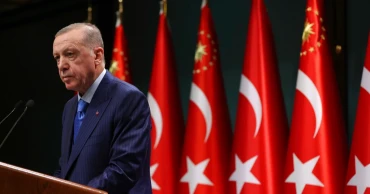
Turkey’s president cast serious doubt on NATO's expansion Monday after warning Sweden not to expect support for its bid for membership into the military alliance following weekend protests in Stockholm by an anti-Islam activist and pro-Kurdish groups.
President Recep Tayyip Erdogan slammed Rasmus Paludan’s Quran-burning protest on Saturday, saying it was an insult to everyone, especially to Muslims. He was particularly incensed at Swedish authorities for allowing the demonstration to take place outside the Turkish Embassy in Stockholm under “the protection” of security forces.
“It is clear that those who allowed such vileness to take place in front of our embassy can no longer expect any charity from us regarding their NATO membership application,” Erdogan said in his first comments regarding the weekend protests, saying Sweden must have calculated the consequences of permitting Paludan's demonstration.
Read more: Turkey condemns Sweden protests, cancels ministers' meeting
The burning of Islam's holy book angered people across the political spectrum in Turkey, just as Sweden and Finland appeared on the cusp of NATO membership after dropping their longstanding policies of military nonalignment following Russia's war on Ukraine. Russian President Vladimir Putin now stands to benefit as the potential enlargement of the world’s most powerful military alliance appears to be stymied.
Erdogan also criticized Sweden for allowing pro-Kurdish protests where demonstrators waved flags of various Kurdish groups, including the Kurdistan Workers’ Party, or PKK, which has waged a decades-long insurgency against Turkey. The PKK is considered a terrorist group in Turkey, the European Union and the United States, but its symbols aren’t banned in Sweden.
Read more: Dhaka, Ankara eye Turkish president's visit this year
“So you will let terror organizations run wild on your avenues and streets and then expect our support for getting into NATO. That’s not happening,” Erdogan said, referring to Sweden and Finland’s accession bids for the military alliance. He said if Sweden won’t show respect to NATO-member Turkey or Muslims, then “they won’t see any support from us on the NATO issue.”
A joint memorandum signed by Turkey, Sweden and Finland in June averted a Turkish veto of their membership bid at NATO’s Madrid summit where they confirmed the PKK as a terror group and committed to prevent its activities. Continued protests are infuriating Ankara who has said Sweden must address Turkey's security concerns and demands for the Turkish parliament to ratify their NATO request.
“If they love terror organization members and enemies of Islam so much, we recommend that they refer their countries’ security to them," he added. Several hundred pro-Kurdish protestors walked over a photo of Turkish President Recep Tayyip Erdogan on Saturday and an Erdogan effigy was hung from a lamppost in a previous protest. Turkish officials cancelled bilateral meetings in response.
Swedish officials have stressed that freedom of expression is guaranteed by the Swedish Constitution and gives people extensive rights to express their views publicly, though incitement to violence or hate speech isn’t allowed. Demonstrators must apply to police for a permit for a public gathering. Police can deny such permits only on exceptional grounds, such as risks to public safety. Top Swedish officials have said freedom of expression is crucial to democracy while criticizing Paludan's actions as disrespectful and ones they disagree with.
Anti-Islam activist Paludan, who holds both Danish and Swedish citizenship, established far-right parties in both countries that have failed to win any seats in national, regional or municipal elections. In last year’s parliamentary election in Sweden, his party received just 156 votes nationwide. His burning of the Quran sparked counter-protests in Turkey over the weekend, where demonstrators burned his photograph and a Swedish flag.
3 years ago

Turkish Muslims protest Quran-burning in Sweden
Outrage over a Quran-burning protest in Sweden produced a second day of protests in Turkey, reflecting tensions between the two countries.
Some 250 people gathered outside the Swedish Consulate in Istanbul, where a photo of Danish anti-Islam activist Rasmus Paludan was set on fire. Paludan burned Islam’s holy book outside the Turkish Embassy in Stockholm on Saturday, sparking protests in Istanbul and Ankara that night.
Participants in Sunday's event carried green flags featuring the Islamic proclamation of faith and banner that said “We condemn Sweden’s state-supported Islamophobia.” A sign on a window of the Swedish Consulate read, “We do not share that book-burning idiot’s view.”
The protests have renewed concerns about Turkey holding up Sweden and Finland's bid to join NATO. Turkey has not yet ratified the Nordic nations' memberships in the military alliance, saying Sweden needs to address Ankara’s security concerns.
Turkish officials slammed Sweden for allowing the Quran-burning protest but President Recep Tayyip Erdogan did not comment on it during his weekend speeches.
Read more: Bangladesh strongly condemns burning Holy Quran in Sweden
Swedish Prime Minister Ulf Kristersson tweeted late Saturday that freedom of expression was crucial to democracy but added that “what is legal is not necessarily appropriate."
"Burning books that are holy to many is a deeply disrespectful act. I want to express my sympathy for all Muslims who are offended by what has happened in Stockholm today,” Kristersson said.
Mustafa Demircan, one of the people protesting in Istanbul on Sunday, said the act of burning the Quran should not be considered an act protected by the right of free expression.
Protesters also gathered outside the Swedish Embassy in Ankara for a second day. In southeastern Sanliurfa province, men held the Quran high after prayers in a mosque and chanted “God is great” in videos shared online. More protests were planned for Sunday evening.
3 years ago

Germany says it won't block Poland giving Ukraine tanks
The German government will not object if Poland decides to send Leopard 2 battle tanks to Ukraine, Germany's top diplomat said Sunday (January 22, 2023), indicating movement on supplying weapons that Kyiv has described as essential to its ability to fend off an intensified Russian offensive.
German Foreign Minister Annalena Baerbock told French TV channel LCI that Poland has not formally asked for Berlin's approval to share some of its German-made Leopards but added “if we were asked, we would not stand in the way.”
German officials “know how important these tanks are" and “this is why we are discussing this now with our partners,” Baerbock said in interview clips posted by LCI.
Ukraine’s supporters pledged billions of dollars in military aid to Ukraine during a meeting at Ramstein Air Base in Germany on Friday. International defense leaders discussed Ukraine's urgent request for the Leopard 2 tanks, and the failure to work out an agreement overshadowed the new commitments.
Read more: Russia claims progress in eastern Ukraine; Kyiv craves tanks
Germany is one of the main donors of weapons to Ukraine, and it ordered a review of its Leopard 2 stocks in preparation for a possible green light. Nonetheless, the government in Berlin has shown caution at each step of increasing its military aid to Ukraine, a hesitancy seen as rooted in its history and political culture.
Germany’s tentativeness has drawn criticism, particularly from Poland and the Baltic states, countries on NATO’s eastern flank that feel especially threatened by Russia’s renewed aggression.
Polish Prime Minister Mateusz Morawiecki said that if the fellow NATO and European Unio member did not consent to transferring Leopard tanks to Ukraine, his country was prepared to build a “smaller coalition” of countries that would send theirs anyway.
“Almost a year had passed since the outbreak of war,” Morawiecki said in an interview with Polish state news agency PAP published Sunday. “Evidence of the Russian army’s war crimes can be seen on television and on YouTube. What more does Germany need to open its eyes and start to act in line with the potential of the German state?”
Read more: Deadly missile strike adds to Ukraine war fears in Poland
Previously, some officials in Poland indicated that Finland and Denmark also were ready to send Leopards to Ukraine.
Earlier Sunday, the speaker of the lower house of Russia’s parliament, State Duma Chairman Vyacheslav Volodin, said governments that give more powerful weapons to Ukraine risked causing a “global tragedy that would destroy their countries.”
“Supplies of offensive weapons to the Kyiv regime would lead to a global catastrophe,” Volodin said. “If Washington and NATO supply weapons that would be used for striking peaceful cities and making attempts to seize our territory as they threaten to do, it would trigger a retaliation with more powerful weapons.”
French President Emmanuel Macron, meanwhile, said Sunday that he had asked his defense minister to “work on” the idea of sending some of France's Leclerc battle tanks to Ukraine.
Read More: The AP Interview: Envoy says Taiwan learns from Ukraine war
Macron spoke during a news conference in Paris with German Chancellor Olaf Scholz as France and Germany commemorated the 60th anniversary of their post-World War II friendship treaty. In a joint declaration, the two countries committed to their “unwavering support” for Ukraine.
France will make its tank decision based on three criteria, Macron said: that sharing the equipment does not lead to an escalation of the conflict, that it would provide efficient and workable help when training time is taken into account, and that it wouldn’t weaken France’s own military.
Scholz did not respond when asked about the Leopard 2 tanks Sunday, but stressed that his country already has made sizable military contributions to Ukraine.
“The U.S. is doing a lot, Germany is doing a lot, too," he said. "We have constantly expanded our deliveries with very effective weapons that are already available today. And we have always coordinated all these decisions closely with our important allies and friends.”
Read More: German caution on Ukraine arms rooted in political culture
In Washington, two leading lawmakers urged the U.S. on Sunday to send some of its Abrams tanks to Ukraine in the interests of overcoming Germany’s reluctance to share its own, more suitable tanks.
“If we announced we were giving an Abrams tank, just one, that would unleash” the flow of tanks from Germany, Rep. Michael McCaul, the Republican chairman of the House Foreign Affairs Committee, told ABC’s “This Week on Sunday.” “What I hear is that Germany’s waiting on us to take the lead.”
Sen. Chris Coons, a Democrat who is on the Senate Foreign Relations Committee, also spoke up for the U.S. sending Abrams.
“If it requires our sending some Abrams tanks in order to unlock getting the Leopard tanks from Germany, from Poland, from other allies, I would support that,” Coons said.
Read More: Defense leaders meet amid dissent over tanks for Ukraine
Dmitry Medvedev, the deputy head of the Russian Security Council, said Friday's U.S.-led meeting at the air base in Germany “left no doubt that our enemies will try to exhaust or better destroy us,” adding that “they have enough weapons” to achieve the purpose.
Medvedev, a former Russian president, warned that “in case of a protracted conflict,” Russia could seek to form a military alliance with "the nations that are fed up with the Americans and a pack of their castrated dogs."
Ukraine has argued it needs more weapons as it anticipates Russia's forces launching a new offensive in the spring.
Oleksii Danilov, the secretary of Ukraine’s Security and Defense Council, warned that Russia may try to intensify its attacks in the south and in the east and to cut supply channels of Western weapons, while conquering Kyiv “remains the main dream” in President Vladimir Putin’s "fantasies,” he said.
Read More: Kyiv helicopter crash kills 18, including Ukraine’s interior minister, his two children
In a column published by online newspaper Ukrainska Pravda. he described the Kremlin’s goal in the conflict as a “total and absolute genocide, a total war of destruction"
Among those calling for more arms for Ukraine was the former British prime minister, Boris Johnson, who made a surprise trip to Ukraine on Sunday. Johnson, who was pictured in the Kyiv region town of Borodyanka, said he traveled to Ukraine at the invitation of President Volodymyr Zelenskyy.
“This is the moment to double down and to give the Ukrainians all the tools they need to finish the job. The sooner Putin fails, the better for Ukraine and for the whole world,” Johnson said in a statement.
The last week was especially tragic for Ukraine even by the standards of a brutal war that has gone on for nearly a year, killing tens of thousands of people, uprooting millions more and creating vast destruction of Ukrainian cities.
Read More: Netherlands says it will send Patriot assistance to Ukraine
A barrage of Russian missiles struck an apartment complex in the southeastern city of Dnipro on Jan. 14, killing at least 45 civilians. On Wednesday, a government helicopter crashed into a building housing a kindergarten in a suburb of Kyiv. Ukraine's interior minister, other officials and a child on the ground were among the 14 people killed.
Zelenskyy vowed Sunday that Ukraine would ultimately prevail in the war.
“We are united because we are strong. We are strong because we are united," the Ukrainian leader said in a video address as he marked Ukraine Unity Day, which commemorates when east and west Ukraine were united in 1919.
Read More: Ukraine strike deaths hit 40; Russia seen preparing long war
3 years ago