europe

Russia's hypersonic missile-armed ship to patrol global seas
Russian President Vladimir Putin on Wednesday sent a frigate armed with the country's latest Zircon hypersonic missile on a trans-ocean cruise in a show of force as tensions with the West escalate over the war in Ukraine.
Russia touts that the Zircon missile can evade any Western air defenses by flying at an astounding 7,000 miles per hour (11,265 km/h).
Here is a glance at the ship and its weapons.
Read more: EU hails high gas storage levels despite Russian cuts
THE PRIDE OF THE RUSSIAN NAVY
Commissioned by the navy in 2018 following long trials, the Admiral Gorshkov is the first ship in the new series of frigates which were designed to replace the aging Soviet-built destroyers as a key strike component of the Russian navy.
Armed with an array of missiles, the ship is 130-meters (427-feet) long and has a crew of about 200.
In 2019, it circled the world oceans on a 35,000-nautical mile journey.
INTENSIVE TESTS
The Admiral Gorshkov has served as the main testbed for the latest Russian hypersonic missile, Zircon.
In recent years, the Zircon has undergone a series of tests, including being launched at various practice targets. The military declared the tests successful and Zircon officially entered service last fall.
Zircon is intended to arm Russian cruisers, frigates and submarines and could be used against both enemy ships and ground targets. It is one of several hypersonic missiles that Russia has developed.
THE NEW WEAPON
Putin has hailed Zircon as a potent weapon capable of penetrating any existing anti-missile defenses by flying nine times faster than the speed of sound at a range of more than 1,000 kilometers (over 620 miles).
Putin has emphasized that Zircon gives the Russian military a long-range conventional strike capability, allowing it to strike any enemy targets with precision.
Russia's hypersonic weapons drive emerged as the U.S. has been working on its own Conventional Prompt Global Strike capability that envisions hitting an adversary’s strategic targets with precision-guided conventional weapons anywhere in the world within one hour.
Putin heralded Zircon as Russia's answer to that, claiming that the new weapon has no rival, giving Russia a strategic edge.
Months before ordering the invasion of Ukraine, Putin put the U.S. and its NATO allies on notice when he warned that Russian warships armed with Zircon would give Russia a capability to strike the adversary's “decision-making centers” within minutes if deployed in neutral waters.
Speaking via video link during Wednesday's sendoff ceremony, Putin again praised Zircon as a “unique weapon” without an “equivalent for it in any country in the world.”
In response, the Pentagon said it is monitoring the ship, and did not think it presented a threat that could not be countered.
“We are aware of the reports regarding the Russian launch of a frigate, the Admiral Grorshkov. We will continue to routinely monitor its activities as we maintain awareness of our operating environment," said Pentagon spokesman Army Col. Roger Cabiness. "While we do not comment on specific capabilities or speculate on hypotheticals, the Department of Defense remains confident in our ability to deter our adversaries and defend United States national security interests at any time, in any place.”
Read more: Russia says phone use allowed Ukraine to target its troops
OTHER RUSSIAN HYPERSONIC WEAPONS
Russia has already commissioned the Avangard hypersonic glide vehicles for some of its ground-based intercontinental ballistic missiles that constitute part of Russia’s strategic nuclear triad. Putin has hailed the Avangard's ability to maneuver at hypersonic speeds on its approach to target, dodging air defenses.
The Russian military has also deployed the Kinzhal hypersonic missiles on its MiG-31 aircraft and used them during the war in Ukraine to strike some priority targets. Kinzhal reportedly has a range of about 1,500 kilometers (about 930 miles).
PATROL DUTY
Russian Defense Minister Sergei Shoigu reported to Putin on Wednesday that the Admiral Gorshkov will patrol the Atlantic and Indian Oceans and the Mediterranean, but didn’t give further details.
Shoigu said the Admiral Gorshkov's crew will focus on “countering the threats to Russia, maintaining regional peace and stability jointly with friendly countries.” He added the crew will practice with hypersonic weapons and long-range cruise missiles “in various conditions."
Some military experts say a single, hypersonic missile-armed warship is no match for the massive naval forces of the U.S. and its allies.
But others noted that the frigate's potential deployment close to U.S. shores could be part of Putin's strategy to up the ante in the Ukrainian conflict.
“This is a message to the West that Russia has nuclear-tipped missiles that can easily pierce any missile defenses,” pro-Kremlin political analyst Sergei Markov wrote in a commentary.
3 years ago

EU hails high gas storage levels despite Russian cuts
Natural gas storage levels in the European Union stand at nearly 84% and were higher in December than the average amount in reserve 4-6 years ago, the EU’s executive branch said Wednesday, despite Russian attempts to choke off supplies amid its war on Ukraine.
Fearing winter shortages, the 27 EU countries began stocking up on gas last year. Joint gas reserve levels climbed to 82% by September, well ahead of an 80% target set for November. Gas consumption also dropped by 20% from August to November as prices spiked.
Read more: Bangladesh may prefer to import Russian oil via third country
Angered by EU war-related sanctions, Russia tightened its gas taps to Europe last year. Its pipeline gas accounted for 40% of all gas Europe imported before President Vladimir Putin ordered his troops into Ukraine in late February, but now it only accounts for around 9%.
“It’s a fairly good position to be in,” EU commission spokesman Tim McPhie told reporters. “We have a healthy level of gas storage for the start of this year, but we are by no means complacent. We know that this year will continue to be challenging.”
The commission estimates that joint gas storage levels stand at almost 84%, and that storage levels in December were 13% higher than the EU average in 2016-2018. Energy prices have also tumbled in recent months, in part due to milder than expected winter weather.
Read more: All you need to know about Nord Stream 2 gas pipeline
“The more we can invest in energy efficiency, reducing energy use, and the more that we can give a boost to renewables the better we will be based in terms of reducing our dependence on gas,” which influences electricity prices and contributes to global warming, McPhie said.
The first regular shipment of liquefied natural gas from the United States arrived in Germany on Tuesday, part of wide-ranging European efforts to find new, more reliable suppliers and replace resources once bought from Russia.
3 years ago

UK’s Sunak vows to halve inflation, tackle illegal migration
British Prime Minister Rishi Sunak pledged to halve inflation, grow the U.K. economy and stop illegal immigration Wednesday as he set out his Conservative government’s priorities in his first major speech of 2023.
Sunak focused on tackling the U.K.’s slowing economy and made promises to reduce national debt. He also vowed to pass new laws to stop migrants from arriving on U.K. shores in small boats, as well as cut massive backlogs in Britain’s public health service.
“Those are the people’s priorities. They are your government’s priorities. And we will either have achieved them or not,” Sunak said.
“No trick, no ambiguity, we’re either delivering for you or we’re not. We will rebuild trust in politics through action, or not at all,” he added.
Sunak, who came to office in October after a tumultuous year in U.K. politics that saw the resignation of two other prime ministers, stressed that he would deliver stability. He said his first priority was to “halve inflation this year to ease the cost of living and give people financial security.”
Sunak’s predecessor, Liz Truss, unveiled a disastrous package of unfunded tax cuts in September and was forced to quit after less than two months in the job. Her policies sent the British pound tumbling, drove up the cost of borrowing and triggered emergency intervention from Britain’s central bank.
Read more: Rishi Sunak as UK PM: What are the expectations?
Since Sunak replaced Truss in late October, the U.K. economy has calmed but his government is grappling with a cost-of-living crisis and widening labor unrest as key public sector workers from nurses and ambulance drivers to train workers stage disruptive strikes to demand better pay to keep pace with soaring inflation.
Inflation in the U.K. stood at 10.7% in November — down slightly from October — but that’s still near the highest in four decades. Energy and food costs have soared, in large part driven by Russia’s war on Ukraine, and living standards have plunged for millions of Britons.
In recent weeks, Sunak’s government was also under increasing pressure to address failings in the public health system, with many frontpage headlines focusing on the lack of hospital beds and record waiting times for seeing a doctor or getting an ambulance.
Authorities have blamed high numbers of flu and COVID-19 cases, but health chiefs say the problems are longstanding and a result of chronic government underfunding.
Sunak has also repeatedly said that stopping migrants from crossing the English Channel in small boats to claim asylum in the U.K. was a top priority for his term in office. Last year more than 45,700 people crossed the Channel to the U.K. — a record high and up 60% compared to numbers in 2021.
Read more: Next UK PM: Rishi Sunak a strong favorite
“We will pass new laws to stop small boats, making sure that if you come to this country illegally, you are detained and swiftly removed,” Sunak said.
Sunak’s Conservative Party, which has been in power for 12 years, is lagging behind the opposition Labour Party in polls. The next general election is due to take place by the end of 2024.
3 years ago
Russia says phone use allowed Ukraine to target its troops
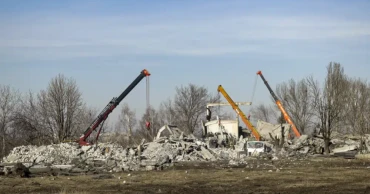
Unauthorized use of cell phones by Russian soldiers led to a deadly Ukrainian rocket attack on the facility where they were stationed, the Russian military said late Tuesday, raising the death toll from the weekend attack to 89.
Gen. Lt. Sergei Sevryukov said in a statement that phone signals allowed Kyiv’s forces to “determine the coordinates of the location of military personnel” and launch a strike. Sevryukov said unspecified measures were being taken to “prevent similar tragic incidents in the future” and promised to punish officials responsible for the infraction.
Read more: Russia, shaken by Ukrainian strike, could step up drone use
The attack, one of the deadliest on the Kremlin’s forces since the start of the war over 10 months ago, occurred one minute into the new year, according to Sevryukov.
Ukrainian forces fired six rockets from a U.S.-provided HIMARS multiple launch system at a building “in the area of Makiivka” where the soldiers were stationed. Two rockets were downed but four hit the building and detonated, prompting the collapse of the structure. The Russian Defense Ministry initially said the strike killed 63 troops. But as emergency crews sifted through the rubble of the building, the death toll has grown to 89, Sevryukov said on Tuesday. The regiment’s deputy commander was among the dead.
Other, unconfirmed reports put the death toll much higher.
The Strategic Communications Directorate of Ukraine’s armed forces claimed Sunday that around 400 mobilized Russian soldiers were killed in a vocational school building in Makiivka and about 300 more were wounded. That claim couldn’t be independently verified. The Russian statement said the strike occurred “in the area of Makiivka” and didn’t mention the vocational school.
Read more:
The attack marked yet another setback for the Kremlin’s bogged-down war effort in Ukraine, undermined by a successful Ukrainian counteroffensive. It stirred renewed criticism inside Russia of the way the war is being conducted.
Unconfirmed reports in Russian-language media said the victims were mobilized reservists from the region.
3 years ago

Drone advances in Ukraine could bring dawn of killer robots
Drone advances in Ukraine have accelerated a long-anticipated technology trend that could soon bring the world’s first fully autonomous fighting robots to the battlefield, inaugurating a new age of warfare.
The longer the war lasts, the more likely it becomes that drones will be used to identify, select and attack targets without help from humans, according to military analysts, combatants and artificial intelligence researchers.
That would mark a revolution in military technology as profound as the introduction of the machine gun. Ukraine already has semi-autonomous attack drones and counter-drone weapons endowed with AI. Russia also claims to possess AI weaponry, though the claims are unproven. But there are no confirmed instances of a nation putting into combat robots that have killed entirely on their own.
Experts say it may be only a matter of time before either Russia or Ukraine, or both, deploy them.
“Many states are developing this technology,” said Zachary Kallenborn, a George Mason University weapons innovation analyst. ”Clearly, it’s not all that difficult.”
The sense of inevitability extends to activists, who have tried for years to ban killer drones but now believe they must settle for trying to restrict the weapons’ offensive use.
Ukraine’s digital transformation minister, Mykhailo Fedorov, agrees that fully autonomous killer drones are “a logical and inevitable next step” in weapons development. He said Ukraine has been doing “a lot of R&D in this direction.”
“I think that the potential for this is great in the next six months,” Fedorov told The Associated Press in a recent interview.
Ukrainian Lt. Col. Yaroslav Honchar, co-founder of the combat drone innovation nonprofit Aerorozvidka, said in a recent interview near the front that human war fighters simply cannot process information and make decisions as quickly as machines.
Ukrainian military leaders currently prohibit the use of fully independent lethal weapons, although that could change, he said.
“We have not crossed this line yet – and I say ‘yet’ because I don’t know what will happen in the future.” said Honchar, whose group has spearheaded drone innovation in Ukraine, converting cheap commercial drones into lethal weapons.
Russia could obtain autonomous AI from Iran or elsewhere. The long-range Shahed-136 exploding drones supplied by Iran have crippled Ukrainian power plants and terrorized civilians but are not especially smart. Iran has other drones in its evolving arsenal that it says feature AI.
Without a great deal of trouble, Ukraine could make its semi-autonomous weaponized drones fully independent in order to better survive battlefield jamming, their Western manufacturers say.
Those drones include the U.S.-made Switchblade 600 and the Polish Warmate, which both currently require a human to choose targets over a live video feed. AI finishes the job. The drones, technically known as “loitering munitions,” can hover for minutes over a target, awaiting a clean shot.
“The technology to achieve a fully autonomous mission with Switchblade pretty much exists today,” said Wahid Nawabi, CEO of AeroVironment, its maker. That will require a policy change — to remove the human from the decision-making loop — that he estimates is three years away.
Drones can already recognize targets such as armored vehicles using cataloged images. But there is disagreement over whether the technology is reliable enough to ensure that the machines don’t err and take the lives of noncombatants.
Read more: Ukraine reports more Russian drone attacks
The AP asked the defense ministries of Ukraine and Russia if they have used autonomous weapons offensively – and whether they would agree not to use them if the other side similarly agreed. Neither responded.
If either side were to go on the attack with full AI, it might not even be a first.
An inconclusive U.N. report last year suggested that killer robots debuted in Libya’s internecine conflict in 2020, when Turkish-made Kargu-2 drones in full-automatic mode killed an unspecified number of combatants.
A spokesman for STM, the manufacturer, said the report was based on “speculative, unverified” information and “should not be taken seriously.” He told the AP the Kargu-2 cannot attack a target until the operator tells it to do so.
Fully autonomous AI is already helping to defend Ukraine. Utah-based Fortem Technologies has supplied the Ukrainian military with drone-hunting systems that combine small radars and unmanned aerial vehicles, both powered by AI. The radars are designed to identify enemy drones, which the UAVs then disable by firing nets at them — all without human assistance.
The number of AI-endowed drones keeps growing. Israel has been exporting them for decades. Its radar-killing Harpy can hover over anti-aircraft radar for up to nine hours waiting for them to power up.
Other examples include Beijing’s Blowfish-3 unmanned weaponized helicopter. Russia has been working on a nuclear-tipped underwater AI drone called the Poseidon. The Dutch are currently testing a ground robot with a .50-caliber machine gun.
Honchar believes Russia, whose attacks on Ukrainian civilians have shown little regard for international law, would have used killer autonomous drones by now if the Kremlin had them.
“I don’t think they’d have any scruples,” agreed Adam Bartosiewicz, vice president of WB Group, which makes the Warmate.
AI is a priority for Russia. President Vladimir Putin said in 2017 that whoever dominates that technology will rule the world. In a Dec. 21 speech, he expressed confidence in the Russian arms industry’s ability to embed AI in war machines, stressing that “the most effective weapons systems are those that operate quickly and practically in an automatic mode.” Russian officials already claim their Lancet drone can operate with full autonomy.
“It’s not going to be easy to know if and when Russia crosses that line,” said Gregory C. Allen, former director of strategy and policy at the Pentagon’s Joint Artificial Intelligence Center.
Switching a drone from remote piloting to full autonomy might not be perceptible. To date, drones able to work in both modes have performed better when piloted by a human, Allen said.
The technology is not especially complicated, said University of California-Berkeley professor Stuart Russell, a top AI researcher. In the mid-2010s, colleagues he polled agreed that graduate students could, in a single term, produce an autonomous drone “capable of finding and killing an individual, let’s say, inside a building,” he said.
An effort to lay international ground rules for military drones has so far been fruitless. Nine years of informal United Nations talks in Geneva made little headway, with major powers including the United States and Russia opposing a ban. The last session, in December, ended with no new round scheduled.
Washington policymakers say they won’t agree to a ban because rivals developing drones cannot be trusted to use them ethically.
Toby Walsh, an Australian academic who, like Russell, campaigns against killer robots, hopes to achieve a consensus on some limits, including a ban on systems that use facial recognition and other data to identify or attack individuals or categories of people.
“If we are not careful, they are going to proliferate much more easily than nuclear weapons,” said Walsh, author of “Machines Behaving Badly.” “If you can get a robot to kill one person, you can get it to kill a thousand.”
Scientists also worry about AI weapons being repurposed by terrorists. In one feared scenario, the U.S. military spends hundreds of millions writing code to power killer drones. Then it gets stolen and copied, effectively giving terrorists the same weapon.
Read more: Russia, shaken by Ukrainian strike, could step up drone use
The global public is concerned. An Ipsos survey done for Human Rights Watch in 2019 found that 61% of adults across 26 countries oppose the use of lethal autonomous weapons systems.
To date, the Pentagon has neither clearly defined “autonomous weapon” nor authorized a single such weapon for use by U.S. troops, said Allen, the former Defense Department official. Any proposed system must be approved by the chairman of the Joint Chiefs of Staff and two undersecretaries.
That’s not stopping the weapons from being developed across the U.S. Projects are underway at the Defense Advanced Research Projects Agency, military labs, academic institutions and in the private secto
The Pentagon has emphasized using AI to augment human warriors. The Air Force is studying ways to pair pilots with drone wingmen. A booster of the idea, former Deputy Defense Secretary Robert O. Work, said in a report last month that it “would be crazy not to go to an autonomous system” once AI-enabled systems outperform humans — a threshold that he said was crossed in 2015, when computer vision eclipsed that of humans.
Humans have already been pushed out in some defensive systems. Israel’s Iron Dome missile shield is authorized to open fire automatically, although it is said to be monitored by a person who can intervene if the system goes after the wrong target.
Multiple countries, and every branch of the U.S. military, are developing drones that can attack in deadly synchronized swarms, according to Kallenborn, the George Mason researcher.
So will future wars become a fight to the last drone?
That’s what Putin predicted in a 2017 televised chat with engineering students: “When one party’s drones are destroyed by drones of another, it will have no other choice but to surrender.”
3 years ago

Russia, shaken by Ukrainian strike, could step up drone use
Emergency crews on Tuesday sifted through the rubble of a building struck by Ukrainian rockets, killing at least 63 Russian soldiers in the latest blow to the Kremlin’s war strategy as Ukraine says Moscow’s tactics could be shifting.
An Associated Press video of the scene in Makiivka, a town in the partially Russian-occupied eastern Donetsk region, showed five cranes and emergency workers removing big chunks of concrete under a clear blue sky.
In the attack, which apparently happened last weekend, Ukrainian forces fired rockets from a U.S.-provided HIMARS multiple launch system, according to a Russian Defense Ministry statement.
Read more: Ukrainian rocket strike kills 63 Russian troops: Moscow
It was one of the deadliest attacks on the Kremlin’s forces since the war began more than 10 months ago and an embarrassment that stirred renewed criticism inside Russia of the way the war is being conducted.
The Russian statement Monday about the attack provided few other details. Other, unconfirmed reports put the death toll much higher.
The Strategic Communications Directorate of Ukraine’s armed forces claimed Sunday that around 400 mobilized Russian soldiers were killed in a vocational school building in Makiivka and about 300 more were wounded. That claim couldn’t be independently verified. The Russian statement said the strike occurred “in the area of Makiivka” and didn’t mention the vocational school.
Satellite photos analyzed by The AP show the apparent aftermath of the strike. An image from Dec. 20 showed the building standing. An image from Jan. 2 showed it reduced to rubble. Other days had intense cloud cover, making seeing the site by standard satellite imagery impossible.
Vigils for soldiers killed in the strike took place in two Russian cities Tuesday, the state RIA Novosti agency reported.
In Samara, in southwestern Russia, locals gathered for an Orthodox service in memory of the dead. The service was followed by a minute’s silence, and flowers were laid at a Soviet-era war memorial, RIA reported.
Unconfirmed reports in Russian-language media said the victims were mobilized reservists from the region.
With the fighting raging much longer than anticipated by the Kremlin, and becoming bogged down in a war of attrition amid a Ukrainian counteroffensive backed by Western-supplied weapon s, Russian President Vladimir Putin is mulling ways of regaining momentum.
His plan, according to Ukrainian officials, includes stepping up bombardments of Ukraine territory with Iranian-made exploding drones.
“We have information that Russia is planning a prolonged attack by Shaheds (exploding drones),” Ukrainian President Volodymyr Zelenskyy said in his nightly video address late Monday.
He said the goal is to break Ukraine’s resistance by “exhausting our people, (our) air defense, our energy,” more than 10 months after Russia invaded its neighbor.
For the Russian military, the exploding drones are a cheap weapon which also spreads fear among Ukrainian troops and civilians. The United States and its allies have sparred with Iran over Tehran’s role in allegedly supplying Moscow with the drones.
The Institute for the Study of War said that Putin is striving to strengthen support for his strategy among key voices in Russia.
“Russia’s air and missile campaign against Ukraine is likely not generating the Kremlin’s desired information effects among Russia’s nationalists,” the think tank said late Monday.
Read more: Ukraine reports more Russian drone attacks
“Such profound military failures will continue to complicate Putin’s efforts to appease the Russian pro-war community and retain the dominant narrative in the domestic information space,” it added.
Putin’s additional reliance on drones might not help him achieve his goals, however, as Ukraine claims a high success rate against the weapons.
During the first two days of the new year, which were marked by relentless nighttime drone attacks on Ukrainian cities and energy infrastructure, the country’s forces shot down more than 80 Iranian-made drones, Zelenskyy said.
Since September, Ukraine’s armed forces have shot down almost 500 drones, Ukrainian air force spokesman Yurii Ihnat claimed in a television interview Tuesday.
As well as seeking to wear down resistance to Russia’s invasion, the long-range bombardments have targeted the power grid to leave civilians at the mercy of biting winter weather as power outages ripple across the country.
In the latest fighting, a Russian missile strike overnight on the city of Druzhkivka in the Donetsk region wounded two people, the deputy head of Ukraine’s presidential office, Kyrylo Tymoshenko, reported Tuesday.
The Russian military on Tuesday acknowledged carrying out strikes on Druzhkivka and Kramatorsk, also in Donetsk. The Defense Ministry claimed it destroyed four HIMARS launchers in the area. This claim could not be independently verified.
A reporter with French broadcaster TF1 was live on television screens when a blast from one of the strikes erupted behind him in Druzhkivka. A German reporter with Bild newspaper suffered a minor injury from shrapnel in the same bombardment.
Officials said the attack ruined an ice hockey arena described as the largest hockey and figure skating school in Ukraine.
In the recently retaken areas of the southern Kherson region, Russian shelling on Monday killed two people and wounded nine, Kherson’s Ukrainian governor, Yaroslav Yanushevych, said Tuesday. He said Russian forces fired at the city of Kherson 32 times on Monday.
He also reported that two people were killed in the Kherson region Tuesday after driving over a mine left by withdrawing Russian troops.
Also, one civilian was killed and two others wounded on Tuesday morning as Russian forces shelled the city of Kurakhove in the eastern Donetsk region, hitting a residential area, local Gov. Pavlo Kyrylenko reported.
3 years ago

Ukraine reports more Russian drone attacks
Russia deployed multiple drones overnight to attack parts of Ukraine and dozens were shot down, Ukrainian officials said Monday, in a series of relentless attacks through the weekend that killed three civilians on New Year's Eve.
Kyiv Mayor Vitali Klitschko said that 40 exploding drones “headed for Kyiv” overnight, according to air defense forces, and all of them were destroyed.
Klitschko said 22 drones were destroyed over Kyiv, three in the outlying Kyiv region and 15 over neighboring provinces.
Read more: Ukraine faces grim start to 2023 after fresh Russian attacks
Energy infrastructure facilities in the capital were damaged and an explosion occurred in one city district, the mayor said. It wasn’t immediately clear whether that was caused by drones or other munitions. A 19-year-old man was hospitalized with wounds, Klitschko added, and emergency power outages were underway.
In the outlying Kyiv region, which was also attacked with drones, a “critical infrastructure object” and residential buildings were hit, Gov. Oleksiy Kuleba said.
Seven drones were shot down over the southern Mykolaiv region, according to Gov. Vitali Kim, and three more were shot down in the southeastern Dnipropetrovsk region, Gov. Valentyn Reznichenko said.
In the Dnipropetrovsk region, a missile was also destroyed, according to Reznichenko. He said that energy infrastructure in the region was being targeted.
Read more: Evidence of Russian crimes mounts as war in Ukraine drags on
A blistering New Year’s Eve assault killed at least three civilians across the country, Ukrainian authorities reported, and wounded dozens.
Multiple blasts rocked the capital and other areas of Ukraine on Saturday and through the night. The strikes came 36 hours after widespread missile attacks Russia launched Thursday to damage energy infrastructure facilities, and the unusually quick follow-up alarmed Ukrainian officials.
Russia has carried out airstrikes on Ukrainian power and water supplies almost weekly since October, increasing the suffering of Ukrainians, while its ground forces struggle to hold ground and advance.
3 years ago
Ukraine faces grim start to 2023 after fresh Russian attacks
Ukrainians faced a grim start to 2023 as Sunday brought more Russian missile and drone attacks following a blistering New Year's Eve assault that killed at least three civilians across the country, authorities reported.
Air raid sirens sounded in the capital shortly after midnight, followed by a barrage of missiles that interrupted the small celebrations residents held at home due to wartime curfews. Ukrainian officials alleged Moscow was deliberately targeting civilians along with critical infrastructure to create a climate of fear and destroy morale during the long winter months.
In a video address Sunday night, President Volodymyr Zelenskyy praised his citizens' “sense of unity, of authenticity, of life itself.” The Russians, he said, “will not take away a single year from Ukraine. They will not take away our independence. We will not give them anything.”
Ukrainian forces in the air and on the ground shot down 45 Iranian-made explosive drones fired by Russia on Saturday night and before dawn Sunday, Zelenskyy said.
Another strike at noon Sunday in the southern Zaporizhzhia region killed one person, according to the head of the regional military administration, Alexander Starukh. But Kyiv was largely quiet, and people there on New Year's Day savored the snippets of peace.
“Of course it was hard to celebrate fully because we understand that our soldiers can’t be with their family,” Evheniya Shulzhenko said while sitting with her husband on a park bench overlooking the city.
Read more: Evidence of Russian crimes mounts as war in Ukraine drags on
But a “really powerful” New Year's Eve speech by Zelenskyy lifted her spirits and made her proud to be Ukrainian, Shulzhenko said. She recently moved to Kyiv after living in Bakhmut and Kharkiv, two cities that have experienced some of the heaviest fighting of the war.
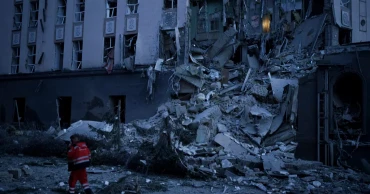
Multiple blasts rocked the capital and other areas of Ukraine on Saturday and through the night, wounding dozens. An AP photographer at the scene of an explosion in Kyiv saw a woman’s body as her husband and son stood nearby.
Ukraine’s largest university, the Taras Shevchenko National University in Kyiv, reported significant damage to its buildings and campus. Mayor Vitali Klitschko said two schools were damaged, including a kindergarten.
The strikes came 36 hours after widespread missile attacks Russia launched Thursday to damage energy infrastructure facilities. Saturday's unusually quick follow-up alarmed Ukrainian officials. Russia has carried out airstrikes on Ukrainian power and water supplies almost weekly since October, increasing the suffering of Ukrainians, while its ground forces struggle to hold ground and advance.
Nighttime shelling in parts of the southern city of Kherson killed one person and blew out hundreds of windows in a children’s hospital, according to deputy presidential chief of staff Kyrylo Tymoshenko. Ukrainian forces reclaimed the city in November after Russia's forces withdrew across the Dnieper River, which bisects the Kherson region.
When shells hit the children's hospital on Saturday night, surgeons were operating on a 13-year-old boy who was seriously wounded in a nearby village that evening, Kherson Gov. Yaroslav Yanushevych said. The boy was transferred in serious condition to a hospital about 99 kilometers (62 miles) away in Mykolaiv.
Elsewhere, a 22-year-old woman died of wounds from a Saturday rocket attack Saturday in the eastern town of Khmelnytskyi, the city’s mayor said.
Instead of New Year's fireworks, Oleksander Dugyn said he and his friends and family in Kyiv watched the sparks caused by Ukrainian air defense forces countering Russian attacks.
Read more: Ukraine conflict casts shadow on Russia as it enters 2023
“We already know the sound of rockets, we know the moment they fly, we know the sound of drones. The sound is like the roar of a moped,” said Dugin, who was strolling with his family in the park. “We hold on the best we can.”
While Russia's bombardments have left many Ukrainians without heating and electricity due to damage or controlled blackouts meant to preserve the remaining power supply, Ukraine's state-owned grid operator said Sunday there would be no restrictions on electricity use for one day.
“The power industry is doing everything possible to ensure that the New Year’s holiday is with light, without restrictions,” utility company Ukrenergo said.
It said businesses and industry had cut back to allow the additional electricity for households.
Zelenskyy, in his nightly address, thanked utility workers for helping to keep the lights on during the latest assault. “It is very important how all Ukrainians recharged their inner energy this New Year’s Eve,” he said.
In separate tweets Sunday, the Ukrainian leader also reminded the European Union of his country's wish to join the EU. He thanked the Czech Republic and congratulated Sweden, which just exchanged the EU’s rotating presidency, for their help in securing progress for Ukraine’s bid.
Meanwhile, NATO Secretary-General Jens Stoltenberg said the Western military alliance's 30 members need to “ramp up” arms production in the coming months both to maintain their own stockpiles and to keep supplying Ukraine with the weapons it needs to fend off Russia.
The war in Ukraine, now in its 11th month, is consuming an “enormous amount” of munitions, Stoltenberg told BBC Radio 4′s “The World This Weekend” in an interview that aired Sunday.
“It is a core responsibility for NATO to ensure that we have the stocks, the supplies, the weapons in place to ensure our own deterrence and defense, but also to be able to continue to provide support to Ukraine for the long haul,” he said.
Achieving the twin goals “is a huge undertaking. We need to ramp up production, and that is exactly what the NATO allies are doing," Stoltenberg said.
The NATO chief said that while Russia has experienced battlefield setbacks and the fighting on the ground appears at a stalemate, “Russia has shown no sign of giving up its overall goal of taking control over Ukraine.” he said.
“The Ukrainian forces have had the momentum for several months but we also know that Russia has mobilized many more forces. Many of them are now training.
“All that indicates that they are prepared to continue the war and also potentially try to launch a new offensive,” Stoltenberg said.
He added that what Ukraine can achieve during negotiations to end the war will depend on the strength it shows on the battlefield.
“If we want a negotiated solution that ensures that Ukraine prevails as a sovereign, independent, democratic state in Europe, then we need to provide support for Ukraine now," Stoltenberg said.
3 years ago

Evidence of Russian crimes mounts as war in Ukraine drags on
Ten months into Russia’s latest invasion of Ukraine, overwhelming evidence shows the Kremlin’s troops have waged total war, with disregard for international laws governing the treatment of civilians and conduct on the battlefield.
Ukraine is investigating more than 58,000 potential Russian war crimes — killings, kidnappings, indiscriminate bombings and sexual assaults. Reporting by The Associated Press and “Frontline,” recorded in a public database, has independently verified more than 600 incidents that appear to violate the laws of war. Some of those attacks were massacres that killed dozens or hundreds of civilians and as a totality it could account for thousands of individual war crimes.
As Karim Khan, chief prosecutor of the International Criminal Court in The Hague, told the AP, “Ukraine is a crime scene.”
That extensive documentation has run smack into a hard reality, however. While authorities have amassed a staggering amount of evidence — the conflict is among the most documented in human history — they are unlikely to arrest most of those who pulled the trigger or gave the beatings anytime soon, let alone the commanders who gave the orders and political leaders who sanctioned the attacks.
The reasons are manifold, experts say. Ukrainian authorities face serious challenges in gathering air-tight evidence in a war zone. And the vast majority of alleged war criminals have evaded capture and are safely behind Russian lines.
Read more: EU proposes UN-backed court to investigate Russia's war crimes in Ukraine
Even in successful prosecutions, the limits of justice so far are glaring. Take the case of Vadim Shishimarin, a baby-faced 21-year-old tank commander who was the first Russian tried on war crimes charges. He surrendered in March and pleaded guilty in a Kyiv courtroom in May to shooting a 62-year-old Ukrainian civilian in the head.
The desire for some combination of justice and vengeance was palpable in that courtroom. “Do you consider yourself a murderer?” a woman shouted at the Russian as he stood bent forward with his head resting against the glass of the cage he was locked in.
“What about the man in the coffin?” came another, sharper voice. A third demanded the defense lawyer explain how he could fight for the Russian’s freedom.
The young soldier was first sentenced to life in prison, which was reduced to 15 years on appeal. Critics said the initial penalty was unduly harsh, given that he confessed to the crime, said he was following orders and expressed remorse.
Ukrainian prosecutors, however, have not yet been able to charge Shishimarin’s commanders or those who oversaw him. Since March, Ukraine has named more than 600 Russians, many of them high-ranking political and military officials, as suspects, including Minister of Defense Sergei Shoigu. But, so far, the most powerful have not fallen into Ukrainian custody.
“It would be terrible to find a scenario in which, in the end, you convict a few people of war crimes and crimes against humanity who are low-grade or mid-grade military types or paramilitary types, but the top table gets off scot-free,” said Philippe Sands, a prominent British human rights lawyer.
Throughout the war Russian leaders have denied accusations of brutality.
Read more: UN rights experts find war crimes evidence against Russia in Ukraine
Moscow’s U.N. ambassador, Vassily Nebenzia, said no civilians were tortured and killed in the Kyiv suburb of Bucha despite the meticulous documentation of the atrocities by AP, other journalists, and war crimes investigators there.
“Not a single local person has suffered from any violent action,” he said, calling the photos and video of bodies in the streets “a crude forgery” staged by the Ukrainians.
Such statements have been easily rebutted by Ukrainian and international authorities, human rights groups and journalists who have meticulously documented Russian barbarity since the Kremlin ordered the unprovoked invasion in February.
3 years ago

Croatia rings in New Year as fully integrated EU member
At the stroke of midnight on Saturday, Croatia switched to the shared European currency, the euro, and removed dozens of border checkpoints to join the world’s largest passport-free travel area.
It marked a fresh start for the small Balkan nation of 4 million people that captured international attention three decades ago as the site of a brutal war that left nearly a quarter of its economy in ruins.
Joining Europe's ID-check-free Schengen zone means Croats will now be among almost 420 million people who are free to roam its 27 member countries without passports for work or leisure.
Adopting the euro will likewise offer Croatia the benefits stemming from deeper financial ties with the currency’s 19 other users and with the European Central Bank. It will also make traveling and doing business easier, removing the hassle of currency exchange for Croats going abroad and for tens of thousands of tourists who visit their country each year for work or to enjoy its stunning Adriatic coastline.
Read more: Amazon to make big business changes in EU settlement
As revelers around Croatia took to the streets to ring in the New Year, the country’s interior minister, Davor Bozinovic, was at the Bregana border crossing with Slovenia to wish the best of luck to the last travelers to have their passports checked there.
Slovenia has been a part of the Schengen zone and tasked with safeguarding its external frontier since 2007.
Now, the task will be taken over by Croatia, which will continue to apply strict border controls on its eastern borders with non-EU neighbors Bosnia, Serbia and Montenegro.
“We opened our doors to borderless Europe. This goes beyond eliminating border controls, it is the final affirmation of our European identity,” Bozinovic said after watching the ramps at the Bregana border crossing being lifted for the final time in the company of his Slovenian counterpart Sanja Ajanovic-Hovnik.
Stipica Mandic, a 72-year-old professional driver, shared the sentiment and said the freedom of movement without long waits at border crossings was his personal dream and the reason why he left a New Year’s Eve party at his home and drove 20 kilometers (12.4 miles) to Bregana to see it come true.
“I spent years of my life waiting at border checkpoints, so I came here tonight to witness this moment, the moment after which I will wait no more,” he said.
Read more: EU member countries reach compromise on gas price cap
At about the same time, shortly after midnight, Croatia’s finance minister and central bank governor walked to an ATM in the capital, Zagreb, to withdraw euro banknotes and symbolically relegate Croatia's old national currency, the kuna, to history.
Croatia joined the EU in 2013, but to adopt the euro the country had to fulfil a set of strict economic conditions, including having a stable exchange rate, controlled inflation and sound public spending.
The Croatian kuna and the euro will be in dual use for cash payments for only 14 days, but as people shop post-holiday in January they will receive only euros in change.
The New Year’s Eve developments were described by many Croats as proof their country has completed a difficult journey to the European mainstream 31 years after it fought a war for independence from Serb-dominated Yugoslavia in which 20,000 people were killed and hundreds of thousands displaced.
“We used to dream about this and I am happy that we lived to see it happen,” said Zlatko Leko, a resident of the port city of Split in the country’s south. “I hope this means we are finally a part of Europe."
Elenmari Pletikos-Solon in Zagreb agreed: “We have already been a part of Europe, but dismantling the borders and switching to the euro is the final confirmation that we are fully integrated” with the European Union.
“I am truly happy. It will make many things in our life much easier,” she added.
3 years ago