europe
Russia returns bodies of 1,200 Ukrainian soldiers under Istanbul agreement
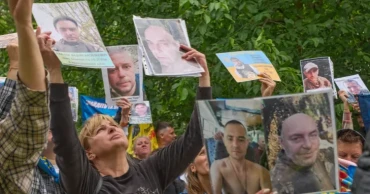
Russia has handed over the bodies of another 1,200 Ukrainian soldiers killed in the ongoing war, bringing the total number of war dead repatriated to Ukraine to more than 4,800, Ukrainian officials said on Sunday.
Ukraine’s Coordination Headquarters for the Treatment of Prisoners of War announced the development via Telegram, stating that the return was part of a broader agreement reached during talks in Istanbul earlier this month.
Ukrainian Defence Minister Rustem Umerov expressed gratitude to all those involved in the handover process, noting that the upcoming identification phase would be “a complex and sensitive task” aimed at providing closure to grieving families.
The recent exchange represents one of the largest returns of remains since Russia’s full-scale invasion of Ukraine began in February 2022.
While Russian state media confirmed the transfer, it claimed Moscow had not received any Russian bodies in return, accusing Kyiv of failing to uphold its end of the deal. According to the agreement, both sides are to exchange up to 6,000 bodies, along with severely wounded prisoners and those under the age of 25. So far, Russia says it has received only 27 of its fallen soldiers.
Russian attacks kill 3 as drones hit Kharkiv and other parts of Ukraine
Ukraine has not publicly responded to the allegation.
The latest repatriation came amid heightened hostilities. Russia claimed it had captured the village of Malynivka in Ukraine’s eastern Donetsk region and was making advances toward the northeastern Sumy region, with forces reportedly just 18 to 20 kilometers from Sumy's capital.
Meanwhile, Ukraine’s military said it targeted a drone production facility in Russia’s Tatarstan region, about 1,000 kilometers from the border. The site in the city of Yelabuga was allegedly being used to manufacture and launch drones for attacks on Ukrainian energy and civilian infrastructure, according to Ukraine’s General Staff.
Source: With inputs from Al Jazeera
11 months ago

Earthquakes damage centuries-old monasteries in a secluded religious community in Greece
Centuries-old monasteries have been damaged by an ongoing series of earthquakes in a secluded monastic community in northern Greece, authorities said Friday.
A magnitude 5.3 earthquake struck the Mount Athos peninsula on June 7, followed by a series of both undersea and land-based tremors that continued through Friday.
The quakes caused “severe cracks” in the dome of the Monastery of Xenophon, which was built in the late 10th century, and damaged religious frescoes at that site and several others, the Culture Ministry said.
Mount Athos is one of the most important religious sites for Orthodox Christians, and is often referred to as the Holy Mountain. It is a semi-autonomous monastic republic and is home to 20 Orthodox monasteries.
The self-governing community still observes strict traditions under Greek sovereignty, including a ban on all women entering the territory.
At least 290 killed in Air India crash
“We are fully aware of the immense archaeological, historical, and spiritual significance of Mount Athos, and we are ensuring that all damage is addressed according to scientific and ethical standards,” Culture Minister Lina Mendoni said.
The restoration work — including structural reinforcement and the repair of artwork — will be expanded and accelerated, Mendoni added.
A more detailed assessment of the damage is expected next week, the Culture Ministry said.
11 months ago

Danish Parliament approves U.S. military base deal amid Greenland concerns
Denmark’s Parliament on Wednesday passed legislation allowing the U.S. to set up military bases on Danish territory, deepening defense ties as former U.S. President Donald Trump continues to express interest in acquiring Greenland.
The bill expands a 2023 defense agreement made with the Biden administration, which already granted U.S. troops significant access to Danish airbases. The updated framework enables a more permanent American presence, drawing criticism from opponents who argue it compromises Danish sovereignty.
The move comes amid ongoing U.S. interest in Greenland, a semi-autonomous and mineral-rich island governed by Denmark. Although Denmark and the U.S. are both NATO members, Trump’s past remarks about purchasing the island have heightened sensitivities.
In response to questions from lawmakers, Danish Foreign Minister Lars Løkke Rasmussen clarified that Denmark retains the right to withdraw from the agreement if the U.S. attempts to annex any part of Greenland.
Okinawa gov. renews demand to stop US base relocation plan
The bill passed with 94 votes in favor and 11 against. It now awaits royal assent from King Frederik X.
Greenland’s prime minister has previously criticized American comments about the island, saying they were offensive and emphasizing that “Greenland will never, ever be a piece of property that can be bought.”
Source: With inputs from agency
11 months ago
Russian court jails Navalny ally in absentia for 18 years as dissident crackdown continues
Courts in Russia on Friday convicted one opposition figure in absentia and placed another under house arrest as Moscow continues its crackdown on dissent.
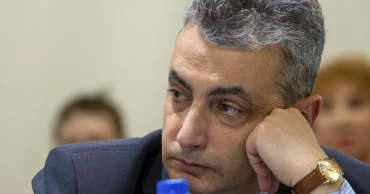
Leonid Volkov, a close associate of the late Russian opposition leader Alexei Navalny, was sentenced in absentia to 18 years in prison after being found guilty on criminal charges.
Moscow’s Second Western District Military convicted Volkov under 40 counts including justifying terrorism, organizing and financing an extremist group, rehabilitating Nazism, and creating a non-governmental organization that violated citizens’ rights, Russian news agencies reported.
As well as the prison sentence, Volkov was also fined 2 million rubles (approx. $25,000) and banned from using the internet for 10 years.
“Oh no! They banned me from the internet for 10 years as prosecutors requested, but I've already been using it”, Volkov wrote in a tongue-in-cheek social media post after the sentence was released. “Damn. Whatever am I going to do?"
US and Europe trade negotiators discuss tariffs in Paris
Volkov, who was in charge of Navalny’s regional offices and election campaigns, left Russia several years ago under pressure from the authorities. He led Navalny’s Anti-Corruption Foundation between 2021 and 2023, during which time he was placed on the Russian government’s list of terrorists and extremists. The case against him is widely seen in Russia as political motivated.
Separately, Lev Shlosberg, a senior member of the Yabloko opposition party, was placed under house arrest Wednesday after being detained on charges of discrediting the Russian army.
A court in the city of Pskov, close to Russia’s western border, ordered Shlosberg to be detained at home for two months pending investigation and trial, the court’s press service said. His case has also been widely viewed as politically motivated.
Russian authorities have accused Shlosberg of discrediting the nation’s military by calling for a ceasefire in Russia’s war with Ukraine. Shlosberg has said that he did not share the social media video or administer the page on which it was posted. If found guilty, he faces up to five years imprisonment.
Germany unveils tax plan to spur investment, revive economy
The politician, who has repeatedly criticized Moscow’s war, was previously named as a “foreign agent” by Russian authorities, a loaded term that carries connotations of Soviet-era treachery.
Since Russia launched its invasion of Ukraine in February 2022, the Kremlin has clamped down on all forms of dissent, targeting rights groups, independent media and other members of civil-society organizations, LGBTQ+ activists and certain religious affiliations.
11 months ago
Russian attacks kill 3 as drones hit Kharkiv and other parts of Ukraine
Russian forces launched a fresh drone assault across Ukraine overnight Wednesday, killing three people and wounding 64 more, Ukrainian officials said.
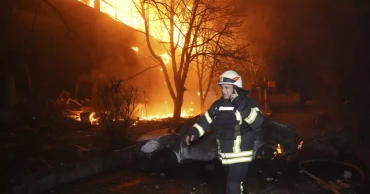
One of the hardest-hit areas was the city of Kharkiv in northeastern Ukraine, where 17 attack drones struck two residential districts, said Mayor Ihor Terekhov. Emergency crews, municipal workers and volunteers worked through the night to extinguish fires, rescue residents from burning homes, and restore gas, electricity and water services.
“Those are ordinary sites of peaceful life — those that should never be targeted,” Terekhov wrote on Telegram.
Three people were confirmed killed, according to Kharkiv regional head Oleh Syniehubov. In a statement, Ukrainian President Volodymyr Zelenskyy said that 64 people had been injured and reiterated his calls for greater international pressure on Moscow.
"Every new day now brings new vile Russian attacks, and almost every strike is telling," he said. “We must not be afraid or postpone new decisions that could make things more difficult for Russia. Without this, they will not engage in genuine diplomacy. And this depends primarily on the United States and other world leaders. Everyone who has called for an end to the killings and for diplomacy must act.”
Kharkiv has been frequently targeted in recent months as Russia launched repeated large-scale drone and missile attacks on civilian infrastructure.
Moscow's forces have deployed high numbers of drones and missiles in recent days, with a record bombardment of almost 500 drones on Monday and a wave of 315 drones and seven missiles overnight on Tuesday.
Russian drone and missile attacks kill 2 in Ukraine
The attacks come despite discussions of a potential ceasefire. The two sides traded memoranda at direct peace talks in Istanbul on June 2 that set out conditions. However, the inclusion of clauses that both sides see as nonstarters make any quick deal unlikely.
Wednesday's strikes also caused widespread destruction in Kharkiv's Slobidskyi and Osnovianskyi districts, hitting apartment buildings, private homes, playgrounds, industrial sites and public transport. Images from the scene published by Ukraine’s Emergency Service on Telegram showed burning apartments, shattered windows and firefighters battling the blaze.
“We stand strong. We help one another. And we will endure,” Terekhov said. “Kharkiv is Ukraine. And it cannot be broken.” Ukraine's airforce said that 85 attack and decoy drones were fired over the country overnight. Air defense systems intercepted 40 of the drones, while nine more failed to reach their targets without causing damage.
11 months ago
Russian drone and missile attacks kill 2 in Ukraine
Russia sent waves of drones and missiles in an attack on two Ukrainian cities early Tuesday that killed two people and wounded at least thirteen others, Ukrainian officials said.
Ukrainian President Volodymyr Zelenskyy in an online statement called the attack "one of the biggest" in the war that has raged for over three years, saying Moscow's forces fired over 315 drones, mostly Shaheds, and seven missiles at Ukraine overnight.
Russia-Ukraine war is top of the agenda as European leaders meet in Albania on security concerns
“Russian missile and Shahed strikes are louder than the efforts of the United States and others around the world to force Russia into peace,” Zelenskyy wrote, urging “concrete action” from the United States and Europe in response to the attack.
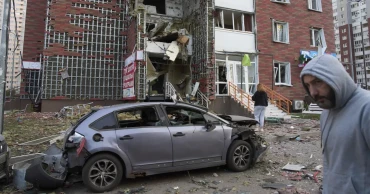
A maternity hospital and residential buildings in the center of the southern port city of Odesa were damaged in the attack, regional head Oleh Kiper said. Two people were killed and nine injured in the city, according to a statement from the regional prosecutor's office.
Four people were injured in the attack on the capital, Kyiv Mayor Vitali Klitschko said. Associated Press journalists heard explosions and the buzzing of drones around the city for hours.
The fresh attacks came hours after Moscow launched almost 500 drones at Ukraine in the biggest overnight drone bombardment in the three-year war. Ukrainian and Western officials have been anticipating a Russian response to Ukraine's audacious June 1 drone attack on distant Russian air bases.
Plumes of smoke were visible in Kyiv as air defense forces worked to shoot down drones and missiles Tuesday morning.
Meanwhile, Ukrainian residents took shelter and slept in metro stations during the hourslong attack. Nina Nosivets, 32, and her 8-month-old son Levko were among them.
“I just try not to think about all this, silently curled up like a mouse, wait until it all passes, the attacks. Distract the child somehow because its probably the hardest thing for him to bear," she said.
Krystyna Semak, a 37-year-old Kyiv resident, said the explosions frightened her and she ran to the metro at 2 a.m. with her rug.
Russian attack on Kharkiv kills 3, injures 21
Russia has been launching a record-breaking number of drones and missiles targeting Ukraine while the two countries continue to swap prisoners of war, the only tangible outcome of recent direct peace talks held in Istanbul. A ceasefire, long sought by Kyiv, remains elusive.
In Kyiv, fires broke out in at least four districts after debris from shot down drones fell on the roofs of residential buildings and warehouses, according to the Kyiv City Military Administration.
Vasyl Pesenko, 25, stood in his kitchen, damaged in the attack.
“I was lying in bed, as always hoping that these Shaheds (drones) would fly past me, and I heard that Shahed (that hit the house),” he said. “I thought that it would fly away, but it flew closer and closer and everything blew away.”
The Russian attack sparked 19 fires across Ukraine, Interior Minister Ihor Klymenko wrote on Telegram. “Russia must answer for every crime it commits. Until there is justice, there will be no security. For Ukraine. And for the world,” he said.
The Russian Defense Ministry on Tuesday morning reported downing 102 Ukrainian drones over Russian regions and Crimea, the Black Sea peninsula Moscow illegally annexed from Ukraine in 2014.
The drones were downed both over regions on the border with Ukraine and deeper inside Russia, including central Moscow and Leningrad regions, according to the Defense Ministry’s statement.
Because of the drone attack, flights were temporarily restricted in and out of multiple airports across Russia, including all four airports in Moscow and the Pulkovo airport in St. Petersburg, the country’s second largest city.
11 months ago
Russian attack on Kharkiv kills 3, injures 21
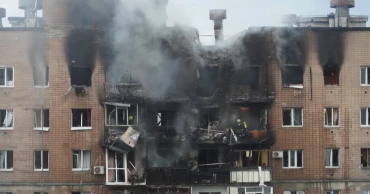
A large Russian drone-and-missile attack targeted Ukraine's eastern city of Kharkiv on Saturday, killing at least three people and injuring 21, local officials said. The barrage — the latest in near daily widescale attacks — included aerial glide bombs that have become part of a fierce Russian onslaught in the three-year war.
According to AP, the intensity of the Russian attacks on Ukraine over the past weeks has further dampened hopes that the warring sides could reach a peace deal anytime soon days — especially after Kyiv recently embarrassed the Kremlin with a surprising drone attack on military airfields deep inside Russia.
According to Ukraine’s Air Force, Russia struck with 215 missiles and drones overnight, and Ukrainian air defenses shot down and neutralized 87 drones and seven missiles.
Several other areas in Ukraine were also hit, including the regions of Donetsk, Dnipropetrovsk, Odesa, and the city of Ternopil, Ukrainian Foreign Minister Andrii Sybiha said in a post on X.
“To put an end to Russia’s killing and destruction, more pressure on Moscow is required, as are more steps to strengthen Ukraine,” he said.
Israel hits Southern Beirut suburbs, claims Hezbollah drone sites targeted
There was no immediate comment from Moscow on the latest attack.
Kharkiv’s mayor Ihor Terekhov said the strikes also damaged 18 apartment buildings and 13 private homes. Terekhov said it was “the most powerful attack” on the city since Russia's full-scale invasion of Ukraine in February 2022.
Kharkiv’s regional governor Oleh Syniehubov said two districts in the city were struck with three missiles, five aerial glide bombs and 48 drones. Among the injured were two children, a month and a half old boy and a 14-year old girl, he added.
The attack on Kharkiv comes one day after Russia launched one of the fiercest barrages on Ukraine, striking six Ukrainian territories and killing at least six people and injuring about 80. Among the dead were three emergency responders in Kyiv, one person in Lutsk and two people in Chernihiv.
US President Donald Trump said this week that his Russian counterpart, Vladimir Putin, told him Moscow would respond to Ukraine’s attack on Russian military airfields last Sunday.
Trump also said that it might be better to let Ukraine and Russia “fight for a while” before pulling them apart and pursuing peace. Trump’s comments were a remarkable detour from his often-stated appeals to stop the war and signaled he may be giving up on recent peace efforts.
11 months ago
US and Europe trade negotiators discuss tariffs in Paris
Europe and the United States are meeting in Paris to negotiate a resolution to an escalating tariff conflict that has serious global economic implications.
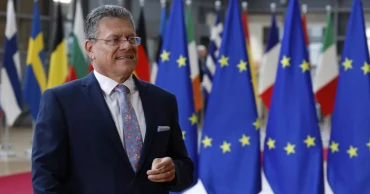
Maroš Šefčovič, the European Union’s chief trade negotiator, met with U.S. Trade Representative Jamieson Greer on Wednesday on the sidelines of the Organization for Economic Cooperation and Development (OECD) meeting. Šefčovič shared a photo of their handshake on social media platform X, stating that both sides are "advancing in the right direction at pace" and maintaining close contact to keep up the momentum.
Germany unveils tax plan to spur investment, revive economy
Despite the ongoing talks, Brussels and Washington are not expected to finalize a meaningful trade agreement during the Paris meeting due to the complexity of the issues involved.
U.S. President Donald Trump continues to express frustration over the persistent U.S. trade deficit with the EU, which reached a record $161 billion last year, according to the U.S. Commerce Department. He attributes the imbalance to unfair trade practices and often criticizes the EU’s 10% tariff on imported cars. By contrast, the U.S. tariff was 2.5% before Trump raised it to 25% in April. The EU counters that its purchases of American services—especially in the tech sector—significantly offset the goods deficit.
The trade tensions intensified after the Trump administration unexpectedly imposed new steel tariffs last week, shaking global markets and further complicating the broader negotiations with the EU. In response, the EU announced on Monday that it is preparing “countermeasures” against the United States.
As part of its negotiating position, the EU has proposed a “zero-for-zero” deal that would eliminate tariffs on all industrial goods, including automobiles. Trump has so far rejected this proposal, though EU officials insist it remains available for discussion.
The EU may be open to buying more U.S. liquefied natural gas and defense products and lowering auto tariffs. However, it is unlikely to concede on scrapping the value-added tax (VAT)—a sales tax-like levy—which the U.S. views as a trade barrier. Nor is the EU expected to open its market to more American beef.
French Trade Minister Laurent Saint-Martin said in Paris on Wednesday that there is still time to negotiate. “If the discussion and negotiation do not succeed, Europe is capable of having countermeasures on American products and services as well,” he warned.
Greta Peisch, who served as general counsel for the U.S. Trade Representative during the Biden administration and is now a partner at law firm Wiley Rein, suggested the zero-for-zero deal could be a viable path forward—if the Trump administration is interested in avoiding more tariffs. However, she questioned Washington’s commitment, noting Trump’s longstanding criticism of EU trade policies.
Among Trump’s key complaints is the VAT system, which he and his advisers see as unfairly protectionist because it is applied to U.S. exports. However, VATs—implemented at the national level rather than by the EU itself—are applied equally to domestic and imported goods, and have traditionally not been viewed as trade barriers. Major changes to national tax systems to satisfy U.S. demands appear unlikely.
European leaders are also expected to resist U.S. demands to eliminate food and safety regulations that Washington views as non-tariff trade barriers. These include bans on hormone-treated beef, chlorinated chicken, and genetically modified foods.
Spain cancels contract for anti-tank missiles built by Israeli subsidiary
William Reinsch, a former U.S. trade official, noted, “When you start talking about chickens or GMOs or automobile safety standards, you’re talking about the ways countries choose to regulate their economies.” While the U.S. sees such regulations as protectionist, European nations argue they are essential for public health—an enduring point of contention for over six decades.
1 year ago

Germany unveils tax plan to spur investment, revive economy
Germany's new government on Wednesday launched a package of tax breaks and eventual tax cuts for companies, moving to encourage investment as it tries to give new momentum to an economy that has shrunk for the past two years and is expected to stagnate this year.
Chancellor Friedrich Merz's Cabinet approved the so-called growth booster programme, which must still be passed by lawmakers.
Its central component is a hefty tax write-off on investments in machinery and other equipment over the next three years, followed by a gradual reduction of the corporate tax rate from 15 per cent to 10 per cent between 2028 and 2032, reports AP.
Spain cancels contract for anti-tank missiles built by Israeli subsidiary
There will also be tax breaks over the next 2.5 years for companies that buy electric cars and measures to encourage investment in research.
Finance Minister Lars Klingbeil, who is also the vice chancellor, said that “we are making Germany as a location more competitive internationally.” Germany has Europe's biggest economy.
Several industry associations have already called for more help, for example, in bringing down electricity prices.
The package launched Wednesday is separate from a 500 billion-euro ($570 billion) fund that Merz's coalition pushed through parliament before it even took office last month to pour money into Germany’s creaking infrastructure over the next 12 years.
Klingbeil said that the government plans to launch legislation formally setting up that fund in late June.
1 year ago

Spain cancels contract for anti-tank missiles built by Israeli subsidiary
Spain has cancelled a deal for anti-tank missile systems that were to be manufactured in Madrid by a subsidiary of an Israeli company, in a bid to move away from Israeli military technology, the Defence Ministry said Tuesday.
The decision will affect the license for 168 SPIKE LR2 anti-tank missile systems with an estimated value of 285 million euros ($325 million). The systems would have been developed in Spain by Pap Tecnos, a Madrid-based subsidiary of Israel’s Rafael Advanced Defence Systems, according to local press.
“The goal is clear...a total disconnection from Israeli technology,” government spokesperson Pilar Alegría told reporters, adding the government is studying “the effects of the cancellation.”
Israel’s Defence Ministry referred questions on the decision to Rafael. The company’s press office said in a statement to The Associated Press that it “has not been informed of any cancellation.” Pap Tecnos, located on the outskirts of Madrid, did not comment, reports AP.
Spain approved the deal on October 3, 2023, four days before an insurgent assault led by Hamas on southern Israel that sparked a devastating war in Gaza. Authorities argued at the time that the systems used by the Spanish forces were obsolete and should be replaced for up-to-date versions like those used by allied armies.
Spain's leftist government says it stopped exporting arms to Israel as of October 2, 2023, but there where reports some shipments slipped through.
China slams EU's protectionist measures aimed at Chinese medical device companies
United States late last year opened an investigation into whether NATO ally Spain denied port entry to at least three cargo vessels reportedly transporting US weapons to Israel.
Spain formally recognised a Palestinian state in May 2024 in a coordinated effort with Norway and Ireland.
A month later, Spain became the first European country to ask the top United Nations court, the International Court of Justice, permission to join a case mounted by South Africa that accuses Israel of genocide in Gaza. Israel strongly denies the charge.
1 year ago