europe
Ukraine may keep some F-16 warplanes abroad to protect it from Russian strikes
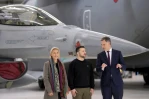
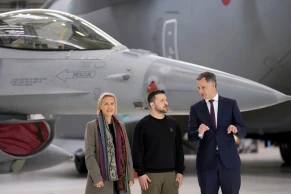
Ukraine may keep some of the F-16 fighter jets it's set to receive from its Western allies at foreign bases to protect them from Russian strikes, a senior Ukrainian military officer said Monday.
Belgium, Denmark, the Netherlands and Norway have committed to providing Ukraine with over 60 U.S.-made F-16 fighter jets to help it fend off Russian attacks. Ukrainian pilots are currently undergoing training to fly the warplanes ahead of the deliveries expected to start later this year.
Serhii Holubtsov, head of aviation within Ukraine’s air force, said that "a certain number of aircraft will be stored at secure air bases outside of Ukraine so that they are not targeted here.”
Holubtsov told the U.S. government-funded Radio Free Europe/Radio Liberty that those F-16s could be used to replace damaged aircraft as they undergo repairs as well as for training Ukrainian pilots abroad.
“This way, we can always have a certain number of aircraft in the operational fleet that corresponds to the number of pilots we have," he said. "If there are more pilots, there will be more aircraft in Ukraine.”
Russian President Vladimir Putin has warned that Moscow could consider launching strikes at facilities in NATO countries if they host the warplanes used in Ukraine.
“If they are stationed at air bases outside the Ukrainian borders and used in combat, we will have to see how and where to strike the assets used in combat against us,” Putin said last year. “It poses a serious danger of NATO being further drawn into the conflict.”
In March, the Russian leader again warned Ukraine’s Western allies against providing air bases from where the F-16s could launch sorties against the Kremlin’s forces. Those bases would become a “legitimate target,” he said.
“F-16s are capable of carrying nuclear weapons, and we will also need to take that into account while organizing our combat operations,” Putin stated.
On Monday, Andrei Kartapolov, the head of the defense committee in the Russian Parliament's lower house told the state RIA Novosti news agency that NATO bases hosting Ukrainian F-16s would be “legitimate targets” for Moscow if the warplanes use them to launch attacks on Russia.
The F-16s require a high standard of runways and reinforced hangars to protect them from attacks on the ground. It’s not clear how many Ukrainian air bases can meet those requirements, and Russia would be certain to quickly target a few that could accommodate them once the jets arrive.
Holubtsov noted that the F-16s will help protect front-line and border regions from Russian glide bombs that have inflicted significant damage to both troops and residential areas, including Kharkiv. Glide bombs are heavy Soviet-era bombs fitted with precision guidance systems and launched from aircraft flying out of range of air defenses.
“I think we will succeed, first of all, in pushing back the aircraft that drop glide bombs farther from the contact line," he said. “If we manage to push them back at least another 30-50 kilometers (19-31 miles), this can already be considered a turning point and an achievement, if not of superiority, then of parity in the airspace.”
Ukraine’s Western allies are trying to bolster military support for Kyiv as Russian troops have launched attacks along the more than 1,000-kilometer (620-mile) frontline, taking advantage of a lengthy delay in U.S. military aid. Ukraine is currently fighting to hold back a Russian push near its second-largest city of Kharkiv, less than 30 kilometers (less than 20 miles) from the border.
Russian troops have also continued their slow offensive in the eastern Donetsk region. On Monday, the Russian Defense Ministry claimed that the Kremlin's forces had captured the village of Staromaiorske, the claim that hasn't been confirmed by Kyiv and couldn't be independently verified.
Ukraine has struck back with regular missile and drone attacks on Moscow-occupied territories and areas inside Russia.
In the latest strike, Ukrainian forces hit Russian air defense systems in Dzhankoy, Chornomorske and Yevpatoriya in the Moscow-occupied Crimea with missiles, Ukraine's General Staff said Monday. The Russian Defense Ministry hasn't commented on the Ukrainian claim, which couldn't be independently confirmed.
The U.S. and other NATO allies have responded to the latest Russian offensive by allowing Ukraine to use weapons they deliver to Kyiv to carry out limited attacks inside Russia. The decision could potentially impede Moscow’s ability to concentrate its troops for a bigger offensive near Kharkiv and in other border areas.
Last week, Putin responded by warning that Moscow “reserves the right” to arm adversaries of the West worldwide. "If they supply (weapons) to the combat zone and call for using these weapons against our territory, why don’t we have the right to do the same?” Putin said.
He didn’t specify where such arms might be sent. The U.S. has said that Russia has turned to North Korea and Iran to beef up its stock of relatively simple weapons, but Moscow could dip into its stock of high-tech missiles to share with adversaries of the West if Putin decides to fulfill his threat.
1 year ago
Macron dissolves the French parliament and calls a snap election after defeat in EU vote
President Emmanuel Macron dissolved the lower house of France's parliament in a surprise announcement sending voters back to the polls in the coming weeks to choose lawmakers, after his party was handed a humbling defeat by the far-right in the European elections Sunday.
The legislative elections will take place in two rounds on June 30 and July 7.
The announcement came after the first projected results from France put the far-right National Rally party well ahead in the European Union's parliamentary elections, handing a chastening loss to Macron’s pro-European centrists, according to French opinion poll institutes.
Marine Le Pen’s anti-immigration, nationalist party was estimated to get around 31%-32% of the votes, a historic result more than double the share of Macron’s Renaissance party, which was projected to reach around 15%.
Macron himself wasn’t a candidate in the EU elections and his term as president still runs for three more years.
He said the decision was “serious” but showed his “confidence in our democracy, in letting the sovereign people have their say.”
President Macron’s speech on Europe at the Sorbonne
“In the next few days, I’ll be saying what I think is the right direction for the nation. I’ve heard your message, your concerns, and I won’t leave them unanswered,” he said.
In latest legislative elections in 2022, Macron's centrist party won the most seats but lost its majority at the National Assembly, forcing lawmakers into political maneuvering to pass bills.
With Sunday's decision, he is taking a big risk with a move that could backfire and increase the chances of Le Pen to eventually take power.
A scenario in which an opposition party would eventually win a parliament majority could lead to a fraught power-sharing situation called “cohabitation,” with Macron to name a prime minister with different views.
Le Pen, who head the National Rally group at the National Assembly, “welcomed” Macron’s move.
’We’re ready for it,” said Le Pen, who was the runner-up to Macron in the last two presidential elections. “We’re ready to exercise power if the French people place their trust in us in these future legislative elections. We’re ready to turn the country around, ready to defend the interests of the French, ready to put an end to mass immigration, ready to make the purchasing power of the French a priority.”
Macron says recognizing a Palestinian state is not a taboo for France
The EU elections results were a hard blow for Macron, who has been advocating for Europe-wide efforts to defend Ukraine and the need for the EU to boost its own defenses and industry.
The National Rally’s lead candidate for the EU elections, Jordan Bardella, campaigned for limiting free movement of migrants by carrying out national border controls and dialing back EU climate rules. The party no longer wants to leave the EU and the euro, but aims to weaken it from within.
“Tonight, our compatriots have expressed a desire for change,” Bardella said. “Emmanuel Macron is tonight a weakened president.“
An official at Macron’s office said the decision to dissolve the National Assembly was justified by the “historic score of the far-right” that could not be ignored and the current “parliamentarian disorder."
“You’re never wrong when you give the people a say,” said the official, who spoke anonymously in line with the practice of Macron's office.
EU elections' projections also show a resurgence of the Socialist Party, with about 14% of the votes. The party campaigned on more ambitious climate policies and protections for European businesses and workers, with about 14% of the votes.
Reacting to Macron’s announcement, far-left politician Francois Ruffin called on all leaders from the left, including the Greens to unite under a single “Popular Front” banner. “To avoid the worse, to win,” he wrote on X.
France gets its youngest-ever prime minister, Gabriel Attal, as Macron shakes up government
France is electing 81 members of the European Parliament, which has 720 seats in total.
1 year ago
11 bodies of migrants who were trying to reach Italy recovered off Libya
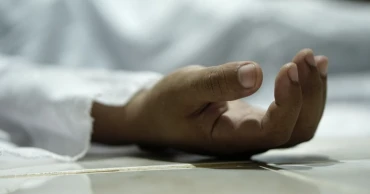
An aid group said Saturday it recovered the bodies of 11 migrants off the Libyan coast and transferred them to an Italian coast guard ship off Lampedusa island, where thousands are trying to reach from North Africa.
The aid group, Doctors Without Borders, said its Geo Barents rescue ship had recovered the bodies following a search operation that lasted more than nine hours, after being alerted by German humanitarian organization Sea-Watch, which also rescues migrants at sea.
The German group said it was unclear whether the migrants were victims of a previous shipwreck, adding they had tried to contact Libya’s coast guard to recover the bodies but received no reply.
5 migrants have died while crossing the English Channel, hours after UK approved deportation bill
During Saturday’s mission, the Sea-Watch crew also discovered another body.
“As we cannot determine the reason behind this tragedy, we know that people will continue to take dangerous routes in a desperate attempt to reach safety, and Europe must find safe and legal pathways for them,” Doctors Without Borders, also known as MSF, wrote in a post on X.
The MSF vessel was ordered to transport the other 165 people onboard, who were rescued during its Mediterranean operations, to the northern port of Genoa. The group complained that the decision would significantly delay assistance to migrants.
At least 16 migrants killed, 29 injured in a bus crash in southern Mexico
Thousands of migrants leaving from North African countries try to reach Europe using Libya as a departing point, as they brave a dangerous journey across the Mediterranean to escape war and poverty.
The central Mediterranean route remains the world’s most dangerous crossing. In 2023, more than 3,000 people went missing on this route, according to the International Organization for Migration.
More than 4,000 migrants in the Lampedusa hotspot in Italy
1 year ago
Attacks in Russian-occupied Ukrainian regions leave 28 dead, Moscow-backed officials say
Russia-installed officials in the partially occupied Ukrainian regions of Kherson and Luhansk said Ukrainian attacks left at least 28 people dead as Russia and Ukraine continued to exchange drone attacks overnight into Saturday.
A Ukrainian attack Friday on the small town of Sadove in Ukraine’s partially occupied Kherson region killed 22 and wounded 15 people, Moscow-backed governor Vladimir Saldo said.
Russian state news agency Tass cited Saldo as saying that Ukrainian forces first struck the town with a French-made guided bomb, then attacked again with a U.S.-supplied HIMARS missile. He said Ukrainian forces had “deliberately made a repeat strike to create greater numbers of casualties” when “residents of nearby houses ran out to help the injured."
Officials declared Saturday a day of mourning in Luhansk, and public events will be similarly cancelled Sunday and Monday in Kherson.
Further east, Leonid Pasechnik, the Russia-installed governor in Ukraine’s partially occupied Luhansk region, said Saturday that two more bodies had been pulled from the rubble following Friday’s Ukrainian missile attack on the regional capital, also called Luhansk. Russian state news agency Interfax cited regional authorities as saying this brought the death toll to six. Pasechnik also said 60 people were wounded in the attack.
Ukraine did not comment on either assault.
Meanwhile, drone attacks between Russia and Ukraine persisted.
Ukraine launched a barrage of drones across Russian territory overnight Friday, Russia’s Defense Ministry said Saturday. Twenty-five drones were reportedly destroyed over Russia’s southern Kuban and Astrakhan regions, the western Tula region, and the Moscow-annexed Crimean peninsula.
On Saturday morning, officials said air defenses for the first time shot down Ukrainian drones over the North Ossetia region in the North Caucasus, some 900 km (560 miles) east of the front line in Ukraine’s partially occupied Zaporizhzhia region.
Russia’s Ministry of Defense said that one drone had been destroyed, whereas regional Gov. Sergei Menyailo reported three downed drones over the region. Menyailo said that the target was a military airfield.
Ukrainian air defense overnight shot down nine out of 13 Russian drones over the central Poltava region, southeastern Zaporizhzhia and Dnipropetrovsk regions, and the Kharkiv region in the northeast, Ukraine’s air force said Saturday.
Dnipropetrovsk regional Gov. Serhiy Lysak said the overnight drone attack damaged commercial and residential buildings.
Later on Saturday, a Ukrainian military spokesman said Ukraine now controlled more than half of the town of Vovchansk, a flashpoint for fighting since Russia launched a renewed offensive in Ukraine’s northeastern Kharkiv region last month.
“Most of the city is under the control of the defense forces,” Nazar Voloshin, spokesman for the Khortytsia ground forces formation, said on Ukrainian state TV.
Independent confirmation of this claim wasn’t immediately possible.
Russia’s Kharkiv push appears to be a coordinated new offensive that includes testing Ukrainian defenses in the Donetsk region further south, while also launching incursions in the northern Sumy and Chernihiv regions.
1 year ago
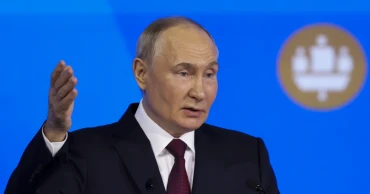
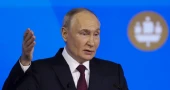
Putin says Russia's economy is growing despite heavy international sanctions as he courts investors
President Vladimir Putin said Friday that the Russian economy is growing despite heavy international sanctions and the country has expanded economic ties with countries in Africa, the Middle East and Asia, as he sought to court investors.
Addressing the presidents of Bolivia and Zimbabwe and business leaders at the St. Petersburg International Economic Forum, Putin said Russia “remains one of the key participants in world trade,” despite the fact that the country is under sweeping sanctions for sending troops into Ukraine.
The forum has been used by Russia for decades as a showcase for touting the country's development, though Western officials and investors have steered clear of the session since sanctions cut off much of Russia’s trade with Western Europe, the U.S. and their allies.
The main driver of Russia's economic growth is the fighting in Ukraine — now as important to the Kremlin economically as it is politically.
Russians are finding a few imported staples, and most global brands have disappeared — or been reincarnated as Russian equivalents. But not much else has changed economically for most people, with massive state spending for military equipment and hefty payments to volunteer soldiers giving a strong boost to the economy.
Putin has heavily controlled his media appearances since sending his forces into Ukraine but he took questions Wednesday from international journalists, including some from Western countries he has criticized, on the sidelines of the forum.
At that meeting, Putin warned that Russia could provide long-range weapons to others to strike Western targets in response to NATO allies allowing Ukraine to use their arms to attack Russian territory. He also reaffirmed Moscow’s readiness to use nuclear weapons if it sees a threat to its sovereignty.
Last year, journalists from countries that Russia regards as unfriendly — including the U.S., the U.K. and the European Union — were not invited to the forum.
1 year ago
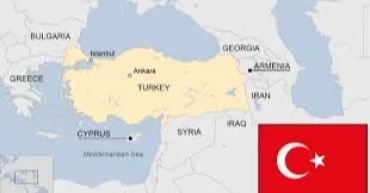
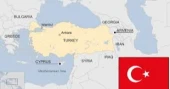
A military training plane crashes in central Turkey, killing its 2 pilots
A military plane crashed during training on Tuesday, killing its two pilots on board, Turkey’s defense ministry announced.
The SF-260D training plane crashed into an agricultural field in central Turkey, after taking off from a Air Force base near the city of Kayseri.
Earthquake measuring 5.6 hits central Turkey
The defense ministry said the cause of the crash remains unknown. The state-run Anadolu Agency reported that authorities have initiated an investigation.
Television footage captured black smoke rising from the wreckage of the plane among the crops in the field.
2 years ago
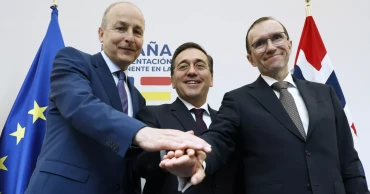
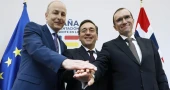
Spain, Norway and Ireland formally recognize a Palestinian state as EU rift with Israel widens
Spain, Norway and Ireland moved to formally recognize a Palestinian state on Tuesday in a coordinated effort by the three western European nations designed to add international pressure on Israel to soften its devastating response to last year’s Hamas-led attack. Tel Aviv slammed the diplomatic move that will have no immediate impact on its grinding war in Gaza.
Spanish Prime Minister Pedro Sánchez told his nation in a televised address from Madrid that “this is a historic decision that has a single goal, and that is to help Israelis and Palestinians achieve peace."
Israel’s Foreign Minister Israel Katz quickly lashed out at Spain on X, saying Sánchez's government was “being complicit in inciting genocide against Jews and war crimes.”
Ireland and Norway soon joined Spain in formalizing a decision they had jointly announced the previous week. The Palestinian flag was raised in Dublin outside Leinster House, the seat of the Irish parliament.
“This is an important moment and I think it sends a signal to the world that there are practical actions you can take as a country to help keep the hope and destination of a two-state solution alive at a time when others are trying to sadly bomb it into oblivion,” Irish Prime Minister Simon Harris said before his Cabinet meets to formally sign off on the decision.
Norwegian Foreign Minister Espen Barth Eide said in a statement that “for more than 30 years, Norway has been one of the strongest advocates for a Palestinian state. Today, when Norway officially recognizes Palestine as a state, is a milestone in the relationship between Norway and Palestine.”
UN assembly approves resolution granting Palestine new rights and reviving its UN membership bid
While dozens of countries have recognized a Palestinian state, none of the major Western powers has done so. Still, the adherence of three European countries to the group represents a victory for Palestinian efforts in the world of public opinion.
Relations between the EU and Israel have nosedived with the diplomatic recognitions by two EU members, and Madrid insisting on Monday that the EU should take measures against Israel for its continued deadly attacks in southern Gaza’s city of Rafah.
After Monday’s meeting of EU foreign ministers, Irish Foreign Minister Micheál Martin said “for the first time at an EU meeting, in a real way, I have seen a significant discussion on sanctions” for Israel.
Harris, the Irish leader, insisted Tuesday the EU should consider economic sanctions for Israel, saying “Europe could be doing a hell of a lot more."
Norway, which is not an EU member but often aligns its foreign policy with the bloc, handed diplomatic papers to the Palestinian government over the weekend ahead of its formal recognition.
At the same time, the EU’s foreign policy chief Josep Borrell threw his weight behind the International Criminal Court, whose prosecutor is seeking an arrest warrant against Israeli Prime Minister Benjamin Netanyahu and others, including leaders of the Hamas militant group.
The formal declaration and resulting diplomatic dispute come over seven months into a grinding war waged by Israel against Hamas in Gaza following the Oct. 7 Hamas-led attack in which militants stormed across the Gaza border into Israel, killing 1,200 people and taking some 250 hostage. Israel’s air and land attacks have killed 36,000 Palestinians, according to Gaza’s Health Ministry, which does not distinguish between combatants and civilians.
UN to vote on resolution that would grant Palestine new rights and revive its UN membership bid
Last week's joint announcement by Spain, Ireland and Norway triggered an angry response from Israeli authorities, which summoned the countries’ ambassadors in Tel Aviv to the Foreign Ministry, where they were filmed while being shown videos of the Oct. 7 Hamas attack and abductions.
Some 140 countries — more than two-thirds of the United Nations — recognize a Palestinian state. The addition of three western European countries to that group will likely put pressure on EU heavyweights France and Germany to rethink their position.
Slovenia’s Prime Minister Robert Golob said Monday his government will decide on the recognition of a Palestinian state on Thursday and forward its decision to parliament for final approval.
The United States and Britain, among others, back the idea of an independent Palestinian state alongside Israel but say it should come as part of a negotiated settlement. Netanyahu’s government says the conflict can only be resolved through direct negotiations.
In his speech on Tuesday, Sánchez said that the recognition of a Palestinian state was “a decision that we do not adopt against anyone, least of all against Israel, a friendly people whom we respect, whom we appreciate and with whom we want to have the best possible relationship.”
The Socialist leader, who announced his country’s decision before parliament last week, has spent months touring European and Middle Eastern countries, including stops in Oslo and Dublin, to garner support for the recognition of a Palestinian state and a cease-fire in Gaza.
For Palestine: Students across Bangladesh participate in largest solidarity rallies called by BSL
He called for a permanent cease-fire, for stepping up humanitarian aid into Gaza and for the release of hostages that Hamas has held since the Oct. 7 attack that triggered Israel’s response.
Sánchez said that the move was to back the beleaguered Palestinian Authority, which lost effective political control of Gaza to Hamas. He laid out his vision for a state ruled by the Palestinian Authority that must connect the West Bank and Gaza via a corridor with east Jerusalem as its capital.
Norway's Barth Eide added that “it is regrettable that the Israeli government shows no signs of engaging constructively."
“The recognition is a strong expression of support for moderate forces in both countries," Norway's top diplomat said.
The Western-backed Palestinian Authority administers parts of the Israeli-occupied West Bank, cooperates with Israel on security matters and favors a negotiated two-state solution. Its forces were driven out of Gaza by Hamas when the militants seized power there in 2007.
The Palestinians have long sought an independent state in Gaza, the West Bank and east Jerusalem, territories Israel captured in the 1967 Mideast war. The idea of a land corridor linking Gaza and the West Bank through Israel was discussed in previous rounds of peace talks, but no serious or substantive peace negotiations have been held in over 15 years.
“We will not recognize changes in the 1967 border lines other than those agreed to by the parties,” Sánchez added.
“Furthermore, this decision reflects our absolute rejection of Hamas, a terrorist organization who is against the two-state solution,” Sánchez said. “From the outset, Spain has strongly condemned the terrorist attacks of Oct. 7. This clear condemnation is the resounding expression of our steadfast commitment in the fight against terrorism. I would like to underline that starting tomorrow we would focus all our efforts to implement the two state solution and make it a reality.”
Israel is also under pressure from the International Criminal Court after its chief prosecutor said he would seek arrest warrants for Netanyahu and his defense minister. The ICJ is also considering allegations of genocide that Israel has strenuously denied.
2 years ago
12 people injured after Qatar Airways plane hits turbulence on way to Dublin
Twelve people were injured when a Qatar Airways plane flying from Doha to Dublin on Sunday hit turbulence, airport authorities said.
Dublin Airport said in a statement that the plane landed safely as scheduled before 1 p.m. (1200 GMT).
Qatar Airways staff bus burnt in Khulna’s Sonadanga
“Upon landing, the aircraft was met by emergency services, including Airport Police and our Fire and Rescue department, due to six passengers and six crew … reporting injuries after the aircraft experienced turbulence while airborne over Turkey,” the statement said.
Qatar Airways scores Airline of the Year Award for 7th time
The airport did not provide details on the severity of the injuries.
The incident comes five days after a British man died of a suspected heart attack and dozens of people were injured when a Singapore Airlines flight from London hit severe turbulence.
2 years ago

WIPO adopts treaty to recognize genetic resources, traditional knowledge
The World Intellectual Property Organization (WIPO) approved on Friday a new treaty to highlight the disclosure of genetic resources and associated traditional knowledge in patent applications.
This is the first WIPO treaty to address the interface between intellectual property, genetic resources and traditional knowledge and also the first WIPO treaty to include provisions specifically for indigenous peoples and local communities.
The WIPO Treaty on Intellectual Property, Genetic Resources and Associated Traditional Knowledge is intended to prevent patents from being granted for inventions that are not novel or inventive with regards to genetic resources and associated traditional knowledge.
The treaty, once it enters into force with 15 contracting parties, will establish in international law a new disclosure requirement for patent applicants whose inventions are based on genetic resources and/or associated traditional knowledge.
Genetic resources are contained in, for example, medicinal plants, crops and animal breeds. Under the new treaty, patent applicants are now required to specify where genetic resources are from and what inputs from indigenous people are drawn in their inventions.
Daren Tang, the organization's director-general, hailed the agreement, which was approved after a 25-year negotiation, as living proof of multilateralism at WIPO.
"Today we made history in many ways," he said. "Through this, we are showing that the IP system can continue to incentivize innovation while evolving in a more inclusive way, responding to the needs of all countries and their communities."
2 years ago
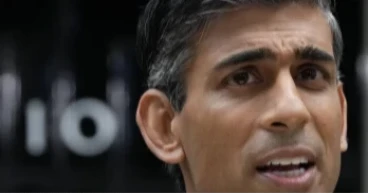
UK Prime Minister Rishi Sunak is betting that calmer economic conditions will get him reelected
British Prime Minister Rishi Sunak has portrayed himself as thorough and evidence-led. That's why his gamble to call a U.K. general election for July 4 has come as such a surprise.
Those personal traits were supposed to be attributes that would endear him to British voters following the chaos of his two predecessors in the top job, Boris Johnson and Liz Truss.
But if opinion polls ahead of the election prove right, he hasn't shifted the dial much, if at all. The main opposition Labour Party is widely seen to be ahead of the Conservatives, who have been in power since 2010.
Sunak became prime minister in October 2022, when he replaced his predecessor Truss and pitched himself as a stable pair of hands after Truss roiled financial markets with a botched plan of unfunded tax cuts.
Sunak had warned Conservative Party members that her economic plan was reckless and would cause havoc. He was proved right.
On replacing her after an uncontested leadership battle, Sunak became Britain’s first leader of color, the first Hindu to become prime minister — and at 42, the youngest leader for more than 200 years.
Sunak, now 44, had enjoyed a rapid rise to the top within Conservative ranks. He was plucked from seemingly nowhere four years ago to become Treasury chief on the eve of the coronavirus pandemic.
Within weeks, he had to unveil the biggest economic support package any Chancellor of the Exchequer has ever had to outside wartime.
Smooth, confident and at ease with the march of modern technology, he was dubbed “Dishy Rishi” and quickly became one of the most trusted and popular faces within Johnson's government. His geekiness — he's a self-confessed “huge” Star Wars fan — added to his popularity.
As Treasury chief, Sunak was lauded for rolling out a COVID-19 job retention package that arguably saved millions of jobs. But it came at a cost, bringing the country's tax burden to its highest level since the 1940s.
Sunak is instinctively a low-tax, small-state politician who idolizes former Prime Minister Margaret Thatcher. But he notably highlighted his record during the pandemic in his address to the nation on Wednesday as he announced the date of the general election.
“As I stand here as your prime minister, I can’t help but reflect that my first proper introduction to you was just over four years ago," Sunak said in pouring rain outside No. 10 Downing Street.
“As I did then, I will forever do everything in my power to provide you with the strongest possible protection I can — that is my promise to you," he added.
In his 19 months in office, Sunak has struggled to keep a lid on bitter divisions within his Conservative Party. One side wants him to be much tougher on immigration and bolder in cutting taxes, while another have urged him to move more to the centerground of politics, the space where historically British elections are won.
That tension has been most notable in his controversial plan to send migrants arriving in small boats across the English Channel to Rwanda rather than being allowed to seek asylum in Britain. The more right wing elements in his party have argued that the policy is destined to fail, and urged Sunak to block all routes of legal challenge.
Despite a toxic inheritance of squeezed living standards and over-stretched public services, he pitched himself as a leader that would restore calm and stability to the economy and revive the party's fortunes.
A year and a half on, inflation is down to near-normal levels, wages are rising and mortgage rates are set to start falling. A general election must take place before Jan. 2025, but Sunak's decision to call an early election is widely seen as a gamble that he will be rewarded for steering the British economy into calmer waters.
Time will tell if that gamble pays off, but the early reaction to his rain-soaked speech Wednesday wasn't promising. Thursday's newspapers ran with headlines like “Drowned and out" and Sunak became a figure of fun across social media.
“It doesn’t look good, for any prime minister to look completely sodden and, damp in the way that Rishi Sunak did,” said Tim Bale, a professor of politics at Queen Mary University of London.
Sunak was born in 1980 in Southampton on England’s south coast to parents of Indian descent who were both born in East Africa. His father was a family doctor and his mother ran a pharmacy, whose accounts he’d often help with.
He has described how his parents saved to send him to Winchester College, one of Britain’s most expensive boarding schools, then went to Oxford University to study politics, philosophy and economics — the degree of choice for future prime ministers.
He then got an MBA at Stanford University, which proved to be a launchpad for his subsequent career as a hedge fund manager at Goldman Sachs in the U.S. There, he met his wife, Akshata Murty, the daughter of the billionaire founder of Indian tech giant Infosys. They have two daughters.
The couple are the wealthiest inhabitants yet of No. 10 Downing Street, according to the Sunday Times’ 2024 Rich List, with an estimated fortune of 651 million pounds ($815 million). They’re even richer than King Charles III, a level of wealth that Labour leader Keir Starmer says make Sunak out of touch with the everyday realities and struggles of working people.
With his fortune secure, Sunak was elected to Parliament for the safe Tory seat of Richmond in Yorkshire in 2015. In Britain’s 2016 Brexit referendum, he supported leaving the European Union.
When “leave” unexpectedly won, Sunak enjoyed a meteoric rise that swiftly led him to Downing Street.
He's not used to losing. Maybe that's why he's taken the gamble of his political life.
2 years ago