europe

German Federal prosecutor declines to investigate Myanmar atrocities
The Federal Public Prosecutor General of Germany decided not to initiate an investigation into genocide, war crimes, and crimes against humanity in Myanmar alleged in a 215-page complaint filed in January by Fortify Rights and 16 individual complainants from Myanmar, said Fortify Rights in a statement released on Thursday from Bangkok.
The complaint, filed in January 2023 under the principle of universal jurisdiction against senior Myanmar military generals and others, focused on those responsible for committing genocide, crimes against humanity, and war crimes against the Rohingya in 2016 and 2017 and for crimes against humanity committed throughout the country since the Myanmar military launched a failing coup d’état in February 2021.
Also read: Support desperate Rohingya refugees following Indonesia: UN expert
There is no reason to believe that this decision will hamper future universal jurisdiction complaints either in Germany or elsewhere, said Fortify Rights.
“The prosecutor’s decision is hugely disappointing,” said Matthew Smith, Chief Executive Officer at Fortify Rights. “We remain confident in the evidence and legal arguments in the complaint, and indeed, the German Federal Prosecutor’s office made clear that its decision was not based on the merits or strength of the evidence.”
Also read: EU “sustaining its support” to Rohingya crisis, says Ambassador Whiteley
The German Federal Public Prosecutor informed Fortify Rights last month that it had declined to open an investigation primarily because of a lack of suspects present in Germany and under the belief that its investigation would duplicate the work that the Independent Investigative Mechanism on Myanmar (IIMM) is currently undertaking.
“When we filed the complaint, we knew that Min Aung Hlaing and others responsible for atrocities in Myanmar weren’t present in Germany. Such presence is not required for an investigation under German law. We didn’t expect this factor to lead the prosecutor to fully decline any investigation into the evidence presented,” said Matthew Smith.
Also read: Japan will continue to stand by Rohingyas and assist host community in Bangladesh: Ambassador
“We know that the IIMM is diligently collecting and preserving evidence, and we expected German authorities to use and leverage the IIMM’s work for future prosecutions in Germany. That is the point of the IIMM. Parts of this decision seem counter to the purpose of Germany’s universal jurisdiction.”
The Federal Prosecutor underscored the absence of Myanmar junta leader Min Aung Hlaing and other named perpetrators in Germany as a decisive factor. However, history has shown that individuals responsible for atrocity crimes often elude custody until political winds and circumstances shift, leading to extraditions, trials, and convictions in courts of law, said Fortify Rights.
Under German law, there are limited opportunities to formally appeal the Prosecutor’s discretionary decision not to investigate or prosecute based on Section 153f of the Code of Criminal Procedure. However, advocates in Germany, such as at the European Center for Constitutional and Human Rights (ECCHR), have recommended reforming the law to enable such reviews.
Also read: High-level regional meeting on Rohingya refugees in Bangkok October 17
“While completely disappointing, the Prosecutor’s decision underscores the urgent need for a truly international effort to prosecute the crimes unfolding in Myanmar,” said Matthew Smith.
“We’re grateful the Prosecutor clarified that the German government is cooperating with efforts to collect and preserve evidence of crimes in Myanmar and that the Prosecutor’s decision was unrelated to the strength of the evidence submitted. We’ll continue to pursue accountability for the heinous crimes committed in Myanmar, and we’re already working on new strategies with survivors and others to that end. The team at Fortify Rights is growing and is more committed than ever to ending and remedying these horrors.”
Also read: Rohingya refugees in Bangladesh face new crisis as funding diminishes: UN
Approximately half of the 16 individual complainants who brought their cases to Germany with Fortify Rights survived the Rohingya genocide and Myanmar military-led “clearance operations” in Rakhine State in 2016 and 2017. The other half survived post-coup atrocities in states and regions throughout the country in 2021 and 2022.
In its statement released today, Fortify Rights noted the Myanmar military’s “longstanding impunity for international crimes, including genocide, war crimes, and crimes against humanity” against “millions of innocent civilians.” The statement concludes that “Fortify Rights is determined to pursue every means possible” to ensure that accountability “happens swiftly and efficiently.”
2 years ago

9th Primakov Readings held in Moscow
The 9th International Scientific and Expert Forum Primakov Readings ended in Moscow, Russia.
This year, the Primakov Readings was attended by 80 leading foreign experts in international security, world politics, and economics from 31 countries of the world including Armenia, Azerbaijan, Bangladesh, China, Cuba, Egypt, Finland, India, Iran, Kazakhstan, Nigeria, Oman, South Africa, Syria, Turkey, Uganda, USA, Uzbekistan and others.
In total, more than 1300 representatives of the Russian and foreign scientific and expert community, government agencies, and political and business circles took part in the forum.
Post-Globalization Horizons was the main topic of the discussions at the event, said a media release on Wednesday.
During its five sessions, experts discussed nuclear energy, Russia-Africa relations, the challenges of post-Soviet countries, as well as the current state of the Baltic Sea and the rise of the Global South.
The second day of the forum was opened with a special session attended by Alexey Likhachev, Director General of the State Atomic Energy Corporation Rosatom.
The speaker spoke about the company’s main activities and current projects, and gave an overview of the nuclear industry in other countries.
According to the speaker, despite the political factor, “the global nuclear family has not split”.
The next session was devoted to Russia-Africa relations.
This topic was chosen for the first time in the history of the forum.
Another innovation was the participation of two presidents: current President of Uganda Yoweri Kaguta Museveni, and President of South Africa (1999-2008) Thabo Mbeki.
The latter spoke about promising sectors of Russian-African cooperation, “There is a serious shortage of energy resources on the continent. If Russia were to start developing hydropower in the Democratic Republic of Congo, it would solve 90 percent of Africa’s problems in this area.”
Mikhail Bogdanov, Russian Deputy Minister of Foreign Affairs, also shared his view on cooperation between Russia and Africa, “Russia attaches special importance to building a long-term strategic partnership with Africa, which is gaining the status of one of the world’s significant centers of power. The principled positions of Russia and Africa on most issues on the international agenda, urgent problems of our time, global challenges and threats are close or coincide.”
The session was followed by the search for new development models for Central Asia, the South Caucasus and Russia.
One of the speakers, Eduard Solovyev, Head of the Center for Post-Soviet Studies, Primakov National Research Institute of World Economy and International Relations (IMEMO), spoke about the situation in the post-Soviet space, “If we talk about the weaknesses of post-Soviet Eurasia, these are conflicts and institutions. Conflicts in the context of great geopolitical confrontation become entry points for non-regional powers, while political institutions cause the need to create stable and effective states on the territory of the post-Soviet space.”
Yerkin Tukumov, Director of the Kazakhstan Institute for Strategic Studies under the President of the Republic of Kazakhstan, in his turn called upon the expert community to respond competently to current events and set the agenda in the information field.
The Central Asian topic was followed by a discussion on the problems of the Baltic region.
In particular, Alexander Grushko, Russian Deputy Minister of Foreign Affairs, spoke vividly and pessimistically about the expansion of the European Union, “EU enlargement has turned out not to be the elimination of borders, but the erection of new walls and the transfer of old ones to the East.
In the eyes of our neighbors, the ideal of regional security consists of borders wrapped in barbed wire, anti-tank trench, and a training ground for military exercises. Their dream is to turn the Baltic into a NATO sea, as some NATO officials are directly talking about.”
The forum ended with a session entitled The Rise of the Global South, where experts discussed the need to include developing countries in the processes of world governance.
Thus, José Ramón Cabañas, Director of the Centre for International Policy Studies (Republic of Cuba), noted that the Global South does not have a ready-made solution to all the world’s problems, but nevertheless there is a positive trend for countries who strive to jointly develop alternative development paths.
The two days of the Primakov Readings included eight working sessions, as well as traditional address by Russian Foreign Minister Sergey Lavrov.
The discussions were focusing on political risks for global energy markets, cooperation of Russia and states of Central Asia and South Caucasus, Sino-American relations, and the development of the Global South.
The participants are also touched on the balance of power in the Baltic region and prospects for the development of relations between Russia and countries of the Middle East and Africa.
The event was organized by the Primakov National Research Institute of World Economy and International Relations, Russian Academy of Sciences, the Primakov Center for International Cooperation, the World Trade Center, and the Chamber of Industry and Commerce of the Russian Federation with the support of the Presidential Grants Foundation.
2 years ago

Ukraine has a new way to get its grain to the world despite Russia's threat in the Black Sea
Grain thunders into rail cars and trucks zip around a storage facility in central Ukraine, a place that growing numbers of companies turned to as they struggled to export their food to people facing hunger around the world.
Now, more of the grain is getting unloaded from overcrammed silos and heading to ports on the Black Sea, set to traverse a fledgling shipping corridor launched after Russia pulled out of a U.N.-brokered agreement this summer that allowed food to flow safely from Ukraine during the war.
“It was tight, but we kept working … we sought how to accept every ton of products needed for our partners,” facility general director Roman Andreikiv said about the end of the grain deal in July. Ukraine’s new corridor, protected by the military, has now allowed him to “free up warehouse space and increase activity.”
Growing numbers of ships are streaming toward Ukraine’s Black Sea ports and heading out loaded with grain, metals and other cargo despite the threat of attack and floating explosive mines. It’s giving a boost to Ukraine’s agriculture-dependent economy and bringing back a key source of wheat, corn, barley, sunflower oil and other affordable food products for parts of Africa, the Middle East and Asia where local prices have risen and food insecurity is growing.
"We are seeing renewed confidence among commercial operators keen to take Ukrainian grain cargoes,” said Munro Anderson, head of operations for Vessel Protect, which assesses war risks at sea and provides insurance with backing from Lloyd’s, whose members make up the world’s largest insurance marketplace.
Ihor Osmachko, general director of Agroprosperis Group, one of Ukraine’s biggest agricultural producers and exporters, says he's feeling “more optimistic than two months ago.”
“At that time, it was completely unclear how to survive,” he said.
Since the company’s first vessel departed in mid-September, it says it has shipped more than 300,000 metric tons of grain to Egypt, Spain, China, Bangladesh, the Netherlands, Tunisia and Turkey.
After ending the agreement brokered by the U.N. and Turkey, Russia has attacked Ukraine’s Black Sea ports — a vital connection to global trade — and grain infrastructure, destroying enough food to feed over 1 million people for a year, the U.K. government said.
The risk to vessels is the main hurdle for the new shipping corridor. Russia, whose officials haven't commented on the corridor, warned this summer that ships heading to Ukraine's Black Sea ports would be assumed to be carrying weapons.
Ukrainian President Volodymyr Zelenskyy said that allies had agreed to provide ships to help his country protect commercial vessels in the Black Sea but that more air defense systems were needed.
“Air defense is in short supply,” he told reporters Saturday at an international food security summit in Kyiv. “But what’s important is that we have agreements, we have a positive signal and the corridor is operational.”
While a deadly missile strike on the port of Odesa hit a Liberian-flagged commercial ship this month, not long afterward, insurers, brokers and banks teamed up with the Ukrainian government to announce affordable coverage for Black Sea grain shipments, offering shippers peace of mind.
Despite such attacks, Ukraine has exported over 5.6 million metric tons of grain and other products through the new corridor, U.S. Ambassador to Ukraine Bridget Brink tweeted Friday. Before the war, it was nearly double that per month, Ukrainian Deputy Economy Minister Taras Kachka said.
“The way that they’re transporting right now, it’s certainly much more expensive and time consuming,” said Kelly Goughary, a senior research analyst at agriculture data and analytics firm Gro Intelligence.
“But they are getting product out the door, which is better than I think many were anticipating with the grain initiative coming to an end,” she said.
Farmers also are facing low prices for their grain, which makes sending trucks to Odesa's often-attacked port not worth the risk for one agricultural company near the front line.
Instead, Slavhorod, which farms near the border with Russia in the Sumy province that faces daily shelling, has chosen to store its peas, wheat, soybeans, sunflower and corn in warehouses.
There's risk in keeping the 3,500-hectare (8,650-acre) farm running at all: Signs warned of explosive mines near where workers were collecting corn in a field 3 kilometers (nearly 2 miles) from Russia.
But “who, if not us? It’s the only industry that brings some income to the country,” said Slavhorod’s chief agronomist, Oleksandr Kubrakov, who survived driving over a mine last year.
But it's becoming increasingly challenging to maintain morale.
“This year, there is less enthusiasm because grain prices are low, the product remains near the border and at any moment" it could be destroyed, he said. “It’s a big risk.”
Since the war started, Ukraine has struggled to get its food supplies to countries in need. Even during the yearlong U.N. deal, when Ukraine shipped nearly 33 million metric tons of food, Russia was accused of slowing down ship inspections required to be done by all sides.
“That corridor worked in an unpredictable way for us,” said Mykola Horbachov, president of the Ukrainian Grain Association.
Now, the Ukrainian military decides when it’s safe to sail.
“This may incur additional costs, but it is still more predictable than it was before,” Horbachov said.
Osmachko of Agroprosperis Group agrees. Before the invasion, the exporter paid $50 per metric ton to ship grain through the Black Sea. Alternatives since the war — including river routes through Europe — cost the company nearly three times more, Osmachko said. Under Ukraine’s new corridor, the company pays $70 to 80 per metric ton.
“It’s more efficient, more profitable,” he said.
Plus, Ukraine’s shipping corridor allows vessels to travel less in dangerous areas compared with the grain deal and avoid those often-delayed inspections, said Anderson of Vessel Protect.
Agroprosperis Group no longer needs to pay for ships to wait around. Inspection delays cost the company $30 million in losses during the yearlong grain deal, Osmachko said.
While the delays are gone, there still “is military risk, safety risk, war risk. And not all of the insurance companies are ready to take this risk,” Osmachko said.
To ease that hurdle, an insurance program launched this month to provide affordable coverage to shippers carrying food from Ukraine’s Black Sea ports. The partnership between insurance broker Marsh McLennan, Lloyd’s, two Ukrainian state banks and the government offers up to $50 million for each of two types of coverage protecting against damage and other losses.
In another boost, a humanitarian program was extended Saturday that donates Ukrainian grain to nations facing food shortages with support from countries worldwide. Next, it will bring enough grain to help nearly 400,000 people in Nigeria, Zelenskyy said.
The goal for the new shipping corridor is to export at least 6 million metric tons of grain a month, Ukrainian Agriculture Minister Mykola Solskyi said. It has a lot of work to do: Ukraine exported 4.3 million metric tons of grain in October through all routes, the ministry said.
“We maintain cautious optimism, based on the fact that we have been fighting before and will continue to fight further,” he said.
2 years ago

Ex UK PM David Cameron makes return to government as foreign secretary
Former British Prime Minister David Cameron made a shock return to high office on Monday, becoming foreign secretary in a major shakeup of the Conservative government that also saw the firing of divisive Home Secretary Suella Braverman.
Cameron, who led the U.K. government between 2010 and 2016, was appointed by Prime Minister Rishi Sunak in a Cabinet shuffle in which he sacked Braverman, a divisive figure who drew anger for accusing police of being too lenient with pro-Palestinian protesters.
Ex-PM David Cameron 'sorry' for creating Brexit divisions
She was replaced by James Cleverly, who had been foreign secretary.
Cameron's appointment came as a surprise to seasoned politics-watchers. It's rare for a non-lawmaker to take a senior government post, and it has been decades since a former prime minister held a Cabinet job.
Rishi Sunak fires UK Home Secretary Suella Braverman who accused police of favoring pro-Palestinian protesters
The government said Cameron was being appointed to Parliament's unelected upper chamber, the House of Lords. The last foreign secretary to serve in the Lords, rather than the elected House of Commons, was Peter Carrington, who was part of Prime Minister Margaret Thatcher's government in the 1980s.
Cameron, 57, said Britain was “facing a daunting set of international challenges, including the war in Ukraine and the crisis in the Middle East.”
Civilians fleeing northern Gaza's combat zone report a terrifying journey on foot past Israeli tanks
“While I have been out of front-line politics for the last seven years, I hope that my experience — as Conservative leader for 11 years and prime minister for six — will assist me in helping the prime minister to meet these vital challenges," he said in a statement.
Cameron's appointment brings back to government a leader brought down by Britain's decision to leave the European Union. Cameron called the 2016 EU membership referendum, confident the country would vote to stay in the bloc. He resigned the day after voters opted to leave.
Sunak was a strong backer of the winning “leave” side in the referendum. Cameron's return, and Braverman’s sacking, are likely to infuriate the Conservative Party’s right wing and inflame tensions in the party that Sunak has sought to soothe.
Prominent right-wing lawmaker Jacob Rees-Mogg said sacking Braverman was “a mistake, because Suella understood what the British voter thought and was trying to do something about it.”
Sunak had been under growing pressure to fire Braverman — a hard-liner popular with the party's authoritarian wing — from one of the most senior jobs in government, responsible for handling immigration and policing.
In a highly unusual attack on the police last week, Braverman said London’s police force was ignoring lawbreaking by “pro-Palestinian mobs.” She described demonstrators calling for a cease-fire in Gaza as “hate marchers.”
On Saturday, far-right protesters scuffled with police and tried to confront a large pro-Palestinian march by hundreds of thousands through the streets of London. Critics accused Braverman of helping to inflame tensions.
Last week Braverman wrote an article for the Times of London in which she said police “play favorites when it comes to protesters” and acted more leniently toward pro-Palestinian demonstrators and Black Lives Matter supporters than toward right-wing protesters or soccer hooligans.
The article was not approved in advance by the prime minister’s office, as would usually be the case.
Braverman said Monday that “it has been the greatest privilege of my life to serve as home secretary,” adding that she would “have more to say in due course.”
Braverman, a 43-year-old lawyer, has become a leader of the party’s populist wing by advocating ever-tougher curbs on migration and a war on human rights protections, liberal social values and what she has called the “tofu-eating wokerati.” Last month she called migration a “hurricane” that would bring “millions more immigrants to these shores, uncontrolled and unmanageable.”
As home secretary Braverman championed the government’s stalled plan to send asylum-seekers who arrive in Britain in boats on a one-way trip to Rwanda. A U.K. Supreme Court ruling on whether the policy is legal is due on Wednesday.
Critics say Braverman has been building her profile to position herself for a party leadership contest that could come if the Conservatives lose power in an election expected next year.
The bold changes are an attempt by Sunak to reset his faltering government. The Conservatives have been in power for 13 years, but opinion polls for months have put them 15 to 20 points behind the opposition Labour Party amid a stagnating economy, persistently high inflation, an overstretched health care system and a wave of public sector strikes.
Last month Sunak tried to paint his government as a force of change, saying he would break the “30-year status quo” that includes the governments of Cameron and other Conservative predecessors.
“A few weeks ago, Rishi Sunak said David Cameron was part of a failed status quo. Now he’s bringing him back as his life raft,” said Labour lawmaker Pat McFadden.
As well as bringing about Brexit, Cameron's government imposed years of public-spending cuts after the 2008 global financial crisis that have frayed the country's welfare system and state-funded health service. After leaving office he was caught up in a scandal over his lobbying for Greensill Capital, a financial services firm that later collapsed.
Tim Bale, professor of politics at Queen Mary University of London, said Cameron's appointment “is a measure of the desperation that surrounds this government.”
“It’s difficult to believe that this is going to impress voters, whether they are convinced Brexiteers who despise David Cameron for being a remainer, or convinced remainers who despise David Cameron for holding and losing a referendum," he said.
“On the upside, it’s a useful distraction from Braverman’s sacking, and as a former prime minister it will mean that the U.K. has rather more clout in international circles than perhaps might have been the case.”
2 years ago
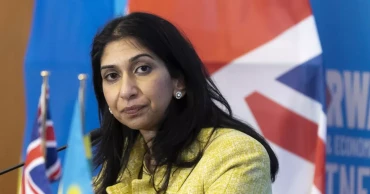
Rishi Sunak fires UK Home Secretary Suella Braverman who accused police of favoring pro-Palestinian protesters
British Prime Minister Rishi Sunak on Monday fired Home Secretary Suella Braverman, a divisive figure who drew anger for accusing police of being too lenient with pro-Palestinian protesters.
The government said Braverman had left her job as part of a Cabinet shuffle as Sunak shakes up his top government team. She was replaced by James Cleverly, who had been foreign secretary.
Braverman said “it has been the greatest privilege of my life to serve as home secretary,” adding that she would “have more to say in due course.”
Sunak had been under growing pressure to fire Braverman — a hard-liner popular with the authoritarian wing of the governing Conservative Party — from one of the most senior jobs in government, responsible for handling immigration and policing.
Read: UN review on human rights in Bangladesh underway in Geneva
In a highly unusual attack on the police last week, Braverman said London’s police force was ignoring lawbreaking by “pro-Palestinian mobs.” She described demonstrators calling for a cease-fire in Gaza as “hate marchers.”
On Saturday, far-right protesters scuffled with police and tried to confront a large pro-Palestinian march by hundreds of thousands through the streets of London. Critics accused Braverman of helping to inflame tensions.
Last week Braverman wrote an article for the Times of London in which she said police “play favorites when it comes to protesters” and acted more leniently toward pro-Palestinian demonstrators and Black Lives Matter supporters than to right-wing protesters or soccer hooligans.
The article was not approved in advance by the prime minister’s office, as would usually be the case.
Braverman, a 43-year-old lawyer, has become a leader of the party’s populist wing by advocating ever-tougher curbs on migration and a war on human rights protections, liberal social values and what she has called the “tofu-eating wokerati.”
Read: Civilians fleeing northern Gaza's combat zone report a terrifying journey on foot past Israeli tanks
Last month she called migration a “hurricane” that would bring “millions more immigrants to these shores, uncontrolled and unmanageable.”
As home secretary Braverman championed the government’s stalled plan to send asylum-seekers who arrive in Britain in boats on a one-way trip to Rwanda. A U.K. Supreme Court ruling on whether the policy is legal is due on Wednesday.
Critics say Braverman has been building her profile to position herself for a party leadership contest that could come if the Conservatives lose power in an election expected next year. Opinion polls for months have put the party 15 to 20 points behind the opposition Labour Party.
2 years ago

International Forum "Primakov Readings" to be held on November 27-28 in Moscow
The ninth edition of the International Forum "Primakov Readings" will be held on November 27-28, 2023 in Moscow.
The theme of the forum is "Postglobalization Horizons". Sergey Lavrov, Russian Minister of Foreign Affairs, will speak at the forum.
“The consequences of the COVID-19 pandemic, the crises in Ukraine and the Middle East, rising tensions between China and the United States, energy risks, as well as security challenges such as climate and migration crises – these and other factors are shaping the post-global world and in this regard are in the focus of this year's Primakov Readings,” Member of the Forum Organizing Committee – Director of Primakov Institute, Corresponding Member of the Russian Academy of Sciences Feodor Voitolovsky said.
Also read: Russia takes aim at urban areas; Biden vows Putin will ‘pay’
The forum will bring together the leading Russian and foreign experts in the field of international security, world politics and economics, representatives of public organizations, politicians and diplomats.
The discussions will center on political risks for the world energy markets, Russia's cooperation with the countries of Central Asia and the South Caucasus, the relationship between China and the United States, and the development of the countries of the "Global South".
Also read: Russia rehearsed 'massive' nuclear strike: Kremlin
The participants will also discuss the balance of power in the Baltic region and the prospects for Russia's relations with the countries of the Middle East and the African continent, said a media release on Tuesday.
The forum program includes a special session with the participation of Alexei Likhachev, Director General of the State Atomic Energy Corporation "Rosatom".
The event is organized by the Primakov Institute of World Economy and International Relations, Russian Academy of Sciences, with the assistance of its partners Primakov Center for International Cooperation, World Trade Center and the Russian Chamber of Commerce and Industry. The project is supported by the Presidential Grants Foundation.
Media accreditation is available on the official forum website (https://www.primakovreadings.ru/en).
International Scientific and Expert Forum "Primakov Readings" is an annual international discussion platform for analysing problems of world economy, politics and security with the participation of leading representatives of Russian and foreign research centers and think tanks.
Also read: Ukrainians prepare firewood and candles to brace for a winter of Russian strikes on the energy grid
It was first held in 2015 and was named after Yevgeny Primakov, a Russian scientist, politician and diplomat who served as Prime Minister of Russia from 1998 to 1999.
2 years ago

Russia rehearsed 'massive' nuclear strike: Kremlin
Russia has practised delivering a "massive" nuclear strike, Kremlin has said.
The military practice featured delivering a "response to an enemy nuclear strike," said Russian Defence Minister Sergei Shoigu, reports BBC.
Also read: Russia rains missiles on recaptured Ukrainian city
Russian state television showed him telling President Vladimir Putin about the rehearsal, it said.
It comes as Russia's parliament endorsed Moscow's departure from a worldwide treaty that prohibits all physical testing of nuclear weapons.
Also read: Ukraine accuses Russia of targeting rescue workers with consecutive missile strikes
Russia and the US perform monthly nuclear readiness simulations, with Moscow often holding its own towards the end of October, said the report.
This year's drills included "delivering a massive nuclear strike by strategic offensive forces in response to an enemy nuclear strike," according to Shoigu's report to Putin.
Also read: Russian missile and drone attack in Ukraine kills 21 people
According to a Kremlin statement, "practical launches of ballistic and cruise missiles" had happened, the report added.
According to the statement, a Yars intercontinental ballistic missile was launched from a test location in Russia's far-east, while another missile was launched from a nuclear-powered submarine in the Barents Sea.
The defence ministry made available video of the testing, the report continued.
Putin announced earlier this month that Russia has conducted a "final successful test" of a nuclear-powered cruise missile.
The experimental weapon, initially unveiled in 2018, was lauded as potentially having an infinite range, but President Putin's story has yet to be officially confirmed.
The new tests will be viewed as a demonstration of force.
There is no indication that the Kremlin intends to strike Ukraine with nuclear weapons, according to the US government.
2 years ago

Women in Iceland including the prime minister go on strike for equal pay and an end to violence
Iceland's prime minister and women across the volcanic island nation went on strike Tuesday to push for an end to unequal pay and gender-based violence.
Prime Minister Katrin Jakobsdottir said she would stay home as part of the "women's day off," and expected other women in her Cabinet would do the same.
"We have not yet reached our goals of full gender equality and we are still tackling the gender-based wage gap, which is unacceptable in 2023," she told news website mbl.is. "We are still tackling gender-based violence, which has been a priority for my government to tackle."
India's cricket board announces equal pay for men and women players
Organizers called on women and nonbinary people to refuse both paid and unpaid work, including household chores, during the one-day strike.
Schools and the health system, which have female-dominated workforces, said they would be heavily affected by the walkout. National broadcaster RUV said it was reducing television and radio broadcasts for the day.
PM likely to visit Saudi Arabia to attend Conference on Women in Islam from Nov 6 to 8
Tuesday's walkout is being billed as biggest since Iceland's first such event on Oct. 24, 1975, when 90% of women refused to work, clean or look after children, to voice anger at discrimination in the workplace. The following year Iceland passed a law guaranteeing equal rights irrespective of gender.
Giving birth in a war zone: Around 50,000 women in Gaza are pregnant
The original strike inspired similar protests in other countries including Poland, where women boycotted jobs and classes in 2016 to protest a proposed abortion ban.
Iceland, a rugged island of some 340,000 people just below the Arctic Circle, has been ranked as the world's most gender-equal country 14 years in a row by the World Economic Forum, which measures pay, education health care and other factors. No country has achieved full equality, an there remains a gender pay gap in Iceland.
Women’s Empowerment: UN finds social, economic, increasing environmental barriers as major obstacles
2 years ago

Ukrainians prepare firewood and candles to brace for a winter of Russian strikes on the energy grid
In the humble backyard of a destroyed house, a 13-year-old chops firewood to get ready for winter. His mother, Tetiana Yarema, has been preparing for months as she remembers last winter's Russian strikes on the energy infrastructure that plunged Ukraine into darkness.
"Those were dark days. I didn't want anything. I just wanted to pack my things and go abroad," said Yarema, 48, who says she ended up staying because of her son's insistence.
For the Yarema family, like millions of other Ukrainians touched by Russia's war on Ukraine, winter is an especially challenging time.
Putin begins visit in China underscoring ties amid Ukraine war and Israeli-Palestinian conflict
The mother and son live in trailers that were set up in their backyard after fighting in the early days of the war destroyed their house in Moshchun, a village about 25 kilometers (15 miles) northwest of Kyiv.
"I have a feeling that when the cold sets in, they'll start bombing again," the woman said, echoing the sentiments of many Ukrainians.
This time, however, they say they are better prepared.
Sales of generators exploded toward the end of summer. Some, who can afford it, have invested in solar panels. Others, like Yarema, have been purchasing candles, batteries, flashlights, and portable lanterns and stocking up on compact gas canisters, making the most of discounted prices.
"It's a bit challenging … but I already know what to do," she said.
600 days into the war, Russia's assault on a key eastern Ukraine city appears to be weakening
Last winter was declared the most challenging in the history of Ukraine's energy system, with over 1,200 missiles and drones fired by Russians at power plants, according to Ukrainian state-owned grid operator, Ukrenergo.
The strikes impacted almost a half of Ukraine's energy capacity. People were forced to endure hours without electricity and water during the coldest months in what Ukrainian officials described as "energy terror."
Millions of people across Ukraine had to learn to work, live, and cover their basic needs without relying on electricity.
After a lull of six months, Ukraine's energy system sustained its first attack of the season on Sept. 21, resulting in damage to facilities in the central and western regions, Ukrenergo said.
Ukrainian President Volodymyr Zelenskyy has committed to substantially enhancing air defense systems, which already have demonstrated greater effectiveness than the previous year.
"Everyone must play their part in defensive efforts to ensure that Russian aggression does not halt Ukraine this winter. Just as on the battlefield, in all areas, we must be resilient and strong," Zelenskyy said in a recent address to the nation.
What to do with 1.1 million bullets seized from Iran? US ships them to Ukraine
Ukrainian Prime Minister Denys Shmyhal recently announced that the United States has allocated $522 million for energy equipment and the protection of Ukraine's infrastructure.
"We stand on the threshold of a difficult winter. Thanks to the assistance of our allies, we successfully weathered the last, which was the most challenging winter season in our history," Shmyhal said.
Major retailer Epicenter said sales of generators increased 80% in August compared to the same time last year, and sales of portable charging stations increased by 25 times.
Yurii Musienko, 45, another resident of Moshchun, also plans to rely heavily on firewood, and has a wood-burning stove in his compact wooden trailer that has been provided to him for two years, and which sits next to his ruined home.
"I've already adapted," he said with a smile. The gates of his home still bear the holes from exploded ammunition that serve as a reminder of when Russian forces tried to seize the Ukrainian capital.
Biden says there’s ‘not much time’ to keep aid flowing to Ukraine and Congress must ‘stop the games’
"May no one ever have to endure such conditions," said his mother, Valentyna Kiriian, who lives in a separate plastic trailer installed in the same courtyard.
She's dressed in a hat and a coat, with multiple layers of clothing to stay warm. She notes that the cold has already set in, forcing her to sleep fully clothed, much like the previous winter.
During the power outages last winter, the mother and son relied on canned food. Occasionally, Valentyna would visit her neighbor, whose house remained intact and had a gas stove for boiling water.
"It's difficult for me to talk about. It pains my soul, and my heart weeps," she said.
Private Ukrainian energy producer DTEK has spent the last seven months restoring its damaged infrastructure and fortifying the protection of its equipment for the approaching winter.
The company invested about 20 billion Ukrainian hryvnias ($550 million) to prepare for the upcoming season, and it lost billions of hryvnias because of last year's disruptions caused by Russian attacks, according to CEO Maxim Timchenko.
"We learned our lessons," Timchenko said.
Andrii Horchynskyi, 49. who lives in the village of Maliutianka about 25 kilometers (15 miles) southwest of Kyiv, has invested over $30,000 in recent years to ensure his house is self-sufficient, and ramped up those efforts since Russia's invasion.
Last year, he spent $12,000 to install solar panels to help power his spacious house, where other members of his extended family came to stay for the winter — eight of them surviving comfortably.
"We had a whole ant heap here," Horchynskyi recalled.
He is convinced the Russians will try to damage Ukraine's infrastructure for gas, which he thinks will become expensive or even unavailable. So, he has installed a boiler that burns pine pellets. He also stores one and half cubic meters of water in his backyard.
"They will bombard even more this winter than the last," Horchynskyi said.
2 years ago

Tens of thousands of pro-Palestinian protesters march in London as Israel-Hamas war roils the world
Tens of thousands of pro-Palestinian demonstrators marched through a rainy London on Saturday to demand Israel stop its bombardment of Gaza, and similar calls were heard in cities around the world as the Israel-Hamas war entered its third week.
On the day a trickle of aid entered Gaza, where more than 1 million people have left their homes because of the conflict, protesters gathered in at Marble Arch near London's Hyde Park before marching to the government district, Whitehall.
Police estimated the crowd that wound its way through the city for three hours at “up to 100,000.”
Waving Palestinian flags and chanting “Stop bombing Gaza,” participants called for an end to Israel’s blockade and airstrikes launched in the wake of a brutal incursion into southern Israel by the Hamas militant group that controls Gaza.
Authorities in Gaza say more than 4,300 people have been killed in the territory since the latest war began. More than 1,400 people have been killed in Israel, mostly civilians slain during Hamas’ deadly incursion on Oct. 7.
Israel continued to bombard targets in Gaza on Saturday ahead of an expected ground offensive. A small measure of relief came when 20 trucks carrying humanitarian aid were allowed to enter Gaza across the southern Rafah border crossing with Egypt.
The war has raised tensions around the world, with both Jewish and Muslim communities feeling under threat. The British Transport Police force said it was investigating after footage was posted online that appears to show a London Underground driver leading passengers in a chant of “Free, free Palestine” over the subway intercom.
British authorities urged demonstrators to be mindful of the pain and anxiety felt by the Jewish community. London’s Metropolitan Police force says it has seen a 13-fold upsurge in reports of antisemitic offenses in October compared to last year. Reports of anti-Muslim crimes have more than doubled.
Read: Islamic parties stage protest condemning Israeli attacks on Palestine
Police said there had been "pockets of disorder and some instances of hate speech” during protests over the war, but “the majority of the protest activity has been lawful and has taken place without incident.”
Hundreds of pro-Palestinian protesters also gathered in Belfast and in Northern Ireland’s second city, Londonderry, where speakers included lawmaker Colum Eastwood of the Irish nationalist Social Democratic and Labour Party.
“The murder of children is wrong,” he told the crowd, calling for an immediate cease-fire in the conflict. “I don’t know how that is so difficult for some of our world leaders to actually utter. It doesn’t matter whether they are Israeli children or Palestinian children.”
Across the border in the Republic of Ireland, thousands marched through the capital, Dublin, calling for an end to Israel's bombardment.
In France, pro-Palestinians demonstrators gathered in several cities including Rennes, Montpellier, Dijon and Lyon, where thousands of people could be seen chanting “we all are Palestinians” in the central square.
In Marseille, the country’s second-largest city, some people took to the streets, waving Palestinians flags and shouting “Free Gaza,” despite the protest being banned by local police.
A pro-Palestinian gathering scheduled for Sunday in Paris has been allowed by police.
German police said almost 7,000 people took part in a peaceful pro-Palestinian demonstration in Düsseldorf on Saturday. The demonstrators carried Palestinian flags or banners calling for an end to “violence and aggression in Gaza.”
Police in Berlin banned a pro-Palestinian demonstration that was scheduled for Sunday in the center of the city, German news agency dpa reported. Police in the German capital have stopped several similar events in recent weeks, citing the potential of violence and antisemitic hate speech. Some pro-Palestinian demonstrators have taken to the streets anyway, resulting in clashes with police.
Read: Overwhelmed to see love and support here for people in Palestine: Ambassador
Authorities allowed a pro-Israel demonstration scheduled for Sunday that was expected to draw together thousands of people in central Berlin.
Elsewhere, several hundred people marched through Rome on Saturday, some holding signs saying “Palestine, Rome is with you,” and “No peace until we get freedom.”
“Israel carries out war crimes there, crimes against humanity there, and the international community has never acted,” said Maya Issa, president of the Movement of Palestinian Students in Italy, which organized the demonstration.
Tens of thousands of demonstrators waving Palestinian flags flooded the streets of downtown Barcelona to demand an end to the Israeli airstrikes.
In Muslim-majority Kosovo, several hundred people walked from mosques to Pristina's Zahir Pajaziti square after lunchtime prayers to express support for Palestinians.
In Australia, thousands marched through central Sydney on Saturday, shouting “Shame, shame Israel” and “Palestine will never die.”
The war sparked protests across the Arab world and beyond on Friday, including in the occupied West Bank, where Palestinians burned tires and threw stones at Israeli military checkpoints. Israeli security forces responded firing tear gas and live rounds.
Crowds gathered in Israel’s northern neighbor Lebanon; in Iraq at the country’s border crossing with Jordan; in Jordan itself; in cities and towns across Egypt; in Turkey’s capital Ankara and its most populous city of Istanbul; and in Indonesia, Malaysia, Morocco and South Africa.
In New York, hundreds of protesters from Muslim, Jewish and other groups marched to U.S. Sen. Kristen Gillibrand’s Manhattan office, many shouting “cease fire now.” Police later arrested dozens of protesters who blocked Third Avenue outside Gillibrand’s office by sitting in the road.
Read more: Only dialogue, diplomacy can offer a lasting solution to Israel-Palestine conflict: Bangladesh
Thousands of demonstrators also marched through the streets of downtown Los Angeles demanding an immediate cease-fire.
Pro-Israel demonstrations and vigils have also been held around the world, many focused on securing the return of hostages captured by Hamas.
Rome’s Jewish community on Friday remembered the more than 200 people believed held by Hamas by setting a long Shabbat table for them outside the capital’s main synagogue and empty chairs for each of the hostages.
On the back of each chair was a flyer featuring the name, age and photo of each missing person. On the table were candles, wine and loaves of challah, the braided bread typically eaten during the Friday night meal.
2 years ago