europe

A bus crashes off the road in central Turkey, leaving 12 passengers dead
A passenger bus veered off the road and crashed into a roadside ditch in central Turkey on Monday, killing 12 people and injuring 19 others, officials said.
The driver of the bus lost control of the vehicle, which crossed into the oncoming lane and then plunged into the ditch near the central Turkish city of Yozgat, Gov. Mehmet Ali Ozkan said.
The bus was traveling from Sivas — some 240 kilometers (150 miles) east of Yozgat — to Istanbul.
Read: 131 dead in 137 railway accidents in 6 months of 2023: SCRF
Ozkan said 11 of the passengers died at the scene of the crash while one died later in the hospital.
The injured passengers were being treated in nearby hospitals and one of them was in serious condition, he said.
The cause of the crash was under investigation, Ozkan said, adding that it appeared to be the result of “carelessness” by the driver.
Read more: 16 workers killed in the collapse of a crane being used to build a bridge in India
2 years ago

China appears to be building an airstrip on a disputed South China Sea island
China appears to be constructing an airstrip on a disputed South China Sea island that is also claimed by Vietnam and Taiwan, according to satellite photos analyzed by The Associated Press.
The work on Triton island in the Paracel group mirrors construction on seven human-made islands in the Spratly group to the east which have been equipped with airstrips, docks and military systems, although it currently appears to be somewhat more modest in scale.
China claims virtually the entire South China Sea as its own, denying the claims of others and defying an international ruling invalidating its assertion.
Also read: India and China pledge to maintain 'peace and tranquility' along disputed border despite tensions
Satellite photos from Planet Labs PBC analyzed by the AP show construction on the airstrip first visible in early August. News website The Drive first reported on the satellite images Tuesday.
The runway, as currently laid out, would be more than 600 meters (2,000 feet) in length, long enough to accommodate turboprop aircraft and drones, but not fighter jets or bombers.
Also visible are large numbers of vehicle tracks running across much of the island, along with what appear to be containers and construction equipment.
Triton is one of the major islands in the Paracels, which is roughly equidistant from the coast of Vietnam and China's island province of Hainan.
The U.S. takes no stance on the sovereignty claims, but regularly sends Navy ships on "freedom of navigation operations" near the Chinese-held islands. Triton was the focus of one of those missions in 2018.
Also read: China says US military aid to Taiwan will not deter its will to unify the island
China has had a small harbor and buildings on the island for years, along with a helipad and radar arrays. Two large fields on the island sport a star from the Chinese flag and a hammer and sickle representing the ruling Communist Party.
China has refused to provide details of its island construction work other than to say it is aimed at helping global navigation safety. It has rejected accusations that it is militarizing the crucial waterway, through which an estimated $5 trillion in trade passes annually, and says it has the right to do as it wishes in its sovereign territory.
China seized full control of the Paracels from Vietnam in a brief 1974 naval conflict.
Also read: US -China conflict: A civilizational or a cold war ?
2 years ago

Migrant sea arrivals more than double so far in 2023
Migrant sea arrivals more than doubled in the first seven months of 2023 compared to the same period last year, according to interior ministry data released on Tuesday.
Italy registered 89,158 landings on its southern shores from January to July, compared to 41,435 in 2022, a rise of 115.18%.
Read: Russia evacuates 2,000 in Far East flooding
In the first seven months of the year the main country of departure to Italy was Tunisia.
In the same period in 2022 the main country of departure was Libya.
2023 has also seen an increase in the number of arrivals following search and rescue events, according to the ministry.
Read: Ukraine accuses Russia of targeting rescue workers with consecutive missile strikes
In the period January-July 64,764 migrants and refugees - 72.64% of total sea arrivals - were disembarked in Italy following a sea rescue, compared to 19,171 - 43.27% of the total - in the same period in 2022.
Of the people disembarked following sea rescue, 5.8% were rescued by humanitarian ships run by NGOs.
The number of applications for asylum also increased by 70.59% to 72,460, the ministry said.
Read: Europe gripped by extreme weather as 'era of global boiling' arrives
Some 2,561 people were repatriated following a negative outcome to their asylum claim, up 28.05% over the same period last year.
2 years ago
Russia hits Ukrainian grain depots again as a foreign ship tries out Kyiv's new Black Sea corridor
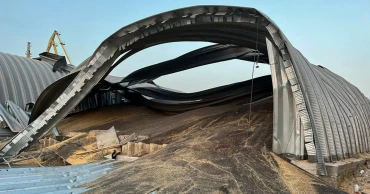
KYIV, Ukraine,Aug 16(AP/UNB) Russia resumed its targeting of grain infrastructure in Ukraine's southern Odesa region, local officials said Wednesday, using drones in overnight strikes on storage facilities and ports along the Danube River that Kyiv has increasingly used for grain transport to Europe after Moscow broke off a key wartime export deal through the Black Sea.
Read also:Ukraine accuses Russia of targeting rescue workers with consecutive missile strikes
At the same time, a loaded container ship stuck at the port of Odesa since Russia's full-scale invasion more than 17 months ago set sail and was heading through the Black Sea to the Bosporus along a temporary corridor established by Ukraine for merchant shipping.
Read also:Russia promises retaliation after Ukrainian drones hit a Russian tanker in 2nd sea attack in a day
Ukraine's economy, crunched by the war, is heavily dependent on farming. Its agricultural exports, like those of Russia, are also crucial for world supplies of wheat, barley, sunflower oil and other food that developing nations rely on.
Read also:US to send $200 million in military aid to Ukraine
After the Kremlin tore up a month ago an agreement brokered last summer by the U.N. and Turkey to ensure safe Ukraine grain exports through the Black Sea, Kyiv has sought to reroute transport through the Danube and road and rail links into Europe. But transport costs that way are much higher, some European countries have balked at the consequences for local grain prices, and the Danube ports can't handle the same volume as seaports.
Odesa Gov. Oleh Kiper said the primary targets of Russia's overnight drone bombardment were port terminals and grain silos, including at the ports in the Danube delta. Air defenses managed to intercept 13 drones, according to Kiper.
It was the latest attack amid weeks of aerial strikes as Russia has targeted the Danube delta ports, which are only about 15 kilometers (10 miles) from the Romanian border. The Danube is Europe's second-longest river and a key transport route.
Meanwhile, the container ship departing Odesa was the first vessel to set sail since July 16, according to Oleksandr Kubrakov, Ukraine's deputy prime minister. It had been stuck in Odesa since February 2022.
The Hong Kong-flagged Joseph Schulte was traveling down a temporary corridor that Ukraine asked the International Maritime Organization to ratify. The United States has warned that the Russian military is preparing for possible attacks on civilian shipping vessels in the Black Sea.
Sea mines also make the voyage risky, and ship insurance costs are likely to be high for operators. Ukraine told the IMO it would would "provide guarantees of compensation for damage."
Last Sunday, a Russian warship fired warning shots at a Palau-flagged cargo ship in the south Black Sea. According to Russia's Defense Ministry, the Sukru Okan was heading northwards to the Ukrainian Danube River port of Izmail.
Ship-tracking data analyzed by The Associated Press confirmed that the Joseph Schulte was steaming south.
The Joseph Schulte is carrying more than 30,000 tons of cargo, with 2,114 containers, including food products, according to Kubrakov.
He said the corridor will be primarily used to evacuate ships stuck in the Ukrainian ports of Chornomorsk, Odesa and Pivdennyi since the outbreak of war.
On the war's front line, Ukrainian officials claimed another milestone in Kyiv's grinding counteroffensive, with Deputy Defense Minister Hanna Maliar saying troops have retaken a village in the eastern Donetsk region.
The village of Urozhaine is near Staromaiorske, a hamlet that Ukraine also claimed to have recaptured recently. The claims could not be independently verified.
Ukraine appears to be trying to drive a wedge between Russian forces in the south, but it is up against strong defensive lines and is advancing without air support.
Also Wednesday, the Russian military said it shot down three drones over the Kaluga region southwest of Moscow and blamed the attack on Ukraine. No damage or casualties were reported.
2 years ago

Russia evacuates 2,000 in Far East flooding
Over 2,000 people have been evacuated from flooded areas of the Primorye region in Russia’s Far East, emergency officials said Sunday.
The heavy downpours that flooded villages in the region were slated to bring double the monthly rainfall to some areas over the weekend, according to Russian state media.
Read: Deadly flooding is hitting several countries at once. Scientists say this will only be more common
“More than 2,000 people, including 405 children, have been evacuated in Primorye,” the Russian Emergency Situations Ministry said on Telegram.
Over 4,300 residential buildings were flooded and 28 settlements cut off by floodwaters, with 16 of the region’s districts affected.
Read: Beijing records heaviest rainfall in at least 140 years, causing severe flooding and 21 deaths
On Friday, local officials said that downpours had already caused floods in seven districts and killed at least three people — a woman and two children, ages 10 and 12.
The rain was from the remnants of Typhoon Khanun, which earlier battered Japan and the Korean Peninsula.
Read more: 11 dead and 27 missing in flooding around Beijing after days of rain
2 years ago

Putin profits off US and European reliance on Russian nuclear fuel
The U.S. and its European allies are importing vast amounts of nuclear fuel and compounds from Russia, providing Moscow with hundreds of millions of dollars in badly needed revenue as it wages war on Ukraine.
The sales, which are legal and unsanctioned, have raised alarms from nonproliferation experts and elected officials who say the imports are helping to bankroll the development of Moscow’s nuclear arsenal and are complicating efforts to curtail Russia’s war-making abilities. The dependence on Russian nuclear products — used mostly to fuel civilian reactors — leaves the U.S. and its allies open to energy shortages if Russian President Vladimir Putin were to cut off supplies. The challenge is likely to grow more intense as those nations seek to boost production of emissions-free electricity to combat climate change.
“We have to give money to the people who make weapons? That’s absurd,” said Henry Sokolski, executive director of the Washington-based Nonproliferation Policy Education Center. “If there isn’t a clear rule that prevents nuclear power providers from importing fuel from Russia — and it’s cheaper to get it from there — why wouldn’t they do it?”
Russia sold about $1.7 billion in nuclear products to firms in the U.S. and Europe, according to trade data and experts. The purchases occurred as the West has leveled stiff sanctions on Moscow over its 2022 invasion of Ukraine, blocking imports of such Russian staples as oil, gas, vodka and caviar.
Russia’s military push on the eastern front prompts Ukraine to evacuate thousands of civiliansThe West has been reluctant to target Russia’s nuclear exports, however, because they play key roles in keeping reactors humming. Russia supplied the U.S. nuclear industry with about 12% of its uranium last year, according to the U.S. Energy Information Administration. Europe reported getting about 17% of its uranium in 2022 from Russia.
Reliance on nuclear power is expected to grow as nations embrace alternatives to fossil fuels. Nuclear power plants produce no emissions, though experts warn that nuclear energy comes with the risk of reactor meltdowns and the challenge of how to safely store radioactive waste. There are about 60 reactors under construction around the world — 300 more are in the planning stages.
Many of the 30 countries generating nuclear energy in some 440 plants are importing radioactive materials from Russia’s state-owned energy corporation Rosatom and its subsidiaries. Rosatom leads the world in uranium enrichment, and is ranked third in uranium production and fuel fabrication, according to its 2022 annual report.
Rosatom, which says it is building 33 new reactors in 10 counties, and its subsidiaries, exported around $2.2 billion worth of nuclear energy-related goods and materials last year, according to trade data analyzed by the Royal United Service Institute, a London-based think-tank. The institute said that figure is likely much larger because it is difficult to track such exports.
Rosatom’s CEO Alexei Likhachyov told the Russian newspaper Izvestia the company’s foreign business should total $200 billion over the next decade. That lucrative civilian business provides critical funds for Rosatom’s other major responsibility: designing and producing Russia’s atomic arsenal, experts say.
Ukrainian officials have pleaded with world leaders to sanction Rosatom to cut off one of Moscow’s last significant funding streams and to punish Putin for launching the invasion. Ukrainian President Volodmyr Zelenskyy again pressed Western leaders to target Rosatom after Russian forces captured the Zaporizhzhia nuclear power plant. Rosatom is running the partially shutdown plant, and the International Atomic Energy Agency has repeatedly warned that a radiation leak at the Russian-occupied facility could be a major disaster.
“Ukraine does not understand why sanctions have not yet been introduced against Rosatom and its leadership,” Zelenskyy said in May, “when representatives of this company continue to occupy Zaporizhzhia Nuclear Power Plant and put our general security at risk.”
Nuclear energy advocates say the U.S. and some European countries would face difficulty in cutting off imports of Russian nuclear products. The U.S. nuclear energy industry, which largely outsources its fuel, produces about 20% of U.S. electricity.
The value of Russian nuclear fuel and products sent to the U.S. hit $871 million last year, up from $689 million in 2021 and $610 million in 2020, according to the U.S. Census Bureau. In terms of weight, U.S. imports of uranium products from Russia nearly doubled from 6.3 tons in 2020 to 12.5 tons in 2022, according to trade data from ImportGenius.
The reasons for that reliance goes back decades. The U.S. uranium industry took a beating following a 1993 nonproliferation deal that resulted in the importation of inexpensive weapons-grade uranium from Russia, experts say. The downturn accelerated after a worldwide drop in demand for nuclear fuel following the 2011 meltdown of three reactors at Japan’s Fukushima Daiichi power plant.
American nuclear plants plants purchased 5% of their uranium from domestic suppliers in 2021, the last year for which official U.S. production data are available, according to the U.S. Energy Information Administration. The largest source of uranium for such plants was Kazakhstan, which contributed about 35% of the supply. A close Russian ally, Kazakhstan is the world’s largest producer of uranium.
The Biden administration says it is trying to revive uranium mining and the production of nuclear fuel, and lawmakers have introduced legislation to speed up the process. This week, however, President Joe Biden announced the formation of a national monument to preserve land around Grand Canyon National Park that would prevent new uranium mining in the region.
“It is critical that we stop funding Russia’s state-owned nuclear monopoly, Rosatom,” said Sen. John Barrasso, the Wyoming Republican who introduced legislation earlier this year to fund America’s nuclear fuel supply chain. “We also need to give America’s nuclear fuel suppliers market certainty.”
Europe is in a bind largely because it has 19 Russian-designed reactors in five countries that are fully dependent on Russian nuclear fuel. France also has a long history of relying on Russian-enriched uranium. In a report published in March, Greenpeace, citing the United Nations’ Comtrade database, showed that French imports of enriched uranium from Russia increased from 110 tons in 2021 to 312 tons in 2022.
Europe spent nearly $828 million (almost €750 million) last year on Russian nuclear industry products — including fuel elements, nuclear reactors, and machinery — according to Eurostat, the EU’s statistics office.
Some European nations are taking steps to wean themselves off Russian uranium. Early on in the Ukraine conflict, Sweden refused to purchase Russian nuclear fuel. Finland, which relies on Russian power at two out of its five reactors, scrapped a trouble-ridden deal with Rosatom to build a new nuclear power plant. Finnish energy company Fortum also announced an agreement with the U.S. Westinghouse Electric Company to supply fuel for two reactors after its contracts with Rosatom subsidiary Tvel expire over the next seven years.
The Czech Republic has sought to wean itself off Russian supplies completely and turned to Westinghouse and the French company Framatome for future shipments of fuel assemblies for its only nuclear power plant, currently supplied by Tvel, with the new supplies expected to begin in 2024. Slovakia and Bulgaria, two other countries that rely on Tvel for nuclear fuel, have also turned to different suppliers.
Despite the challenges, experts believe political pressure and questions over Russia’s ability to cut off supplies will eventually spur much of Europe to abandon Rosatom. “Based on apparent prospects (of diversification of fuel supplies), it would be fair to say that Rosatom has lost the European market,” said Vladimir Slivyak, co-chair of the Russian environmental group Ecodefense.
What remains unclear, Slivyak said, are how Hungary and France will address the issue. France has not expressed a willingness to shut off Russia’s uranium spigot. Hungary, which maintains close ties to Russia, is fully dependent on Moscow to provide fuel for its four-reactor nuclear power plant. It has plans to expand that plant by two Rosatom reactors — a project that is financed by a 10 billion euro line of credit from a Russian bank.
Those reactors, experts said, will be fully reliant on Russian nuclear fuel for years, if not decades, to come.
2 years ago

Ukraine accuses Russia of targeting rescue workers with consecutive missile strikes
Ukrainian officials on Tuesday accused the Kremlin’s forces of targeting rescue workers by hitting residential buildings with two consecutive missiles — the first one to draw crews to the scene and the second one to wound or kill them.
The strikes Monday evening in the downtown district of the city of Pokrovsk killed nine people and wounded more than 80 others, Ukrainian President Volodymyr Zelenskyy said in his nightly address. According to Ukrainian authorities, one of those killed was an emergency official, and most of those wounded were police officers, emergency workers and soldiers who rushed to assist residents.
The Russian missiles slammed into the center of Pokrovsk in the eastern Donetsk region, which is partially occupied by Russia. Emergency crews were still removing rubble on Tuesday. The Iskander missiles, which have an advanced guidance system that increases their accuracy, hit within 40 minutes of each other, according to Donetsk Gov. Pavlo Kyrylenko said.
Since the start of the war, Russia has used artillery and missiles to hit targets and then struck the exact same spot around 30 minutes later, often hitting emergency teams responding to the first blast. The tactic is called a “double tap” in military jargon. Russians used the same method in Syria’s civil war.
Read: Voters in Ohio reject GOP-backed proposal that would have made it tougher to protect abortion rights
“All of (the police) were there because they were needed, putting their efforts into rescuing people after the first strike,” Ivan Vyhivskyi, chief of Ukraine’s National Police, said Tuesday. “They knew that under the rubble were the injured — they needed to react, to dig, to retrieve, to save. And the enemy deliberately struck the second time.”
Russia’s Ministry of Defense claimed it hit a Ukrainian army command post in Pokrovsk. Neither side’s claims could be independently verified.
Among those injured was Volodymyr Nikulin, a police officer originally from the now Russian-occupied port city of Mariupol.
Arriving at the scene after the first missile strike, Nikulin was wounded in the second strike when shrapnel pierced his left lung and left hand.
“Today is not my happy day because Russian criminals committed another awful crime in Pokrovsk,” he said in a video he sent to The Associated Press from a hospital ward.
In the video, he is seen lying on a bed shirtless, with dried blood on his side and covering his left hand. He moves with pain to show his wounds.
Read: Investigators say Myanmar's military is committing increasingly brazen war crimes
Pointing his camera to show other wounded security forces in the ward, he says: “Look, these are Ukrainian heroes who helped (injured) people.”
He told the National Police in a video that he feared a second strike but went to help anyway.
There were so many injured at the hospital that Nikulin was still waiting for surgery on Tuesday morning. He was later transported to a hospital in Dnipro, where he was to have the shrapnel removed.
Nikulin had already witnessed some of the war’s horrors. He helped an AP team escape after Russian troops that besieged Mariupol entered the downtown area and searched for them.
He was featured in the award-winning documentary “20 Days in Mariupol," a joint project between The Associated Press and PBS “Frontline” about the earliest phase of the invasion of Mariupol.
In a statement, the U.N. humanitarian coordinator in Ukraine, Denise Brown, described the latest attack as “absolutely ruthless” and said it was “a serious breach" of international law and violated "any principle of humanity.”
Since the beginning of Russia’s invasion in February 2022, 78 employees of Ukraine's State Emergency Service have been killed and 280 have been wounded while responding to Russian missile strikes, according to agency spokesperson Col. Oleksandr Khorunzhyi.
Ukrainian officials say rescuers are protected by international conventions as they are providing humanitarian assistance and are not engaged in combat operations.
The head of the Pokrovsk city administration, Serhii Dobriak, described the attacks as “a typical Russian scenario," with 30 to 40 minutes between missiles.
“When rescuers come to save people’s lives, another rocket arrives. And the number of casualties increases,” he said in a video comment to local media.
Kyrylenko, the regional governor, said that 12 multistory buildings were damaged in Pokrovsk, as well as a hotel, a pharmacy, two stores and two cafes.
The roof of one building was partially demolished, and rubble filled the sidewalk outside. Across the road, a children's playground was wrecked.
Russian missiles, drones and artillery have repeatedly struck civilian areas in the war. The Kremlin says its forces target only military assets and claims other damage is caused by debris from Ukrainian air defenses.
Meanwhile, an overnight attack on the town of Kruhliakivka, in the northeastern Kharkiv region, killed three people and injured nine others, Gov. Oleh Syniehubov said.
Russia also dropped four guided bombs on a village near Kupiansk, in the Kharkiv region, killing two civilians, Ukraine’s presidential office said.
Rescuers later came under fire, and two of them were wounded, it said.
Also on Tuesday, Russian-installed authorities of the Donetsk region accused Kyiv's forces of shelling the region's namesake capital and killing three people. The Moscow-appointed leader of the Donetsk region, Denis Pushilin, said Ukrainian shelling of the Russian-held city of Donetsk also wounded 11.
2 years ago

New Covid-19 variant ‘Eris’ growing at a 20.5% rate per week in the UK
The EG.5.1 form of Covid-19 that is currently spreading is just another illustration of how the virus will continue to mutate.
The World Health Organization (WHO) listed EG.5# as another severe acute respiratory coronavirus 2 (SARS-CoV-2) variant to its variation under monitoring (VUM) list on July 19, 2023, reports Forbes.
Also read: Symptoms of Omicron: How is it different from Covid-19 Variant Delta?
Currently, this WHO VUM serves as a catch-all for any variant beginning with EG.5, such as EG.5 and EG.5.1.
On Twitter, T Ryan Gregory, PhD, a Professor of Integrative Biology at the University of Guelph in Ontario, Canada, coined the term "Eris" to describe the EG.5.1 variation.
“There's nothing particularly special about EG.5.1 [XBB.1.9.2.5.1] as far as we can tell,” Gergory’s tweet read.
Also read: Omicron sub-variant detected in Bangladesh: Researchers
Given the rate at which it has spread, it appears to be more transmissible than preceding forms.
According to the UK Health Security Agency, as of July 20, the EG.5.1 variant accounted for 14.55% of all Covid-19 cases and was growing at a pace of 20.51% each week in the UK.
According to the Centres for Disease Control and Prevention (CDC) Covid-19 Data Tracker, EG.5 variants increased from an estimated 11.9% of all Covid-19 cases during the two-week period ending July 22 to 17.3% during the two-week period ending August 5 in the US. It has now eclipsed the XBB.1.16 as the most common variation in the United States, the Forbes report also said.
Also read: Omicron: What we know about the COVID-19 Variant so far
The emergence and spread of Eris should not cause panic. It is, however, an indication of how the Covid-19 virus continues to change and remains a problem. Everyone should keep up to date on what varieties arise and what they are doing.
2 years ago

Russia promises retaliation after Ukrainian drones hit a Russian tanker in 2nd sea attack in a day
Moscow promised retaliation Saturday after Ukrainian drones hit a Russian tanker in the Black Sea near Crimea late Friday, the second sea attack involving drones in one day.
Ukraine struck a major Russian port earlier on Friday.
Moscow strongly condemned what it sees as a Ukrainian "terrorist attack" on a civilian vessel in the Kerch Strait, said Russian Foreign Ministry spokeswoman Maria Zakharova.
Also read: Overnight drone attack on Moscow injures 1, temporarily closes airport for traffic
"There can be no justification for such barbaric actions, they will not go unanswered and their authors and perpetrators will inevitably be punished," she wrote on the Telegram messaging app.
As Kyiv's naval capabilities grow, the Black Sea is becoming an increasingly important battleground in the war.
Three weeks ago, Moscow withdrew from a key export agreement that allowed Ukraine to ship millions of tons of grain across the Black Sea for sale on world markets. In the wake of that withdrawal, Russia carried out repeated strikes on Ukrainian ports, including Odesa.
An official with Ukraine's Security Service confirmed to The Associated Press that the service was behind the attack on the tanker, which was transporting fuel for Russian forces. A sea drone, filled with 450 kilograms (992 pounds) of TNT, was used for the attack, added the official, who spoke on condition of anonymity because he was not authorized to give official statements.
Also read: Ukraine wants ships to keep exporting its grain despite Russian attacks. Some are interested
"The Sig tanker ... suffered a hole in the engine room near the waterline on the starboard side, presumably as a result of a sea drone attack," Russia's Federal Agency for Marine and River Transport wrote on Telegram, adding that there were no casualties among the 11 crew members.
Vladimir Rogov, a Kremlin-installed official in Ukraine's partially occupied southern Zaporizhzhia region, said several members of the ship's crew were wounded because of broken glass.
Without specifying that Ukraine was responsible for the drone strike, Vasyl Malyuk, who leads Ukraine's Security Service, said that "such special operations are conducted in the territorial waters of Ukraine and are completely legal." Any such explosions, he said, are "an absolutely logical and effective step with regard to the enemy."
The attack briefly halted traffic on the Kerch Bridge, as well as ferry transport.
Tugboats were deployed to assist the tanker, which is under United States sanctions for helping provide jet fuel to Russian forces fighting in Syria, according to Russia's Tass news agency.
Ukraine's earlier strike on Novorossiysk halted maritime traffic for a few hours and marked the first time a commercial Russian port has been targeted in the nearly 18-month-old conflict. The port has a naval base, shipbuilding yards and an oil terminal, and is key for exports. It lies about 110 kilometers (about 60 miles) east of Crimea.
Shipping expert Jayendu Krishna told The Associated Press that the attacks left Russian shipping activity "largely unaffected." He believes that they may increase the risk of Russian attacks on Ukrainian ports rather than serving as a tool to put pressure on Russia to halt attacks and reinstate the grain deal.
"Every time anything happens to Russia, you see Putin in retaliation mode … therefore, you may see further attacks on other parts of Ukraine," Krishna said.
"I think it will probably compound the effect and compound the risk in the Black Sea, rather than reducing it," he added. "It's very difficult for me to imagine that Russia will give in, unless and until their banks have smooth operations, and they're able to export their own cargo uninterruptedly."
A Telegram post on Saturday by Deputy Chair of Russia's Security Council Dmitry Medvedev implied that Russia would increase its attacks against Ukrainian ports in response to Kyiv's attacks on Russian ships in the Black Sea:
"Apparently, the strikes on Odesa, Izmail, and other places were not enough for them," he wrote.
In other developments, Russia's Defense Ministry said Saturday it captured a settlement in Ukraine's easternmost Luhansk region, most of which is occupied by Russia. "In the area of Kupiansk … the settlement of Novoselivske was liberated," the ministry wrote on Telegram.
Elsewhere, a two-day summit on finding a peaceful settlement to the war kicked off in Saudi Arabia.
Senior officials from around 40 countries – but not Russia – will aim to agree key principles on how to end the conflict.
"It is very important because in such matters as food security, the fate of millions of people in Africa, Asia, and other parts of the world directly depends on how fast the world will be in implementing the Peace Formula," Ukrainian President Volodymyr Zelenskyy said of the summit. "I am grateful to Saudi Arabia for this platform for negotiations."
Also read: By pulling out of the Ukrainian grain deal, Russia risks alienating its few remaining partners
The main Ukrainian envoy to the summit in Jeddah, chief Ukrainian presidential aide Andriy Yermak, spoke of the talks on Friday night in a television interview published on his Telegram account: "I expect that the conversation will be difficult, but behind us is truth, behind us goodness," he said.
Commenting on the talks in Saudi Arabia, Zakharova told Russian state media that the idea of making decisions on the conflict without the participation of Moscow was "absurd." Nevertheless, she said, delegates have "full scope for creativity" to discuss the issue.
2 years ago

Europe gripped by extreme weather as 'era of global boiling' arrives
Record-breaking heatwaves and droughts, devastating wildfires, torrential rain and hailstorms all across Europe are costing lives, damaging infrastructure, diminishing biodiversity and hitting tourism, harvests and the economy. Some governments have imposed rules to ensure the safety of their workers and are calling for rigorous measures to combat climate change.
Hotspot
Heatwaves have simultaneously gripped three continents in the Northern Hemisphere this summer as global warming worsens. In Mediterranean countries especially favoured by tourists, such as Spain, Italy and Greece, temperatures have topped 40 degrees celsius in places, and further heatwaves are expected. The Mediterranean region has long been classified as a climate change hotspot by the United Nations Intergovernmental Panel on Climate Change (IPCC).
July is set to be the hottest month in thousands of years, climate scientists from the World Meteorological Organisation (WMO) and the European Climate Change Service Copernicus reported after analysing data up to July 23.
"We don't have to wait for the end of the month to know this.
Short of a mini-Ice Age over the next days, July 2023 will shatter records across the board," UN Secretary-General António Guterres said, adding that "the era of global warming has ended; the era of global boiling has arrived." Scientists from the World Weather Attribution initiative said the heatwaves that have hit parts of Europe and North America in July would have been almost impossible without human-caused climate change.
Read: Italy's extraordinary heatwave approaches peak
"We are seeing unprecedented changes all over the world," top NASA climatologist Gavin Schmidt said, with records being broken on land and at sea.
Over the past year, more than 60,000 people have died in Europe due to extreme heat, according to Hans Kluge, the World Health Organisation's director for Europe, adding that the number of deaths from extreme heat "is set to rise year-on-year."
Europe split in two extremes
Although the weather in Germany and northern Europe this July felt less warm than in other summers, heatwaves in North America, Asia and southern Europe lifted the global average.
Greece has been battling devastating wildfires driven by intense heat on the islands of Evia, Corfu and Rhodes. Thousands of people have been evacuated. According to the European Commission, European Union countries have been supporting Greece with almost 500 firefighters and seven planes deployed to different areas in the country.
"Together, we are deploying available resources to fight the fires and protect our citizens and landscapes," EU Crisis Commissioner Janez Lenarčič said in a statement. Countries worldwide can request help from EU members in case of a disaster, with the European Commission coordinating the deployment of civil protection equipment and experts.
Aside from Greece, other countries in Europe such as Turkey, Spain, Portugal, Italy and France are also facing abnormally sweltering temperatures. In Turkey, temperatures around the Aegean and Mediterranean Sea are up to 8 degrees above the usual level for this time of year, according to the weather service.
Read: 'Heat storm' hits Italy
Fires caused landmines to explode near the southern Croatian city of Dubrovnik, local media reported. So far this summer, Spain has avoided major fires but the country has suffered a drought caused by high temperatures and a months-long lack of rain. After experiencing the second driest spring in 62 years, several areas, such as the two most populated regions Andalusia and Catalonia, have been hit by critically low water levels in reservoir and other storage sites. Reservoirs in Andalusia were at 24 percent of their total capacity last week, while this week in Catalonia, internal basins barely reached 27 percent.
Meanwhile, many European countries and regions experienced other extreme weather events, such as storms with extreme rainfall and wind.
Bosnia and Herzegovina, for example, saw floods and torrents caused by heavy rainfall in May and June which was followed by a first heatwave. Storms and strong winds have caused severe material damage particularly in the north, but also in the southern parts of Bosnia.
While Slovenia was battling the worst fires in its history this time last year, 2023 has seen it face extremely severe storms with heavy rainfall, hail and gail-force winds. Serbia has equally been affected by storms and hail which damaged crops, infrastructure, cars and residential buildings.
Italy experienced "one of the most complicated days in recent decades - rainstorms, tornadoes and giant hail in the north, and scorching heat and devastating fires in the centre and south," said Italian Civil Protection Minister Nello Musumeci. The country battled deadly and destructive fires in the south and equally fatal storms in the north which left at least seven people dead and caused severe damage to property, infrastructure and crops. Most of the fires were caused by arson, prosecutors said.
Extreme temperatures affecting business, infrastructure and peoples' safety
With extremely high temperatures, the need for air conditioning has driven up electricity consumption which in some countries led to day-long or repeated power outages as well as damage to underground cables.
The Maltese Hotel and Restaurant Association reported that frustrated guests had checked out of hotels because of the power cuts. Restaurants and supermarkets in the country had to throw away defrosted food while malfunctioning air conditioners caused Italian McDonald's staff to strike. They complained that they had been "suffocating" in the "intolerable" 40-degree-plus temperatures in the outlets. Several farm labourers have died of heatwave-related causes in Italy, too. CGIL, Italy's biggest trade union, urged authorities to step up efforts to protect workers from the effects of the tropical temperatures that have hit the country. Maurizio Landini, CGIL's leader, said "the heatwave is increasing the risks to the health and safety of female and male workers". He added that "this is totally unacceptable." As a result, the Italian government is now working on a protocol on heat risks and issues at Italian workplaces.
In Germany, the rains are affecting harvests of grain, fruit and vegetables. While the rainfall has forced grain farmers to interrupt their harvests again and again, fruit and vegetable growers are content. Torsten Krawczyk, president of the Saxon state farmers' association, said it had been the most expensive harvest ever. The costs for fertiliser, for example, were twice to three times as high. Significantly more money also had to be paid for labour and energy.
Mitigating climate change, building resilience and protection
Recent extreme weather conditions have prompted governments across Europe to step up their civil protection efforts and take appropriate measures to protect their citizens. UN Secretary-General Guterres called on politicians to take immediate and drastic steps to curb climate change and Pope Francis also renewed his call for action to address the climate crisis in the face of extreme weather events.
Read: Over 30,000 crimes against environment in Italy in 2022
In response to water scarcity in Spain, the regional government of Catalonia has declared a situation of "water exceptionality" in most of its territory. In the almost 500 municipalities affected by the shortage - home to six million people - a restriction of 230 litres of water per inhabitant per day for domestic use has been imposed. A 40 percent reduction in water for agricultural use and a 15 percent cut for industry have also come into force.
In May, the Spanish government approved measures to prevent accidents and deaths in outdoor work that may be affected by adverse weather such as heatwaves. Maltese authorities issued a heat warning urging people not to leave their homes between 11 a.m. and 4 p.m., the hottest hours of the day. Similarly, the Romanian Territorial Labour Inspectorate made it mandatory for employers to take measures to protect their employees' health, such as reducing the intensity of physical activities, ensuring ventilation in the workplace, interspersing physically demanding work with less active duties and introducing more breaks out of the hot sun during working hours.
German Health Minister Karl Lauterbach (SPD) presented a heat protection plan in late July in a bid to halve the number of heat-related deaths this year, mainly by providing more public guidance on how to cope with hot weather. While some saw it as a good starting point, a health policy expert from the opposition conservative CDU Tino Sorge, accused Lauterbach of inappropriate alarmism as common sense should be the guiding principle for protection and prevention.
Slovenia is warming faster than the global average due to its geography, with an average temperature rise of 2.2 degrees between 1980 and 2021. More investment in prevention would definitely be needed, said Environment Minister Uroš Brežan. He stressed that there was a particular need to safeguard water supplies. Business leaders and politicians have been pointing to the need for systemic measures to adapt to climate change as well as intervention to tackle the consequences.
Italian Environment and Energy Security Minister Gilberto Pichetto said "the government is already engaged on this front to ensure close coordination between all the implementing bodies, both in emergencies and ordinary periods." However, he insisted that "the main problem is not funding, but the spending mechanism and procedures".
Record breaking extreme weather not enough to convince some that climate change is real
Despite the extreme weather in Italy, 34.7 percent of Italians believe there is excessive alarm about climate change, according to the Ital Communications-Censis report "Disinformation and fake news in Italy'" The report also showed that 16.2 percent of the overall population denies that climate change exists, with the percentage rising to 18.3 percent among the elderly and to 18.2 percent among the less educated.
This content is based on news by agencies participating in the enr, on this occasion AFP, AGERPRES, ANSA, dpa, EFE, Europa Press, FENA, STA and Tanjug.
2 years ago