europe

Ukraine keeps up pressure following Russian declaration of victory in Bakhmut
Watching imagery from a drone camera overhead, Ukrainian battalion commander Oleg Shiryaev warned his men in nearby trenches that Russian forces were advancing across a field toward a patch of trees outside the city of Bakhmut.
The leader of the 228th Battalion of the 127th Kharkiv Territorial Defense Brigade then ordered a mortar team to get ready. A target was locked. A mortar tube popped out a loud orange blast, and an explosion cut a new crater in an already pockmarked hillside.
“We are moving forward,” Shiryaev said after at least one drone image showed a Russian fighter struck down. “We fight for every tree, every trench, every dugout."
Russian forces declared victory in the eastern city last month after the longest, deadliest battle since their full-scale invasion of Ukraine began 15 months ago. But Ukrainian defenders like Shiryaev aren't retreating. Instead, they are keeping up the pressure and continuing the fight from positions on the western fringes of Bakhmut.
The pushback gives commanders in Moscow another thing to think about ahead of a much-anticipated Ukrainian counteroffensive that appears to be taking shape.
Ukrainian Deputy Defense Minister Hanna Maliar said Russia sought to create the impression of calm around Bakhmut, but in fact, artillery shelling still goes on at levels similar to those at the height of the battle to take the city. The fight, she said, is evolving into a new phase.
“The battle for the Bakhmut area hasn't stopped; it is ongoing, just taking different forms,” said Maliar, dressed in her characteristic fatigues in an interview from a military media center in Kyiv. Russian forces are now trying — but failing — to oust Ukrainian fighters from the “dominant heights” overlooking Bakhmut.
“We are holding them very firmly,” she said.
From the Kremlin's perspective, the area around Bakhmut is just part of the more than 1,000-kilometer (621-mile) front line that the Russian military must hold. That task could be made more difficult by the withdrawal of the mercenaries from private military contractor Wagner Group who helped take control of the city. They will be replaced with Russian soldiers.
For Ukrainian forces, recent work has been opportunistic — trying to wrest small gains from the enemy and taking strategic positions, notably from two flanks on the northwest and southwest, where the Ukrainian 3rd Separate Assault Brigade has been active, officials said.
Russia had envisioned the capture of Bakhmut as partial fulfillment of its ambition to seize control of the eastern Donbas region, Ukraine’s industrial heartland. Now, its forces have been compelled to regroup, rotate fighters and rearm just to hold the city. Wagner’s owner announced a pullout after acknowledging the loss of more than 20,000 of his men.
Maliar described the nine-month struggle against Wagner forces in nearly existential terms: “If they had not been destroyed during the defense of Bakhmut, one can imagine that all these tens of thousands would have advanced deeper into Ukrainian territory.”
The fate of Bakhmut, which lays largely in ruins, has been overshadowed in recent days by near-nightly attacks on Kyiv, a series of unclaimed drone strikes near Moscow and the growing anticipation that Ukraine's government will try to regain ground.
But the battle for the city could still have a lingering impact. Moscow has made the most of its capture, epitomized by triumphalism in Russian media. Any slippage of Russia’s grip would be a political embarrassment for President Vladimir Putin.
Michael Kofman of the Center for Naval Analyses, a U.S. research group, noted in a podcast this week that the victory brings new challenges in holding Bakhmut.
With Wagner fighters withdrawing, Russian forces are “going to be increasingly fixed to Bakhmut ... and will find it difficult to defend,” Kofman told “War on the Rocks" in an interview posted Tuesday.
“And so they may not hold on to Bakhmut, and the whole thing may have ended up being for nothing for them down the line,” he added.
A Western official who spoke on condition of anonymity said Russian airborne forces are heavily involved in replacing the departing Wagner troops — a step that is "likely to antagonize” the airborne leadership, who see the duty as a further erosion of their “previously elite status" in the military.
Ukrainian forces have clawed back slivers of territory on the flanks — a few hundred meters (yards) per day — to solidify defensive lines and seek opportunities to retake some urban parts of the city, said one Ukrainian analyst.
“The goal in Bakhmut is not Bakhmut itself, which has been turned into ruins,” military analyst Roman Svitan said by phone. The goal for the Ukrainians is to hold on to the western heights and maintain a defensive arc outside the city.
More broadly, Ukraine wants to weigh down Russian forces and capture the initiative ahead of the counteroffensive — part of what military analysts call “shaping operations” to set the terms of the battle environment and put an enemy in a defensive, reactive posture.
Serhiy Cherevatyi, a spokesman for Ukrainian forces in the east, said the strategic goal in the Bakhmut area was “to restrain the enemy and destroy as much personnel and equipment as possible” while preventing a Russian breakthrough or outflanking maneuver.
Analyst Mathieu Boulègue questioned whether Bakhmut would hold lessons or importance for the war ahead.
Military superiority matters, he said, but so does “information superiority” — the ability “to create subterfuge, to create obfuscation of your force, to be able to move in the shadows."
Boulègue, a consulting fellow with the Russia and Eurasia program at the Chatham House think tank in London, said those tactics “could determine which side gains an advantage that catches the other side by surprise, and turns the tide of the war.”
3 years ago

Ukrainian president says at least 500 children killed by war
Ukrainian President Volodymyr Zelenskyy said Sunday that Russia's war, now in its 16th month, has killed at least 500 Ukrainian children.
Zelenskyy provided the number hours after rescue workers found the body of a 2-year-old girl who died in one of the latest Russian strikes.
The president said in a statement that “Russian weapons and hatred, which continue to take and destroy the lives of Ukrainian children every day," killed the hundreds who had perished since Russia's full-scale invasion of Ukraine started on Feb. 24, 2022.
“Many of them could have become famous scholars, artists, sports champions, contributing to Ukraine’s history,” he said.
Zelenskyy said it was impossible to establish the exact number of children who were casualties due to the ongoing hostilities and because some areas are under Russian occupation.
“We must hold out and win this war!” the Ukrainian president said. “All of Ukraine, all our people, all our children, must be free from the Russian terror!”
Rescuers found the 2-year-old's body early Sunday while combing through the rubble of an apartment building in the suburbs of the central city of Dnipro.
The regional governor, Serhiy Lysak, said five children were among 22 people injured by Saturday's attack, which damaged two residential buildings.
The Russians launched more strikes with drones and cruise missiles Sunday, targeting multiple areas of the country, including the capital, Kyiv.
The Ukrainian air force said the country's air defenses downed three of the five Shahed self-exploding drones and four of the six cruise missiles fired.
Ukrainian air force spokesman Yurii Ihnat said two missiles struck a military air base in Kropyvnytskyi, a city in central Ukraine's Kyrovohrad province. He did not report what damage they caused.
The Russian military said it has conducted a series of strikes in recent days on Ukrainian air defense batteries, air bases and troops depots. The long-range strikes come as Ukraine prepares for a long-expected counteroffensive in which it hopes to reclaim more ground.
Concerns over civilian safety were exacerbated after officials announced that nearly a quarter of the 4,800 air raid shelters they inspected were locked or unusable.
The acknowledgment on Saturday came after a 33-year-old woman in Kyiv reportedly died while waiting outside a shuttered shelter during a Russian missile barrage on Thursday.
Prosecutors in the capital said four people were detained as part of a criminal probe into the woman's death as she and others waited to enter a locked shelter. A security guard who allegedly failed to unlock the doors remained in custody. Three others, including a local official, were placed under house arrest.
Kyiv Mayor Vitali Klitschko said Saturday that city authorities received “more than a thousand” complaints regarding locked, dilapidated or insufficient air-raid shelters within a day of launching an online feedback service.
3 years ago

Turkey's Erdogan takes oath of office, ushering in his third presidential term
Turkey’s longtime leader, Recep Tayyip Erdogan, took the oath of office on Saturday, ushering in his third presidential term that followed three stints as prime minister.
Erdogan, 69, won a new five-year term in a runoff presidential race last week that could stretch his 20-year rule in the key NATO country that straddles Europe and Asia into a quarter-century. The country of 85 million controls NATO’s second-largest army, hosts millions of refugees and played a crucial role in brokering a deal that allowed the shipment of Ukraine grain, averting a global food crisis.
Also read: What 5 more years of Erdogan's rule means for Turkey
Erdogan was sworn in during a session in parliament before an inauguration ceremony at his sprawling palace complex. Supporters waited outside parliament despite the heavy rain, covering his car with red carnations as he arrived.
All eyes are on the announcement of his new Cabinet later on Saturday. Its lineup should indicate whether there will be a continuation of unorthodox economic policies or a return to more conventional ones amid a cost-of-living crisis.
Dozens of foreign dignitaries are traveling to attend the ceremony, including NATO Secretary General Jens Stoltenberg and Carl Bildt, a high-profile former Swedish prime minister. They are expected to press Erdogan to lift his country’s objections to Sweden’s membership in the military alliance — which requires unanimous approval by all allies.
Also read: Turkey’s Erdogan turns away reform-minded challenger to win another term
Turkey accuses Sweden of being too soft on Kurdish militants and other groups that Turkey considers to be terrorists. NATO wants to bring Sweden into the alliance by the time allied leaders meet in Lithuania on July 11-12, but Turkey and Hungary have yet to endorse the bid. Hungarian Prime Minister Viktor Orban will also be attending the ceremony.
According to state-run Anadolu Agency, other leaders in attendance include Azerbaijan’s Ilham Aliyev, Venezuela’s Nicolas Maduro, South Africa’s Cyril Ramaphosa, Armenia’s Nikol Pashinyan, Pakistan’s Shahbaz Sharif, and Libya’s Abdul Hamid Dbeibah.
Erdogan was sworn in amid a host of domestic challenges ahead, including a battered economy, pressure for the repatriation of millions of Syrian refugees and the need to rebuild after a devastating earthquake in February that killed 50,000 and leveled entire cities in the south of the country.
Turkey is grappling with a cost-of-living crisis fueled by inflation that peaked at a staggering 85% in October before easing to 44% last month. The Turkish currency has lost more than 10% of its value against the dollar since the start of the year.
Critics blame the turmoil on Erdogan’s policy of lowering interest rates to promote growth, which runs contrary to conventional economic thinking that calls for raising rates to combat inflation.
Unconfirmed media reports say Erdogan plans to reappoint Mehmet Simsek, a respected former finance minister and deputy prime minister, to the helm of the economy. The move would signify a return by the country — which is the world’s 19th largest economy according to the World Bank — to more orthodox economic policies.
In power as prime minister and then as president since 2003, Erdogan is already Turkey’s longest-serving leader. He has solidified his rule through constitutional changes that transformed Turkey’s presidency from a largely ceremonial role to a powerful office. Critics say his second decade in office was marred by sharp democratic backsliding including the erosion of institutions such as the media and judiciary and the jailing of opponents and critics.
Erdogan defeated opposition challenger Kemal Kilicdaroglu in a runoff vote held on May 28, after he narrowly failed to secure an outright victory in a first round of voting on May 14. Kilicdaroglu had promised to put Turkey on a more democratic path and improve relations with the West. International observers deemed the elections to be free but not fair.
3 years ago

Sweden close to becoming first 'smoke free' country in Europe as daily use of cigarettes dwindles
Summer is in the air, cigarette smoke is not, in Sweden's outdoor bars and restaurants.
As the World Health Organization marks “World No Tobacco Day” on Wednesday, Sweden, which has the lowest rate of smoking in the Europe Union, is close to declaring itself “smoke free” — defined as having fewer than 5% daily smokers in the population.
Many experts give credit to decades of anti-smoking campaigns and legislation, while others point to the prevalence of “snus,” a smokeless tobacco product that is banned elsewhere in the EU but is marketed in Sweden as an alternative to cigarettes.
Whatever the reason, the 5% milestone is now within reach. Only 6.4% of Swedes over 15 were daily smokers in 2019, the lowest in the EU and far below the average of 18.5% across the 27-nation bloc, according to the Eurostat statistics agency.
Figures from the Public Health Agency of Sweden show the smoking rate has continued to fall since then, reaching 5.6% last year.
“We like a healthy way to live, I think that’s the reason,” said Carina Astorsson, a Stockholm resident. Smoking never interested her, she added, because “I don’t like the smell; I want to take care of my body.”
The risks of smoking appear well understood among health-conscious Swedes, including younger generations. Twenty years ago, almost 20% of the population were smokers — which was a low rate globally at the time. Since then, measures to discourage smoking have brought down smoking rates across Europe, including bans on smoking in restaurants.
France saw record drops in smoking rates from 2014 to 2019 but that success hit a plateau during the height of the COVID-19 pandemic — blamed in part for causing stresses that drove people to light up. About one-third of people aged 18 to 75 in France professed to having smoked in 2021 — a slight increase on 2019. About a quarter smoke daily.
Sweden has gone further than most to stamp out cigarettes, and says it’s resulted in a range of health benefits, including a relatively low rate of lung cancer.
“We were early in restricting smoking in public spaces, first in school playgrounds and after-school centers, and later in restaurants, outdoor cafes and public places such as bus stations,” said Ulrika Årehed, secretary-general of the Swedish Cancer Society. “In parallel, taxes on cigarettes and strict restrictions on the marketing of these products have played an important role.”
She added that “Sweden is not there yet,” noting that the proportion of smokers is higher in disadvantaged socio-economic groups.
The sight of people lighting up is becoming increasingly rare in the country of 10.5 million. Smoking is prohibited at bus stops and train platforms and outside the entrances of hospitals and other public buildings. Like in most of Europe, smoking isn’t allowed inside bars and restaurants, but since 2019 Sweden’s smoking ban also applies to their outdoor seating areas.
On Tuesday night, the terraces of Stockholm were full of people enjoying food and drinks in the late-setting sun. There was no sign of cigarettes, but cans of snus could be spotted on some tables. Between beers, some patrons stuffed small pouches of the moist tobacco under their upper lips.
Swedish snus makers have long held up their product as a less harmful alternative to smoking and claim credit for the country’s declining smoking rates. But Swedish health authorities are reluctant to advise smokers to switch to snus, another highly addictive nicotine product.
“I don’t see any reason to put two harmful products up against each other,” Årehed said. “It is true that smoking is more harmful than most things you can do, including snus. But that said, there are many health risks even with snus.”
Some studies have linked snus to increased risk of heart disease, diabetes and premature births if used during pregnancy.
Swedes are so fond of their snus, a distant cousin of dipping tobacco in the United States, that they demanded an exemption to the EU’s ban on smokeless tobacco when they joined the bloc in 1995.
“It’s part of the Swedish culture, it’s like the Swedish equivalent of Italian Parma ham or any other cultural habit,” said Patrik Hildingsson, a spokesman for Swedish Match, Sweden’s top snus maker, which was acquired by tobacco giant Philip Morris last year.
He said policymakers should encourage the tobacco industry to develop less harmful alternatives to smoking such as snus and e-cigarettes.
“I mean, 1.2 billion smokers are still out there in the world. Some 100 million people smoke daily in the EU. And I think we can (only) go so far with policymaking regulations,” he said. “You will need to give the smokers other less harmful alternatives, and a range of them.”
WHO, the U.N. health agency, says Turkmenistan, with a rate of tobacco use below 5%, is ahead of Sweden when it comes to phasing out smoking, but notes that’s largely due to smoking being almost nonexistent among women. For men the rate is 7%.
WHO attributes Sweden’s declining smoking rate to a combination of tobacco control measures, including information campaigns, advertising bans and “cessation support” for those wishing to quit tobacco. However, the agency noted that Sweden’s tobacco use is at more than 20% of the adult population, similar to the global average, when you include snus and similar products.
“Switching from one harmful product to another is not a solution,” WHO said in an email. “Promoting a so-called ‘harm reduction approach’ to smoking is another way the tobacco industry is trying to mislead people about the inherently dangerous nature of these products.”
Tove Marina Sohlberg, a researcher at Stockholm University’s Department of Public Health Sciences, said Sweden’s anti-smoking policies have had the effect of stigmatizing smoking and smokers, pushing them away from public spaces into backyards and designated smoking areas.
“We are sending signals to the smokers that this is not accepted by society,” she said.
Paul Monja, one of Stockholm’s few remaining smokers, reflected on his habit while getting ready to light up.
“It’s an addiction, one that I aim to stop at some point,” he said. “Maybe not today, perhaps tomorrow.”
3 years ago

Fresh Russian bombardment of Ukraine's capital kills at least 3 people, wounds others
Russian forces began June with a fresh aerial bombardment of Kyiv on Thursday, killing at least three people and wounding others, authorities said.
Following up on a reported 17 attacks on the Ukrainian capital in May, mostly using drones, Russian forces hit the capital in the early morning with ground-launched missiles, damaging apartment buildings, a medical clinic, a water pipeline and a car.
Kyiv City Administration reported three people were killed, two children among them, and 10 people were wounded. The casualty toll was the most from one attack on Kyiv in the past month.
After a woman was killed watching an aerial attack from her balcony earlier this week, Kyiv authorities urged residents to heed warning sirens and stay in shelters or other safe locations.
Ukraine's air defenses have become increasingly effective at intercepting Russian drones and missiles, but the resulting debris sometimes causes fires and injuries in buildings and on the ground. Preliminary indications were that Kyiv's air defenses intercepted all incoming weapons early Thursday, and that the latest deaths and injuries were caused by falling debris.
In Desnianskyi district, the debris fell on a hospital and a nearby multistory building. In another district, Dniprovskyi, a residential building was damaged by debris, parked cars caught fire, and debris fell onto the roadway.
On Wednesday, Russian forces carried out three aerial attacks over the south of Kherson region, along with missile and heavy artillery strikes on other parts of the region.
In earlier developments:
—Russian troops around the Zaporizhzhya nuclear power plant attacked the city of Nikopol and surrounding villages on the bank of Dnieper River with drones and heavy artillery, damaging several residences.
—Authorities in Russia’s southern region of Krasnodar, which borders the annexed Crimean Peninsula, reported that drones crashed into two oil refineries. One briefly caught fire and another didn’t sustain damage, officials said. They didn’t explicitly blame Ukraine.
—The governor of Russia’s Belgorod region, Vyacheslav Gladkov, announced the evacuation of children from two areas that have often come under Ukrainian shelling.
—Russian-installed authorities of the partially occupied Luhansk region said Ukrainian armed forces shelled the village of Karpaty, killing five people and wounding 19.
—In another apparent cross-border attack, two construction workers in Russia’s Kursk region were injured during shelling from Ukraine, the regional governor, Roman Starovoit, reported. He said on Telegram channel the two were working in the Korenevsky district “on a defensive line along the state border.”
—The Russian Defense Ministry said the Ukrainian Navy’s landing ship Yurii Olefirenko was destroyed in a strike Monday on the Odesa harbor. There was no immediate comment from Ukraine. The Russian Defense Ministry said the Yurii Olefirenko was the last Ukrainian Navy ship that remained in service, but this claim couldn’t be independently verified.
3 years ago

NATO to send 700 more troops to Kosovo to help quell violent protests
NATO will send 700 more troops to northern Kosovo to help quell violent protests after clashes with ethnic Serbs there left 30 international soldiers wounded, the alliance announced Tuesday.
The latest violence in the region has stirred fear of a renewal of the 1998-99 conflict in Kosovo that claimed more than 10,000 lives, left more than 1 million people homeless and resulted in a NATO peacekeeping mission that has lasted nearly a quarter of a century.
The clashes grew out of a confrontation that unfolded last week after ethnic Albanian officials elected in votes overwhelmingly boycotted by Serbs entered municipal buildings to take office. When Serbs tried to block them, Kosovo police fired tear gas to disperse the crowd.
Also Read: 25 NATO-led peacekeepers injured in Kosovo in clashes with Serbs outside municipal building
More violence followed on Monday when Serbs clashed with police and NATO peacekeepers.
NATO Secretary-General Jens Stoltenberg said an additional reserve battalion would be put on high readiness in case additional troops are needed.
"These are prudent steps," said Stoltenberg, who made the announcement in Oslo after talks with the Norwegian prime minister.
The NATO-led peacekeeping mission in the region is known as KFOR and currently consists of almost 3,800 troops.
Also Tuesday, KFOR's multinational peacekeepers used metal fences and barbed-wire barriers to reinforce positions in a northern town that has become a hot spot. The troops sealed off the municipal building in Zvecan, where unrest on Monday sent tensions soaring.
A former province of Serbia, Kosovo's 2008 declaration of independence is not recognized by Belgrade. Ethnic Albanians make up most of the population, but Kosovo has a restive Serb minority in the north of the country bordering Serbia.
Stoltenberg condemned the violence and warned that NATO troops would "take all necessary actions to maintain a safe and secure environment for all citizens in Kosovo."
He urged both sides to refrain from "further irresponsible behavior" and to return to EU-backed talks on improving relations.
The United States and most European Union nations have recognized Kosovo's independence from Serbia while Russia and China have sided with Belgrade. China on Tuesday expressed its support for Serbia's efforts to "safeguard its sovereignty and territorial integrity," and Moscow has repeatedly criticized Western policies in the dispute.
In response to the confrontation last week, Serbia put the country's military on the highest state of alert and sent more troops to the border with Kosovo. The Serbs protested again Monday, insisting that both ethnic Albanian mayors and Kosovo police must leave northern Kosovo.
The confrontations worsened when Serbs attempted to enter the municipal offices in Zvecan, 45 kilometers (28 miles) north of the capital, Pristina. They clashed first with Kosovo police and then with the international peacekeepers.
In a video message issued Tuesday evening, Kosovo Prime Minister Albin Kurti said the mayors elected on April 23 "are the only ones who have the legitimacy to be at the municipal buildings and to the citizens' service."
Instigators of the violence have been identified, according to the prime minister, who named some Serb businessmen who oblige their employees to protest.
"In Kosovo, power is won through elections, not with violence and crime," he said.
The United States and the EU recently stepped up their efforts to negotiate an agreement between Serbia and Kosovo, fearing instability as Russia's war rages in Ukraine. The EU has made it clear to both Serbia and Kosovo that they must normalize relations if they're to make any progress toward joining the bloc.
"We have too much violence in Europe already today. We cannot afford another conflict," the EU's foreign policy chief, Josep Borrell, told reporters Tuesday in Brussels.
As a first step to easing tensions, he said, Kosovo police should suspend the operation focusing on municipal buildings in the north, and violent protesters should "stand down."
In response to the recent unrest, NATO has decided to increase its KFOR troops with the deployment of "operational reserve forces" for the Western Balkans, a statement said, without specifying a number. Another unit will be on standby "to be ready to reinforce KFOR if necessary."
A statement issued Tuesday by KFOR said 30 soldiers — 11 Italians and 19 Hungarians — were hurt, including fractures and burns from improvised explosive incendiary devices.
Three Hungarian soldiers were "wounded by the use of firearms," but their injuries were not life-threatening, the statement added.
Serb officials said 52 people were injured, including three seriously. Four protesters were detained, according to Kosovo police.
"Both parties need to take full responsibility for what happened and prevent any further escalation, rather than hide behind false narratives," KFOR commander Maj. Gen. Angelo Michele Ristuccia said.
Belgrade and Pristina have blamed each other for the escalation.
Meanwhile, ambassadors from the so-called Quint countries — France, Germany, Italy, the United Kingdom and the U.S. — met Monday with Kurti in Pristina and on Tuesday with Serbian President Aleksandar Vucic in Belgrade.
Vucic later also met with the ambassadors in Serbia of Russia and China.
In a statement from his office, Vucic expressed "immense dissatisfaction and strong concern" over what he described as international "tolerance" of Kurti's actions that fueled violence against Serbs.
Urgent measures to guarantee the security of the Serbs in Kosovo are a precondition for any future talks, Vucic insisted.
Kurti has thanked KFOR troops for "valiant action to preserve peace in the face of violent extremism."
Russia and China both have sharply criticized Western backing for Kosovo's independence. Russian President Vladimir Putin often has cited the "precedent" of NATO bombardment of Serbia in 1999 to justify his unlawful annexation of parts of Ukraine.
The conflict in Kosovo erupted in 1998 when separatist ethnic Albanians rebelled against Serbia's rule, and Serbia responded with a brutal crackdown. About 13,000 people, mostly ethnic Albanians, died.
NATO's military intervention in 1999 eventually forced Serbia to pull out of the territory and paved the way for the establishment of the KFOR peacekeeping mission.
3 years ago
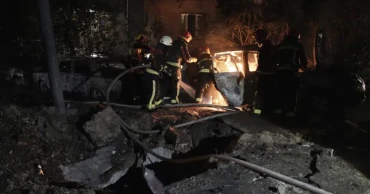
Russia launches pre-dawn attack on Kyiv, killing at least 1; Moscow attacked by drones
Russia launched a pre-dawn attack on Ukraine’s capital Tuesday, killing at least one person and sending Kyiv’s residents again scrambling into shelters to escape a relentless wave of daylight and nighttime bombardments. Moscow authorities reported a drone attack on the Russian capital.
At least 20 Shahed drones were destroyed by air defense forces in Kyiv’s airspace in Russia’s third attack on the capital in the past 24 hours, according to the Kyiv Military Administration.
The buzzing of drones could be heard over the city, followed by loud explosions as they were taken down by air defense systems.
In Moscow, residents reported hearing explosions and Mayor Sergei Sobyanin later confirmed there had been a drone attack.
Sobyanin said in a Telegram post that the attack caused “insignificant damage” to several buildings and that no one has been seriously hurt, without elaborating.
Residents of two buildings damaged in the attack were evacuated, Sobyanin said.
There was no immediate comment on the attacks from Ukrainian officials.
It was the second reported an attack on Moscow, after authorities said two drones targeted the Kremlin earlier this month in what was labeled an attempt on President Vladimir Putin’s life.
In the attacks overnight on Kyiv, one person died and three were injured when a high-rise building in the Holosiiv district caught fire. It was not immediately clear what caused the blaze but frequently the falling debris from drones being hit and the interceptor missiles have caused damage on the ground.
The building’s upper two floors were destroyed, and there may be people under the rubble, the Kiyv Military Administration said. More than 20 people were evacuated.
Resident Valeriya Oreshko told The Associated Press in the aftermath that even though the immediate threat was over, the attacks had everyone on edge.
“You are happy that you are alive, but think about what will happen next,” the 39-year-old said.
Oksana, who only gave her first name, said the whole building shook when it was hit.
“Go to shelters, because you really do not know where it (the drone) will fly,” she advised others. “We hold on.”
Elsewhere in the capital, falling debris caused a fire in a private house in the Darnytskyi district and three cars were set alight in the Pechersky district, according to the military administration.
The series of attacks that began Sunday included a rare daylight attack Monday that left puffs of white smoke in the blue skies.
On that day, Russian forces fired 11 ballistic and cruise missiles at Kyiv at about 11:30 a.m., according to Ukraine’s chief of staff, Valerii Zaluzhnyi. All of them were shot down, he said.
Debris from the intercepted missiles fell in Kyiv’s central and northern districts during the morning, landing in the middle of traffic on a city road and also starting a fire on the roof of a building, the Kyiv military administration said. At least one civilian was reported hurt.
The Russian Defense Ministry said it launched a series of strikes early Monday targeting Ukrainian air bases with precision long-range air-launched missiles. The strikes destroyed command posts, radars, aircraft and ammunition stockpiles, it claimed. It didn’t say anything about hitting cities or other civilian areas.
3 years ago

25 NATO-led peacekeepers injured in Kosovo in clashes with Serbs outside municipal building
The NATO-led KFOR peacekeeping force on Monday said that 25 of its troops were injured in the clashes with ethnic Serbs in northern Kosovo who were trying to take over the offices of one of the municipalities where ethnic Albanian mayors took up their posts last week.
The Serbs started clashing with the police in the morning in the municipality of Zvecan, 45 kilometers (28 miles) north of the capital, Pristina. In the afternoon, KFOR soldiers called on Serbs to clear the way for two vehicles from the Kosovar special police forces.
The soldiers then used tear gas and stun grenades to protect the Kosovar officers in the vehicles and disperse protesters, according to witnesses and local media. The assembled Serbs responded by throwing rocks and other hard objects.
"Several soldiers of the Italian and Hungarian KFOR contingent were the subject of unprovoked attacks and sustained trauma wounds with fractures and burns due to the explosion of incendiary devices," said a KFOR statement.
Some Kosovo police vehicles and one belonging to journalists were damaged. Pictures showed graffiti with Serb nationalist symbols sprayed over them.
The violence was the latest incident as tensions soared over the past week, with Serbia putting the country's military on high alert and sending more troops to the border with Kosovo, which declared independence from Belgrade in 2008.
Kosovo and Serbia have been foes for decades, with Belgrade refusing to recognize Kosovo's sovereignty.
The United States and the European Union have stepped up efforts to help solve the Kosovo-Serbia dispute, fearing further instability in Europe as Russia's war rages in Ukraine. The EU has made it clear to both Serbia and Kosovo they must normalize relations if they're to make any progress toward joining the bloc.
Russian Foreign Minister Sergei Lavrov considered the situation in Kosovo as "worrisome," blaming the U.S. and NATO for claiming dominance in that part of the world.
"A big 'explosion' is brewing in the center of Europe, in the very place where, in 1999, NATO carried out aggression against Yugoslavia," he said from Nairobi, Kenya.
On Monday, Kosovar police and the NATO-led Kosovo Force, or KFOR, were seen protecting the municipal buildings in Zvecan, Leposavic, Zubin Potok and Mitrovica, four municipalities in the north that held early elections last month.
The votes were largely boycotted by ethnic Serbs, who form the majority in those areas. Only ethnic Albanian or other smaller minority representatives were elected to the mayoral posts and assemblies.
Police said that Serbs gathered early Monday morning at three of the municipal buildings — in Zvecan, Leposavic and Zubin Potok but not in northern Mitrovica. In Zvecan, they tried to enter using violence and tear gas. The situation remains tense in Zvecan, a police statement said.
Serbia's prime minister, Ana Brnabic, criticized the international handling of the events in Kosovo, saying that KFOR was "not protecting the people … they are protecting the usurpers," apparently referring to the new mayors.
"But we must protect the peace. Peace is all we have," she said.
Defense Minister Milos Vucevic said the Serbian army was wrapping up its deployment following the decision to raise the alert level. Vucevic, who said he was hoping for a political solution, also criticized KFOR, saying that their position "looks like they are protecting the police from unarmed people."
Serbs say they want both the new mayors, whom they called "illegal and illegitimate sheriffs," to resign and leave the offices, and special police to leave northern Kosovo, according to Goran Rakic, a local Serb politician.
KFOR increased its presence in the four municipalities, including Mitrovica. It called on all sides to refrain from actions that could cause escalation and urged both "Belgrade and Pristina to engage in the EU-led dialogue."
U.S. Ambassador Jeff Hovenier met with President Vjosa Osmani and then together with other western powers' ambassadors — the U.S., France, Italy, Germany and the U.K. known as the Quint — with Prime Minister Albin Kurti, urging him to take steps to de-escalate the situation and reduce tensions.
They suggested the newly elected mayors work in other buildings, not from the municipality buildings.
"Peaceful protest needs to remain peaceful," said Hovenier, denouncing the Serbs' violence.
EU Ambassador Tomas Szunyog denounced the attack on journalists' cars saying that "journalists must be allowed to conduct their work without fear for their safety."
Last Friday, ethnic Serbs in northern Kosovo, who are a majority in that part of the country, tried to block recently elected ethnic Albanian officials from entering municipal buildings. Kosovo police fired tear gas to disperse the crowd and let the new officials into the offices.
More than a dozen Serbs and five Kosovar police officers were injured. Serbian troops on the border with Kosovo were put on high alert the same day.
The U.S. and the EU condemned Kosovo's government for using police to forcibly enter the municipal buildings.
At a rally Friday evening in Belgrade with his supporters, Serbian President Aleksandar Vucic said, "Serbia won't sit idle the moment Serbs in northern Kosovo are attacked."
However, any attempt by Serbia to send its troops over the border would mean a clash with NATO-led troops stationed there.
The conflict in Kosovo erupted in 1998 when separatist ethnic Albanians rebelled against Serbia's rule, and Serbia responded with a brutal crackdown. About 13,000 people, mostly ethnic Albanians, died. NATO's military intervention in 1999 eventually forced Serbia to pull out of the territory. Washington and most EU countries have recognized Kosovo as an independent state, but Serbia, Russia and China haven't.
3 years ago
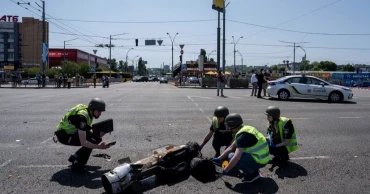
Russia strikes Kyiv in daylight after hitting Ukraine's capital with series of nighttime barrages
Explosions rattled Kyiv during daylight Monday as Russian ballistic missiles took aim at the Ukrainian capital, hours after a more common nighttime barrage of the city by drones and cruise missiles.
Russian forces fired 11 ballistic and cruise missiles at Kyiv at about 11:30 a.m. (0830 GMT; 4:30 a.m. EDT), according to Ukraine's chief of staff, Valerii Zaluzhnyi. All of them were shot down, he said, and puffs of white smoke could be seen in the blue sky over the city from street level.
Debris from the intercepted missiles fell in Kyiv's central and northern districts during the morning, landing in the middle of traffic on a city road and also starting a fire on the roof of a building, the Kyiv military administration said. At least one civilian was reported hurt.
The blasts unnerved some locals, already under strain after being awakened by the night attack.
"After what happened last night, I react sharply to every siren now. I was terrified, and I'm still trembling," shared Alina Ksenofontova, a 50-year-old woman who took refuge in the Kyiv subway with her dog Bublik.
The central station, Teatralna, was crowded with sheltering locals.
Artem Zhyla, a 24-year-old who provides legal services abroad, took his laptop with him and kept working underground.
"I heard two or three explosions, went to the bathroom, and then I heard five or seven more explosions. That's when I realized something terrible was happening," he said.
Like many others in the capital, he feels exhausted and stressed. However, he has no intention of giving up and plans to attend his yoga class to recharge.
"This is certainly not enough to break us," he said.
Ukraine President Volodymyr Zelenskyy and first lady Olena Zelenska both posted a video of what they said were frightened schoolchildren running and screaming down a Kyiv street toward a bomb shelter as sirens wailed.
"This is what an ordinary weekday looks like," the president wrote on Telegram.
Russia used Iskander short-range missiles in the morning attack, the spokesman for Ukraine's air force said on local television.
The missiles were fired from north of Kyiv, Yurii Ihnat said, without clarifying if he meant Russian territory. Kyiv lies around 380 kilometers (236 miles) from the Russian border.
The Russian Defense Ministry said it launched a series of strikes early Monday targeting Ukrainian air bases with precision long-range air-launched missiles. The strikes destroyed command posts, radars, aircraft and ammunition stockpiles, it claimed. It didn't say anything about hitting cities or other civilian areas.
Ukrainian Foreign Minister Dmytro Kuleba warned against indifference, saying the repeated strikes on civilian areas amounted to "war crimes."
"Russia's drone and missile attacks on peaceful Ukrainian cities cannot be seen as usual, no matter how frequent they grow," he tweeted in English.
During the previous night, Ukraine air defenses brought down more than 40 targets as Russian forces bombarded Kyiv with a combination of drones and cruise missiles in their 15th nighttime attack on the capital so far this month, said Serhii Popko, the head of Kyiv's military administration.
On Saturday night, Kyiv was subjected to the largest drone attack since the start of Russia's war. At least one person was killed, local officials said.
The Kremlin's strategy of long-range bombardment has brought many sleepless nights for Ukrainians.
Over the winter, Russian forces aimed their missiles and drones at power plants and other infrastructure. The apparent goal was to weaken Ukraine's resolve and compel the Ukrainian government to negotiate peace on Moscow's terms, but Ukrainians swiftly and defiantly repaired the damage.
In recent months, Ukraine has been receiving advanced air defense systems from its Western allies, improving its ability to fend off bombardments by the Kremlin's forces.
The head of the International Atomic Energy Agency is to speak Tuesday at the United Nations Security Council about safety at the Zaporizhzhia nuclear power plant, which is under Russian control and endangered by the fighting.
Mikhail Ulyanov, Russia's amabssador to international organizations in Vienna, said IAEA head Rafael Grossi was expected to "set out specific ideas" about how to strengthen security at the plant, which is Europe's largest nuclear power station.
Across the country, the Ukrainian air force said that over Sunday night it shot down 37 out of 40 cruise missiles and 29 out of 35 drones launched by the Kremlin's forces.
Four civilians were killed and around two dozen others were injured, including three children and a pregnant woman, in Russian shelling elsewhere across the country, authorities said.
Russian warplanes dropped bombs on the town of Toretsk on Monday afternoon, killing three civilians, Donetsk regional Gov. Pavlo Kyrylenko said.
Strikes on the eastern Dnipropetrovsk region killed two people, officials said.
Meanwhile, in the Belgorod region of Russia on the border with Ukraine, one person was killed by Ukrainian shelling of the village of Grafovka, according to Gov. Vyacheslav Gladkov.
Russian missiles also slammed into a military airport In the western Khmelnytskyi region of Ukraine, destroying five aircraft and damaging the runway, local Gov. Serhyi Hamaliy said on television.
The strike sparked fires at nearby warehouses storing fuel and military equipment, he added.
3 years ago

What 5 more years of Erdogan's rule means for Turkey
Turkish President Recep Tayyip Erdogan won reelection in a runoff Sunday, following a nail-biter first round two weeks earlier. Having secured another five years, Erdogan now faces a host of domestic challenges in a deeply divided country, from a battered economy to pressure for the repatriation of Syrian refugees to the need to rebuild after a devastating earthquake.
Here's a look at the challenges ahead.
Economy: how much longer can Erdogan's unorthodox policies be sustained?
Inflation in Turkey hit a staggering 85% in October before easing to 44% last month — although independent experts think the latest figure still masks how severe the cost-of-living crisis is in a country where people are having trouble paying skyrocketing rents and buying basic goods.
Critics blame the crisis on Erdogan's policy of keeping interest rates low to promote growth. Economists generally recommend raising rates to combat inflation.
Despite a faltering economy, Erdogan won the election, in part by softening the effects of inflation with public spending that experts say is unsustainable, including minimum wage and pension increases.
"The Turkish economy has been partying for a long time and well beyond its means. And I think in the period after the election, this is when we are going to pay for the feast that we consumed," said Selva Demiralp, professor of economics at Istanbul's Koc University.
Moving forward, the government will need to decide whether to stick to low rates, as Erdogan has promised, make gradual hikes, or combine small increases with other measures. All will be bring an "unavoidable slowdown" in the Turkish economy and higher unemployment rates, according to Demiralp, but the question is whether it's a controlled slowdown or a sudden stop.
Earthquake: Erdogan has vowed to rebuild — but at what cost?
Erdogan's overwhelming victory in the provinces hit hardest by the Feb. 6 earthquake that killed some 50,000 people came despite criticism that the government's response was slow and ineffective.
Voters in nine of the 11 provinces affected by the quake backed the president, including in especially hard-hit Hatay. In his victory speech, Erdogan said rebuilding efforts would be a top priority for his government.
The World Bank estimates that the earthquake caused $34.2 billion in "direct damages" — an amount equivalent to 4% of Turkey's 2021 gross domestic product. The recovery and reconstruction costs could add up to twice that much, it said.
Erdogan's two-decades in power have been marked by a huge boom in construction. Despite criticism that the lax enforcement of building codes contributed to the deadliness of the quake, many of his supporters believe he has shown that he can rebuild. But geologists and engineers have warned that a speedy construction campaign could also pose risks.
Syrians: Erdogan under pressure to send refugees home
Erdogan is deeply aware that sentiment has soured on the 3.4 million Syrians who fled violence at home for Turkey, especially as the country grapples with an economic downturn.
In his victory speech, Erdogan said some 600,000 refugees had already voluntarily returned to Syria, where his government is creating so-called "safe zones" in northern areas that it controls. An additional million would follow thanks to a joint resettlement program with Qatar, Erdogan said, without providing details.
But Emma Sinclair-Webb from Human Rights Watch said Syria is still not safe for many refugees — while the polarizing discourse in Turkey is also creating a dangerous situation for them.
Rights and freedoms: Erdogan signals crackdown to continue
Erdogan's presidency has been marked by a crackdown on freedom of expression and increasing hostility toward minority groups: Mainstream media is pro-government, internet censorship is widespread, new social media laws could limit expression online, and he has frequently targeted members of the LGBTQ community and ethnic Kurds.
In the aftermath of the 2016 failed coup attempt that Turkey blames on a U.S.-based Muslim cleric, the government used broad terror laws to imprison those with links to the cleric, pro-Kurdish politicians and members of civil society.
Sinclair-Webb, the human rights campaigner, said Erdogan's victory speech was a "taste of what's to come" when he targeted the imprisoned pro-Kurdish politician Selahattin Demirtas, as crowds chanted slogans for capital punishment.
He similarly used another victory speech to stir up anti-LGBTQ sentiment.
Erdogan once called the mistreatment of gay people "inhumane" but now refers to members of LGBTQ community as "deviants." Since 2015, his government has banned pride parades, as officials have increased the use of discriminatory language while trying to strengthen their conservative base.
Erdogan's government has also withdrawn Turkey from a landmark European treaty protecting women from domestic violence, bowing to conservative groups that claimed the treaty promoted homosexuality.
Anti-gay rhetoric only escalated during Erdogan's campaign.
"Mentioning it again at the first opportunity in the balcony speech on victory is a chilling reminder of how he's really putting LGBT people at great risk," said Sinclair-Webb, the human rights campaigner.
Turkey's oldest LGBTQ association, Kaos GL, said that Erdogan's win would not silence them.
"Even though they promise to shut us down, we came out once and we are not going back in," the organization and others said in a statement.
3 years ago