Latin-America
A gang in Haiti has killed more than 20 and injured dozens after raiding a small town, official says
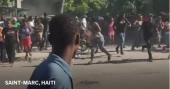
Gang members attacked a small town in central Haiti early Thursday, killing more than 20 people, including children, according to a human rights group.
Another 50 people were injured as the Gran Grif gang burned homes and cars in the town of Pont-Sondé, said Bertide Harace, spokeswoman for the Commission for Dialogue, Reconciliation and Awareness to Save the Artibonite.
“A lot of people ran and left the area,” she told Radio Kiskeya.
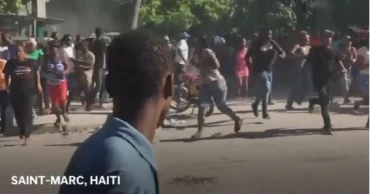
A video posted on social media shows a group of people fleeing through the brush, with one woman who was out of breath saying, “Nowhere to go. Nowhere to go.” In another video, dozens of people start running through a street after hearing rumors that the gang was approaching.
Harace and others criticized police in the nearby coastal city of Saint-Marc, saying they did not mobilize to help people being attacked in Pont-Sondé.
Read:As UN meets, Haitians express hopelessness at finding an international solution to gang crisis
Venson François, a government prosecutor based in Saint-Marc, called the attack a “massacre” in an interview with Radio Caraïbes.
Dozens of people crowded around a hospital in Saint-Marc where the injured were taken, with one man telling reporters that local authorities are not doing enough to protect people.
The attack in Pont-Sondé was blamed on the Gran Grif gang. It operates in the central Artibonite region, and experts have described it as one of Haiti’s cruelest gangs. It has gained control of more territory since 2022 under the leadership of Luckson Elan, who was sanctioned by the U.S. Treasury Department last month.
In January 2023, the Gran Grif gang was accused of attacking a police station in Liancourt, located near Pont-Sondé, and killing at least six officers. Violence unleashed by the gang also forced the closure of a hospital in February 2023 that serves more than 700,000 people.
Read more: Human rights group calls on governments to protect Venezuelan and Haitian immigrants
Former Haitian legislator Prophane Victor, who represented the Artibonite department, began arming young men who eventually formed the Gran Grif gang to secure his election and control over the area, according to a U.N. report. The U.S. also sanctioned Victor last month.
The gang has about 100 members and has been accused of crimes including murder, rape, robberies and kidnappings, according to the report.
While most of the gang violence is concentrated in the capital of Port-au-Prince, it has spread in recent years to the Artibonite region, where much of Haiti's food is produced.
1 year ago
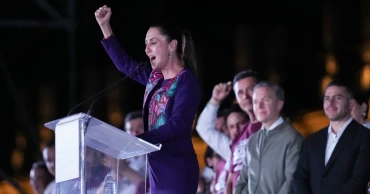
Claudia Sheinbaum to be sworn in as Mexico’s 1st female president
Claudia Sheinbaum will take the oath of office Tuesday as Mexico’s first female president in more than 200 years of independence, promising to protect an expanded social safety net and fight for the poor like her predecessor, but facing pressing problems.
The 62-year-old scientist-turned-politician will receive a country with a number of immediate challenges, foremost among them stubbornly high levels of violence, a sluggish economy and hurricane-battered Acapulco.
Sheinbaum romped to victory in June with nearly 60% of the vote, propelled largely by the sustained popularity of her political mentor, former President Andrés Manuel López Obrador.
He took office six years ago declaring “For the good of all, first the poor,” and promising historical change from the neoliberal economic policies of his predecessors. Sheinbaum promised continuity from his popular social policies to controversial constitutional reforms to the judiciary and National Guard rammed through during his final days in office.
Despite her pledge of continuity, she is a very different personality.
“López Obrador was a tremendously charismatic president and many times that charisma allowed him to cover up some political errors that Claudia Sheinbaum will not have that possibility of doing,” said Carlos Pérez Ricart, a political analyst at Mexico’s Center for Economic Research and Teaching. “So, where López Obrador was charismatic, Claudia Sheinbaum will have to be effective.”
He is not leaving her an easy situation.
Her first trip as president will be to the flood-stricken Pacific coast resort of Acapulco.
Hurricane John, which struck as a Category 3 hurricane last week and then reemerged into the ocean and struck again as a tropical storm, caused four days of incredibly heavy rain that killed at least 17 people along the coast around Acapulco. Acapulco was devastated in October 2023 by Hurricane Otis, and had not recovered from that blow when John hit.
Sheinbaum must also deal with raging violence in the cartel-dominated northern city of Culiacan, where factional fighting within the Sinaloa cartel broke out after drug lords Ismael “El Mayo” Zambada and Joaquín Guzmán López were apprehended in the United States after they flew there in a small plane on July 25.
López Obrador has long sought to avoid confronting Mexico’s drug cartels and has openly appealed to the gangs to keep the peace among themselves, but the limitations of that strategy have become glaringly apparent in Culiacan, the capital of Sinaloa state, where gun battles have raged on the city’s streets. Local authorities and even the army — which López Obrador has relied on for everything — have essentially admitted that the fighting will only end when the cartel bosses decide to end it.
But that’s only the latest hotspot.
Drug-related violence is surging from Tijuana in the north to Chiapas in the south, displacing thousands.
While Sheinbaum inherits a huge budget deficit, unfinished construction projects and a burgeoning bill for her party’s cash hand-out programs — all of which could send financial markets tumbling — perhaps her biggest looming concern is the possibility of a victory for Donald Trump in the Nov. 5 U.S. presidential election.
Trump has already vowed to slap 100% tariffs on vehicles made in Mexico. Though that would likely violate the current U.S.-Mexico-Canada trade agreement, there are other things Trump could do to make life difficult for Sheinbaum, including his pledge of massive deportations.
Things with its northern neighbor were already tense after López Obrador said he was putting relations with the U.S. embassy “on pause” after public criticism of the proposed judicial overhaul.
First lady Jill Biden struck an optimistic tone for relations with the incoming Sheinbaum administration saying at a reception Monday that, “Under Dr. Sheinbaum’s presidency I know we will continue to build a more prosperous, safe and democratic region — and take the steps in our U.S.-Mexico partnership."
There are areas where Sheinbaum could try to take Mexico in a new direction. For example, she has a Ph.D. in energy engineering and has spoken of the need to address climate change. López Obrador built a massive new oil refinery and poured money into the state-owned oil company. But his budget commitments do not leave her much room to maneuver.
Jennifer Piscopo, professor of gender and politics at the Royal Holloway University of London who has studied Latin America for decades, said Mexico electing its first female leader is important because it will show girls they can do it too, but it can also create unrealistic expectations.
“Woman firsts are powerful symbols, but they do not gain magic power,” she said. “Especially when the governance challenges are so large, expecting magic solutions overnight can also generate outsized disappointment.”
1 year ago
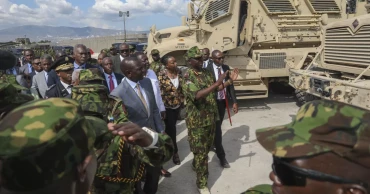
As UN meets, Haitians express hopelessness at finding an international solution to gang crisis
As world leaders meeting in the United Nations this week discuss the future of efforts to rein in the gangs strangling Haiti, Haitians are expressing hopelessness that an international response can turn the tide of violence.
Thus far, a UN-backed force of 400 police from Kenya and about two dozen Jamaican officers have done little to quell the country's gangs, which have terrorized the country since the 2021 assassination of President Jovenel Moïse. World leaders have been discussing the next steps in a convoluted efforts to restore order to the Caribbean nation, and Kenya this weekend pledged 600 more officers.
The United States has floated the idea of a U.N. peacekeeping force, but the idea was considered too controversial given the introduction of cholera and sexual abuse cases that occurred the last time U.N. troops were in Haiti.
The deployment of Kenyan forces was, in part, to avoid tensions that may be sparked by sending another U.N. peacekeeping mission.
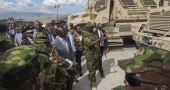
But in a visit to Haiti by Kenya's President William Ruto over the weekend – on his way to the United Nations General Assembly session, which began on Sunday – Ruto said he would be open to expanding Kenya's operations into a larger U.N. peacekeeping mission.
“On the suggestion to transit this into a fully U.N. Peacekeeping mission, we have absolutely no problem with it, if that is the direction the U.N. security council wants to take,” Ruto said.
While Ruto hailed the successes of the Kenyan forces on Sunday, a recent report by a UN human rights expert said gang violence is spreading across Haiti and that Haitian police still lack the “logistical and technical capacity” to fight gangs.
The ongoing violence has left Haitians like 39-year-old Mario Canteve disillusioned with further international efforts to quell the gangs, saying he no longer believes promises by world leaders that they'll be able to change anything in the crisis-stricken nation.
“No one is coming to save Haiti. Nothing is changing," he said. “A new mission cannot save Haiti.”
Canteve sells cellphone chips and repairs electronics in the capital of Port-au-Prince, 80% of which is estimated to be controlled by gangs. Facing brutal gang violence, some Haitians have organized vigilante groups to battle the gangs themselves.
Such groups underscore to the lack of hope many Haitians have that an international solution can mark a shift in Haiti.
Moise Jean-Pierre, a 50-year-old school teacher, recalled past U.N. missions in Haiti and said such efforts were a “waste of time.”
“It would not be the first time we've had U.N. missions in Haiti,” he said. “What difference will it make?”
Sentiments on the ground speak to the bind world leaders are in as they've spent years looking for a larger solution to Haiti's woes.
The current security mission is expected to reach a total of 2,500 personnel, with the Bahamas, Bangladesh, Barbados, Benin and Chad also pledging to send police and soldiers. Though it still is not clear when that would happen.
Few at the U.N. have an appetite for a larger peacekeeping mission in part due to the abuses in past missions, but also because many Haitians have an aversion to foreign interventions. Experts say three previous interventions by US and the UN have not improved crises in Haiti.
Some harbor hope that elections planned next year will pave the path to a Haitian-born solution.
The country has not held general elections since 2016 as the crisis has dragged on.
Last week, Haiti took its first steps in creating a provisional election council to prepare the nation for elections. Haiti still has many hurdles ahead of it to get there. Chief among them is violence.
While Canteve, the cellphone chip salesman, called for unity and said “a new mission cannot save Haiti, the children of Haiti need to save themselves,” he also expressed doubts the country was safe enough to facilitate elections.
“How can you hold an election when everything is so violent. Everyone is shooting," he said. "When police cannot even go into certain areas, what kind of election are going to get?”
1 year ago
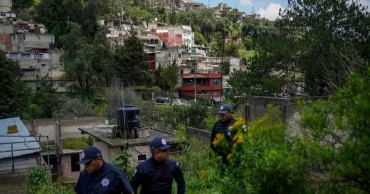
6 die in landslide caused by heavy rains in Mexico
A landslide caused by heavy rains has killed six people near Mexico City, authorities said.
The landslide on Monday night in Naucalpan, a community northwest of Mexico City, also affected a house and school, the State of Mexico government said in a statement. The victims were four men and two women. Another three people were injured and transported to a state hospital.
State Gov. Delfina Gómez ordered the deployment of rescue teams and security task forces to support affected families.
The deaths in Naucalpan occurred a few days after another landslide killed nine people on Saturday in Jilotzingo, west of Mexico City in the State of Mexico. A 3-month-old baby was among the victims. Two children, ages 10 and 12, and a 34-year-old woman were rescued. Several homes were affected and authorities had to evacuate more than 100 people for fear of further landslides.
The landslides and heavy rains have been pounding the State of Mexico since the start of the rainy season in late July.
In cities like Chalco that have also experienced heavy torrential rains, the combination of unchecked growth and failing infrastructure have caused sewage-infused waters to invade streets, homes and businesses.
1 year ago
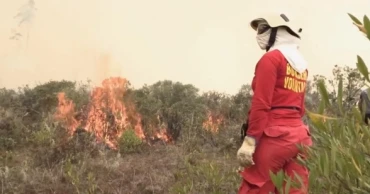
15 dead, thousands hectares scorched as wildfires sweep Peru
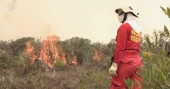
Wildfires in Peru have left at least 15 dead and more than 3,000 hectares (11.58 square miles) of cultivated land and natural areas scorched, authorities said Monday.
Prime Minister Gustavo Adrianzén told reporters that the fires were started by human activity and that 22 of the 24 regions that make up the country have active outbreaks. He added that clouds, smoke and winds were hampering the operations of the aircraft available to fight the fires.
A Civil Defense report seen by The Associated Press indicates that since July at least 15 people have died and another 98 have been injured due to the fires. Of the fatalities, 10 died in the last two weeks and more than 1,800 people have been affected. The livestock sector was reported to have lost 334 animals.
Peru's National Forest and Wildlife Service, SERFOR, indicated that the effects of climate change intensify the conditions that facilitate the spread of fire.
“Extremely strong winds and prolonged droughts dry out vegetation, turning it into highly flammable fuel," said Romina Liza, a specialist in monitoring and management of forest Fires at SERFOR. "This allows the fire to spread rapidly."
Some of the most complicated fires are in the Amazon region, which borders Ecuador, the head of civil defense, Juan Urcariegui, told a local television station.
1 year ago
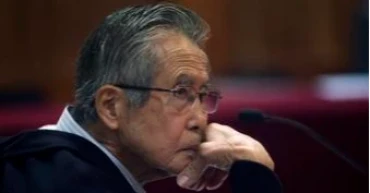
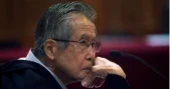
Alberto Fujimori, a former president of Peru who was convicted for human rights abuses, dies at 86
Alberto Fujimori, whose decade-long presidency began with triumphs righting Peru’s economy and defeating a brutal insurgency only to end in a disgrace of autocratic excess that later sent him to prison, has died. He was 86.
His death Wednesday in the capital, Lima, was announced by his daughter Keiko Fujimori in a post on X.
He had been pardoned in December from his convictions for corruption and responsibility for the murder of 25 people. His daughter said in July that he was planning to run for Peru’s presidency for the fourth time in 2026.
Fujimori, who governed with an increasingly authoritarian hand in 1990-2000, was pardoned in December from his convictions for corruption and responsibility for the murder of 25 people. His daughter said in July that he was planning to run for Peru’s presidency for the fourth time in 2026.
The former university president and mathematics professor was the consummate political outsider when he emerged from obscurity to win Peru’s 1990 election over writer Mario Vargas Llosa. Over a tumultuous political career, he repeatedly made risky, go-for-broke decisions that alternately earned him adoration and reproach.
He took over a country ravaged by runaway inflation and guerrilla violence, mending the economy with bold actions including mass privatizations of state industries. Defeating fanatical Shining Path rebels took a little longer but also won him broad-based support.
His presidency, however, collapsed just as dramatically.
After briefly shutting down Congress and elbowing himself into a controversial third term, he fled the country in disgrace in 2000 when leaked videotapes showed his spy chief, Vladimiro Montesinos, bribing lawmakers. The president went to Japan, the land of his parents, and famously faxed in his resignation.
He stunned supporters and foes alike five years later when he landed in neighboring Chile, where he was arrested and then extradited to Peru. He had hoped to run for Peru’s presidency in 2006, but instead wound up in court facing charges of abuse of power.
The high-stakes political gambler would lose miserably. He became the first former president in the world to be tried and convicted in his own country for human rights violations. He was not found to have personally ordered the 25 death-squad killings for which he was convicted, but he was deemed responsible because the crimes were committed in his government’s name.
His 25-year sentence did not stop Fujimori from seeking political revindication, which he planned from a prison built in a police academy on the outskirts of Lima, the capital.
His congresswoman daughter Keiko tried in 2011 to restore the family dynasty by running for the presidency but was narrowly defeated in a runoff. She ran again in 2016 and 2021, when she lost by just 44,000 votes after a campaign in which she promised to free her father.
“After a long battle with cancer, our father, Alberto Fujimori, has just departed to meet the Lord," she said on X Wednesday. "We ask those who loved him to accompany us with a prayer for the eternal rest of his soul.”
Fujimori’s presidency was, in fact, a brash display of outright authoritarianism, known locally as “caudillismo,” in a region shakily stepping away from dictatorships toward democracy.
He is survived by his four children. The oldest, Keiko, became first lady in 1996 when his father divorced his mother, Susana Higuchi, in a bitter battle in which she accused Fujimori of having her tortured. The youngest child, Kenji, was elected a congressman.
Fujimori was born July 28, 1938, Peruvian Independence Day, and his immigrant parents picked cotton until they could open a tailor’s shop in downtown Lima.
He earned a degree in agricultural engineering in 1956, and then studied in France and the United States, where he received a graduate degree in mathematics from the University of Wisconsin in 1972.
In 1984 he became rector of the Agricultural University in Lima, and six years later, he ran for president without ever having held political office, billing himself as a clean alternative to Peru’s corrupt, discredited political class.
He soared from 6% in the polls a month before the 1990 election to finish second out of nine in the balloting. He went on to beat Vargas Llosa in a runoff.
The victory, he later said, came from the same frustration that fueled the Shining Path.
“My government is the product of rejection, of being fed up with Peru because of the frivolity, corruption and nonfunctioning of the traditional political class and the bureaucracy,” he said.
Once in office, Fujimori’s tough talk and hands-on style at first won him only plaudits, as car bombings still ripped through the capital and annual inflation approached 8,000 percent.
He applied the same economic shock therapy that Vargas Llosa had advocated but he had argued against in the campaign.
Privatizing state-owned industries, Fujimori slashed public spending and attracted record foreign investment.
Known affectionately as “El chino,” due to his Asian ancestry, Fujimori often donned peasant garb to visit jungle Indigenous communities and highland farmers, while delivering electricity and drinking water to dirt-poor villages. That distinguished him from the patrician, white politicians who typically lacked his commoner’s touch.
Fujimori also gave Peru’s security forces free rein to take on the Shining Path.
In September 1992, police captured rebel leader Abimael Guzmán. Deservedly or not, Fujimori took credit.
Taking power just years after much of the region had shed dictatorships, the former university professor ultimately represented a step back. He developed a growing taste for power and resorted to increasingly anti-democratic means to amass more of it.
In April 1992, he shut down Congress and the courts, accusing them of shackling his efforts to defeat the Shining Path and spur economic reforms.
International pressure forced him to call elections for an assembly to replace the Congress. The new legislative body, dominated by his supporters, changed Peru’s constitution to allow the president to serve two consecutive five-year terms. Fujimori was swept back into office in 1995, after a brief border war with Ecuador, in an election landslide.
Human rights advocates at home and abroad blasted him for pushing through a general amnesty law forgiving human rights abuses committed by security forces during Peru’s “anti-subversive” campaign between 1980 and 1995.
The conflict would claim nearly 70,000 lives, a truth commission found, with the military responsible for more than a third of the deaths. Journalists and businessmen were kidnapped, students disappeared and at least 2,000 highland peasant women were forcibly sterilized.
In 1996, Fujimori’s majority bloc in Congress put him on the path for a third term when it approved a law that determined his first five years as president didn’t count because the new constitution was not yet in place when he was elected.
A year later, Fujimori’s Congress fired three Constitutional Tribunal judges who tried to overturn the legislation, and his foes accused him of imposing a democratically elected dictatorship.
By then, almost daily revelations were showing the monumental scale of corruption around Fujimori. About 1,500 people connected to his government were prosecuted on corruption and other charges, including eight former Cabinet ministers, three former military commanders, an attorney general and a former chief of the Supreme Court.
The accusations against Fujimori led to years of legal wrangling. In December, Peru’s Constitutional Court ruled in favor of a humanitarian pardon granted to Fujimori on Christmas Eve in 2017 by then-President Pablo Kuczynski. Wearing a face mask and getting supplemental oxygen, Fujimori walked out of the prison door and got in a sport utility vehicle driven by his daughter-in-law.
The last time he was seen in public was on Sept. 4, leaving a private hospital in a wheelchair. He told the press that he had undergone a CT scan and when asked if his presidential candidacy was still going ahead, he smiled and said “We’ll see, we’ll see.”
1 year ago

Amid the worst drought in Brazil history, wildfires rage and Amazon falls to record low level
Brazil is enduring its worst drought since nationwide measurements began over seven decades ago, with 59% of the country under stress — an area roughly half the size of the U.S.
Major Amazon basin rivers are registering historic lows, and uncontrolled manmade wildfires have ravaged protected areas and spread smoke over a vast expanse, plummeting air quality.
“This is the first time that a drought has covered all the way from the North to the country's Southeast,” Ana Paula Cunha, a researcher at the National Center for Monitoring and Early Warning of Natural Disasters, said in a statement Thursday. “It is the most intense and widespread drought in history.”
Smoke on Monday afternoon caused Sao Paulo, a metropolitan area of 21 million people, to breathe the second most polluted air in the world after Lahore, Pakistan, according to data gathered by IQAir, a Swiss air technology company.
About 1,100 kilometers (683 miles) to the north, a wildfire is sweeping through Chapada dos Veadeiros National Park, one of Brazil’s most famous tourism sites.
“This year, the dry season started much earlier than in previous years, whereas the rain season was intense yet short,” Nayara Stacheski, head of the park, told The Associated Press. “The wind is strong, the air humidity is very low and it’s extremely hot. All this worsens the wildfire.”
On Monday, there was one uncontrolled wildfire in a remote area. A helicopter was expected to arrive to transport firefighters. Another fire was controlled by 80 firefighters, with support from two aircraft. Two other fires were threatening to enter the park.
The blazes in one of the few protected areas of Cerrado, the Brazilian savanna, are just the latest drama in the country beset by months of blazes. From the beginning of the year until Sept. 8, Brazil registered almost 160,000 fires, the worst year since 2010. In Pantanal, the world’s largest wetland area, it has been the second worst fire year on record.
Most fires are manmade as part of the deforestation process or for clearing pastures and agricultural land. So far this year, an area the size of Italy has burned in Brazil.
Fire is not the only problem. More than 1,900 kilometers (1,200 miles) from Chapada dos Veadeiros to the Northeast, the Amazon — the world’s most voluminous river — and one of its main tributaries, the Madeira River, have registered new daily record lows at the city of Tabatinga. There's no end sight — significant rain is not expected until October.
Low river levels have stranded dozens of communities only accessible by water. One of the largest is Fidadelfia, inhabited by 387 families of the Tikuna tribe. Due to the drought, there is shortage of potable water and children are drinking dirty water, leading to a surge in illnesses. Food is becoming scarce as crops die and it’s increasingly difficult to travel to the city, local leader Myrian Tikuna told the AP.
Tikuna sent a selfie taken Monday in her community. Instead of water, endless banks of sand dominate the landscape.
“This used to be the Amazon River," she said. "Now it’s a desert. If things get worse, our people will disappear. Now we are realizing the severity of climate change.”
1 year ago
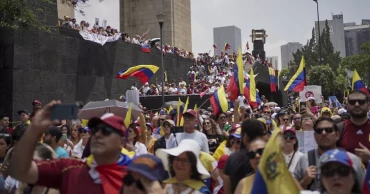
Venezuelans in Caracas and across the world demonstrate to defend opposition’s victory claim
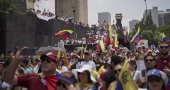
Venezuelans across the world — some with flags and other patriotic paraphernalia — responded to a call from their country’s political opposition Saturday and took to the streets to defend the faction’s claim to victory over President Nicolás Maduro in last month’s disputed presidential election.
The demonstrations in Tokyo, Sidney, Mexico City and several other cities were an effort by the main opposition coalition to make visible what they insist is the real outcome of the election. They also called on governments to throw their support behind candidate Edmundo González and express support to Venezuelans who are fearful in their home country of speaking against Maduro and his allies during a brutal repression campaign.
As thousands of Venezuelans waved the national flag, opposition leader María Corina Machado made her way through the streets of Caracas on a truck while shouting “brave” and “freedom.” Then, before a crowd, she said it was the moment “that every vote is respected.”
“Let the world and everyone in Venezuela recognize that the president-elect is Edmundo González,” she said while being applauded by thousands of cheering supporters.
Earlier, González, the opposition candidate wrote on his X account: “They will not be able to cover up the reality of July 28: we won resoundingly.” He didn't show up at the demonstration in Caracas.
In Mexico City’s Monument to the Revolution downtown, hundreds of people young and old alike loudly repeated the chants for “Freedom! Freedom!” that dominated the opposition’s rallies ahead of the election. “Maduro out! Maduro out!” they then screamed as motorists going by honked their horns.
“What is happening right now is that Venezuela woke up ... so much so that the government doesn’t dare to show the tally sheets,” Antonia Imbernon said, referring to the voting results documents that are considered the ultimate proof of results. “What are they afraid of?”
Venezuela’s National Electoral Council, whose members are loyal to the ruling party, declared Maduro the winner of the July 28 election hours after polls closed. Unlike previous presidential elections, the electoral body has not released the tally sheets’ detailed voting data to back up its claim that Maduro earned 6.4 million votes while González, who represented the Unitary Platform opposition coalition, garnered 5.3 million.
But González and opposition leader Maria Corina Machado shocked Venezuelans when they revealed they obtained more than 80% of the vote tally sheets issued by every electronic voting machine after polls closed. The documents, they said, showed González winning by a wide margin and were uploaded to a website for anyone to see.
Machado urged supporters to print the tally sheet from their voting station and take it to Saturday’s demonstrations. In Mexico City, some held signs reproaching the decision by Mexico’s government to not participate in a Friday hearing of the Organization of American States focused on Venezuela’s election crisis.
“Mexico, we missed you at the OEA,” a sign stated using the acronym in Spanish for the regional body.
The opposition has consistently expressed the need for the international community’s help to get Maduro to accept the unfavorable results of the election.
“The derision is worse this time because there is proof; anyone can see them,” said Janett Hurtado, 57, who left Venezuela two years ago, referring to the tally sheets. “(The government) took away other elections from us again.”
Hurtado said she has noticed Venezuelans’ fear to speak against Maduro following the widespread arrests across the South American country in connection with protests sparked by the election results. She said she has friends who have not sent her a single text message since then.
Security forces have rounded up more than 2,000 people for demonstrating against Maduro or casting doubt on his claim he won a third term despite strong evidence he lost the vote by a more than 2-to-1 margin. Another 24 have been killed, according to Venezuela-based human rights group Provea.
The spree of detentions — urged on by Maduro himself — is unprecedented, and puts Venezuela on pace to easily exceed those jailed during three previous crackdowns against Maduro’s opponents.
Those arrested include journalists, political leaders, campaign staffers and an attorney defending protesters. Others have had their Venezuelan passports annulled trying to leave the country. One local activist even livestreamed her arrest by military intelligence officers as they broke into her home with a crowbar.
“It pains us to see what’s happening,” said Hurtado’s daughter, Veronica Guedez, 19. “We are here to support us as brothers and sisters.”
The opposition was dealt a blow Thursday when Brazil and Colombia — countries that had been pressuring Maduro to release vote tallies backing his claim to victory — began suggesting a repeat of the contest instead. But Machado categorically rejected any plan to redo the election, and she said that it would be “an insult” to the people.
1 year ago
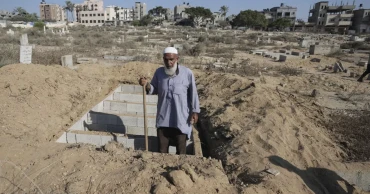
As Gaza death toll passes 40,000, corpses are buried in yards, streets, tiered graves
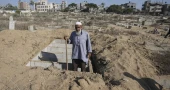
Tiers of graves are stacked deep underground in a bloated Gaza cemetery, where Sa’di Baraka spends his days hacking at the earth, making room for more dead.
“Sometimes we make graves on top of graves,” he said.
Baraka and his solemn corps of volunteer gravediggers in the Deir al-Balah cemetery start at sunrise, digging new trenches or reopening existing ones. The dead can sometimes come from kilometers (miles) away, stretches of Gaza where burial grounds are destroyed or unreachable.
The cemetery is 70 years old. A quarter of its graves are new.
The death toll in Gaza since the beginning of the 10-month-old Israel-Hamas war has passed 40,000, according to the Health Ministry in the Hamas-run territory. The count does not distinguish civilians from militants.
The small, densely populated strip of land is now packed with bodies.
They fill morgues and overflow cemeteries. Families, fleeing repeatedly to escape offensives, bury their dead wherever possible: in backyards and parking lots, beneath staircases and along roadsides, according to witness accounts and video footage. Others lie under rubble, their families unsure they will ever be counted.
“One large cemetery”
A steady drumbeat of death since October has claimed nearly 2% of Gaza’s prewar population. Health officials and civil defense workers say the true toll could be thousands more, including bodies under rubble that the United Nations says weighs 40 million tons.
“It seems,” Palestinian author Yousri Alghoul wrote for the Institute for Palestine Studies, “that Gaza’s fate is to become one large cemetery, with its streets, parks, and homes, where the living are merely dead awaiting their turn.”
Israel began striking Gaza after Hamas-led militants stormed across the Israeli border on Oct. 7, killing about 1,200 people and taking some 250 others hostage. Israel seeks Hamas’ destruction and claims it confines its attacks to militants. It blames Hamas for civilian deaths, saying the militants operate from residential neighborhoods laced with tunnels. The fighting has killed 329 Israeli soldiers.
Even in death, Palestinians have been displaced by Israel’s offensives.
Palestinians move corpses, shielding them from the path of war. Israel’s military has dug up, plowed over and bombed more than 20 cemeteries, according to satellite imagery analyzed by investigative outlet Bellingcat. Troops have taken scores of bodies into Israel, searching for hostages. Trucked back to Gaza, the bodies are often decomposed and unidentifiable, buried quickly in a mass grave.
Israel’s military told The Associated Press that it is attempting to rescue hostage bodies where intelligence indicates they may be located. It said bodies determined not to be hostages are returned “with dignity and respect.”
Haneen Salem, a photographer and writer from northern Gaza, has lost over 270 extended family members in bombardments and shelling. Salem said between 15 and 20 of them have been disinterred — some after troops destroyed cemeteries and others moved by relatives out of fear Israeli forces would destroy their graves.
“I don’t know how to explain what it feels like to see the bodies of my loved ones lying on the ground, scattered, a piece of flesh here and bone there,” she said. “After the war, if we remain alive, we will dig a new grave and spread roses and water over it for their good souls.”
Honoring the dead
In peacetime, Gaza funerals were large family affairs.
The corpse would be washed and wrapped in a shroud, according to Islamic tradition. After prayers over the body at a mosque, a procession would take it to the graveyard, where it would be laid on its right side facing east, toward Mecca.
The rituals are the most basic way to honor the dead, said Hassan Fares. “This does not exist in Gaza.”
Twenty-five members of Fares' family were killed by an airstrike on Oct. 13 in northern Gaza. Without gravediggers available, Fares dug three ditches in a cemetery, burying four cousins, his aunt and his uncle. Survivors whispered quick prayers over the distant hum of warplanes.
Those who died early in the war might have been the lucky ones, Fares said. They had funerals, even if brief.
Nawaf al-Zuriei, a morgue worker at Deir al-Balah’s Al-Aqsa Martyrs Hospital, is on the front lines of the rush of dead. Workers cover the damaged bodies in plastic to avoid bloodstains on white shrouds.
“We wipe the blood off the face so it’s in a suitable state for his loved ones to bid him farewell,” he said.
Following Israeli troop withdrawals, dozens of bodies are left on streets. With fuel scarce, workers collecting the dead fill trucks with corpses, strapping some on top to save gas, said civil defense official Mohammed el-Mougher.
Headstones are rare; some graves are marked with chunks of rubble.
When a corpse remains unidentified, workers place a plastic placard at the grave, bearing the burial date, identification number and where the body was found.
Searching for lost loved ones
The uncertain fate of relatives' bodies haunts families.
Mousa Jomaa, an orthopedist who lives in al-Ram in the Israeli-occupied West Bank, has watched from afar as the war claimed 21 relatives in Gaza.
Jomaa’s cousin Mohammed was killed in an Israeli airstrike early in the war while operating an ambulance in southern Gaza and was buried in Rafah, away from the family’s home in central Gaza. The cemetery was damaged in a later offensive. There’s no sign of Mohammed’s body, Jomaa said.
A strike in December then destroyed Jomaa’s uncle’s house, killing his aunt and her children, 8-year-old Mira and 10-year-old Omar. Jomaa's uncle, Dr. Hani Jomaa, rushed home to search the rubble. Before he could find Mira's body, a strike killed him too.
Because her body has not been recovered, Mira has not been counted among the dead, said Jomaa, who showed a photo of the young girl standing beside her brother, with a rainbow handbag matching her barrette.
In July, an Israeli tank killed two more cousins, Mohammed and Baha. Baha’s body was torn apart, and the shelling made it too dangerous to collect the remains for weeks.
Jomaa said that come the end of the war, he plans to visit Gaza to search for Mira's remains.
Smashed graves and cemeteries off-limits
Israeli evacuation orders cover much of Gaza, leaving some of the largest cemeteries off-limits.
Jake Godin, a Bellingcat researcher, has used satellite imagery to document destruction to more than 20 cemeteries. Sandy, bulldozed expanses appear where some cemeteries once stood. Gaza City’s Sheikh Radwan graveyard is cratered. In Gaza's Eastern Cemetery, roads carved by heavy vehicles bury headstones under tire tracks, he said.
“Anywhere the (Israeli military) is active, they bulldoze and destroy the ground without regard to cemeteries,” Godin said.
The military told the AP it does not have a policy of destroying graves. “The unfortunate reality of ground warfare in condensed civilian areas" can result in harm to cemeteries, it said, adding it found Hamas tunnels underneath a cemetery east of the southern city of Khan Younis.
Mahmoud Alkrunz, a student in Turkey, said his father, mother, two brothers, sister and three of his siblings’ children were buried in the Bureij refugee camp’s cemetery after Israel bombed their home.
When Israel withdrew from Bureij in January, the graves were found unearthed. Alkrunz fainted when his uncle delivered the news.
“We don’t know what has happened to the bodies,” he said.
1 year ago

Criticism mounts against Venezuela's Maduro and the electoral council that declared him a victor
International criticism of Venezuelan President Nicolás Maduro mounted Tuesday, a day after electoral authorities declared him the winner in a presidential election that the opposition claims to have won by a landslide.
During a rally in Caracas on Tuesday, opposition leader Maria Corina Machado called on the National Electoral Council, which is loyal to the ruling party, to release voting tally sheets produced by every voting precinct, asking “why don't they publish them?”
Machado said the opposition coalition has obtained more than 84% of the tallies and that she is confident that opposition candidate Edmundo González was elected to be the new president in Sunday's election.
“The only thing we are willing to negotiate is the peaceful transition,” Machado said as the crowd chanted: “We have no fear!”
The Organization of American States chastised Maduro for his government's sustained repression of the opposition. It also lambasted the National Electoral Council not releasing the precinct-level results.
“The worst form of repression, the most vile, is to prevent the people from finding solutions through elections,” the organization said in a statement. “The obligation of each institution in Venezuela should be to ensure freedom, justice, and transparency in the electoral process. The people should have the maximum guarantees of political freedom to be able to express themselves at the polls, and to protect the rights of citizens to be elected.”
The organization, which has called an urgent meeting of its members to discuss Venezuela’s election, even suggested that a new vote should take place to resolve the widely different results that electoral authorities and the opposition presented Monday. The do-over, the organization said, would require robust international observation.
Venezuela has the world’s largest proven crude reserves, and once boasted Latin America’s most advanced economy. But it entered into free fall after Maduro took the helm in 2013. Plummeting oil prices, widespread shortages and hyperinflation that soared past 130,000% led first to social unrest and then mass emigration.
Refugee agency UNHCR estimates more than 7.7 million Venezuelans have left the country since 2014, the largest exodus in Latin America's recent history.
Thousands of Venezuelans took to the streets nationwide Monday to protest the results announced by the electoral council. As they marched, González announced that his campaign has the proof it needs to show he won.
“I speak to you with the calmness of the truth,” González said, as dozens of supporters cheered outside campaign headquarters in Caracas. “We have in our hands the tally sheets that demonstrate our categorical and mathematically irreversible victory.”
Monday's protests in Caracas were mostly peaceful, but when dozens of national police officers wearing riot gear blocked the caravan, a brawl broke out. Police used tear gas to disperse the protesters, some of whom threw stones and other objects at the officers who were deployed on a main avenue of an upper-class district.
A man fired a gun as the protesters moved through the city’s financial district. No one was injured in that incident.
However, Attorney General Tarek William Saab said Tuesday that more than 700 people had been detained in the protests, in which one officer died. Saab said a combined 48 military and police officers also were injured. Charges against some of the detainees will include terrorism, he added.
Those taken into custody included opposition leader Freddy Superlano, who was filmed by a bystander on Tuesday morning as armed individuals pulled him out of a sports utility vehicle and forced him and two other men into another SUV. Superlano and one of the men can be seen throwing what appear to be their cellphones, which were then picked up by the people detaining them.
Long lines started to build Tuesday outside supermarkets and other stores in Caracas that sell food and essential supplies, in apparent anticipation of a prolonged period of demonstrations — as the country has seen before — that could lead to food shortages.
Monday's demonstrations followed an election that was among the most peaceful in recent memory, reflecting hopes that Venezuela could avoid bloodshed and end 25 years of single-party rule. The winner would take control of an economy recovering from collapse and a population desperate for change.
“We have never been moved by hatred. On the contrary, we have always been victims of the powerful,” Maduro claimed in a nationally televised ceremony. “An attempt is being made to impose a coup d’état in Venezuela again of a fascist and counterrevolutionary nature.”
“We already know this movie and this time there will be no kind of weakness,” he added, saying that Venezuela’s “law will be respected.”
In the port city of La Guaira, people toppled a statue of Maduro's mentor and predecessor, Hugo Chavez, dragged it to the street and set it on fire during Monday's protests. Maduro unveiled the statue in 2017, and by Tuesday, all that remained was its base, littered with twisted rebar and broken cement.
Machado told reporters that tally sheets from polling stations show Maduro received more than 2.7 million votes while González secured roughly 6.2 million. Meanwhile, the electoral council reported Maduro and González garnered about 5.1 million and more than 4.4 million votes respectively.
More than 9 million people cast ballots Sunday, according to figures released by National Electoral Council President Elvis Amoroso.
The number of eligible voters for this election was estimated to be around 17 million. Another 4 million Venezuelans are registered to vote, but they live abroad and many did not meet the requirements to register to cast ballots overseas.
1 year ago