middle-east
New wave of Iranian missiles launched toward Israel, army says
Israel’s military reported that a fresh salvo of missiles fired from Iran triggered sirens in multiple parts of Israel shortly before the statement was issued.
According to the army, the launches were detected coming from Iran, prompting immediate defensive action.
“At this time, the Israeli Air Force is operating to intercept and strike threats where necessary to remove the threat,” the military said in a message on Telegram.
One dead in Abu Dhabi after UAE intercepts Iranian missiles
It cautioned civilians to remain alert, saying, “The defense is not hermetic, and therefore it is essential that the public continue to adhere to the Home Front Command’s guidelines. The public is requested to continue to follow the instructions of the Home Front Command.”
Meanwhile, fresh explosions were reported in Doha, the capital of Qatar, shortly after the country’s defence ministry said all incoming missiles in a “second wave” had been intercepted, reports Al Jazeera
In a separate development, Saudi Arabia strongly condemned the Iranian strikes on Bahrain, Qatar, Jordan, Kuwait and the United Arab Emirates, warning of “dire consequence” over continued violations of state sovereignty and international law.
Five killed in Israeli attack on elementary school in Iran
Iran’s state-run IRNA news agency has reported that an Israeli strike hit an elementary girl’s school in Minab, a city located in the Hormozgan province of southern Iran.
It added that five students were killed.
3 months ago
One dead in Abu Dhabi after UAE intercepts Iranian missiles
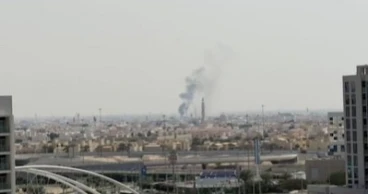
At least one person was killed in Abu Dhabi after several missiles fired from Iran were intercepted, the state news agency of the United Arab Emirates reported.
In a statement, the UAE said the attack amounted to a blatant breach of its national sovereignty and a violation of international law, stressing that it reserves the full right to respond to what it described as a dangerous escalation, reports Al Jazeera.
3 months ago
Near-total internet blackout reported in Iran as Israel strikes military targets in west
A near-total internet blackout has been reported across Iran as the Israel Defense Forces (IDF) said it was carrying out broad air strikes on military targets in the country’s western regions.
Internet monitoring agency NetBlocks said connectivity across Iran had dropped sharply, indicating a widespread disruption to online services amid the ongoing military escalation involving Israel and the United States, reports BBC.
The blackout is not unprecedented. Last month, Iran experienced a similar near-total shutdown during nationwide protests that were forcefully suppressed by authorities. During that period, some users managed limited access through satellite-based services operated by SpaceX as well as virtual private networks (VPNs), and similar workarounds may again be attempted.
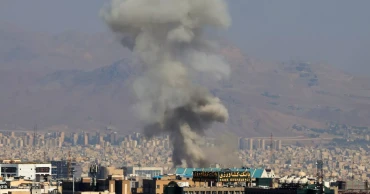
Meanwhile, the IDF said its air force was conducting “a broad strike on a number of military targets” in western Iran. Explosions were reported earlier in the western cities of Kermanshah and Tabriz, though Iranian authorities have not released details on casualties or damage.
The developments come amid escalating tensions following coordinated strikes and threats of retaliation across the region. The communications blackout is expected to further restrict the flow of information from inside Iran as military operations continue.
3 months ago
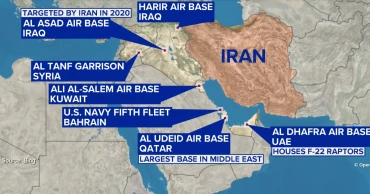
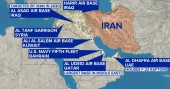
Iran targets US forces in Qatar, Bahrain, Kuwait and UAE amid regional escalation
Iran has targeted United States forces across multiple Gulf countries, including Qatar, Bahrain, Kuwait and the United Arab Emirates, sharply escalating tensions in the Middle East.
Bahrain confirmed that the headquarters of the US Navy’s 5th Fleet was hit in a missile attack, raising concerns over the security of key American military assets in the region, reports Al Jazeera.
In Qatar, the Defence Ministry said an Iranian missile was intercepted by the Patriot air defence system, preventing damage. Following the developments, Qatar, Kuwait and the United Arab Emirates announced the closure of their airspace as a precautionary measure.
Meanwhile, a loud explosion was reported in Abu Dhabi, the capital of the United Arab Emirates, according to Reuters. Authorities in the UAE have not immediately disclosed details on the cause of the explosion.
Earlier, Iran’s Islamic Revolutionary Guard Corps confirmed it had launched missiles and drones towards Israel in response to recent US-Israeli attacks, signalling a widening of the conflict with potential regional and global implications.
3 months ago
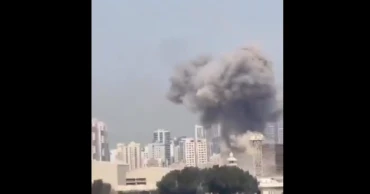
Tensions escalate as missile hits US Navy’s Fifth Fleet in Bahrain
The headquarters of the US Navy’s 5th Fleet in Bahrain has been “subjected to a missile attack”, the Bahrain News Agency reported on Saturday, citing an official statement from the National Communication Centre.
The statement did not attribute responsibility for the strike but said further details would be released later. Authorities urged the public to follow official instructions and rely on verified information only, reports Al jazeera.
Bahrain hosts the headquarters of the US Navy’s Fifth Fleet, whose area of responsibility covers the Gulf, Red Sea, Arabian Sea and parts of the Indian Ocean.
There was no immediate comment from the US military. However, the US Embassy in Bahrain had earlier advised American citizens to shelter in place amid reported threats involving missiles and drones over the country.
Meanwhile, a senior Iranian official warned that all US and Israeli assets in the region could become “legitimate targets”, signalling a possible escalation following recent regional hostilities.
The official, speaking to media, said Tehran would deliver a public response with “no red lines”, adding that the conflict initiated by the United States and Israel could have wide and long-lasting repercussions. Calls for restraint or surrender, the official said, were “unacceptable”.
Tensions across the Middle East remain high as military alerts and diplomatic warnings continue to intensify in the wake of the reported strike.
3 months ago
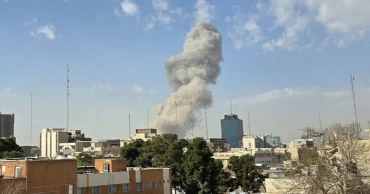
Israel attacks Iran’s capital with US support amid nuclear tensions
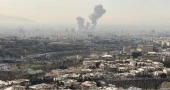
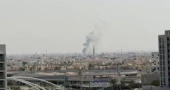
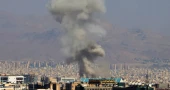
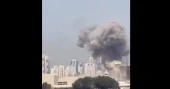
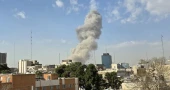
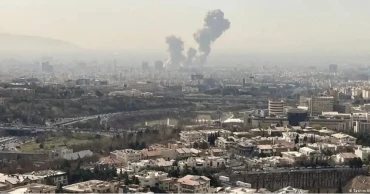
Israel carried out a daytime assault on Tehran on Saturday, sending smoke billowing from the city center.
The initial strike targeted areas near the offices of Supreme Leader Ayatollah Ali Khamenei.
The United States is participating in the operation, though the exact scale of its involvement remains unclear, according to a U.S. official and a source familiar with the mission, who spoke on condition of anonymity due to the sensitivity of military operations.
It is not known whether the 86-year-old Khamenei was present at his offices during the attack.
He has not been seen publicly for several days amid escalating tensions with the United States.
The strikes come as Washington has deployed a large fleet of fighter jets and warships to the region to pressure Iran into a nuclear deal.
Authorities had closed roads leading to Khamenei's compound in central Tehran as other blasts were reported across the city.
US President Donald Trump had aimed for a deal to limit Iran’s nuclear activities and see a chance while the country faces rising domestic unrest following nationwide protests.
Iran had sought to avoid war but insists it has the right to enrich uranium and refuses to negotiate on other issues, including its long-range missile program or support for armed groups such as Hamas and Hezbollah.
It is unclear whether Iran will retaliate immediately, but Tehran has warned that American military personnel and bases across the region would be targets for any response.
Pakistan declares State of emergency in Bannu district of Khyber Pakhtunkhwa province
Israeli Defense Minister Israel Katz described the strikes as being carried out “to remove threats.” He did not provide further details.
In Tehran, witnesses reported hearing the first blast near Khamenei's office. Iranian state television later covered the explosion without specifying a cause.
Sirens sounded across Israel as the country closed its airspace. The Israeli military said it issued a “proactive alert to prepare the public for the possibility of missiles being launched toward the state of Israel.”
Additional explosions were reported in Tehran following the Israeli attack, though authorities have not released casualty figures. Iran meanwhile closed its airspace and disrupted mobile phone services.
Warnings to pilots coincided with the blasts reverberating across the Iranian capital.
3 months ago
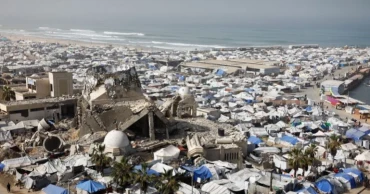
Six killed in Israeli drone strikes on Gaza police sites
At least six Palestinians were killed after Israeli drone attacks hit police sites in central and southern Gaza, amid continued fighting in the war-battered enclave.
Local sources said the overnight strikes targeted a police post near the Bureij refugee camp in the central Gaza Strip and another checkpoint in the al-Mawasi area of Khan Younis in the south.
Medical officials at Nasser Medical Complex in Khan Younis said four bodies and several injured people were brought to the hospital after a strike on a police checkpoint at the al-Maslakh intersection. Some of the wounded were in critical condition.
In a separate attack, two more Palestinians were killed and others injured when an Israeli drone struck a police post at the entrance of the Bureij refugee camp.
Hamas condemned the attacks, saying they showed Israel’s disregard for efforts by mediators to maintain calm. A Hamas spokesperson said the ongoing strikes reflect a continued campaign against the Palestinian people despite talk of ceasefire efforts.
Meanwhile, the Gaza Crossings and Borders Authority said limited movement continued through the Rafah crossing. On Thursday, 50 Palestinians travelled to Egypt, including patients and their companions, while 41 people returned to Gaza.
The authority also said 286 trucks entered Gaza on the same day, including commercial and aid vehicles. Aid groups say the number is far below what is needed to meet basic humanitarian needs, as shortages of food and medicine persist due to restrictions on aid entry.
The situation in Gaza remains dire, with international agencies warning that continued attacks and limits on humanitarian access are deepening the crisis for civilians.
With inputs from ALJAZEERA
3 months ago
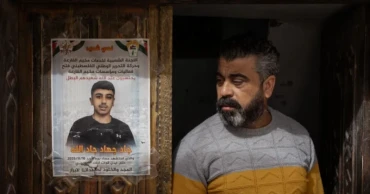
Palestinian boy shot dead as Israeli soldiers block medical help
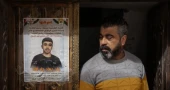
Israeli soldiers shot a 14-year-old Palestinian boy at close range in a refugee camp in the occupied West Bank and then prevented medical teams from reaching him as he lay critically wounded, according to eyewitnesses and verified accounts.
The boy, Jad Jadallah, was shot last November in al-Far'a refugee camp. After the shooting, around 14 Israeli soldiers reportedly surrounded the area and stopped Palestinian ambulances from accessing the injured child. Witnesses said Jad remained on the ground for a long period while bleeding heavily.
Although Israeli soldiers receive training in basic trauma care, no immediate life-saving assistance was provided to the boy, according to those present. Family members said Jad tried to signal for help, but soldiers nearby did not respond.
The Israel Defence Forces said soldiers gave “initial medical treatment” after checking that the boy was not carrying explosives. However, the military did not provide details about what treatment was given or when it was administered.
The Israeli army claimed the boy had thrown a stone, an act it says can justify the use of lethal force. Jad’s family and Israeli rights group B'Tselem rejected the claim and alleged attempts were made to falsely portray the boy as a threat. The military did not respond to specific questions on this allegation.
Jad was later taken away in an Israeli military vehicle. It remains unclear when and where he died or how many times he was shot, as the authorities have not returned his body or disclosed medical findings.
Paramedics from the Palestinian Red Crescent said they arrived near the scene quickly but were blocked by soldiers and forced to wait while the boy lay injured. Jad’s mother said she was also stopped when she tried to reach her son.
The incident occurred in the West Bank, where Israeli military raids are frequent, particularly in refugee camps. The United Nations says dozens of Palestinian children have been killed by Israeli forces in the area in recent years.
Human rights groups say the case raises serious concerns about the use of force and the denial of medical assistance. Many details of Jad’s death remain unknown due to the refusal of Israeli authorities to release his body or provide full information.
With inputs from BBC
3 months ago
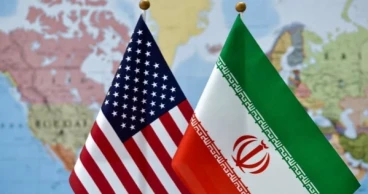
Iran, US prepare for new nuclear talks amid sanctions and military warnings
Iran and the United States are set to open a third round of indirect nuclear negotiations in Switzerland, even as Washington ramps up pressure through new sanctions and renewed warnings of possible military action.
Iranian Foreign Minister Abbas Araghchi arrived in Geneva on Wednesday, where he met Omani Foreign Minister Badr Albusaidi, who is mediating the talks scheduled for Thursday.
Ahead of his departure, Araghchi said a “fair, balanced and equitable” agreement was achievable, reiterating that Iran was not pursuing nuclear weapons but would not relinquish what it calls its right to the peaceful use of nuclear technology.
The negotiations are taking place against a backdrop of deep mistrust, with both sides alternating between diplomatic engagement and confrontational rhetoric.
In Washington, DC, US Vice President JD Vance accused Tehran of attempting to revive its nuclear programme after US strikes on Iranian nuclear facilities last June, warning that Iran should take US military threats seriously.
He said the US position was clear: Iran must not acquire a nuclear weapon, adding that President Donald Trump preferred a diplomatic solution but retained other options.
Trump hails ‘winning’ streak in State of the Union, seeks to soothe economic worries before midterms
Meanwhile, the United States Department of the Treasury announced sanctions on more than 30 individuals, entities and vessels accused of financing Iran’s oil exports, ballistic missile development and weapons production. Treasury Secretary Scott Bessent said Iran was exploiting global financial systems to fund illicit activities and support allied armed groups.
A day earlier, Trump, in his State of the Union address, accused Iran of pursuing “sinister nuclear ambitions” and developing missiles capable of striking the United States. Iranian officials strongly rejected the claims.
Iranian Foreign Ministry spokesman Esmaeil Baghaei dismissed the accusations as “big lies,” comparing the US approach to Nazi-era propaganda.
US Secretary of State Marco Rubio, speaking from Saint Kitts and Nevis, said the Geneva talks would centre on Iran’s nuclear programme but stressed Washington’s concern over Iran’s ballistic missiles, which he said Tehran was trying to extend to intercontinental range. Iran’s refusal to include the missile programme in negotiations, Rubio said, was “a big, big problem.”
The current state of Iran’s nuclear infrastructure remains uncertain. While Trump has claimed last year’s US strikes “obliterated” the programme, inspectors from the International Atomic Energy Agency have not been allowed to verify conditions at key sites, including Fordow, Natanz and Isfahan.
On the US side, the negotiations are being led by Trump’s special envoy Steve Witkoff, alongside the president’s son-in-law Jared Kushner. The first round of talks was held in Oman on February 6, followed by a second session in Geneva on February 17.
After the previous round, Araghchi said both sides had reached a preliminary understanding on broad principles, though no concrete agreement was achieved. Iranian media reports suggest the gaps remain wide, particularly over uranium enrichment and Tehran’s demand for firm guarantees that sanctions would be lifted before it makes concessions.
Iranian parliament speaker Mohammad Bagher Ghalibaf underscored Tehran’s stance, warning that while Iran was open to diplomacy based on mutual respect, any attack during negotiations would draw a strong response.
Iran has also warned that any US strike would trigger retaliation against American military bases across the Middle East and could lead to the closure of the Strait of Hormuz, a vital route for global oil supplies.
US Central Command spokesman Tim Hawkins said the United States was reinforcing its military posture to deter escalation and protect its forces in the region.
US media reports say Washington’s strategy combines tougher rhetoric and sanctions to increase leverage at the negotiating table, with the aim of pushing Iran to curb uranium enrichment and, eventually, its missile programme and regional activities, in exchange for economic relief.
#From ALJAZEERA
3 months ago
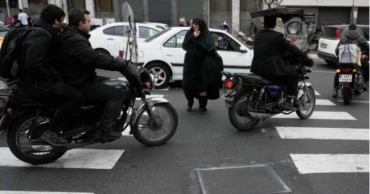
Iran rejects Trump pressure ahead of Geneva nuclear talks amid massive U.S. military deployment
Iran on Wednesday resisted pressure from U.S. President Donald Trump ahead of crucial talks in Geneva over Tehran’s nuclear program, alternating between condemning his statements as “big lies” and expressing cautious optimism for an agreement through “honorable diplomacy.”
The comments by Iranian officials come as the U.S. has deployed its largest force of aircraft and warships to the Middle East in decades, part of Trump’s push for a deal amid growing domestic unrest in Iran following nationwide protests last month. Trump has repeatedly warned of military action if negotiations fail, raising fears of a wider regional conflict while the Israel-Hamas war continues. Tehran has already declared all U.S. bases in the region legitimate targets. Satellite imagery analyzed by The Associated Press shows U.S. warships normally stationed in Bahrain moving out to sea.
Oman confirms fresh US-Iran nuclear talks in Geneva
Responding to Trump’s State of the Union speech, Iranian Foreign Ministry spokesman Esmail Baghaei compared the president to Hitler’s propaganda minister and accused Washington of spreading disinformation. Parliament speaker Mohammad Bagher Qalibaf emphasized Iran’s readiness for diplomacy that respects its dignity, warning that any attack amid negotiations would provoke a “firm blow” from Iran’s defensive forces.
The talks, mediated by Oman, mark the third round between the two nations. Uncertainty remains over the timing, objectives, and scope of potential U.S. military action, the status of Iran’s nuclear program, and the wider regional consequences. Oil prices have risen amid fears of escalation, while Tehran could retaliate against U.S.-allied nations in the Gulf or Israel.
3 months ago