usa-and-canada

Canadian police say Muslim family targeted by deadly attack
A driver plowed a pickup truck into a family of five, killing four of them and seriously injuring the other in a deliberate attack that targeted the victims because they were Muslims, Canadian police said Monday.
Authorities said a young man was arrested in the parking lot of a nearby mall after the incident Sunday night in the Ontario city of London. Police said a black pickup truck mounted a curb and struck the victims at an intersection.
“This was an act of mass murder perpetuated against Muslims,” Mayor Ed Holder said. “It was rooted in unspeakable hatred.”
Read: Canada lowers flags after discovery of bodies at school site
The extended family issued a statement identifying the dead as Salman Afzal, 46; his wife Madiha, 44; their daughter Yumna, 15; and a 74-year-old grandmother whose name was withheld. The hospitalized boy was identified as Fayez.
“Everyone who knew Salman and the rest of the Afzal family know the model family they were as Muslims, Canadians and Pakistanis,” the statement said. “They worked extremely hard in their fields and excelled. Their children were top students in their school and connected strongly with spiritual their identity.”
A fundraising webpage said the father was a physiotherapist and cricket enthusiast and his wife was working on a PhD in civil engineering at Western University in London. Their daughter was finishing ninth grade, and the grandmother was a “pillar” of the family, the page said.
The family said in its statement that the public needs to stand against hate and Islamophobia.
“This young man who committed this act of terror was influenced by a group that he associated with, and the rest of the community must take a strong stand against this, from the highest levels in our government to every member of the community,” the statement said.
Nathaniel Veltman, 20, was in custody facing four counts of first-degree murder. Police said Veltman, a resident of London, did not know the victims.
Detective Supt. Paul Waight said police had not determined if the suspect was a member of any specific hate group. He said London police were working with federal police and prosecutors to see about potential terrorism charges. He declined to detail evidence pointing to a possible hate crime, but said the attack was planned.
Read:More than 200 bodies found at Indigenous school in Canada
About a dozen police officers combed the area around the crash site looking for evidence Monday. Blue markers on the ground dotted the intersection.
“We believe the victims were targeted because of their Islamic faith,” Police Chief Stephen Williams said. “... There is no tolerance in this community who are motivated by hate target others with violence.”
4 years ago

Canada lowers flags after discovery of bodies at school site
Canadian Prime Minister Justin Trudeau asked Sunday that flags at all federal buildings be flown at half-staff to honor more than 200 children whose remains have been found buried at what was once Canada’s largest Indigenous residential school — one of the institutions that held children taken from families across the nation.
The Peace Tower flag on Parliament Hill in the nation’s capital of Ottawa was among those lowered to half-staff.
“To honor the 215 children whose lives were taken at the former Kamloops residential school and all Indigenous children who never made it home, the survivors, and their families, I have asked that the Peace Tower and all federal buildings be flown at half-mast,” Trudeau tweeted.
Read: More than 200 bodies found at Indigenous school in Canada
Mayors of communities across Ontario, including Toronto, Ottawa, Mississauga and Brampton, also ordered flags lowered to honor the children.
Chief Rosanne Casimir of the Tk’emlups te Secwepemc First Nation in British Columbia said the remains of 215 children, some as young as 3 years old, were confirmed last weekend with the help of ground-penetrating radar.
She described the discovery as “an unthinkable loss that was spoken about but never documented at the Kamloops Indian Residential School.″
From the 19th century until the 1970s, more than 150,000 First Nations children were required to attend state-funded Christian schools as part of a program to assimilate them into Canadian society. They were forced to convert to Christianity and not allowed to speak their native languages. Many were beaten and verbally abused, and up to 6,000 are said to have died.
The Canadian government apologized in Parliament in 2008 and admitted that physical and sexual abuse in the schools was rampant. Many students recalled being beaten for speaking their native languages. They also lost touch with their parents and customs.
Indigenous leaders have cited that legacy of abuse and isolation as the root cause of epidemic rates of alcoholism and drug addiction on reservations.
Plans are underway to bring in forensics experts to identify and repatriate the remains of the children found buried on the site.
The Kamloops school operated between 1890 and 1969, when the federal government took over operations from the Catholic Church and operated it as a day school until it closed in 1978.
Read: US tribe shares vaccine with relatives, neighbors in Canada
The National Truth and Reconciliation Commission has records of at least 51 children dying at the school between 1915 and 1963.
Perry Bellegarde, chief of the Assembly of First Nations, said while it is not new to find graves at former residential schools, it’s always crushing to have that chapter’s wounds exposed.
The chief of the Mississaugas of the Credit First Nation, R. Stacey LaForme, wrote Trudeau on Saturday to ask the government to lower the flags and declare a national day of mourning.
“There is a lot more to be done but first and foremost, we need to do this to show love and respect to the 215 children, all of the children, and their families,” LaForme said in a statement. “This should be a moment that the country never forgets.”
Sol Mamakwa, an Indigenous opposition legislator who represents the Ontario riding of Kiiwetinoong, called on the province and Canadian government to work with all First Nations to look for remains at other defunct residential schools.
“It is a great open secret that our children lie on the properties of the former schools — an open secret that Canadians can no longer look away from,” Mamakwa said. “In keeping with the Truth and Reconciliation Commission’s Missing Children Projects, every school site must be searched for the graves of our ancestors.”
Read: Canada pauses AstraZeneca vaccine for under 55
Toronto Mayor John Tory said city flags would stay lowered for nine days — 215 hours — to represent each life.
“This sad story is shocking but not surprising to students of history, I don’t think we know yet when these deaths occurred,” said Nelson Wiseman, a political science professor at the University of Toronto.
“Canada of yesteryear is not the Canada of today,″ he said.
5 years ago

More than 200 bodies found at Indigenous school in Canada
The remains of 215 children, some as young as 3 years old, have been found buried on the site of what was once Canada’s largest Indigenous residential school — one of the institutions that held children taken from families across the nation.
Chief Rosanne Casimir of the Tk’emlups te Secwépemc First Nation said in a news release that the remains were confirmed last weekend with the help of ground-penetrating radar.
More bodies may be found because there are more areas to search on the school grounds, Casimir said Friday.
In an earlier release, she called the discovery an “unthinkable loss that was spoken about but never documented at the Kamloops Indian Residential School.” It was the once the site of Canada’s largest residential school.
From the 19th century until the 1970s, more than 150,000 First Nations children were required to attend state-funded Christian schools as part of a program to assimilate them into Canadian society. They were forced to convert to Christianity and not allowed to speak their native languages. Many were beaten and verbally abused, and up to 6,000 are said to have died.
Also Read: Canada for fostering peaceful campaign environment in Bangladesh
The Canadian government apologized in Parliament in 2008 and admitted that physical and sexual abuse in the schools was rampant. Many students recall being beaten for speaking their native languages; they also lost touch with their parents and customs.
Indigenous leaders have cited that legacy of abuse and isolation as the root cause of epidemic rates of alcoholism and drug addiction on reservations.
A report more than five years ago by a Truth and Reconciliation Commission said at least 3,200 children had died amid abuse and neglect, and it said it had reports of at least 51 deaths at the Kamloops school alone between 1915 and 1963.
“This really resurfaces the issue of residential schools and the wounds from this legacy of genocide towards Indigenous people,” Terry Teegee, Assembly of First Nations regional chief for British Colombia, said Friday.
British Columbia Premier John Horgan said he was “horrified and heartbroken” to learn of the discovery, calling it a tragedy of “unimaginable proportions” that highlights the violence and consequences of the residential school system.
The Kamloops school operated between 1890 and 1969, when the federal government took over operations from the Catholic Church and operated it as a day school until it closed in 1978.
Casimir said it’s believed the deaths are undocumented, although a local museum archivist is working with the Royal British Columbia Museum to see if any records of the deaths can be found.
“Given the size of the school, with up to 500 students registered and attending at any one time, we understand that this confirmed loss affects First Nations communities across British Columbia and beyond,” Casimir said in the initial release issued late Thursday.
The leadership of the Tk’emlups community “acknowledges their responsibility to caretake for these lost children,” Casimir said.
Access to the latest technology allows for a true accounting of the missing children and will hopefully bring some peace and closure to those lives lost, she said in the release.
Casimir said band officials are informing community members and surrounding communities that had children who attended the school.
The First Nations Health Authority called the discovery of the children’s remains “extremely painful” and said in a website posting that it “will have a significant impact on the Tk’emlúps community and in the communities served by this residential school.”
The authority’s CEO, Richard Jock, said the discovery “illustrates the damaging and lasting impacts that the residential school system continues to have on First Nations people, their families and communities,.”
Nicole Schabus, a law professor at Thompson Rivers University, said each of her first-year law students at the Kamloops university spends at least one day at the former residential school speaking with survivors about conditions they had endured.
She said she did not hear survivors talk about an unmarked grave area, “but they all talk about the kids who didn’t make it.”
Australia also apologized for its so-called Stolen Generations - thousands of Aborigines forcibly taken from their families as children under assimilation policies that lasted from 1910 to 1970.
Canada offered those who were taken from their families compensation for the years they attended the residential schools. The offer was part of a lawsuit settlement.
5 years ago
US tribe shares vaccine with relatives, neighbors in Canada
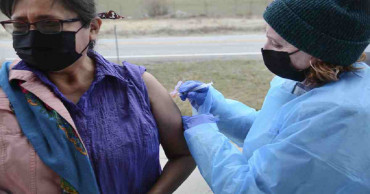
On a cloudy spring day, hundreds lined up in their cars on the Canadian side of the border crossing that separates Alberta and Montana. They had driven for hours and camped out in their vehicles in hopes of receiving the season’s hottest commodity — a COVID-19 vaccine — from a Native American tribe that was giving out its excess doses.
The Blackfeet tribe in northern Montana provided about 1,000 surplus vaccines last month to its First Nations relatives and others from across the border, in an illustration of the disparity in speed at which the United States and Canada are distributing doses. While more than 30% of adults in the U.S. are fully vaccinated, in Canada that figure is about 3%.
Among those who received the vaccine at the Piegan-Carway border crossing were Sherry Cross Child and Shane Little Bear, of Stand Off, about 30 miles (50 kilometers) north of the border.
They recited a prayer in the Blackfoot language before nurses began administering shots, with Chief Mountain — sacred to the Blackfoot people — rising in the distance. The prayer was dedicated to people seeking refuge from the virus, Cross Child said.
Cross Child and her husband have family and friends in Montana but have not been able to visit them since the border closed last spring to all but essential travel.
“It’s been stressful because we had some deaths in the family, and they couldn’t come,” she said. “Just for the support – they rely on us, and we rely on them. It’s been tough.”
More than 95% of the Blackfeet reservation’s roughly 10,000 residents who are eligible for the vaccine are fully immunized, after the state prioritized Native American communities — among the most vulnerable U.S. populations — in the early stages of its vaccination campaign.
The tribe received vaccine allotments both from the Montana health department and the federal Indian Health Service, leaving some doses unused. With an expiration date fast approaching, it turned to other nations in the Blackfoot Confederacy, which includes the Blackfeet and three tribes in southern Alberta that share a language and culture.
“The idea was to get to our brothers and sisters that live in Canada,” said Robert DesRosier, emergency services manager for the Blackfeet tribe. “And then the question came up – what if a nontribal member wants a vaccine? Well, this is about saving lives. We’re not going to turn anybody away.”
Also Read:Canada pauses AstraZeneca vaccine for under 55
The tribe distributed the Pfizer and Moderna vaccines over four days in late April at the remote Piegan Port of Entry, amid a backdrop of rolling grasslands to the east and Glacier National Park’s snow-covered peaks to the west.
As news of the effort spread in Canada, first by word of mouth, then through social platforms and media reports, people traveled from farther away. Some drove five hours from the city of Edmonton.
The effort was particularly timely as Alberta sees a surge in new cases of the respiratory virus, with a caseload record reached this month.
Bonnie Healy, Blackfoot Confederacy health administrator, said she was glad the vaccination effort reached both First Nations and other communities in the province.
“We have family members that live in those areas,” she said. “If we can get these places safe, then it’s safe for our children to go to school there. It’s safe for our elders to go shopping in their stores.”
Canadians who got the vaccines were not allowed to linger in the U.S. They returned home with letters from health officials exempting them from the mandatory 14-day quarantine imposed on all those entering the country.
The tribe’s initiative is one of a few partnerships that have cropped up between communities in the U.S. and Canada, where residents might otherwise have to wait weeks or months for a shot.
Canada has lagged in vaccinating its population because it lacks the ability to manufacture the vaccine and like many countries has had to rely on the global supply chain for the lifesaving shots. Although Canada’s economy is tightly interconnected with the U.S., Washington hasn’t allowed the hundreds of millions of vaccine doses made in America to be exported until very recently, and Canada has had to turn to Europe and Asia.
But vaccinations have ramped up in recent months, and the Canadian government expects to receive at least 10 million vaccines this month and millions more in June. First Nations have been prioritized from the start.
Also Read: Canada clears Johnson & Johnson vaccine, first to approve 4
In the meantime, Alaska Gov. Mike Dunleavy has offered COVID-19 vaccines to residents of Stewart, British Columbia, with hopes it could lead the Canadian government to ease restrictions between that town and the Alaska border community of Hyder, a couple of miles away. In North Dakota, Gov. Doug Burgum and Manitoba Premier Brian Pallister unveiled a plan last month to administer vaccinations to Manitoba-based truck drivers transporting goods to and from the U.S.
On the Montana side of the border, vaccine recipients were often emotional, shedding tears, shouting words of gratitude through car windows as they drove away, and handing the nurses gifts such as chocolate and clothing. Some shared stories about what the vaccine meant to them – the possibility of safely caring for vulnerable loved ones, reuniting with grandparents or traveling again.
Recipients included 17-year-olds who are low on the country’s priority list and parents who camped out with their young children in the backseat.
Maxwell Stein, 25, who plays the horn with the Calgary Philharmonic Orchestra, arrived at the border crossing at 6 p.m. Wednesday and spent the night in his car, finally reaching the front of the line around 10 a.m. Thursday.
“It wasn’t awesome, but you do what you need to to get a vaccine,” he said. He predicted that if he had waited in Canada, he’d likely get his first dose sometime in late June, and it would be months before he would be fully vaccinated.
The Canadian government has recommended extending the interval between the two doses of the Moderna and Pfizer vaccines from around three weeks to four months, with the goal of quickly inoculating more people amid the shortage. Some who attended the Blackfeet clinics had already gotten their first shot in Canada. More than 34% of Canada’s population has received at least one dose of the vaccine, but around 3% have received both doses recommended by the drug manufacturers to reach full immunity. Canadian officials say partial immunity is better than none.
“With vaccines, I think it’s really important to get the correct dosage in the right time period, so your body builds up the full resistance,” Stein said.
When Stein heard about the vaccine clinic on the border, he didn’t hesitate about the long drive, particularly as a professional musician who has a lot of free time with many concerts canceled.
“Really, I have no excuse. If I had to drive 10 hours to get the Pfizer or Moderna, I probably would have done it,” he said.
5 years ago

Mexico City metro overpass collapses onto road; 20 dead
An elevated section of the Mexico City metro collapsed and sent a subway car plunging toward a busy boulevard late Monday, killing at least 20 people and injuring about 70, city officials said.
A crane was working to hold up one subway car left dangling on the collapsed section so that emergency workers could enter to check the car to see if anyone was still trapped. Mayor Claudia Sheinbaum said 49 of the injured were hospitalized, and that seven were in serious condition and undergoing surgery.
Read Also: Mexico tops 155,000 COVID-19 deaths, may be 3rd highest
Sheinbaum said a motorist had been pulled alive from a car that was trapped on the roadway below. Dozens of rescuers continued searching through wreckage from the collapsed, preformed concrete structure.
“There are unfortunately children among the dead,” Sheinbaum said, without specifying how many.
The overpass was about 5 meters above the road in the southside borough of Tlahuac, but the train ran above a concrete median strip, which apparently lessened the casualties among motorists on the roadway below.
“A support beam gave way,” Sheinbaum said, adding that the beam collapsed just as the train passed over it.
Rescue efforts were briefly interrupted at midnight because the partially dangling train was “very weak.”
“We don’t know if they are alive,” Sheinbaum said of the people possibly trapped inside the subway car.
Hundreds of police officers and firefighters cordoned off the scene as desperate friends and relatives of people believed to be on the trains gathered outside the security perimeter.
Read Also: 3 killed, 27 hospitalized after boat capsizes off San Diego
Oscar López, 26, was searching for his friend, Adriana Salas, 26. Six months pregnant, she was riding the subway home from her work as a dentist when her phone stopped answering around the time the accident occurred.
“We lost contact with her, at 10:50 p.m., there was literally no more contact,” López said. With little information and a still serious coronavirus situation in Mexico City, López said “they are not telling us anything, and people are just crowding together.”
The collapse occurred on the newest of the Mexico City subway’s lines, Line 12, which stretches far into the city’s southside. Like many of the city’s dozen subway lines, it runs underground through more central areas of the city of 9 million, but then runs on elevated, pre-formed concrete structures on the city’s outskirts.
The collapse could represent a major blow for Mexican Foreign Relations Secretary Marcelo Ebrard, who was Mexico City’s mayor from 2006 to 2012, when Line 12 was built. Allegations about poor design and construction on the subway line emerged soon after Ebrard left office as mayor. The line had to be partly closed in 2013 so tracks could be repaired.
Ebrard wrote on Twitter: “What happened today on the Metro is a terrible tragedy.”
“Of course, the causes should be investigated and those responsible should be identified,” he wrote. “I repeat that I am entirely at the disposition of authorities to contribute in whatever way is necessary.”
It was not clear whether a 7.1-magnitude earthquake in 2017 could have affected the subway line.
Read Also: Taiwanese man involved in deadly train derailment released on bail
The Mexico City Metro, one of the largest and busiest in the world, has had at least two serious accidents since its inauguration half a century ago.
In March of last year, a collision between two trains at the Tacubaya station left one passenger dead and injured 41 people. In 2015, a train that did not stop on time crashed into another at the Oceania station, injuring 12 people.
5 years ago
.jpg)
U.S. extends nuclear arms control treaty with Russia for five years
The United States on Wednesday extended the New Strategic Arms Reduction Treaty (New START) with Russia for five years, said U.S. Secretary of State Antony Blinken.
5 years ago

Police: Suspicious blast wounds 3 in Nashville on Christmas
An explosion shook the largely deserted streets of downtown Nashville early Christmas morning, shattering windows, damaging buildings and wounding three people. Authorities said they believed the blast was intentional.
5 years ago
.jpg)
Canada health regulator approves Pfizer's COVID-19 vaccine
Canada's health regulator on Wednesday approved Pfizer’s COVID-19 vaccine, days ahead of possible approval in the United States.
5 years ago
Covid-19: Vaccine put to final test in 30,000 volunteers in U.S.
A total of 30,000 planned volunteers are ready to take Covid-19 vaccine created by the U.S. government -- one of several candidates in the final stretch of the global vaccine race.
5 years ago

Coronavirus: Police find 17 bodies at New Jersey nursing home
New Jersey police found 17 bodies in one of the state's largest nursing homes after an anonymous tip said a body was being stored in a shed.
6 years ago