Others
Ordinance issued revoking govt's ability to raise power and energy prices bypassing BERC
An ordinance has been issued revoking the provision for increasing the prices of gas and electricity by executive order.On Tuesday, August 27, the President issued the "Bangladesh Energy Regulatory Commission (Amendment) Ordinance, 2024."Earlier, on August 22, the draft ordinance was approved in the interim government's advisory council meeting.By amending the "Bangladesh Energy Regulatory Commission Act, 2003," the ordinance has abolished Section 34(k) which allowed for increasing the prices of oil, gas, and electricity by executive order.On December 1, 2022, in a special case, the President issued the "Bangladesh Energy Regulatory Commission (Amendment) Ordinance, 2022," giving the government, not the Bangladesh Energy Regulatory Commission (BERC), the power to determine, readjust, and coordinate the prices of oil, electricity, and gas at the consumer level.The ordinance included Section 34(k) under the heading of government power to determine, readjust, or coordinate tariffs. This section stated, "Notwithstanding anything in the other provisions of this law, in special cases, the government, by notification in the official gazette, for the purpose of subsidy adjustment, in the public interest, to ensure uninterrupted energy supply based on demand for agriculture, industry, fertilizers, trade, and household needs, may take prompt effective measures for the production increase, transmission, transportation, and marketing of energy, and may determine, readjust, or coordinate tariffs for electricity production, energy transmission, storage, marketing, supply, distribution, and at the consumer level."Later, when the parliament convenes, the ordinance will become law. The ministry had been repeatedly increasing the prices of gas, electricity, and oil, which caused dissatisfaction among consumers.On August 22, the advisory council meeting gave final approval for issuing the ordinance to repeal Section 34(k) of the "Bangladesh Energy Regulatory Commission Act, 2003," with the aim of ensuring greater public involvement, transparency, accountability, governance, public expectations, and consumer interests in tariff/price determination of electricity production, gas resources, and petroleum products through public hearings in the current context.On August 5, the day of the 'March to Dhaka' program called by the anti-discrimination student movement, Sheikh Hasina resigned from the position of Prime Minister and moved to India. On the same day, the cabinet was dissolved.Subsequently, on August 8, the interim government was sworn in, with Dr. Muhammad Yunus, the Nobel Peace Prize-winning economist, taking on the role of chief advisor.Muhammad Fouzul Kabir Khan was appointed as the advisor on electricity, energy, and mineral resources in the interim government. On Sunday, August 18, he announced on his first day at the office that the prices of gas, electricity, and oil would not be increased by executive order.
Removal of Sheikh Hasina's name from Youth Development InstituteThe name of former Prime Minister Sheikh Hasina has been removed from the 'Sheikh Hasina National Youth Development Institute.' For this purpose, the "Sheikh Hasina National Youth Development Institute (Amendment) Ordinance, 2024" has been issued. On the same day, the draft ordinance was approved in the advisory council meeting.According to the ordinance, the new name is "Bangladesh National Youth Development Institute."
1 year ago
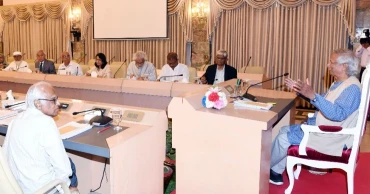
6 ministries under Chief Adviser following latest reshuffle in interim govt
The interim government has once again shuffled around roles and responsibilities for various ministries and divisions among members of its advisory council.
This was confirmed on Tuesday through a notification issued by the Cabinet Division.
As per the latest decision, Chief Adviser Dr. Muhammad Yunus has been assigned responsibilities for six ministries and divisions, which include the Cabinet Division, Ministry of Defence, Armed Forces Division, Ministry of Food, Ministry of Public Administration, and the Ministry of Civil Aviation and Tourism.
Adviser Salehuddin Ahmed has been given charge of the Ministry of Finance, the Ministry of Commerce, and the Ministry of Science and Technology.
Adviser Hasan Arif has been assigned to two ministries: Ministry of Local Government, Rural Development and Cooperatives, and the Ministry of Land.
Adviser Brigadier General (Retd.) Dr. M. Sakhawat Hossain has been assigned the Ministry of Textiles and Jute, as well as the Ministry of Shipping.
Adviser Sharmeen Murshid has been assigned to the Ministry of Social Welfare and the Ministry of Women and Children Affairs.
The notification was issued by Cabinet Secretary Md. Mahbub Hossain on behalf of the president.
1 year ago

Death toll from floods stands at 27; Over 56 lakh people affected
Four more deaths were reported in flood-hit Cumilla district, raising the death toll from the disaster to 27 on Tuesday, said Disaster Management and Relief Ministry’s Adviser Farooq-e-Azam.
He came up with the information while briefing the media about the current situation of the ongoing flood at the Secretariat.
The highest 10 people died in Cumilla, five each in Chattogram and Noakhali, three in Cox’s Bazar and one each in Feni, Brahmanbaria, Khagrachhari and Lakshmipur districts respectively, he said.
The adviser said 12, 07, 429 families have been stranded in 74 upazilas of 11 flood-hit districts--Feni, Cumilla, Chattogram, Khagrachhari, Noakhali, Moulvibazar, Habiganj, Brahmanbaria, Sylhet, Lakshmipur and Cox’s Bazar.
Moreover, 56, 19, 375 people have been affected in 545 municipalities or unions of the 11 districts, he said.
Meanwhile, at least 5, 09,728 people have taken shelter in 3,886 shelter centres while 34, 9421 domestic animals were kept there, according to data from the ministry.
A total of 620 medical teams are providing medical services in the flood affected areas.
Two people remained missing in Moulvibazar, it reads.
So far, a sum of Tk 3.52 crore has been allocated in the flood-stricken districts while 20,650 tonnes of rice, 15,000 pieces of dry foods or other foods and baby foods and fodder worth Tk 35 lakh each were allocated, said the ministry.
1 year ago
ACC provides expert panel to assist agencies fighting financial crime
Anti-Corruption Commission (ACC) on Tuesday formed a six-member panel to support the law enforcement agencies' ongoing operations to tackle financial corruption.
ACC informed the matter through a letter signed by its director general on Tuesday.
It also said the panel will assist in seizing evidence and handling legal issues during search operations.
ACC approves case against former Postal Department officials over alleged corruption in govt project
The members of the panel are- ACC Deputy Directors Debabrata Mondal, Md Humayun Kabir, Md Saiful Islam, and Mohammad Tajul Islam Bhuiyan, as well as assistant directors Muhammad Zafar Sadeq Shibli and Shoyeb Ibne Alam.
1 year ago

Keep NID registration as task for EC, say officials
The Bangladesh Election Commission Officers’ Association has demanded cancellation of a law enacted during the previous Awami League’s regime to transfer the national identity registration operation from the Election Commission to the Security Services Division of the Home Affairs Ministry.
The association submitted a memorandum to the Chief Election Commissioner on Tuesday, seeking the National Identity Registration Act, 2023 to be scrapped.
The Election Commission (EC) has been continuing the national identity registration operation for the last 17 years using its own manpower, said the memorandum signed by Muhammad Hasanuzzaman, the Secretary General of the Association and also director (Administration and Finance) of EC’s National Identity Wing.
The commission has been providing the national identity cards to the citizens as per the National Identity Registration Act, 2010 after the development of a national voter database with the help of the Bangladesh Army during the 2007-2008.
Since the EC’s manpower is used to carry out registration operations, it requires no additional cost.
The Election Commission has its own infrastructure, trained and skilled manpower throughout the country to operate this national identity registration operation, said the EC officers.
But the previous government enacted the National Identity Registration Act, 2023, ignoring the opinions of the civil society, political parties and experts, they claimed
Considering the Bangladesh Election Commission as a role model, the election commissions of different countries including Jamaica, Trinidad and Tobago, Saint Lucia, and Saint Vincent and Grenada Islands are successfully conducting the national identity registration operations, said the EC officers in its memorandum.
They said if the registration operation is transferred under the Home Ministry, it would invite unnecessary controversy and create various problems regarding the national identity database.
Citing the problems, they said questions about the implementation of court decisions, legal complications and credibility of voter lists will arise; citizens' constitutional fundamental right to privacy of information will be undermined; a huge amount of government money will be wasted in setting up new infrastructure and hiring manpower; and the authenticity of the database will be destroyed and security threats for the data will arise.
Though the National Identity Registration Act, 2023 was enacted in September last, the registration operation has not been transferred to the Home Ministry yet.
1 year ago
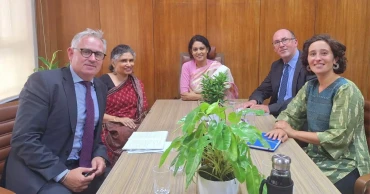
Environment Adviser and UN Delegation Discuss Advancing Human Rights in Bangladesh
Syeda Rizwana Hasan, Adviser on Environment, Forest, and Climate Change, met with a delegation led by Rory Mungoven, Head of the Asia-Pacific Division of the United Nations Human Rights Office, at her office in the Bangladesh Secretariat on Tuesday.
During the meeting, the discussion focused on crimes and human rights violations related to the anti-discrimination student movement in Bangladesh. The talks explored potential areas of collaboration between the United Nations and the Government of Bangladesh to ensure the protection of human rights.
Rizwana highlighted the government’s ongoing efforts in environmental conservation and human rights protection. She emphasized Bangladesh's commitment to safeguarding human rights.
Rory Mungoven praised Bangladesh's initiatives and reaffirmed the United Nations' support in advancing the human rights agenda in the region. He stressed the importance of continued dialogue and partnerships to strengthen institutional capacity in addressing these challenges.
Both parties expressed strong interest in working closely together to uphold human rights in Bangladesh.
Livia Cosenza, Human Rights Officer, Asia Pacific Section; Alexander James Amir El Jundi, Human Rights Officer, OHCHR; and Huma Khan, Senior Human Rights Adviser of the UN Resident Coordinator's Office in Bangladesh, were present at the time, among others.
1 year ago

Justice Zubayer Rahman Chowdhury appointed BJSC Chairman
The government has appointed Justice Zubayer Rahman Chowdhury of the Appellate Division of Supreme Court as chairman of Bangladesh Judicial Service Commission (BJSC).
The Ministry of Law, Justice and Parliamentary Affairs issued a gazette notification in this regard on Tuesday.
The order will be made effective immediately.
BJSC chairman presents commission's Annual Report-2019 to President
END/UNB/M-MAS
1 year ago
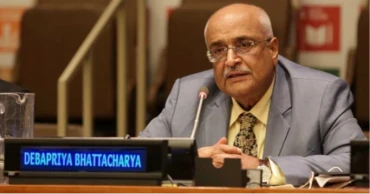
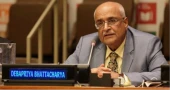
Chief Adviser authorises 10-member panel to draft White Paper on Bangladesh’s Economy in 90 days
Chief Adviser Prof Muhammad Yunus has authorized the formation of a ten-member panel led by Dr. Debapriya Bhattacharya to prepare a white paper on the state of Bangladesh’s economy.
A source in the Secretariat confirmed the development, though the specific names of the panel members are yet to be disclosed.
The panel, chaired by Bhattacharya—who is the convener of the Citizen’s Platform for SDGs and a distinguished fellow at the Centre for Policy Dialogue—will be tasked with crafting the white paper within 90 days.
This document will outline strategic recommendations aimed at stabilizing the economy, achieving Sustainable Development Goals (SDGs), and addressing the challenges faced by Bangladesh as it transitions from the least developed country (LDC) status.
The white paper will focus on several key areas:
Public Finance Management: Examining domestic resource collection, public expenditure including investments and subsidies, and budget deficit financing.
Inflation and Food Management: Assessing production, public procurement, and food distribution mechanisms.
External Balance: Evaluating factors such as export and import dynamics, remittance flows, foreign direct investment, foreign exchange reserves, and external debt.
Energy and Power: Analyzing demand, supply, pricing, costs, and procurement agreements in the energy sector.
Private Sector: Reviewing access to credit, electricity, connectivity, and logistics.
Employment: Investigating employment conditions both domestically and abroad, including formal and informal wage structures and youth employment issues.
The committee will operate without compensation and will be based at the Planning Commission, receiving secretarial support from the General Economic Division.
1 year ago

Palli Bidyut officers, employees call off mass leave, mass resignation
Officers and employees of Palli Bidyut Samity (PBS) called off their planned mass leave and mass resignation programme after discussion with the chairman of the Bangladesh Rural Electrification Board (REB) and Power Division on Tuesday.
In a joint statement, three coordinators of the PBS Anti-Discrimination Movement--Abdul Hakim, Asaduzzaman Bhuiyan and Ranjan Kumar Das--said that they have called off the programme after getting assurance from the REB and Power Division that they will consider their demands.
“The mass resignation and mass leave programme have been withdrawn against the backdrop of the requests from the mass people,” said the statement.
Approximately 40,000 employees and officers from 80 PBSs nationwide have been vocal about their demands, particularly following the fall of the Sheikh Hasina government.
Their primary concerns include ending discrimination in service terms and securing permanent employment status. In response, they threatened mass leave and resignations if their demands were not met.
However, these plans raised suspicions within the interim government that such movements could be part of a broader strategy to destabilise the administration. This concern stems from the fact that many PBS employees were politically appointed during the previous Awami League government.
In an attempt to address the rising tensions, the Power Division established a nine-member committee headed by Additional Secretary Syed Masum Ahmed Chowdhury. The committee includes four representatives from PBS employees, three from the REB, and two from the Power Division.
Representatives of the Palli Bidyut Samity (PBS) officials and employees sat in a meeting with the newly appointed chairman of the Bangladesh Rural Electrification Board (REB) Major General SM Zia-ul-Azim and the head of a Power Division committee at Bidyut Bhaban to address their demands .
Additional Secretary and the head of the Power Division’s committee, Syed Masum Ahmed Chowdhury, said the committee decided to sit in the next meeting on September 4 where the PBS Anti-Discrimination Committee will place a position paper on their demands.
The current unrest follows a protest on 8 August, when PBS officers and employees besieged the REB headquarters in Dhaka's Nikunja area. The demonstrators demanded the implementation of uniform employment rules and the regularisation of irregular employees.
The siege was lifted after the REB authorities, with army mediation, agreed to suspend any staff transfers until the Power Division's report was received.
The PBSs, rural electricity cooperatives, operate under the administrative control of the REB and play a crucial role in the country's electrification efforts.
The ongoing grievances center around perceived discrimination in employment practices, with workers alleging that despite holding the same qualifications and performing the same tasks, they are treated unfairly compared to their REB counterparts.
1 year ago
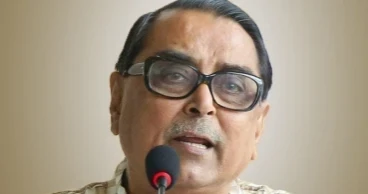
Rashed Khan Menon placed on remand for 6 days
A Dhaka court on Tuesday placed Workers Party President and former lawmaker as well as minister, Rashed Khan Menon, on remand six days in a garment worker murder case filed with Adabor Police Station.Dhaka Metropolitan Magistrate Saifur Rahman passed the order when Mintu Chandra Banik, inspector of Adabor Police Station and also the investigating officer of the case produced him before the court with ten-day remand prayer in the case.On August 22, police arrested Menon from the capital’s Gulshan area. Later, a Dhaka court placed Menon on five-day remand in a case filed for killing businessman Abdul Wadud on the following day.
Rashed Khan Menon remanded for 5 daysAccording to the case statement, Rubel, a garment worker along with the locals and students brought out a procession at Ring Road area during the quota reform protest on August 5.Police, leaders and activists of Awami League and its associate bodies opened fire on them during a chase and counter chase.Rubel sustained bullet injuries during the incident and he was pronounced dead after being taken to a local hospital.Rafiqul Islam, father of Rubel, filed a case with Adabor Police Station on August 22.Former Prime Minister Sheikh Hasina, Sheikh Rehana, Awami League general secretary Obaidul Quader, cricketer Sakib Al Hasan, film actor Ferdous Ahmed and Barrister Syed Sayedul Haque Sumon are also accused in the case.
1 year ago