others
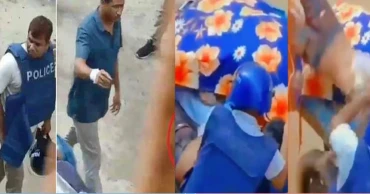
Those involved in piling bodies on van in Ashulia identified: Police
The police officers who were seen present and involved in piling up dead bodies on a van in Ashulia have been identified, police said.
“We are not disclosing names to allow for further steps. But it will be revealed to you very soon,” Dhaka District Superintendent of Police (SP) Ahmad Muyeed told the media after visiting Ashulia Police Station on Sunday.
Besides, a four-member investigation committee comprising Additional SP and DB officials have been constituted to investigate the incident of the video which went viral on social media, he added.
Police are handling the matter with utmost seriousness, Ahmad Muyeed said after inspecting the police station. "The committee is working diligently on the investigation."
However, the officer said no specific deadline has been given for the submission of the investigation report.
In response to the question whether a case will be filed against the police involved, he said that a case will be filed in the name of whoever is the culprit. “The police are not outside the law.”
He further said that not only the students, but also many policemen were burnt to death. There will also be a police murder case, he said.
"There are specific directives from the chief adviser to deal with crimes against humanity with utmost importance," he further stated.
On Thursday night, a 1-minute and 14-second video went viral on social media, showing two policemen grabbing the arms and legs of a dead body and throwing it onto a van already stacked with bodies.
Subsequently it was geolocated by factchecker for AFP's Bangladesh office, Qadaruddin Shishir, and pinpointed to a spot near Ashulia police station, raising a tremendous hue and cry on social media, where some of the officers involved were also identified as attached to Ashulia police station.
1 year ago

Central bank announces special loan repayment facility for flood victims
Bangladesh Bank (BB) has announced a special facility for flood-affected farmers and CMSME (Cottage, Micro, Small and medium enterprises) entrepreneurs to repay the loan installments.
In this case, August installments of short-term agriculture and CMSME sector term loans in these areas can be repaid over three months.
The Banking Regulations and Policy Department (BRPD) of BB issued a circular in this regard on Sunday.
In the circular, the central bank stated that borrowers affected by the recent floods are finding it difficult to repay or adjust their loans. To continue the normal economic activities of the affected borrowers, it has been asked to ease the repayment.
The BB circular said to ease the repayment or adjustment of existing unclassified (non-compensatory) short-term agriculture and CMSME loans as of July 1 of other flood-affected areas-including Feni, Noakhali, Laxmipur, Comilla, and Chattogram- identified by the Ministry of Disaster Management and Relief,
Short-term agriculture and CMSME sector term borrowers can repay the loan installments for August to October within three months of the expiry of the respective loan period.
The BB asked banks to increase the adjustment period of the ongoing loans of the CMSME sector between August 2024 and October 2024.
“No penalty interest, additional interest, excess profit, late fee penalty (by whatever name called) other than regular interest shall be levied or levied on late payment. This directive will be effective immediately,” stated in the circular.
1 year ago

BAU students to distribute free 'Late Aman' seedlings to flood-hit farmers
Students and faculty from Bangladesh Agricultural University (BAU) have launched the "Late Aman" project to address food shortages caused by recent floods.
The initiative involves distributing free Nabiaman rice seedlings to affected farmers, aiming to recover the loss caused by devastating flash floods in the agricultural sector.
The seeds were planted on August 29 and 31 on research fields at BAU, Professor Dr. Md. Moshiur Rahman said on Sunday.
Prof. Rahman stated that sudden floods destroyed Aman rice seedlings, threatening timely cultivation and raising concerns about potential food shortages. Preparing new seedlings takes about a month, risking a missed planting season. In response, BAU students launched a project to distribute rice seeds to affected farmers, ensuring food security.
They also plan to provide agricultural tools, fertilizers, pesticides, and vegetable seeds in the future, he added.
"The students are hopeful that the rice seedlings will sprout within 18 to 20 days. After that, they will deliver these seedlings free of charge to the farmers in the flood-affected areas.", prof. added.
To ensure the success of this initiative, researchers, teachers, and students from BAU, Noakhali Science and Technology University (NSTU), Sher-e-Bangla Agricultural University (SAU), Sylhet Agricultural University, seed companies, and agricultural entrepreneurs have formed the 'Agri Students' Alliance BD'.
Under the "Late Aman" project, seeds have been planted on a total of 12 acres across various locations: 5 acres at BAU, 1 acre at NSTU, 4 acres at Chittagong, and 2 acres at Lakshmipur. This effort aims to distribute seedlings to 1,000 farmers, covering at least 760 bighas of farmland.
Financial and material support for the project, Buyer Bangladesh provided 500 kilograms of Dhani Gold hybrid seeds worth BDT 265,000 and BDT 200,000 from the 'Krishibid Foundation for Humanity,' comprising BAU’s 96-97 session students.
Additionally, to make the project successful, one ton seeds of BINADHAN-17 have been collected from the Bangladesh Agricultural Development Corporation (BADC), Mymensingh and 150 kilograms seeds of BINADHAN-17 from the Bangladesh Institute of Nuclear Agriculture (BINA), Chapainawabganj.
Mukhlesur Rahman, Principle Scientific Officer at Soil Resource Development Institute, Netrokona, stated that seedlings will be distributed to nearly 1,000 farmers in Feni, Noakhali, and Lakshmipur, covering about one bigha of land per farmer.
He mentioned that BAU faculty and researchers advised producing BINADHAN-17 and Dhani Gold hybrid seedlings, which can yield 70-80% even under suboptimal conditions. BINADHAN 17 can be harvested within 120 days, adaptable to various seasons.
1 year ago
Govt to bring necessary reform to labour laws: Asif Mahmud
Labour and Employment Adviser Asif Mahmud on Sunday said the government would bring the necessary reforms to the labour laws and would work to improve the living standard of the workers.
“Necessary reforms to labour related laws will be made. A good working environment will be ensured,” he told a delegation of International Labour Organization (ILO) at the ministry’s conference room.
Asif Mahmud, also the Youth and Sport Affairs Adviser, said the new government will work to improve the living standard of the workers as it is committed to fulfilling all their just demands.
He expressed hope that it would be possible to enrich the country if all work together for the country.
The Labour adviser said the victims of the Rana Plaza tragedy were not properly compensated. A committee was formed to take note of this complaint. Rehabilitation of the injured is also being considered,” he said.
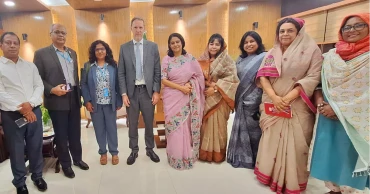
ILO country director Tuomo Poutiainen said ILO has been working with the government and the factory owners on not only the labour issues but also legal assistance and improvement of the institutional standards.
Besides, different issues related to labour including social protection of workers, employment generation, training of workers, enactment of time-befitting labour laws, reform of labour laws, and making an end to child labour came up for discussion in the meeting, said a PID handout.
1 year ago
UNDP and French delegations meet Environment Advisor Rizwana Hasan
Dhaka, Sept 1 (UNB)--A high-level delegation from the United Nations Development Programme (UNDP), led by Resident Representative Stefan Liller, met with Syeda Rizwana Hasan, the Environment, Forest, and Climate Change, and Water Resources Advisor, at secretariat on Sunday.
The discussions covered a range of critical environmental and climate change issues facing Bangladesh.
The topics included enhancing collaboration between the Government of Bangladesh and UNDP on sustainable environmental management, climate resilience, climate change adaptation, ecosystem-based management in Ecologically Critical Areas (ECAs), community-based management in haor regions, sustainable energy, low-carbon urban development, climate-resilient livelihoods, sustainable land management to combat climate change vulnerability, and the reduction of hazardous chemicals.
During the meeting, advisor Syeda Rizwana Hasan highlighted the importance of continued partnership and innovative solutions to address the environmental challenges in Bangladesh.
She stressed the need to explore new opportunities for collaboration and strengthen ongoing initiatives aimed at protecting the environment and promoting sustainable development in the country.
Resident Representative Liller reaffirmed UNDP's commitment to supporting Bangladesh in achieving its Sustainable Development Goals (SDGs), particularly in combating climate change and preserving natural resources.
1 year ago
ADP implementation slow in July amid movement and unrest
The pace of implementation of development projects slowed down in July, the first month of the current fiscal, due to agitations and popular uprisings.
The anti-discrimination movement took place throughout the month of July. Public life almost came to a standstill in the movement. This has affected the development projects.
Annual Development Program (ADP) expenditure has decreased by Tk 567 crore in the first month of the current financial year compared to the same period of the previous year. The total spent amount is Tk 2, 922 crore. The amount of expenditure in July 2023 was Tk 3,489 crore.
The Implementation, Monitoring and Evaluation Division (IMED) of the Ministry of Planning has released the updated picture of ADP implementation for the month of July.
It said only 1.05 percent of ADP was spent last July.
IMED officials said that when the movement spread across the country, in the second half of July, the then Sheikh Hasina government took measures to restrict the movement of people including curfew. As a result of this, many projects were stopped. Cost of money is also reduced.
According to IMED sources, the amount spent in July included Tk 1,298 crore from internal sources, Tk 1,251 crore from foreign loans and Tk 374 crore from the implementing agency's own funds.
The size of ADP for the current financial year is Tk 2,78,288 crore against some 1352 projects. The pace of implementation of ADP slows for a few months in the beginning of every financial year.
Meanwhile, in July, 15 ministries and divisions could not spend a single Taka against any of their projects.
These are – Ministry of Water Resources; Bridge Division; Civil Aviation and Tourism; Department of Health Education and Family Welfare; Prime Minister's Office (including bulk allocation); Ministry of Industry; Ministry of Religious Affairs; CHT Affairs Ministry (with bulk allocation); Internal Resources Division; Rural Development and Cooperatives Division; Financial Institutions Division; Law and Justice Division; Ministry of Foreign Affairs; Implementation, Monitoring and Evaluation Division (IMED) and Parliament Secretariat.
Annual Development Program (ADP) was not implemented at the desired rate in the just concluded financial year 2023-24.
The Ministry of Planning has given six reasons for this. The factors that have hampered the implementation of ADP are: 1. Due to the increase in the value of the US dollar, opening of letters of credit (LC) for import of project goods has become complicated. As a result the suppliers could not deliver the products on time. 2. Lengthy process in land acquisition. 3. Officials were allocated for foreign travel, training, car purchase projects. Due to austerity, expenditure in these sectors has decreased. 4. Labor was scarce on projects in remote areas. Therefore, the implementation of all those projects has been reduced. 5. The project funds are withheld till the end of the financial year. This has slowed the progress of the project. 6. The Ukraine-Russia war has disrupted the supply of goods.
1 year ago
Govt to drive joint operation from Sept 4 to recover illegal arms
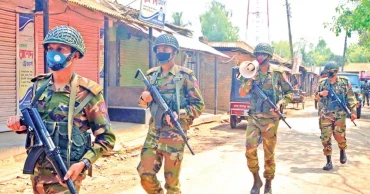
The government will launch a joint operation from September 4 for recovering the firearms and ammunition not deposited in the police station under suspended license and arms looted in recent times from police stations, police lines, police outposts and other places.
The public security divisions of the Home Ministry issued a circular in this regard on Sunday and ordered to take the following steps to conduct the joint operation:
(a) Notifying concerned licensees through SMS of suspension of licenses and deposit of arms and ammunition used in favor of suspended licenses to the police station by September 3, 2024 after preparing a list of suspended licenses on August 25, 2024;
(b) Suspension of the said license and submission of the relevant arms and ammunition to the Police Station and from September 04, 2024 conducting operations to recover illegal arms and taking legal action including filing cases under the Arms Act against illegal arms holders/custodians through the District Information Office;
(c) The District Magistrates will hold a core committee meeting on September 2, 2024 consisting of the Superintendent of Police, representatives of the armed forces and intelligence agencies and other members. The meeting will review the list of suspended licenses. From Sept 4, the armed forces, BGB, Coast Guard, Police, RAB, Ansar will form a joint operation team and take necessary measures to conduct the weapons recovery operation;
(d) Police commissioners in the metropolitan area with the help of all concerned forces and intelligence agencies will take necessary measures to conduct a joint operation to recover weapons from September 4, 2024.
(e) The list of suspended license holders prepared by the District Magistrates and the list of arms license holders deposited till the due date shall be forwarded to this department by September 5.
Earlier on August 25, the Ministry of Home Affairs suspended firearms licenses given to civilians over the past 15 years issued during the tenure of the Awami League government.
1 year ago

Rehabilitation efforts will be implemented transparently under relief coordination committee: Adviser Farooq-E-Azam
Farooq-e-Azam, Bir Pratik, Adviser to the Ministry of Disaster Management and Relief, has stated that the rehabilitation and relief programs will be implemented transparently under the supervision of the Relief Coordination Committee.
He made this announcement during a meeting with the District Disaster Management Committee on Sunday afternoon at the Cumilla Circuit House auditorium, where they discussed measures for the rehabilitation of flood victims. Representatives from all relevant departments provided the latest updates on the flood situation in Cumilla.
The adviser emphasized that the relief and rehabilitation committee will include all necessary ministries, and there will be representation from all required sectors. He urged government officials to move away from traditional rehabilitation programs and ensure that the rehabilitation process is conducted with transparency and intelligence.
Highlighting the collaborative global effort, he said, "We are not the only ones working to assist those affected by the floods; the entire world is involved. Officials can no longer offer excuses, as there are no obstacles in your path. You can operate freely and effectively."
The meeting was also addressed by Colonel Abdul Aziz, Colonel Staff of Cumilla Cantonment, Ashfaquzzaman Akhtar, Superintendent of Police, Cumilla, Dr. Nasima Akter, Civil Surgeon, executive engineers from the Roads and Highways Department and LGED, as well as officials from the Relief and Rehabilitation sectors, and coordinators from the Anti-Discrimination Student Movement.
1 year ago

‘Those who have raised hands against doctors must face justice’: Sarjis
Sarjis Alam, coordinator of the Anti-Discrimination Student Movement, has condemned the recent attacks on doctors and called for justice.
In a video message from his verified Facebook account on Sunday, he said, “Safety of my doctor brothers must be ensured, and those who have raised their hands against them must face appropriate justice.”
Awami League facing consequences of their own actions: Sarjis Alam
He further commented that if anyone is responsible for the death of a patient, it should be investigated thoroughly, and justice should be served accordingly.
“If any hospital authority or doctor is found responsible for a patient’s death, they too should be held accountable after proper investigation.”
Issuing a stern warning, the student leader said, “No one should be allowed to think they can attack others at will. Students are vigilant against all conspiracies.”
Authorities didn't keep their words, movement to continue: Sarjis Alam
According to reports, on the night of August 31, students of a private university attacked doctors at Dhaka Medical College Hospital, accusing them of negligence that allegedly led to the death of a student named Dipto. In protest, doctors halted medical services at Dhaka Medical College from that night.
On Sunday, doctors also announced a shutdown of services at all public and private hospitals across the country.
Not taking steps for injured people is the first failure of the interim govt: Hasnat Abdullah
However, the protesting doctors suspended the shutdown on Sunday afternoon following assurances of arrest of those responsible for the attack on doctors.
1 year ago
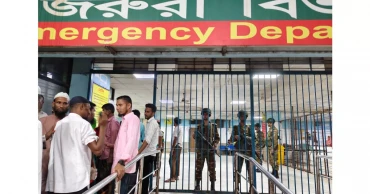
Doctors call off 'shutdown' till 8pm Sept 2 upon Health Adviser’s assurance
The interim government's Health Adviser Nurjahan Begum on Sunday assured the arrest of those who attacked doctors at DMCH within 24 hours.
The adviser gave the assurance during a briefing at the administrative building at Dhaka Medical College Hospital (DMCH) on Sunday afternoon.
Following her assurance, doctors called off their shutdown till 8 pm Monday.
Earlier, doctors, interns, and medical students announced a shutdown for an indefinite period in all public and private hospitals, including upazila and district level hospitals across the country, protesting attack on physicians and vandalism carried out by relatives of a patient at the emergency department of Dhaka Medical College and Hospital (DMCH).
Meanwhile, two separate probe bodies have been formed to look into the attack on doctors and vandalism, and the allegation of negligence in treatment.
1 year ago