others
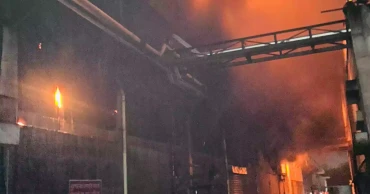
Narayanganj tyre factory fire under control
The fire which broke out at a tyre manufacturing factory in Rupsi area under Rupganj upazila of Narayanganj was finally brought under control after 22 hours on Monday evening.
Lt. Col Md Rezaul Karim, director (training, planning and improvement) of Fire Service and Civil Defence (FSCD) headquarters, said the firefighters managed to bring the fire under control around 7:05 pm.
The fire broke out at the six-story building of Gazi tyre manufacturing factory, owned by former lawmaker Gazi Golam Dastagir, around 9 pm on Sunday.
Fire at Gazi Tyre Factory still burning after 20 hours
On information, 12 firefighting units rushed to the spot and tried to douse the flame.
He said that a total of 120 firefighters have been engaged in dousing the flame while 14 people were rescued from the factory.
However, the cause of the fire and extent of damage could not be known immediately.
Meanwhile, local people claimed that a joyous procession was brought out in the area after hearing the news that the former MP Gazi Golam Dastagir was placed on six-day remand.
BNP and its associated bodies brought out the procession in the Rupsi area.
At one stage, a group of people from the procession stormed into the factory and looted the machineries and furniture.
Around 9 pm, miscreants set fire on the ground floor of the factory.
1 year ago

Palli Bidyut Samity leaders to meet with REB and Power Division to discuss their demands tomorrow
Representatives of the Palli Bidyut Samity (PBS) officials and employees are set to engage in meetings on Tuesday with the newly appointed chairman of the Bangladesh Rural Electrification Board (REB) and the head of a Power Division committee to address their demands before considering any further action.
The first meeting will take place at 10 am at the REB office, where the new chairman, Major General SM Zia-ul-Azim, will meet with PBS representatives. Later, at 2 pm, the second meeting will be held at the Power Division with Additional Secretary Syed Masum Ahmed Chowdhury, who chairs a committee formed to examine the PBS employees’ grievances.
Md Makbul Hossain, a senior general manager of the Brahmanbaria Palli Bidyut Samity and one of the leaders representing PBS officers, expressed hope that these meetings would effectively address their issues.
Approximately 40,000 employees and officers from 80 PBSs nationwide have been vocal about their demands, particularly following the fall of the Sheikh Hasina government. Their primary concerns include ending discrimination in service terms and securing permanent employment status. In response, they have threatened mass leave and resignations if their demands are not met.
However, these plans have raised suspicions within the interim government, which fears that such movements could be part of a broader strategy to destabilize the administration. This concern stems from the fact that many PBS employees were politically appointed during the previous Awami League government.
In an attempt to address the rising tensions, the Power Division established a nine-member committee headed by Additional Secretary Syed Masum Ahmed Chowdhury. The committee includes four representatives from PBS employees, three from the REB, and two from the Power Division. “We hope the committee’s first meeting will thoroughly discuss the issues faced by PBS employees and officials, leading to a viable solution,” said Syed Masum.
The current unrest follows a protest on August 8, when PBS officers and employees besieged the REB headquarters in Dhaka’s Nikunja area. The demonstrators demanded the implementation of uniform employment rules and the regularization of irregular employees. The siege was lifted after the REB authorities, with army mediation, agreed to suspend any staff transfers until the Power Division's report was received.
The PBSs, rural electricity cooperatives, operate under the administrative control of the REB and play a crucial role in the country's electrification efforts. The ongoing grievances center around perceived discrimination in employment practices, with workers alleging that despite holding the same qualifications and performing the same tasks, they are treated unfairly compared to their REB counterparts.
1 year ago

Hajj registration will begin from Sep 1, continue till Nov 30
The primary registration for the 2025-Hajj will begin from September 1 and continue till November 30 under government and private managements.
The deadline for the registration won’t be extended after the primary registration this year, said a media release sent from the Ministry of Religious Affairs on Sunday.
Any person who had registered previously can do the primary registration by depositing Tk 3 lakh. The remaining amount of the Hajj package will have to be paid within the stipulated time, it said.
This year's Hajj package price will be announced considering the Saudi phase cost and the airfare. However, efforts will be made to reduce the general Hajj package price of 2025 from last year.
Tk 30, 000 has been set for the pre-registration under the government and private managements
In 2025, the quota of Hajj pilgrims for Bangladesh is 1, 27,198. If this quota is fulfilled, the pre-registration process will be automatically closed and the deadline for the registration won’t be extended.
Those interested to perform Hajj through government channel will be able to do pre-registration and primary registration from all union digital centres, divisional and district offices of the Islamic Foundation, Baitul Mukarram Mosque and Hajj Office in Dhaka from the e-Hajj System (www.hajj.gov.bd) and e-Hajj BD mobile application.
People wishing to perform Hajj under the government management will have to deposit money in favor of Sonali Bank PLC, local office branch, Motijheel Dhaka's Sale Proceeds of Hajj Deposit account number 0002633000908.
Hajj pilgrims who are keen to perform hajj under private management will have to deposit the initial registration money in the designated bank account of the agency.
Pregnant women and people suffering from chronic diseases like cancer, advanced cardiac disease, liver cirrhosis, kidney disease, infectious tuberculosis, dementia etc. have been requested not to get registered for Hajj.
1 year ago

Maritime ports asked to hoist local cautionary signal No 3
Maritime ports of Chattogram, Cox's Bazar, Mongla and Payra have been advised to keep hoisted local cautionary signal No three as the low-pressure area over northwest bay and adjoining southern part of Bangladesh intensified into a well-marked low.
It is now lies over Gangetic West Bengal and adjoining area. Under its influence deep convection is taking place over North Bay, said a special bulletin of Met office.
Gusty or squally weather may affect the maritime ports, North Bay and adjoining coastal areas of Bangladesh
Met Office advises maritime ports to hoist signal 3
All fishing boats and trawlers over the North Bay have been advised to remain closed to the coast and proceed with caution till further notice.
Maritime ports advised to hoist local cautionary signal 3
1 year ago
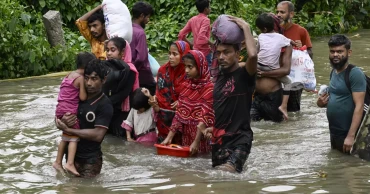
Death toll from floods rises to 23; over 12 lakh families still stranded
Three more people died in flood-hit Noakhali and Khagrachhai districts, raising the death toll from the disaster to 23 on Monday, according to the Disaster Management and Relief Ministry.
Of the new deaths, two died in Noakhali and one in Khagrachhari.
Of the total deaths, six died in Cumilla, five each in Chattogram and Noakhali, three in Cox’s Bazar and one each in Feni, Brahmanbaria, Khagrachhari and Lakshmipur districts respectively, said the ministry.
Over 12 lakh families have been stranded in 74 upazilas of 11 flood-hit districts till Monday afternoon, according to ministry.
However, two people remained missing in Moulvibazar.
At least 57, 01, 204 people have been affected as flood wreaked havoc in Feni, Cumilla, Chattogram, Khagrachhari, Noakhali, Moulvibazar, Habiganj, Brahmanbaria, Sylhet, Lakshmipur and Cox’s Bazar.
The number of families affected in the flood is 12, 38,048 under 545 municipalities or unions.
Meanwhile, at least 4, 69, 523 people have taken shelter in 3,6834 shelter centres while 28,907 domestic animals were kept there.
A total of 645 medical teams are providing medical services in the flood affected areas.
A sum of Tk 3.52 crore has been allocated in the flood-stricken districts while 20,650 tonnes of rice, 15,000 pieces of dry foods or other foods and baby foods and fodder worth Tk 35 lakh each were allocated, said the ministry.
Mobile and telecommunication services have been restored in the worst--hit Feni district. Field hospitals have been prepared to provide treatments.
Alongside government institutions, private organisations, businesses and general people also providing relief materials in the flood-affected areas while the deputy commissioners of the flood-affected districts have been instructed to work together in coordination with the coordinators of the anti-discrimination student movement, army, navy, medical team and other volunteers.
1 year ago
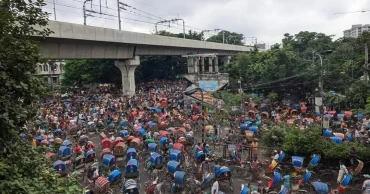
Pedalled rickshaw drivers protest at Dhaka’s Shahbagh, demand ban on battery-run rickshaws
Hundreds of pedalled rickshaw drivers staged a protest at Dhaka’s Shahbagh intersection on Monday, demanding a ban on battery-run rickshaws from the city’s main roads.
The protest began around 11 am, bringing traffic in the area to a standstill.
The protesters shouted slogans such as “No more autorickshaws (batterly-run),” “Illegal autorickshaws will not be tolerated,” and “We won’t accept discrimination in Bangladesh.”
Organized under the banner of the ‘Greater Dhaka City Corporation Rickshaw Owners’ Unity Alliance,’ the rickshaw drivers presented several demands.
Their demands include issuing new licenses and renewing old ones for rickshaw owners from the Dhaka North City Corporation (DNCC), similar to the practices of the Dhaka South City Corporation (DSCC). They also called for driver licenses to be granted by both the DNCC and DSCC to boost government revenue and safeguard the rights of legally licensed rickshaw drivers. Additionally, the protesters demanded free medical treatment for unwell drivers and the issuance of business trade licenses to licensed rickshaw drivers in both city corporations.
The pedalled rickshaw drivers expressed frustration over battery-run rickshaws, accusing them of undercutting fares, flouting traffic regulations, and contributing to congestion and accidents.
They argued that the dominance of battery-run rickshaws on main roads threatens their livelihoods and exacerbates traffic problems.
Shahbagh Police Station’s Officer-in-Charge (OC) AKM Shahabuddin Shaheen said that the rickshaw drivers had gathered on the road with their demands.
“After some time, the police dispersed them, and the situation is now normal with traffic moving smoothly,” he added.
1 year ago

Water level of major rivers in northeastern, eastern and southeastern regions fall, flood situation improving: FFWC
The water level of major rivers in northeastern, eastern and southeastern regions of the country continues to decrease, according to the Flood Forecasting and Warning Centre.
In the last 24 hours, no significant rainfall was observed in eastern Cumilla, Brahmanbaria andFeni districts bordering Indian Tripura and inland basins of Tripura province and water levels in upstream rivers continued to recede, said the FFWC in a bulletin on monday.
As a result, the current flood situation in the lower areas of Feni and Comilla districts continues to improve.
The water level of the rivers in Moulvibazar, Habiganj district has come down below the danger level.
According to the data of meteorological agencies, heavy rainfall in the north-eastern region of the country and adjoining uplands in the next 48 hours is unlikely. At this time, the water level of Manu, Khoai, Dhalai rivers in Moulvibazar and Habiganj districts of northeastern region may decrease.
According to meteorological agencies, there is a possibility of light to moderate rainfall in theeastern part of the country and adjacent upstream regions in the next 24 hours. At this time, the water level of Gumti river in Cumilla district of the region may decrease and the flood situation of adjacent low-lying areas may improve.
The flood situation in the lower areas of Feni district may improve in the next 24 hours, but may remain stable at some places.
According to the information of meteorological agencies, there is a possibility of moderate
rainfall in the southeast region of the country and adjacent uplands in the next 24 hours. At
this time, the water level of Sangu, Matamuhuri, Karnaphuli, Halda and other major rivers of Chittagong district may increase at times.
Water level of Brahmaputra-Jamuna and Surma-Kushiara rivers in northeastern part of the country is receding, water level of Ganga-Padma river is stable, normal flow of Teesta-DharlaDudhkumar river in northern region is prevailing, which may continue for next 48 hours.
1 year ago

40 Ansar members held from Secretariat handed over to police
Forty Ansar personnel, held by Bangladesh Army from the Secretariat following a clash with students on Sunday, were handed over to police.
AKM Shahabuddin heen, officer-in-charge of Shahbagh police station, said the army handed over the Ansar members to them on Sunday night.
A case will be filed against the detained Ansar members, he said.
On Sunday noon, Ansar personnel blocked all five gates of the secretariat, demanding the nationalization of their positions.
The Ansar members took position in front of the Secretariat and its various gates, effectively sealing off the administration hub.
The Ansar battalion called off their protest and returned to work following discussions with Home Affairs Adviser Lt Gen (retd) Md Jahangir Alam.
Around 9 pm, a clash erupted between Dhaka University students and Ansar members at the secretariat as the new spread that key figures from the Anti-Discrimination Student Movement including Sarjis Alam and Hasnat Abdullah were confined to the Secretariat.
Students from several halls of Dhaka University gathered at the Raju Bhashkorjo on campus.
They marched towards the Secretariat area, resulting in a clash between students and Ansar members that left several injured.
1 year ago
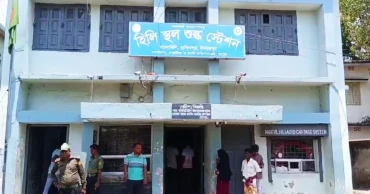
Trade through Hili land port suspended for Janmashtami
Trade between Bangladesh and India through the Hili land port in Dinajpur district remained suspended since Monday morning due to holiday for Janmashtami, a major religious festival of the Hindu community.
Sheikh Ashraful, officer-in-charge of the Hili Immigration Checkpoint, said the import-export activities are suspended but passenger transit through the immigration checkpoint is continuing as usual.
Trade through the land port will resume Tuesday, said Wahedur Rahman Ripon, Office Secretary of the Hili Land Port Import-Export Group.
1 year ago
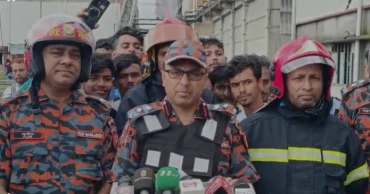
Narayanganj tyre factory fire untamed after 12 hours
A fire that broke out in a tyre manufacturing factory in Rupsi area under Rupganj upazila of Narayanganj remained uncontrolled 12 hours after the incident.
Lt. Col Md Rezaul Karim, director (training, planning and improvement) of Fire Service and Civil Defence (FSCD) headquarters, at a media briefing at the spot on Monday morning said the fire erupted in Gazi Tyre Factory around 10:30pm and they received information within five minutes.
Responding to the call, two firefighting units from Demra station rushed to the spot and later five more units joined, he said.
As the intensity of the fire was massive due to the presence of flammable objects like rubber and tyre, five more firefighting units from several stations joined the previous ones and are still trying to tame the blaze, the FSCD director.
He said that a total of 120 firefighters have been engaged in dousing the flame while 14 people were rescued from the factory.
Replying to a question, the fire service official said the cause of the fire and extent of damage will be known only after investigation.
1 year ago