others
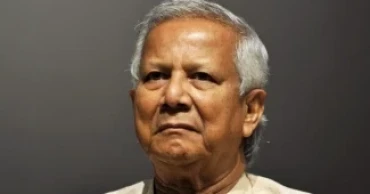
Chief Adviser Yunus visits Abu Sayed’s Rangpur home, condoles family members
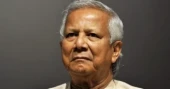
Chief Adviser Prof Muhammad Yunus reached Rangpur on Saturday morning by a helicopter to meet the family members of Abu Sayed, according to Chief Adviser’s Press Wing.
He offered munajat at the grave of Abu Sayed seeking devine blessings for his soul.
Posts, Telecommunications and Information Technology Adviser Md Nahid Islam and Youth and Sports Adviser Asif Mahmud Sajeeb Bhuiyan were accompanying the Chief Adviser.
Prof Yunus visited Sayed’s home and condoled his family members. Sayed’s parents, six bothers and three sisters were present.
Chief Adviser Yunus to visit martyr Abu Sayeed's family in Rangpur
The he will go to Rangpur Medical College Hospital to see the injured persosns.
Abu Sayed was the first student killed in police firing during the Anti-Discrimination Student Movement. Sayed, a student of Begum Rokeya University, Rangpur, was shot dead on July 16.His death sparks agitation among the student protestors which led to the fall of Awami League government on August 5.
In his first speech after arrival in Dhaka on Thursday, Nobel Laureate Prof Muhammad Yunus recalled Begum Rokeya University Student Abu Sayed and said he will remain in the hearts of all in Bangladesh forever.
“…Abu Sayed’s image in the heart of every person in Bangladesh. No one will be able to forget it. The incredible courageous youth was standing in front of the guns,” he told in emotion-choked voice while speaking to the media at the airport.
UN to support Yunus-led interim government until national elections held: Gwyn Lewis
1 year ago
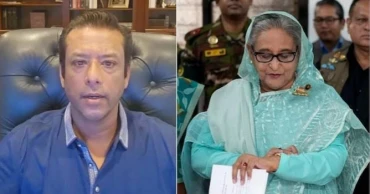
Hasina didn’t ‘officially resign’ before leaving Bangladesh, says Joy
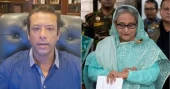
Sajeeb Wazed, the son and adviser of Sheikh Hasina, has said that his mother did not officially resign as Prime Minister before fleeing Bangladesh amid escalating anti-government protests.
"My mother never officially resigned. She didn’t get the time," Wazed told Reuters from Washington on August 10, according to a report by Firstpost. He emphasized that "as far as the constitution goes, she is still the Prime Minister of Bangladesh."
Sheikh Hasina fled to India earlier this week as anti-government protesters marched on her official residence, marking a dramatic end to her 15-year uninterrupted rule.
Education system must ensure learning with joy: PM Hasina
Wazed revealed that the president had dissolved parliament after consulting with the army chief and opposition politicians. He suggested that the establishment of a caretaker government without a formal resignation from the Prime Minister could potentially be challenged in court.
"My mother is ready to face trial back home, as demanded by the students who led the uprising," Wazed stated. He defended his mother, insisting that she was not responsible for any illegal actions taken by her government. "Just because people in her government did illegal things, did not mean my mother ordered it," he added.
Wazed did not specify who within the government was responsible for the violent crackdown on protesters, which resulted in the deaths of at least 300 people, many of whom were students. However, he shifted the blame onto police officers, asserting that his mother did not authorize the use of force.
"Those who are responsible should be brought to justice. My mother absolutely did not order anyone to commit violence against the protesters," Wazed said, adding that the Hasina government had suspended the police officers involved in the shootings.
Hasina back in role providing leadership to AL from India, Joy tells WION
Looking ahead, Wazed confirmed that the Awami League, Hasina’s party, would contest the next election. "I’m confident the Awami League will come to power. If not, we will be the opposition. Either way is fine," he remarked, demanding that the elections be held within three months.
1 year ago

Dhaka's air quality still in the 'moderate' range
Dhaka's air quality continued to be in the ‘moderate’ zone this morning.
With an air quality index (AQI) score of 83 at 9:03 am, Dhaka ranked 11th on the list of cities worldwide with the worst air quality.
Indonesia’s Jakarta, Pakistan’s Lahore and Indonesia’s Medan occupied the first three spots on the list, with AQI scores of 162, 158 and 155, respectively.
Dhaka’s air quality in ‘moderate’ zone this morning
An AQI between 50 and 100 is considered ‘moderate’ with acceptable air quality. However, there may be a health concern for a very small number of people who are unusually sensitive to air pollution.
In Bangladesh, the AQI is based on five criteria pollutants: particulate matter (PM10 and PM2.5), NO2, CO, SO2 and Ozone.
Dhaka has long grappled with air pollution issues. Its air quality usually turns unhealthy in the winter and improves during the monsoon.
Dhaka’s air quality continues to be ‘moderate’
Air pollution consistently ranks among the top risk factors for death and disability worldwide.
As per the World Health Organization (WHO), air pollution kills an estimated seven million people worldwide every year.
1 year ago
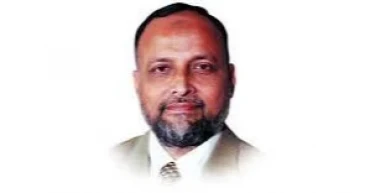
Ex-lawmaker MA Latif detained
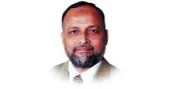
MA Latif, the Awami League lawmaker from Chittagong-11 constituency in the recently dissolved parliament, was detained from the residence of his nephew in the Port City, where he has been hiding since the ouster of his government.
Members of Bangladesh Army detained him from the city's Motherbari Nasu Malum Mosque area around 6:30pm on Friday.Eyewitnesses said that Latif offered Friday prayers at the local Nasu Malum mosque on Friday. After the prayer, he also exchanged greetings with the local people.
Later, he went to his nephew Adnanul Islam Chowdhury's house. When BNP men came to know this, they surrounded the house of Adnanul Islam.On receiving the news, the army members went there and dispersed the BNP leaders and activists, and took Latif into their custody.
Latif, also the former president of the Chittagong Chamber of Commerce & Industry, serving as an MP for the last four times.
1 year ago
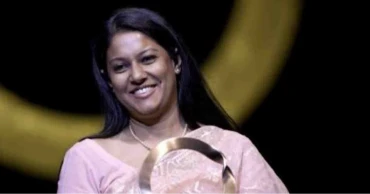
Can’t talk about tenure without knowing reform agenda: Adviser Rizwana Hasan
Adviser to the Interim Government Syeda Rizwana Hasan on Friday said it is not possible to talk about or take a decision right now about the tenure of their newly formed transition government without knowing the reform agenda.
“Without knowing what kind of reform you want, I can’t talk about the tenure. If you don’t want reform, that is a different thing. There is nothing to be restless right now by repeatedly talking about the tenure,” she said replying to a question from journalists.
Rizwana, who on Friday got the portfolio of Environment, Forest and Climate Change as adviser, was talking to reporters about the outcomes of the first informal meeting of the advisory body of Dr Muhammad Yunus-led Interim Government at Jamuna State Guest House.
Jamuna is now being used as the temporary residence of Chief Adviser to the Interim Government Dr Muhammad Yunus.
She said this interim government is to prepare the start of the journey towards a democratic country. “We’ll take only the time that is just required to take this preparation and we finally will move towards democracy,” she added.
The environment adviser said the people often talk about reform in all sectors, that 'things can’t run in this way' and the 'system has to be changed'.
But the interim government alone can’t make reform and it would talk to all of society, including media and professional bodies, she said.
“We’ll go for discussion after fixing a reform agenda,” said Rizwana Hasan.
The meeting discussed how the law and order situation can be brought under control as quickly as possible. “The problem won’t be solved today but we’ve discussed solving it as soon as possible,” she said.
Citing that the religious minority and indigenous community face attacks in some places, she said the government will try to create a shield for them by engaging the local people and the representatives of the affected communities.
She said the Chief Adviser will meet with the families of all the students, who lost lives in this movement and this upsurge at Jamuna State Guest House.
Jamuna is now being used as the temporary residence of Chief Adviser Dr Muhammad Yunus.
Raising other decisions taken in the meeting, Rizwana Hasan said the decisions were taken for arrangement to provide the injured students with proper treatment, steps to be taken to resume the operation of higher courts as quickly as possible, reopening the educational institution as soon as possible, and reviving business activities.
The government decided to take steps to stop the harassment and politically motivated cases as many lawsuits were filed against those who carried out the recent movement and other such cases filed before in the past.
She said there are many cases filed under three laws -- ICT Act, Digital Security Act and Cyber Security Act—that are harassment cases. Though the ICT Act and Digital Security Act were already repealed, many persons were sentenced, many ones are in jail or the proceedings of many cases filed under the two repealed laws still continue, she added..
“So, we will discuss in the coming days over bringing changes to the laws so these couldn’t be used against the freedom of expression or used as tools to curb the dissident views,” said the adviser.
Noting that students would remain engaged with the advisers in running all ministries, she said the government would later finalize how the students could be involved here.
Rizwana Hasan said the life and livelihood of the people, the control over the market and financial sector will get priority.
“Steps would surely be taken against corruption particularly to change the system,” she said replying to a question.
1 year ago

BASIS urges interim government to repeal Cyber Security Act
Bangladesh Association of Software and Information Services (BASIS) has urged the interim government to repeal the Cyber Security Act (CSA) 2023.
The act continues the repressive measures of the Digital Security Act (DSA) 2018 and Section 57 of the Information and Communication Technology (ICT) Act 2006, which are contrary to the country's constitution and pose a severe threat to human rights, BASIS said in a media statement on Friday.
M Asif Rahman, director of the organisation, raised this issue at a general meeting of BASIS. “It was unanimously decided that BASIS would first initiate discussions on the matter with the interim government.”
The Cyber Security Act (CSA) 2023 has frequently been used to target journalists, human rights activists, and dissenting voices, despite legislators' repeated justifications for its enactment. Recent events, such as the arrest of numerous individuals for criticizing the quota system and charges against others for satirical posts, highlight the abuse of this law.
BASIS Director said, “The Cyber Security Act (CSA) 2023 retains many of the provisions of the Digital Security Act (DSA), granting authorities excessive powers to search, arrest, and detain individuals without warrants. This law enables government control over online content and infringes on freedom of speech.”
BASIS President Russell T. Ahmed said, “Based on my recent experiences, I can say that this law is often misused. The Cyber Security Act (CSA) 2023 threatens freedom of expression and personal security in Bangladesh. To end the suppression of dissent and comply with international human rights standards, this law must be repealed.”
BASIS calls on the interim government to repeal or substantially amend the Cyber Security Act (CSA) 2023 and urges the release of individuals detained under this law and the withdrawal of all charges against them.
Furthermore, BASIS advocates for necessary actions to repeal this unconstitutional act, read the statement.
1 year ago
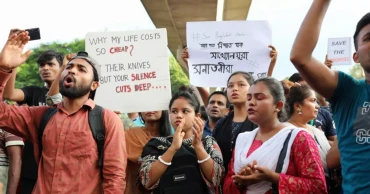
Hindus stage rally at Dhaka’s Shahbagh protesting attacks on the community
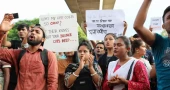
Members of the Hindu community of Bangladesh held a rally in Dhaka’s Shahbagh on Friday to protest attacks and vandalism targeting houses and temples of the minority community.
Protesters thronged Shahbagh in the afternoon on August 9.
From the rally, they demanded to ensure their representation at the policy-making level and safety of the community.
They also demanded a ministry for the minority communities, a minority protection commission, formulating and implementing strict laws to prevent all kinds of attacks against minorities, and allocating 10 percent of seats in the parliament to the minorities.
1 year ago

Save my husband’s life, pleads professor M Anwar Hossain’s wife
Ayesha Hossain, wife of professor M Anwar Hossain, a retired UGC Professor of Biochemistry and Molecular Biology at Dhaka University and former Vice Chancellor of Jahangirnagar University, sought help from interim government to save her husband's life who was brutally attacked by several right-wing fanatics in front of the Hazrat Shahjalal Airport on Monday just after 4 pm.
In a statement, Ayesha Hossain hoped that the newly formed interim government led by Nobel laureate Prof Muhammad Yunus will take immediate steps to protect her husband and family from further attacks.
The student coordinators of the quota-reform movement, the Bangladesh Army and most importantly, the interim government must ensure the safety, security and human rights of all who have been attacked and remain at risk of suffering irreparable harm.
In the statement she also recalled the deadly attacks. She wrote: It is well-known and widely documented that in recent weeks, Professor Hossain was highly critical of the recently deposed government’s indiscriminate attacks on students who organised the quota-reform movement, attacks which led to the loss of hundreds of innocent lives.
On Monday afternoon, my husband, son, daughter-in-law and I left our home on two battery-driven rickshaws around 3.30 pm. The main road approaching the airport from Uttara was packed with hundreds and thousands of people.
On approaching the airport, "we realised it would no longer be possible to continue moving ahead on the rickshaws. We got down and began to walk along with the people on the road. When we arrived exactly in front of the airport, an unknown person who appeared to be in his early 40s suddenly approached my husband and began to shout:
“I recognise you. You’re the professor who was against Jamaat [Jamaat-e-Islami] at the Tribunal [International Crimes Tribunal]. We saw you on the television.”
The same person tried forcefully taking my husband down a narrow lane opposite the airport. My family members and I strongly resisted this. Almost instantly, several more agitated people (three to four) gathered around my husband. They started chanting “Naara-e-Takbeer”. One of them said, “You spoke against Jamaat. We’re going to slit your throat.” The agitated individuals unleashed a vicious attack on my husband with various objects. One of them said: “Hit him on his head. Kill him.”
My daughter-in-law rushed to several uniformed army personnel standing about ten feet away on a military jeep to seek help. One of them told her he would see what could be done, but almost out of fear, none got down from the jeep.
The deadly attacks went on for several minutes, during which my son, my daughter-in-law and I used our own bodies to shield my husband, especially his head. In the process, we were injured during the attack, according to the statement.
“The white shirt my husband wore was drenched in blood. I realised that my husband was on the brink of death, and our desperate attempts to save him were failing. We instinctively felt that we would have to drag my husband away from the clutches of the attackers and take him towards an Army barricade in front of the entrance of the Airport. At this moment, two unknown civilians appeared out of nowhere to our aid. One of them was a tall, dark man wearing a black t-shirt. I can’t recall the appearance of the second person. They joined us in shielding my husband’s body. The man wearing the black T-shirt kept shouting:
“What are you doing?! He is a human being! He is a human being!”
The attacks continued. I don’t know how, but we miraculously dragged my husband across the Airport Road towards the Army barricade. Once we reached the barricade, I could see that the army personnel were in a clear state of shock seeing my husband’s bloodied body. They quickly recovered from the initial shock when we told them who my husband was. They took my husband and my family members onto their side of the barricade. With the support of Air Force personnel and members of the Airport’s security detail (one of whom told me that he was a former student of Jahangirnagar University), we entered the Airport. My husband received immediate treatment at the medical centre beside the departure lounge.
“My son was with him during this time. My daughter-in-law and I waited in a prayer room in the arrivals lounge. In the evening, after spending several hours at the Airport, we left the premises through its VIP exit. We got on to a rickshaw van in front of the Biman Airlines Training Center (BATC) and left for safer locations.”
“As Bangladesh has been plunged into extreme levels of lawlessness and anarchy in the absence of a government, there are compelling reasons to believe many vested quarters took advantage of the situation, including and this includes far-right militant extremists.”
They have unleashed indiscriminate, ruthless and targeted attacks across the country on our religious minorities, individuals and families (such as my husband) known for their uncompromising stand against religious extremism and war criminals, innocent members of the Awami League and many symbols of our Liberation War.
Hundreds and thousands of common students who led the quota-reform movement sparked a mass uprising at an unprecedented scale and have now pledged to build a humane Bangladesh without discrimination and built on the principles of equity and equality and overarchingly a welfare state.
“Too many people have sacrificed their lives in recent weeks to realise their noble dream. We cannot allow this dream to go in vain. We demand justice for all,” read the statement.
1 year ago

Chief Adviser Yunus to visit martyr Abu Sayeed's family in Rangpur
Chief Adviser Prof Muhammad Yunus will go to Rangpur on Saturday to meet the family members of Abu Sayeed, according to Chief Adviser’s Press Wing.
Abu Sayed was the first student killed in police firing during the Anti-Discrimination Student Movement. Sayed, a student of Begum Rokeya University, Rangpur, was shot dead on July 16.
His death sparks agitation among the student protestors which led to the fall of Awami League government on August 5.
We want to keep good ties with all; balanced relations with big countries: Foreign Adviser
In his first speech after arrival in Dhaka on Thursday, Nobel Laureate Prof Muhammad Yunus recalled Begum Rokeya University Student Abu Sayed and said he will remain in the hearts of all in Bangladesh forever.
“…Abu Sayed’s image in the heart of every person in Bangladesh. No one will be able to forget it. The incredible courageous youth was standing in front of the guns,” he told in emotion-choked voice while speaking to the media at the airport.
Cabinet Division announces portfolios of interim govt: Dr. Yunus to hold 27 ministries, divisions
1 year ago
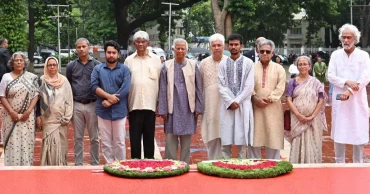
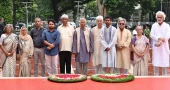
Yunus and his advisers pay respect to language heroes at Shaheed Minar
Chief Adviser Prof Muhammad Yunus on Friday paid homage to the martyrs of the historic Language Movement by placing wreaths at the Central Shaheed Minar.
He arrived at the Shaheed Minar at 11:14am snd was the first to lay the wreath.
Later, Prof Yunus along with other advisers of the interim government placed another wreath at the Shaheed Minar.
They stood in solemn silence for some time as a mark of profound respect to the memories of the language heroes.
The interim administration led by Nobel laureate Prof Yunus, was sworn in on Thursday in the wake of the fall of Sheikh Hasina's government amid nationwide mass movement.
1 year ago