others

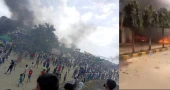
14 policemen killed in Sirajganj, Cumilla
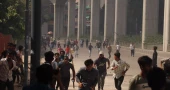
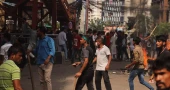
Fourteen policemen were killed in attacks by miscreants in Enayetpur Police Station under Sirajganj district and Eliotganj Highway Police Station under Cumilla district.According to the Police Headquarters sources, the policemen were killed during the countrywide violence over the non-cooperation movement.At least 58 people were killed and over 600 injured in clashes between protesters, police and ruling party activists across the country amid ongoing demonstrations enforced by the Anti-Discrimination Student Movement to press home their one-point demand.
1 year ago
7 die in clashes in Dhaka amid protests; Over 100 injured
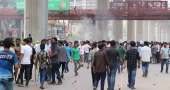
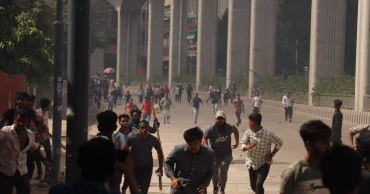
Seven people died and over 100 injured in clashes among protesters, police and ruling party activists in Dhaka as unrest spread amid protests demanding Prime Minister Hasina’s resignation.
Three of the deceased were identified as Tawhidul, 22, Obaidullah Siddique, 23, student of Habibullah Bahar College, Ramijuddon Habib Rup, student of Daffodil University .
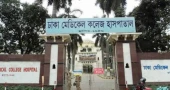
There bodies were kept at Dhaka Medical College Hospital, reports our reporter from the hospital.
Some protesters took away five bodies and marched towards Shaheed Minar. They kept there for sometime and then move towards Shahbagh with the bodies.
of the injured suffered bullet and pellet wounds.
1 year ago
One-point demand: 96 killed in 21 districts in a day of unprecedented violence across Bangladesh
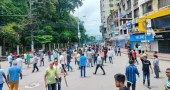
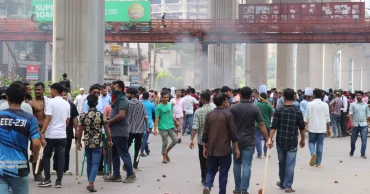
At least 96 people were killed and over 1000 injured in clashes between protesters, who have been joined by other groups over the course of the movement, on one side and police and ruling party activist on the other, one day after the Anti-Discrimination Student Movement that fought for quota reforms in government jobs moved to a new phase in their movement: a one-point demand calling for the resignation of the government, in light of the unprecedented killings of protesters in July by government forces, including law enforcers and the ruling party's student front.
According to reports reaching the UNB news desk throughout Sunday, nine people died each in Dhaka and Feni, six each in Sylhet and Narsingdi district, twenty three in Sirajganj, eight in Laxmipur, five in Bogura, four in Rangpur districts, three each in Magura, Pabna, Cumilla, Kishoreganj and Munshiganj districts, two each in Joypurhat and Sherpur district, while one each in Gazipur, Cox's Bazar, Bhola, Habiganj, Savar, Keraniganj and Barishal.
Besides, over 1000 people suffered injuries, including with bullets in clashes and attacks across the country.
In Dhaka, at least seven people died and over 250 were injured in clashes.
Three of the deceased were identified as Tawhidul, 22, Obaidullah Siddique, 23, student of Habibullah Bahar College, Ramijuddon Habib Rup, student of Daffodil University.
Their bodies were kept at Dhaka Medical College Hospital, reports our reporter from the hospital.
Besides, a group of miscreants carried out an attack on the Dhaka Chief Metropolitan Magistrate court in the morning.
In Narsingdi, six Awami League leaders and activists were beaten to death by the protesters when they opened fire on the protesters in Madhabdi upazila.
During the clash, a number of vehicles, Awami league offices, police stations and other establishments were vandalised and set on fire in different parts of the country, including Chapainawabganj and Barishal.
Students and general people started demonstrations in the morning, extending solidarity to student platform Anti-Discrimination Student Movement’s one-point demand for the resignation of the Sheikh Hasina-led government.
The platform also announced non-cooperation movement from a massive rally on Saturday, resulting in poor traffic on the roads since morning. Shopping malls and shops also remained closed.
The situation turned violent when activists of ruling Awami league and its affiliates took to the streets to counter the protesters, said witnesses, our correspondents and photographers from the spots.
Police also fired tear shells, sound grenades to disperse the protesters in many places, resulting in violent clashes that left many including students dead and injured.
Vandalism, arson attacks were reported from various parts of the country including Dhaka, Chattogram, Dinajpur, Sylhet, Khulna, Kushtia.
Amid escalating violence, the government imposed a curfew for an indefinite period from 6pm on Sunday in the capital and some other parts of the country.
Curfew was slapped in Dhaka Metropolitan area and all divisional headquarters, city corporations, municipalities, industrial areas, district and upazila headquarters.
Besides, the government also announced a three-day general holiday for Monday, Tuesday and Wednesday amid the escalation of the widespread violence across the country.
The High Court (HC) today dismissed the writ petition seeking order not to shoot protesters but gave some observations in this regard.
The HC bench of Justice Mustafa Zaman Islam and Justice SM Masud Hossain Dolon passed the order after hearing the petition.
The court in its observation said all citizens have the right to participate in peaceful assemblies and emphasised that the police must follow legal directives.
The HC also directed the police to follow the Police Regulations of Bengal (PRB) strictly.
1 year ago

Curfew imposed amid deteriorating law and order situation: ISPR
In response to the worsening law and order situation across the country, an indefinite curfew has been imposed starting today (August 4, 2024). The announcement was made on Sunday through the Inter-Services Public Relations (ISPR) website.
The decision aims to ensure the safety of the public and the protection of critical state infrastructure. The Bangladesh Army will carry out its duties in accordance with the Constitution of Bangladesh and existing laws, it said.
The ISPR has requested the public to comply with the curfew and extend full cooperation to the authorities during this period.
1 year ago
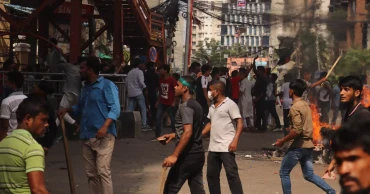
Curfew ‘ineffective’, say Anti-Discrimination Student Movement leaders
Coordinators of Anti-Discrimination Student Movement on Sunday declared ‘ineffective’ the indefinite curfew slapped by the government on Sunday.
“After the one point, none of their orders are valid. Therefore, the curfew announced from 6 pm has been declared ineffective”, Hasnat Abdullah, one of the coordinators of Anti-Discrimination Student Movement in a media release.
Amid escalating violence, the government has imposed curfew for an indefinite period from 6 pm on Sunday in the capital and some other parts of the country.
Curfew was slapped in Dhaka Metropolitan area and all divisional headquarters, city corporations, municipalities, industrial areas, district and upazila headquarters.
The students platform also rescheduled their ‘Long March to Dhaka ‘ programme to Monday from Tuesday.
Earlier in the day, they announced the march programme for Tuesday and demonstration and mass sit-in on Monday to press home their one- point demand.
Nahid Islam, a coordinator of the platform, announced their next course of programme on Sunday through a media release.
They urged students, citizens and workers to come to Dhaka to make their programme a success.
The platform also urged the formation of a ‘Sangram Committees’ in all areas, villages, upazilas and districts led by students.
1 year ago

Govt declares 3-day general holiday starting tomorrow
Amid widespread violence across the country over Anti-Discrimination Student Movement's one-point demand, the government in an executive order on Sunday announced a three-day general holiday for Monday, Tuesday and Wednesday.
HSC candidates nationwide announce exam boycott over quota reform protest arrests
Public Administration Minister Farhad Hossain told UNB.
Emergency services including hospitals, medicine, power, gas, water and other services will be out of the purview of the order.
17-year-old injured during quota reform protest dies at DMCH
Earlier, the government in an executive order declared general holidays on July 21, 22 and 23. Later, it was extended for one more day on July 24.
1 year ago

Curfew slapped in Dhaka, some other parts of the country from 6 pm today
The government on Sunday imposed curfew for an indefinite period from 6 pm on Sunday in the capital and some other parts of the country.
Curfew was slapped in Dhaka Metropolitan area and all divisional headquarters, city corporations, municipalities, industrial areas, district and upazila headquarters
The Home Ministry issued a notice in this regard, said senior information officer Md Sharif Mahmud Apu.
The curfew will remain in force until further notice.
1 year ago
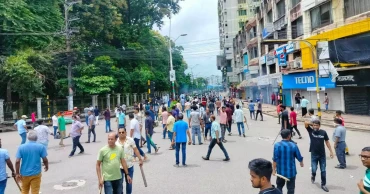
Protesters clash with police, ruling party activists as unrest spread in Ctg , 40 wounded
At least 40 people have been injured as clashes spread between protesting students, Chhatra League activists and police in Chattogram city.
The unrest began around 10 AM when protesters gathered at New Market and around 11:30 AM spread to nearby areas when police fired rubber bullets, tear gas, and sound grenades at the students.
The clashes started following announcements of counter-rallies by students and government supporters in Chattogram.
The violence quickly spread to Kadamtali, Tiger Pass, Kotwali, Laldighi, Jubilee Road, SS Khaled Road, and Kazi Deuri.
Witnesses said that leaders and activists of the Awami League and its affiliates opened fire on protesters at New Market intersection aroudn 2 PM, leaving at least 40 injured.
Among the injured, 23 people have been admitted to Chattogram Medical College Hospital.
Brigadier General Mohammad Taslim Uddin, the director of Chattogram Medical College Hospital, confirmed that 23 people have been admitted by 2 PM, mostly with pellet gun injuries.
Chhatra League members started firing from the City College area, causing the protesters to disperse. As the protesters regrouped near New Market and Reazuddin Bazaar, police reportedly fired rubber bullets, tear gas, and sound grenades at them.
Videos circulating on Facebook show a helmeted man firing shots from behind the Narcotics Control Office on City College Road, while another person is seen throwing a cocktail.
The clashes then spread several kilometers to surrounding areas.
Earlier, heavily armed members of the Awami League and Jubo League forcibly entered and vandalized the Metropolitan BNP office on Noor Ahmed Road, said witnesses.
They hurled bricks, exploded cocktails, and set fire to banners on the BNP office premises.
Later, Jubo League and Chhatra League members marched to Kazi Deuri and attacked the protesting students, injuring several, including women.
In a statement earlier today, Chattogram Metropolitan Police (CMP) Commissioner Mohammad Saiful Islam said that barricades would be placed between the two groups to prevent further violence. About 2,000 police officers have been deployed across the city.
Additionally, several thousand students from the Qawmi-oriented Patiya Madrasa blocked the Chattogram-Cox's Bazar highway from 9 AM, suspending traffic, said Officer-in-Charge Mohammad Rashedul Islam.
1 year ago
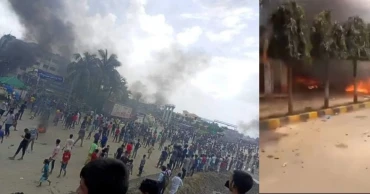
At least 4 dead, scores injured in Sirajganj clashes; police stations, houses of two lawmakers attacked
At least four people were killed and many injured in a series of clashes between protesters, Awami League activists and police in Sirajganj amidst the ongoing ‘All-out non-cooperation’ called by the Anti-Discrimination Student Movement.
Moreover, the district saw extensive destruction, vandalism and arson including on police stations and houses of two lawmakers.
Though the identities of the deceased could not be known immediately, the bodies were kept at North Bengal Medical College Hospital morgue, UNB’s local correspondent reported.
Locals and witnesses said the protesters first gathered on SS Road in Sadar upazila and then attacked the district Awami League office around 11am.
A clash broke out when Awami League men tried to resist the protesters, leaving one dead on the spot, the correspondent reports.
Soon after this, the clash broke out in several areas of the Sadar upazila, leaving three more dead and scores injured.
The protesters vandalized and torched the residences of Awami League lawmakers Jannat Ara Henry and Choyon Islam elected from Sirajganj-2 and 6 seats.
Offices of Deputy Commissioner and Sadar upazila’s Assistant Commissioner (AC-Land) were ransacked.
Several police outposts and Hatikumrul highway police stations also came under attack. Besides, the protesters besieged Belkuchi police station.
As of filing this report at 3pm, police stayed at safer places, leaving the streets.
1 year ago
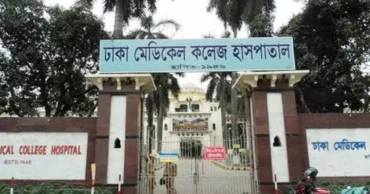
Violence erupts in Dhaka, other districts; 20 admitted to DMCH
At least 20 people,including several with bullet, were injured admitted to Dhaka Medical College Hospital on Sunday.
DMCH police outpost in-charge Bachhu Mia said they suffered wounds in clashes in various parts of the capital.
Violence and clashes continue in Dhaka and other parts of the country as the ruling party activists took to the streets to counter the protesters who have been demonstrating seeking the Prime Minister’s resignation.
The Anti-Discrimination Student Movement announced their one-point movement on Saturday.
1 year ago