USA

US plans for more migrant releases when asylum limits end
The Department of Homeland Security said more migrants may be released into the United States to pursue immigration cases when Trump-era asylum restrictions end next week in one of its most detailed assessments ahead of the major policy shift.
The department reported faster processing for migrants in custody on the border, more temporary detention tents, staffing surges and increased criminal prosecutions of smugglers, noting progress on a plan announced in April.
But the seven-page document dated Tuesday included no major structural changes amid unusually large numbers of migrants entering the country. More are expected with the end of Title 42 authority, under which migrants have been denied rights to seek asylum more than 2.5 million times on grounds of preventing spread of COVID-19.
A federal judge in Washington ordered Title 42 to end Dec. 21 but Republican-led states asked an appeals court to keep it in place. The Biden administration has also challenged some aspects of the ruling, though it doesn't oppose letting the rule lapse next week. The legal back-and-forth could go down to the wire.
Homeland Security Secretary Alejandro Mayorkas traveled this week to El Paso, Texas, which witnessed a large influx Sunday after becoming the busiest corridor for illegal crossings in October. El Paso has been a magnet for Venezuelans, Nicaraguans, Cubans, Colombians, Ecuadoreans and other nationalities.
The geographic shift to Texas' westernmost reaches was likely a result of smugglers' calculations on the best route, said Nicolas Palazzo, an attorney at Las Americas Immigrant Advocacy Center in El Paso.
Like other advocacy groups that work directly with directly with Homeland Security, Palazzo said he has had no conversations with the department about post-Title 42 planning. One key question: How will authorities process migrants who have long been waiting to seek asylum?
U.S. Rep. Henry Cuellar, D-Texas, said Customs and Border Protection officials told him Wednesday that about 50,000 migrants are believed to be waiting to cross once Title 42 is lifted.
Read more: Those wanting to travel to US as visitor or student should apply as early as possible: Embassy
Authorities plan to admit those seeking asylum who go through ports of entry but return to Mexico those who cross illegally between official crossings, Cuellar said in an interview. It was unclear how they will return nationalities that Mexico won't accept — like Cubans and Nicaraguans — and are difficult to send home due to strained diplomatic relations and other challenges.
Administration officials are developing additional measures, which Cuellar said they would not disclose.
“I think the first week is going to be a little bit of chaos,” he said.
U.S. officials in El Paso are currently exempting 70 migrants daily from Title 42, said Palazzo, who questioned how officials will handle more people.
Unless they raise processing capacity significantly, migrants who go through official crossings may be told to wait a year or so for an appointment, said Palazzo. “Realistically can they tell me with a straight face that they expect people to wait that long?”
In its latest assessment, CBP said government agencies “have been managing levels well beyond the capacity for which their infrastructure was designed and resourced, meaning additional increases will create further pressure and potential overcrowding in specific locations along the border.”
More single adults and families with young children may be released into communities with instructions to appear in immigration court without help of nongovernmental groups or financial sponsors, the department said.
The department didn't indicate how many migrants may cross the border when Title 42 ends. Earlier this year, they expected as many as 18,000 a day, a staggering number. In May, migrants were stopped an average of 7,800 times a day, the peak month of Joe Biden’s presidency.
In the fiscal year that ended Sept. 30, migrants were stopped 2.38 million times, up 37% from 1.73 million times the year before. The annual total surpassed 2 million for the first time.
The numbers reflect deteriorating economic and political conditions in some countries, relative strength of the U.S. economy and uneven enforcement of Trump-era asylum restrictions.
3 years ago
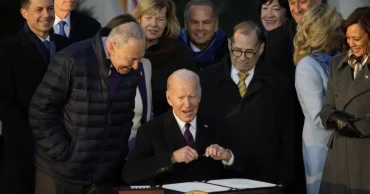
Biden signs gay marriage law, calls it ‘a blow against hate’
A celebratory crowd of thousands bundled up on a chilly Tuesday afternoon to watch President Joe Biden sign gay marriage legislation into law, a joyful ceremony that was tempered by the backdrop of an ongoing conservative backlash over gender issues.
“This law and the love it defends strike a blow against hate in all its forms,” Biden said on the South Lawn of the White House. “And that’s why this law matters to every single American.”
Singers Sam Smith and Cyndi Lauper performed. Vice President Kamala Harris recalled officiating at a lesbian wedding in San Francisco. And the White House played a recording of Biden’s television interview from a decade ago, when he caused a political furor by unexpectedly disclosing his support for gay marriage. Biden was vice president at the time, and President Barack Obama had not yet endorsed the idea.
“I got in trouble,” Biden joked of that moment. Three days later, Obama himself publicly endorsed gay marriage.
Read: Foreigners need not worry: Bali governor says on Indonesia’s law on sex outside marriage
Lawmakers from both parties attended Tuesday’s ceremony, reflecting the growing acceptance of same-sex unions, once among the country’s most contentious issues.
Senate Majority Leader Chuck Schumer, D-N.Y., wore the same purple tie to the ceremony that he wore to his daughter Alison’s wedding. She and her wife are expecting their first child in the spring.
“Thanks to the millions out there who spent years pushing for change, and thanks to the dogged work of my colleagues, my grandchild will get to live in a world that respects and honors their mothers’ marriage,” he said.
House Speaker Nancy Pelosi told the crowd that “inside maneuvering only takes us so far,” and she thanked activists adding impetus with “your impatience, your persistence and your patriotism.”
Despite Tuesday’s excitement, there was concern about the nationwide proliferation of conservative policies on gender issues at the state level.
Biden criticized the “callous, cynical laws introduced in the states targeting transgender children, terrifying families and criminalizing doctors who give children the care they need.”
“Racism, antisemitism, homophobia, transphobia, they’re all connected,” Biden said. “But the antidote to hate is love.”
Read: Indonesia’s Parliament votes to ban sex outside of marriage
Among the attendees were the owner of Club Q, a gay nightclub in Colorado where five people were killed in a shooting last month, and two survivors of the attack. The suspect has been charged with hate crimes.
“It’s not lost on me that our struggle for freedom hasn’t been achieved,” said Kelley Robinson, president of the Human Rights Campaign. “But this is a huge step forward, and we have to celebrate the victories we achieve and use that to fuel the future of the fight.”
Robinson attended the ceremony with her wife and 1-year-old child.
“Our kids are watching this moment,” she said. “It’s very special to have them here and show them that we’re on the right side of history.”
The new law is intended to safeguard gay marriages if the U.S. Supreme Court ever reverses Obergefell v. Hodges, its 2015 decision legalizing same-sex unions nationwide. The new law also protects interracial marriages. In 1967, the Supreme Court in Loving v. Virginia struck down laws in 16 states barring interracial marriage.
Read: Indonesia approves legislation criminalizing sex outside marriage for citizens and foreigners
The signing marks the culmination of a monthslong bipartisan effort sparked by the Supreme Court’s decision in June to overturn Roe v. Wade, the 1973 ruling that made abortion available across the country.
In a concurring opinion in the case that overturned Roe, Justice Clarence Thomas suggested revisiting other decisions, including the legalization of gay marriage, generating fear that more rights could be imperiled by the court’s conservative majority. Thomas did not reference interracial marriage with the other cases he said should be reconsidered.
Lawmakers crafted a compromise that was intended to assuage conservative concerns about religious liberty, such as ensuring churches could still refuse to perform gay marriages.
In addition, states would not be required to issue marriage licenses to same-sex couples if the court overturns its 2015 ruling. But they will be required to recognize marriages conducted elsewhere in the country.
A majority of Republicans in Congress still voted against the legislation. However, enough supported it to sidestep a filibuster in the Senate and ensure its passage.
Read: House passes same-sex marriage bill in retort to high court
Tuesday’s ceremony marks another chapter in Biden’s legacy on gay rights, which includes his surprise endorsement of marriage equality in 2012.
“What this is all about is a simple proposition: Who do you love?” Biden said then on NBC’s “Meet the Press.” “Who do you love and will you be loyal to the person you love? And that is what people are finding out is what all marriages at their root are about.”
A Gallup poll showed only 27% of U.S. adults supported same-sex unions in 1996, when President Bill Clinton signed the Defense of Marriage Act, which said the federal government would only recognize heterosexual marriages. Biden voted for the legislation.
By the time of Biden’s 2012 interview, gay marriage remained controversial, but support had expanded to roughly half of U.S. adults, according to Gallup. Earlier this year, 71% said same-sex unions should be recognized by law.
Biden has pushed to expand LGBT rights since taking office. He reversed President Donald Trump’s efforts to strip transgender people of anti-discrimination protections. His administration includes the first openly gay Cabinet member, Transportation Secretary Pete Buttigieg, and the first transgender person to receive Senate confirmation, Assistant Secretary for Health Rachel Levine.
3 years ago

Storm blowing through California dumps snow in Sierra
Heavy snow fell in the Sierra Nevada as a winter storm packing powerful winds sent ski lift chairs swinging and closed mountain highways while downpours at lower elevations triggered flood watches Sunday across large swaths of California into Nevada.
More than 250 miles (400 km) of the Sierra from north of Reno south to Yosemite National Park remained under winter storm warnings either until late Sunday or early Monday.
The Heavenly ski resort at Lake Tahoe shut down some operations when the brunt of the storm hit Saturday. The resort posted video of lift chairs swaying violently because of gusts that topped 100 mph (161 kph), along with a tweeted reminder that wind closures are "always for your safety.”
To the south, Mammoth Mountain reported that more than 20 inches (51 cm) of snow fell Saturday, with another 2 feet (.6 meters) possible as the tail end of the system moved through the eastern Sierra.
Read more: Heavy rain, wind, snow blows through California into Sierra
The UC Berkeley Central Sierra Snow Lab in Soda Springs, California reported Sunday morning that more than 43 inches (110 cm) had fallen in a 48-hour span.
A 70-mile (112-km) stretch of eastbound U.S. Interstate 80 was closed Saturday “due to zero visibility” from the northern California town of Colfax to the Nevada state line, transportation officials said. Chains were required on much of the rest of I-80 and other routes in the mountains from Reno toward Sacramento.
Many other key roads were closed because of heavy snow, including a stretch of California Highway 89 between Tahoe City and South Lake Tahoe, the highway patrol said.
The U.S. Forest Service issued an avalanche warning for the backcountry in the mountains west of Lake Tahoe where it said “several feet of new snow and strong winds will result in dangerous avalanche conditions.”
Gusts up to 50 mph (80 kph) that sent trees into homes in Sonoma County north of San Francisco on Saturday could reach 100 mph (160 kph) over Sierra ridgetops on Sunday, the National Weather Service said.
Read more: Storm’s fierce winds complicate California wildfire fight
Heavy rain was forecast through the weekend from San Francisco to the Sierra crest with up to 2 inches (5 cm) in the Bay Area and up to 5 inches (13 cm) at Grass Valley northeast of Sacramento.
Warnings and watches were also up across Southern California, as heavy rain caused localized flooding in greater Los Angeles.
“Significant travel delays possible with accumulating snow on several mountain roads. This could include the Tejon Pass and Grapevine area of Interstate 5,” the National Weather Service's LA-area office said in a statement.
Forecasters in Arizona issued a winter storm watch for northern and central Arizona beginning Sunday evening for areas above 5000 feet (1,525 meters) including Flagstaff, Prescott and the Grand Canyon, where icy temperatures and up to a foot of snow was predicted.
As the storm exits the U.S. West, it will push across the country and reach the Plains by mid-week, bringing significant rain and below-average temperatures, said Marc Chenard, meteorologist at the National Weather Service at the national center in College Park, Maryland.
“It will be a busy week while this system moves across the country,” Chenard said Sunday.
3 years ago

Heavy rain, wind, snow blows through California into Sierra
A winter storm packing powerful winds, heavy rain and potentially several feet of snow in the Sierra Nevada shut down mountain highways, toppled trees and triggered flood watches and avalanche warnings on Saturday from the coast of Northern California to Lake Tahoe.
More than 250 miles (400 kilometers) of the Sierra remained under a winter storm warning at least until Sunday night or early Monday from north of Reno to south of Yosemite National Park.
Read more: Shootings at power substation cause North Carolina outages
As much as 4 feet (1.2 meters) of snow is expected to fall by the end of the weekend in the upper elevations around Lake Tahoe, and as much as 6 feet (1.8 meters) in more remote parts of the Sierra to the north and south.
A 70-mile (112-kilometer) stretch of eastbound U.S. Interstate 80 was closed “due to zero visibility” from Colfax, California to the Nevada state line, transportation officials said. Chains were required on much of the rest of I-80 in the mountains from Reno toward Sacramento.
A stretch of California Highway 89 also was closed due to heavy snow between Tahoe City and South Lake Tahoe, California, the highway patrol said.
The U.S. Forest Service issued an avalanche warning for the backcountry in the mountains west of Lake Tahoe where it said “several feet of new snow and strong winds will result in dangerous avalanche conditions.”
Gusts of wind up to 50 mph (80 kph) that sent trees into homes in Sonoma County on Saturday could reach 100 mph (160 kph) over Sierra ridgetops by early Sunday, the National Weather Service said.
Heavy rain was forecast through the weekend from San Francisco to the Sierra crest with up to 2 inches (5 centimeters) in the Bay Area and up to 5 inches (13 cm) at Grass Valley northeast of Sacramento.
The weather service issued a flash flood warning on Saturday when inches of rain fell on burn scars left by wildfires south of Monterey and farther south of Big Sur.
More than 30,000 customers were without power in the Sacramento area at one point Saturday morning, but it was restored to all but a few hundred late in the day. The drivers and passengers of five cars that had been trapped between downed power lines escaped unharmed, the Sacramento Bee reported.
Read more: Trump probe: Court halts Mar-a-Lago special master review
San Francisco Bay Area officials reported power outages and fallen trees, some of which damaged cars and homes. In Monte Rio, a small town along the Russian River in Sonoma County, firefighters responded to several reports of downed trees crashing into homes in 50 mph wind gusts.
Monte Rio Fire Department Chief Steve Baxman told KRON-TV that four different down trees had damaged houses in the area and that no injuries were reported.
“This is our first big storm, we’ve had several years of drought and all these trees were dry. Now they’re filling up with water and starting to topple over,” Baxman told the television station.
In the Sierra, about 10 inches (25 centimeters) of snow already had fallen Saturday afternoon at Mammoth Mountain ski resort south of Yosemite where more than 10 feet (3 meters) of snow has been recorded since early November.
“It just seems like every week or so, another major storm rolls in,” resort spokeswoman Lauren Burke said.
As much as 18 to 28 inches (45 to 71 centimeters) of snow was forecast through the weekend at lake level, and up to 4 feet (1.2 meters) at elevations above 7,000 feet (2,133 meters) with 50 mph (80 kph) winds and gusts up to 100 mph (160 kph).
On the Sierra’s eastern slope, a winter weather advisory runs from 10 p.m. Saturday to 10 a.m. for Reno, Sparks and Carson City, with snow accumulations of 1 to 3 inches (2.5-7.5 cm) on valley floors and up to 8 inches (20 cm) above 5,000 feet (1,524 meters).
3 years ago

Ex-cop who kneeled on George Floyd’s back gets 3.5-year term
The former Minneapolis police officer who kneeled on George Floyd’s back while another officer kneeled on the Black man’s neck was sentenced Friday to 3 1/2 years in prison.
J. Alexander Kueng pleaded guilty in October to a state count of aiding and abetting second-degree manslaughter. In exchange, a charge of aiding and abetting murder was dropped. Kueng is already serving a federal sentence for violating Floyd’s civil rights, and the state and federal sentences will be served at the same time.
Kueng appeared at the hearing via video from a federal prison in Ohio. When given the chance to address the court, he declined.
With credit for time served and different parole guidelines in the state and federal systems, Kueng will likely serve a total of about 2 1/2 years behind bars.
Floyd’s family members had the right to make victim impact statements, but none did. Family attorney Ben Crump, who has taken on some of the nation’s most high-profile police killings of Black people, said in a statement before the hearing that Kueng's sentencing “delivers yet another piece of justice for the Floyd family. ”
“While the family faces yet another holiday season without George, we hope that moments like these continue to bring them a measure of peace, knowing that George’s death was not in vain,” he said.
Floyd died on May 25, 2020, after former Officer Derek Chauvin kneeled on Floyd's neck for 9 1/2 minutes as Floyd repeatedly said he couldn't breathe and eventually went limp. The killing, which was recorded on video by a bystander, sparked worldwide protests as part of a broader reckoning over racial injustice.
Read more: Prosecutor: 3 cops in Floyd killing ‘chose to do nothing’
Kueng kneeled on Floyd's back during the restraint. Then-Officer Thomas Lane held Floyd's legs and Tou Thao, also an officer at the time, kept bystanders from intervening. All of the officers were fired and faced state and federal charges.
As part of his plea agreement, Kueng admitted that he held Floyd’s torso, that he knew from his experience and training that restraining a handcuffed person in a prone position created a substantial risk, and that the restraint of Floyd was unreasonable under the circumstances.
Matthew Frank, who led the prosecution for the Minnesota attorney general’s office, said repeatedly during the hearing that Floyd was a crime victim and that the prosecution “focused on the officers” who caused his death. He added that the case was not meant to be a broader examination of policing, but added that he hopes it will reaffirm that police officers cannot treat those “who are in crisis as non-people or second-class citizens.”
“Mr. Kueng was not simply a bystander that day. He did less than what some of the bystanders attempted to do in helping Mr. Floyd,” Frank said.
Kueng’s attorney, Thomas Plunkett, on Friday blamed the Minneapolis Police Department’s leadership and a lack of training for Floyd’s death. He highlighted Kueng’s status as a rookie — saying he had only been on the job on his own for three days — and accused department leadership of failing to implement training to encourage officers to intervene when one of their colleagues is doing something wrong.
“On behalf of Mr. Kueng, I’m not calling for justice. I’m calling for progress,” he said.
Then-Chief Medaria Arradondo fired Kueng and the three other officers the day after Floyd’s killing and later testified at Chauvin’s trial that the officers did not follow training. The former head of training for the department has also testified that the officers acted in a way that was inconsistent with department policies.
Kueng's sentencing brings the cases against all of the former officers a step closer to resolution, although the state case against Thao is still pending.
Thao previously told Judge Peter Cahill that it “would be lying” to plead guilty. In October, he agreed to what’s called a stipulated evidence trial on the count of aiding and abetting manslaughter. As part of that process, his attorneys and prosecutors are working out agreed-upon evidence in his case and filing written closing arguments. Cahill will then decide whether Thao is guilty or not.
If Thao is convicted, the murder count — which carries a presumptive sentence of 12 1/2 years in prison — will be dropped.
Chauvin, who is white, was convicted of state murder and manslaughter charges last year and is serving 22 1/2 years in the state case. He also pleaded guilty to a federal charge of violating Floyd’s civil rights and was sentenced to 21 years. He is serving the sentences concurrently at the Federal Correctional Institution in Tucson, Arizona.
Read more: Trial of 3 cops in Floyd killing to resume after COVID pause
Kueng, Lane and Thao were convicted of federal charges in February: All three were convicted of depriving Floyd of his right to medical care, and Thao and Kueng were also convicted of failing to intervene to stop Chauvin during the killing.
Lane, who is white, is serving his 2 1/2-year federal sentence at a facility in Colorado. He's serving a three-year state sentence at the same time. Kueng, who is Black, was sentenced to three years on the federal counts; Thao, who is Hmong American, got a 3 1/2-year federal sentence.
3 years ago

Airplane crash in Gulf of Mexico leaves 2 dead, 1 missing
A private airplane crashed into the Gulf of Mexico off the Florida coast Saturday night, with two people confirmed dead as authorities searched for a third person believed to have been on the flight, police said.
Authorities in Venice, Florida, initiated a search Sunday after 10 a.m. following a Federal Aviation Administration inquiry to the Venice Municipal Airport about an overdue single-engine Piper Cherokee that had not returned to its origin airport in St. Petersburg, Florida.
Read more: Plane hits vehicle on runway, catches fire at Lima’s airport
Around the same time, recreational boaters found the body of a woman floating about 2.5 miles (4 kilometers) west of the Venice shore, city of Venice spokesperson Lorraine Anderson said in a statement.
Divers from the Sarasota County Sheriff’s Office located the wreckage of the rented airplane around 2 p.m. about a third of a mile offshore, directly west of the Venice airport, Anderson said.
Rescuers found a deceased girl in the plane’s passenger area. A third person, believed to be a male who was the pilot or a passenger, remained missing Sunday, Anderson said.
Read more: Small plane crashes into Tanzania's Lake Victoria, 19 dead
The county sheriff’s office, the U.S. Coast Guard, the Sarasota Police Department, Florida Fish and Wildlife Conservation Commission and the District 12 Medical Examiner’s Office and the National Transportation Safety Board were involved in the investigation, Anderson said.
3 years ago

Trump rebuked for call to suspend Constitution over election
Former President Donald Trump faced rebuke Sunday from officials in both parties after calling for the “termination” of parts of the Constitution over his lie that the 2020 election was stolen.
Trump, who announced last month that he is running again for president, made the claim over the weekend on his Truth Social media platform.
“A Massive Fraud of this type and magnitude allows for the termination of all rules, regulations, and articles, even those found in the Constitution,” he wrote. “Our great ‘Founders’ did not want, and would not condone, False & Fraudulent Elections!”
Incoming House Democratic leader Hakeem Jeffries on Sunday described Trump's statement as strange and extreme and said Republicans will have to make a choice whether to continue embracing Trump's anti-democratic views.
Read more: Trump probe: Court halts Mar-a-Lago special master review
“Republicans are going to have to work out their issues with the former president and decide whether they’re going to break from him and return to some semblance of reasonableness or continue to lean in to the extremism, not just of Trump, but Trumpism,” Jeffries said.
Trump, who is the first to be impeached twice and whose term ended with his supporters violently storming the Capitol in a deadly bid to halt the peaceful transition of power on Jan. 6, 2021, faces a escalating criminal investigations, including several that could lead to indictments. They include the probe into classified documents seized by the FBI from Mar-a-Lago, and ongoing state and federal inquiries related to efforts to overturn the results of the 2020 presidential election.
Asked about Trump's comments Sunday, Rep. Mike Turner of Ohio, the top Republican on the House Intelligence Committee, said he “vehemently" disagrees and “absolutely” condemns the remarks, saying they should be a factor as Republicans decide who should lead their party in 2024.
“There is a political process that has to go forward before anybody is a frontrunner or anybody is even the candidate for the party,” he said. “I believe that people certainly are going to take into consideration a statement like this as they evaluate a candidate.”
Rep.-elect Mike Lawler, R-N.Y., also objected to the remarks, saying it was time to stop focusing on the “grievances of prior elections.”
"The Constitution is set for a reason, to protect the rights of every American," Lawler said. "I think the former president would be well-advised to focus on the future, if he is going to run for president again.”
Trump’s comments came after Twitter's new owner, Elon Musk, said he would reveal how Twitter engaged in "free speech suppression” leading up to the 2020 election. But files released Friday, which focused on the tech company's confused response to a story about Biden's son Hunter, do not show Democrats trying to limit the story.
Read more: Musk restores Trump’s Twitter account after online poll
The White House on Saturday assailed Trump, saying, “You cannot only love America when you win.”
“The American Constitution is a sacrosanct document that for over 200 years has guaranteed that freedom and the rule of law prevail in our great country," spokesman Andrew Bates said in a statement. “Attacking the Constitution and all it stands for is anathema to the soul of our nation."
Jeffries appeared on ABC's “This Week,” Turner spoke on CBS' “Face the Nation” and Lawler was on CNN's “State of the Union.”
3 years ago

Shootings at power substation cause North Carolina outages
Two power substations in a North Carolina county were damaged by gunfire in what is being investigated as a criminal act, causing damage that could take days to repair and leaving tens of thousands of people without electricity, authorities said Sunday.
In response to ongoing outages, which began just after 7 p.m. Saturday across Moore County, officials announced a state of emergency that included a curfew from 9 p.m. Sunday to 5 a.m. Monday. Also, county schools will be closed Monday.
“An attack like this on critical infrastructure is a serious, intentional crime and I expect state and federal authorities to thoroughly investigate and bring those responsible to justice,” Gov. Roy Cooper wrote on Twitter.
Read more: Most Ukrainians left without power after Russian strikes
Moore County Sheriff Ronnie Fields said at a Sunday news conference that authorities have not determined a motivation. He said someone pulled up and “opened fire on the substation, the same thing with the other one.”
“No group has stepped up to acknowledge or accept that they're the ones that done it,” Fields said, adding “we're looking at all avenues.”
The sheriff noted that the FBI was working with state investigators to determine who was responsible. He also said “it was targeted.”
“It wasn't random,” Fields said.
Fields said law enforcement is providing security at the substations and for businesses overnight.
“We will have folks out there tonight around the clock,” Fields said.
Roughly 37,000 electric customers in the county were without power on Sunday evening, according to poweroutage.us.
With cold temperatures forecast for Sunday night, the county also opened a shelter at a sports complex in Carthage.
Duke Energy spokesman Jeff Brooks said multiple pieces of equipment were damaged and will have to be replaced. He said while the company is trying to restore power as quickly as possible, he braced customers for the potential of outages lasting days.
Read more: Kherson celebrates Russian exit amid no power, no water
“We are looking at a pretty sophisticated repair with some fairly large equipment and so we do want citizens of the town to be prepared that this will be a multiday restoration for most customers, extending potentially as long as Thursday," Brooks said at the news conference.
Dr. Tim Locklear, the county's school superintendent, announced classes will be canceled Monday.
“As we move forward, we'll be taking it day by day in making those decisions,” Locklear said.
The Pilot newspaper in Southern Pines reported that one of its journalists saw a gate to one of the substations had been damaged and was lying in an access road.
“A pole holding up the gate had clearly been snapped off where it meets the ground. The substation’s infrastructure was heavily damaged,” the newspaper reported.
The county of approximately 100,000 people lies about an hour's drive southwest of Raleigh and is known for golf resorts in Pinehurst and other communities.
3 years ago
Trump probe: Court halts Mar-a-Lago special master review
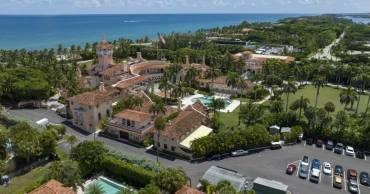
A unanimous federal appeals court on Thursday ended an independent review of documents seized from former President Donald Trump’s Florida estate, removing a hurdle the Justice Department said had delayed its criminal investigation into the retention of top-secret government information.
The decision by the three-judge panel represents a significant win for federal prosecutors, clearing the way for them to use as part of their investigation the entire tranche of documents seized during an Aug. 8 FBI search of Mar-a-Lago. It also amounts to a sharp repudiation of arguments by Trump’s lawyers, who for months had said that the former president was entitled to have a so-called “special master” conduct a neutral review of the thousands of documents taken from the property.
The ruling from the Atlanta-based U.S. Court of Appeals for the 11th Circuit had been expected given the skeptical questions the judges directed at a Trump lawyer during arguments last week, and because two of the three judges on the panel had already ruled in favor of the Justice Department in an earlier dispute over the special master. The decision was a unanimous opinion from the panel of Republican appointees, including two who were selected by Trump. In it, the court rejected each argument by Trump and his attorneys for why a special master was necessary, including his claims that various seized records were protected by attorney-client privilege or executive privilege.
“It is indeed extraordinary for a warrant to be executed at the home of a former president — but not in a way that affects our legal analysis or otherwise gives the judiciary license to interfere in an ongoing investigation,” the judges wrote.
Read more: Musk restores Trump’s Twitter account after online poll
A Trump spokesperson said Thursday’s decision was “purely procedural” and did not address the “impropriety” of the raid, and promised that the ex-president would “continue to fight” against the Justice Department. Lawyers for Trump did not immediately respond when asked if they would appeal the ruling.
The special master litigation has played out alongside an ongoing investigation examining the potential criminal mishandling of national defense information as well as efforts to possibly obstruct the documents probe. Attorney General Merrick Garland last month appointed Jack Smith, a veteran public corruption prosecutor, to serve as special counsel overseeing that investigation. It remains unclear how much longer the investigation will last, or who, if anyone, might be charged. But the probe has shown signs of intensifying, with investigators questioning multiple Trump associates about the documents and granting one key ally immunity to ensure his testimony before a federal grand jury. And the appeals court decision is likely to speed the investigation along by cutting short the outside review of the records.
The conflict over the special master began just weeks after the FBI’s search, when Trump sued in federal court in Florida seeking the appointment of an independent arbiter to review the roughly 13,000 documents the Justice Department says were taken from the home. A federal judge, Aileen Cannon, granted the Trump team’s request, naming veteran Brooklyn judge Raymond Dearie to serve as special master and tasking him with reviewing the seized records and filtering out from the criminal investigation any documents that might be covered by claims of executive privilege or attorney-client privilege.
Read more: Jan. 6 panel summons Trump, shows startling new video
She also barred the Justice Department from using in its criminal investigation any of the seized records, including the roughly 100 with classification markings, pending the completion of Dearie’s work.
The Justice Department objected to the appointment, saying it was an unnecessary hindrance to its criminal investigation and that Trump had no credible basis to invoke either attorney-client privilege or executive privilege to shield the records from investigators.
It sought, as a first step, to regain access to the classified documents. A federal appeals panel sided with prosecutors in September, permitting the Justice Department to resume its review of the documents with classification markings. Two of the judges on that panel — Andrew Brasher and Britt Grant, both Trump appointees — were part of Thursday’s ruling as well. The department also pressed for unfettered access to the much larger trove of unclassified documents, saying such records could contain important evidence for their investigation.
In its ruling Thursday, the appeals court directed Cannon to dismiss the lawsuit that gave rise to Dearie’s appointment and suggested Trump had no legal basis to challenge the search in the first place.
“The law is clear. We cannot write a rule that allows any subject of a search warrant to block government investigations after the execution of the warrant. Nor can we write a rule that allows only former presidents to do so,” the judges wrote.
“Either approach,” they added, “would be a radical reordering of our caselaw limiting the federal courts’ involvement in criminal investigations. And both would violate bedrock separation-of-powers limitations.”
3 years ago

Biden, Macron vow unity against Russia, discuss trade row
Presidents Joe Biden and Emmanuel Macron vowed to maintain a united front against Russia on Thursday amid growing worries about waning support for Ukraine’s war effort in the U.S. and Europe. Biden also signaled he might be willing to tweak aspects of his signature climate legislation that have raised concerns with France and other European allies.
Biden honored Macron with a grand state dinner Thursday evening — the first of the U.S. president’s COVID-19 shadowed presidency for a foreign leader. But following up on Biden’s upbeat comments might not go as smoothly as that fancy affair. Republicans who are about to take control of the House have shown less willingness than Biden to spend billions on Ukraine, and Democratic lawmakers said Thursday they were not about to jump back into the climate legislation.
In fact, for all the positive statements, Macron’s visit to Washington has been tempered by his criticism of Biden’s Inflation Reduction Act and the challenges both leaders face amid the mounting costs of keeping military and economic aid flowing to Kyiv with no end in sight for the Russian invasion.
Despite the differences, Biden and Macron sought to underscore that the U.S.-France alliance remains solid and that the West must hold steadfast against Russian President Vladimir Putin’s war in Ukraine.
Read more: Biden, Macron ready to talk Ukraine, trade in state visit
“Today, we reaffirm that, as I said, we’re going to stand together against this brutality,” Biden said. “Putin thinks that he can crush the will of all those who oppose his imperial ambitions by attacking civilian infrastructure in Ukraine, choking off energy to Europe to drive up prices, exacerbating the food crisis. That’s hurting very vulnerable people not just in Ukraine but around the world and he’s not going to succeed.”
Both leaders at an outdoor welcoming ceremony paid tribute to their countries’ long alliance. But they acknowledged difficult moments lay ahead as Western unity shows some wear nine months into the war in Ukraine.
In Washington, Republicans are set to take control of the House, where GOP leader Kevin McCarthy has said his party’s lawmakers will not write a “blank check” for Ukraine. Across the Atlantic, Macron’s efforts to keep Europe united will be tested by the mounting costs of supporting Ukraine in the war and as Europe battles rising energy prices that threaten to derail the post-pandemic economic recovery.
Macron stressed that the issue has ramifications far beyond Ukraine’s borders.
“What is at stake in Ukraine is not just very far from here, in a small country somewhere in Europe,” he declared. “But it’s about our values. And about our principles.”
“Our two nations are sisters in the fight for freedom,” he said.
Biden indicated he would be willing to talk with Putin if the Russian leader demonstrated that he seriously wanted to end the invasion. But the U.S. president, as always, conditioned such talks on support by NATO allies.
“I’m prepared to speak with Mr. Putin if in fact there is an interest in him deciding that he’s looking for a way to end the war,” Biden said. “He hasn’t done that yet.”
In addition to their talk of Ukraine — what White House officials said was at the top of the agenda — the two leaders discussed Macron’s and other leaders’ concerns about the recently enacted clean energy law.
Macron has made clear that he and other European leaders are opposed to incentives in the Inflation Reduction Act that favor American-made climate technology, including electric vehicles.
Biden acknowledged “glitches” in the legislation but said “there’s tweaks we can make” to satisfy allies.
“The United States makes no apology. And I make no apologies since I wrote it for the legislation we’re talking about,” Biden added.
However, Macron said that while the Biden administration’s efforts to curb climate change should be applauded, the subsidies would be an enormous setback for European companies.
“We want to succeed together, not one against the other,” Macron added. He said the U.S. and France would “resynchronize” their clean energy efforts to ensure there’s no “domino effect” that undermines clean energy projects in Europe.
On Capitol Hill, despite Biden’s talk of possible changes in the law, Senate Finance Committee Chairman Ron Wyden, one of the bill’s main architects, said, “Congress passed a law to rev up the American electric automobile industry, create good-paying American jobs and tackle climate change at the same time. I have no intention of reopening it.”
Read more: Biden strengthening US policy to stem sexual violence in war zones, including in Ukraine
The European Union has also expressed concern that tax credits in the law would discriminate against European producers and break World Trade Organization rules.
The leaders, with aides, met for about three hours after taking part in a formal ceremony with hundreds of people gathered on the South Lawn on a sunny, chilly morning. There was a 21-gun salute and review of troops, and ushers distributed small French and American flags to the guests.
Both Biden and Macron in their public comments sought to keep the focus on the situation in Ukraine.
The state visit should provide a boost to Macron diplomatically that he can leverage back in Europe. His outspoken comments help him demonstrate that he’s defending French workers, even as he maintains a close relationship with Biden. The moment also helps Macron burnish his image as the European Union’s most visible and vocal leader, at a time when Europe is increasingly concerned that its economy will be indelibly weakened by the Ukraine war and resulting energy and inflation crises.
To that end, Biden praised Macron as “not just the leader of France” and for being “very outspoken and very, very commanding in Europe.” In his public comments, Macron repeatedly referred to the U.S. president as “dear Joe.”
Still, at moments, Macron’s rhetoric has rankled U.S. and Ukrainian officials, with calls for Ukraine and Russia to meet at the negotiating table. White House officials have publicly maintained that it is solely up to Ukraine’s leadership to decide when it’s appropriate to engage the Russians and have stressed the war could end immediately if Putin ended his invasion.
Macron also raised eyebrows earlier this month in a speech at a summit in Bangkok when he referred to the U.S. and China as “two big elephants” that are on the cusp of creating “a big problem for the rest of the jungle.” His visit to Washington came as both the U.S. and France are keeping their eyes on China after protests have broken out in several mainland cities and Hong Kong over Beijing’s “zero COVID” strategy.
The state visit marked a return of a White House tradition of honoring close foreign allies that dates back to Ulysses S. Grant’s presidency.
Macron and his wife, Brigitte, came to the U.S. bearing gifts carefully tailored to their American hosts, including a vinyl record and CD of the original soundtrack from the 1966 film “Un Homme et une Femme,” which the Bidens went to see on their first date, according to the palace.
Among the gifts Biden and first lady Jill Biden presented the Macrons was a mirror framed by fallen wood from the White House grounds and made by an American furniture maker.
Vice President Kamala Harris hosted Macron for a lunch at the State Department before the evening state dinner in an enormous tented pavilion constructed on the White House South Lawn. The dinner for hundreds attracted big names from fashion, entertainment, business and politics.
3 years ago